


04 Sep ISRO Chairman on Privatisation: Why India Needs Private Space Sector Growth
✎ The core objective of India’s space sector reforms is to expand the national space ecosystem through calibrated private sector participation, institutionalised via IN-SPACe and NSIL, while ensuring technological sovereignty and…
Subject Relevance — Where This Topic Fits
- GS Paper III — Science and Technology — Developments and their Applications and Effects in Everyday Life | GS Paper III — Indian Economy and Issues Relating to Planning, Mobilisation of Resources, Growth, Development and Employment | GS Paper III — Infrastructure: Energy, Ports, Roads, Airports, Railways and Human Resources
- Prelims: IN-SPACe, New Space India Limited (NSIL), Technology Transfer Mechanism, Foreign Direct Investment (FDI) in Space Sector, GSLV Mark II, EOS-05 Satellite, Kulasekarapattinam Spaceport, Gaganyaan Programme
- Essay: The Role of Public-Private Partnerships in India’s Technological and Economic Growth, Balancing National Security and Economic Liberalisation in Strategic Sectors
Quick Revision: The core objective of India’s space sector reforms is to expand the national space ecosystem through calibrated private sector participation, institutionalised via IN-SPACe and NSIL, while ensuring technological sovereignty and economic growth.
Why is this in the news?
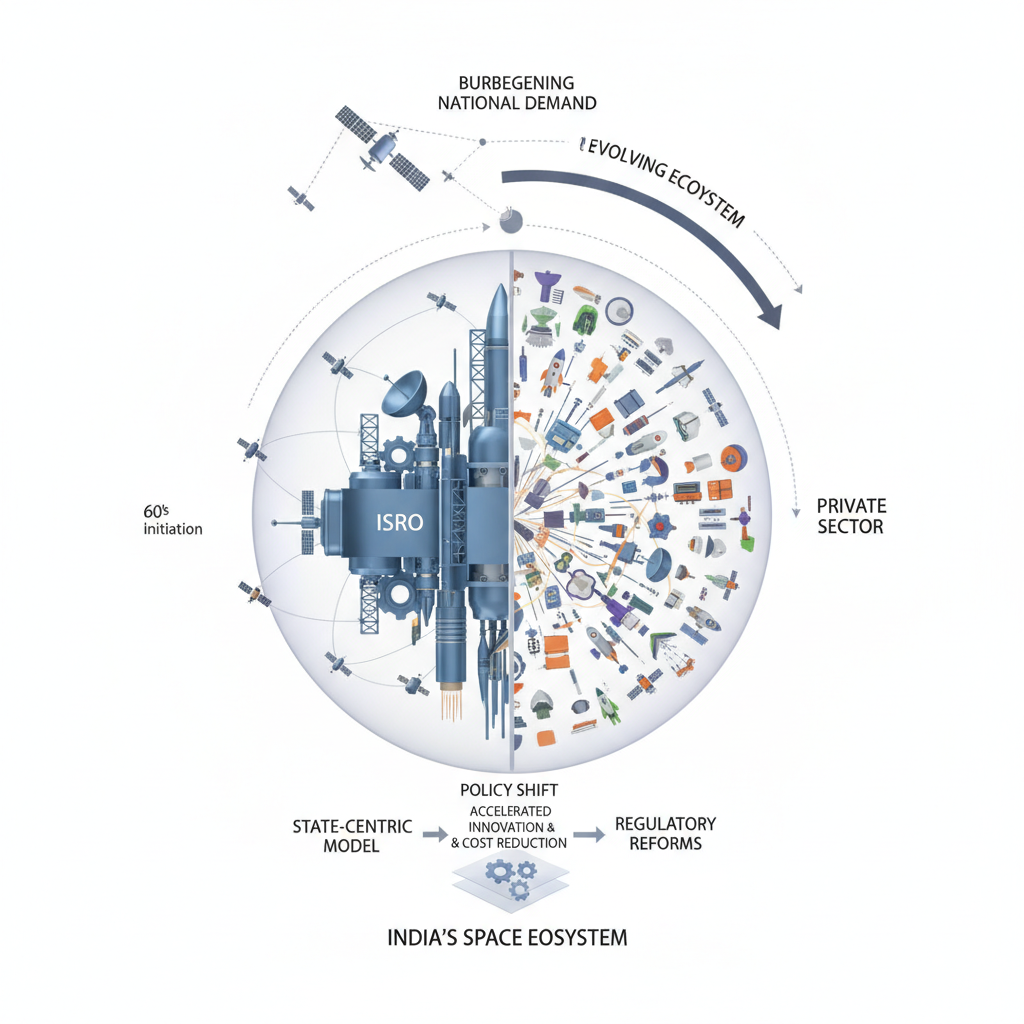
The statement by ISRO Chairman Dr V Narayanan underscores the necessity of expanding India’s space ecosystem beyond the capacity of ISRO alone to meet the country’s burgeoning demand for satellites and space-based services. This highlights the ongoing policy shift toward greater private sector participation in the space sector, as articulated in recent reforms, and raises questions about the institutional mechanisms enabling this transition.
Background
- India’s space programme, initiated in the 1960s under the leadership of Dr Vikram Sarabhai, has historically been driven by ISRO, a government entity under the Department of Space.
- The space sector in India has evolved from a state-centric model to one that now recognises the need for private sector involvement to accelerate innovation, reduce costs, and meet increasing demand for space-based applications.
- The Union Government announced major space sector reforms in June 2020, including the establishment of IN-SPACe (Indian National Space Promotion and Authorisation Centre) as a single-window nodal agency to promote and regulate private participation in the space sector.
- New Space India Limited (NSIL), ISRO’s commercial arm, was mandated to transfer technologies developed by ISRO to private players and facilitate their entry into the space economy.
- The reforms aim to unlock the potential of India’s space sector, which is projected to grow from USD 7 billion in 2019 to USD 50 billion by 2030, according to industry estimates.
- Recent launches, such as the GSLV-F17 carrying the EOS-05 satellite, and the development of the Kulasekarapattinam spaceport, reflect the dual focus on enhancing ISRO’s capabilities while expanding the ecosystem through private participation.
What are India’s Space Sector Reforms and Their Objectives?
- Institutional Reforms: The creation of IN-SPACe as an autonomous body under the Department of Space to act as a facilitator and regulator for private entities, ensuring a level playing field and streamlined approvals.
- Technology Transfer: ISRO is mandated to transfer mature technologies to private players through mechanisms such as licensing and joint ventures, enabling them to develop satellites, launch vehicles, and ground systems independently.
- Foreign Investment Liberalisation: The government has permitted up to 100% FDI in satellite manufacturing and launch services, subject to sectoral guidelines, to attract global capital and expertise.
- Demand Aggregation: NSIL plays a pivotal role in aggregating demand from government and commercial sectors, issuing tenders for satellite launches and data services, thereby providing a market for private players.
- Capacity Building: The reforms aim to create a robust ecosystem by fostering startups, academic collaborations, and skill development in space technology, aligning with the ‘Atmanirbhar Bharat’ initiative.
- Regulatory Framework: A new regulatory regime has been introduced to standardise safety, security, and operational protocols for private entities, ensuring compliance with international obligations such as the Outer Space Treaty.
- Mission Support: ISRO continues to provide critical support in the form of technical guidance, infrastructure sharing, and launch services to private entities during their developmental phases.
- Public-Private Synergy: The reforms are designed to leverage ISRO’s institutional strength while enabling private players to innovate, reduce costs, and scale operations to meet national and global demands.
Key Features
| Feature | Significance |
|---|---|
| Privatisation of space sector | Enables expansion of India’s space economy beyond ISRO’s capacity, fostering innovation, investment, and job creation in the private sector. |
| GSLV-Mk II vehicle upgrade | Enhanced payload capacity (40% increase) demonstrates indigenous technological advancement, improving India’s self-reliance in satellite launches. |
| EOS-05 Earth observation satellite | Supports national missions in agriculture, disaster management, and urban planning through high-resolution Earth observation data. |
| Kulasekarapattinam spaceport project | Expands India’s launch infrastructure, reducing dependency on Sriharikota and enabling polar and small satellite missions. |
| Gaganyaan programme | Advances India’s human spaceflight capabilities, aligning with global space exploration trends and national prestige. |
Why it Matters
Economic
- Expansion of the space economy is projected to generate high-skilled employment and attract foreign direct investment in satellite manufacturing and launch services.
- Private participation reduces fiscal burden on ISRO, allowing reallocation of public funds to R&D and strategic missions.
- India’s share in the global space economy (currently ~2%) is poised to grow, enhancing export potential in satellite components and services.
Strategic
- Diversification of launch capabilities mitigates risks associated with single-point failures in critical space assets.
- Enhanced satellite constellations improve India’s surveillance, communication, and navigation capabilities for defence and civil applications.
- Self-reliance in space technology reduces dependency on foreign launch providers, ensuring strategic autonomy.
Technological
- Collaborative models between ISRO and private entities accelerate indigenous innovation in propulsion, avionics, and satellite systems.
- Upgradation of GSLV-Mk II vehicle reflects sustained investment in India’s launch vehicle technology, reducing reliance on foreign launchers.
- Development of new spaceports (e.g., Kulasekarapattinam) optimises launch windows for polar and small satellite missions.
Institutional
- Space sector reforms institutionalise public-private partnerships, creating a sustainable ecosystem for space activities.
- ISRO’s role shifts from execution to facilitation, enabling it to focus on cutting-edge research and interplanetary missions.
- Regulatory frameworks under the Indian Space Policy 2023 provide clarity on licensing, liability, and technology transfer.
Challenges
1. Regulatory and Licensing Framework
- Ambiguities in licensing norms for private entities may deter investment and innovation in the space sector.
- Need for a streamlined approval process to ensure timely project execution without compromising safety standards.
UPSC Link: GS Paper 3: Science & Tech
2. Technology Transfer and IPR
- Balancing indigenous technology development with technology transfer to private players remains a complex challenge.
- Ensuring fair intellectual property rights (IPR) policies to incentivise private sector participation without stifling innovation.
UPSC Link: GS Paper 3: IPR & Innovation
3. Human Capital Development
- Shortage of skilled manpower in aerospace engineering, satellite technology, and space operations constrains sector growth.
- Need for specialised academic programmes and industry-academia collaborations to bridge the skill gap.
UPSC Link: GS Paper 3: Human Resource Development
4. Infrastructure Bottlenecks
- Limited launch capacity at existing spaceports (e.g., Sriharikota) necessitates development of new facilities like Kulasekarapattinam.
- High capital expenditure for setting up private launch pads and satellite manufacturing units.
UPSC Link: GS Paper 3: Infrastructure
5. Global Competition
- Intense competition from established players (e.g., SpaceX, Arianespace) and emerging space nations (e.g., China, UAE) poses challenges for market penetration.
- Need for cost-competitive launch services to attract international satellite customers.
UPSC Link: GS Paper 2: International Relations
Challenges — UPSC Perspective
| Issue | Concern |
|---|---|
| Private Sector Participation | Ensuring equitable access to space activities without monopolisation by a few entities. |
| Satellite Constellation Growth | Meeting the demand for hundreds of satellites while maintaining quality and reliability standards. |
| Launch Vehicle Reliability | Balancing cost-efficiency with the need for high-reliability launch systems for critical missions. |
| Data Security and Sovereignty | Protecting sensitive satellite data from cyber threats and unauthorised access. |
| International Collaborations | Navigating geopolitical sensitivities while engaging in joint space missions or technology transfers. |
Way Forward
- Formulate clear, time-bound guidelines under the Indian Space Policy 2023 to address ambiguities in licensing, liability, and technology transfer.
- Establish dedicated skill development programmes in collaboration with IITs, ISRO, and private sector entities to address the human capital gap.
- Accelerate the development of the Kulasekarapattinam spaceport to diversify launch infrastructure and reduce dependency on Sriharikota.
- Encourage public-private partnerships for satellite manufacturing, launch services, and downstream applications to foster a self-sustaining space economy.
- Strengthen regulatory oversight to ensure compliance with safety, environmental, and international space treaties while promoting innovation.
- Invest in R&D for reusable launch vehicles and cost-effective propulsion systems to enhance global competitiveness.
- Develop a national space data policy to standardise data sharing, archiving, and utilisation across government and private entities.
- Promote international collaborations for joint missions, technology transfers, and capacity-building while safeguarding national interests.
UPSC Value Addition
Keywords for Mains Answer-Writing
Space sector reforms in India · Privatisation of space sector · ISRO’s role and limitations · Space economy growth · GSLV Mark II capabilities · Gaganyaan programme · Kulasekarapattinam spaceport · EOS-05 satellite mission · Public-Private Partnership in space technology · Satellite launch capacity augmentation · Space sector governance · India’s space programme trajectory · Satellite demand and supply gap · Space-based services and economy
Concept Flow
Growing demand for satellites and space-based services → Recognition of ISRO’s limitations in meeting national requirements → Initiation of space sector reforms → Enactment of Indian Space Policy 2023 → Expansion of public-private partnerships → Development of new launch infrastructure (e.g., Kulasekarapattinam) → Upgradation of indigenous launch vehicles (GSLV-Mk II) → Growth of private sector participation → Enhanced technological innovation and job creation → Strengthened India’s position in the global space economy.
Prelims Practice Questions
Q1. Consider the following statements regarding the privatisation of India’s space sector:
1. The Government of India has announced space sector reforms to enable greater private sector participation.
2. ISRO will solely manage all satellite launches under the new reforms.
3. The reforms aim to expand the space ecosystem and create job opportunities.
How many of the above statements are correct?
- Only one
- Only two
- All three
- None
Answer: Only two — Statement 1 is correct as the government has announced reforms to enable private participation. Statement 2 is incorrect because ISRO will hand-hold private activities rather than manage all launches. Statement 3 is correct as the reforms aim to expand the ecosystem and generate employment.
Q2. Assertion (A): The GSLV Mark II vehicle’s capability has improved by approximately 40% over its initial capacity.
Reason (R): The successful launch of the EOS-05 satellite, the heaviest satellite lifted by GSLV Mark II, demonstrates this capability enhancement.
Options:
A. Both A and R are true, and R is the correct explanation of A.
B. Both A and R are true, but R is NOT the correct explanation of A.
C. A is true, but R is false.
D. A is false, but R is true.
Answer: ? — Both the assertion and reason are true. The GSLV Mark II’s capability has indeed improved by about 40%, rising from 1,536 kg to a higher capacity, as evidenced by the successful launch of the EOS-05 satellite, the heaviest satellite lifted by this vehicle.
Q3. Match the following space missions/initiatives with their respective descriptions:
Column I
1. EOS-05 satellite
2. Gaganyaan programme
3. Kulasekarapattinam spaceport
4. GSLV Mark II
Column II
A. India’s first human spaceflight programme
B. Earth observation satellite launched aboard GSLV-F17
C. Next-generation launch vehicle with improved payload capacity
D. Under-construction spaceport in Tamil Nadu
Options:
A. 1-B, 2-A, 3-D, 4-C
B. 1-A, 2-B, 3-C, 4-D
C. 1-D, 2-A, 3-B, 4-C
D. 1-C, 2-D, 3-A, 4-B
Answer: ? — Correct matching: 1-B (EOS-05 is an Earth observation satellite), 2-A (Gaganyaan is India’s human spaceflight programme), 3-D (Kulasekarapattinam is an under-construction spaceport in Tamil Nadu), 4-C (GSLV Mark II is a launch vehicle with improved payload capacity).
Mains Practice Question
✍ Critically examine the rationale behind the privatisation of India’s space sector, highlighting the limitations of ISRO in meeting the country’s growing space demands. Also, discuss the potential economic and strategic implications of this transition. (15 Marks)
Approach: MODEL-ANSWER SKELETON:
1. **Introduction**: Briefly define the context—ISRO’s current role, India’s space economy growth, and the need for expansion beyond ISRO’s capacity. Mention the government’s space sector reforms and privatisation push.
2. **Limitations of ISRO**:
– **Operational constraints**: ISRO’s current satellite count (56) vs. projected demand (hundreds).
– **Resource constraints**: Limited budget, manpower, and launch capacity to meet rising demands.
– **Technological and innovation lag**: Private sector can drive faster innovation and cost-efficiency.
– **Strategic necessity**: Expanding space-based services (communication, navigation, earth observation) requires a robust ecosystem.
3. **Rationale for Privatisation**:
– **Economic growth**: Expansion of the space economy, job creation, and revenue generation.
– **Capacity augmentation**: Private players can supplement ISRO’s launch capabilities and satellite manufacturing.
– **Global competitiveness**: Aligning with global trends where private entities drive space innovation (e.g., SpaceX, Blue Origin).
– **Government’s role**: ISRO’s shift to a facilitator role (hand-holding) under the reforms.
4. **Economic Implications**:
– **Job creation**: Growth in skilled employment across manufacturing, R&D, and services.
– **Revenue generation**: Potential for increased foreign exchange through commercial launches and satellite services.
– **Cost efficiency**: Private sector’s ability to reduce launch costs via reusable technologies and economies of scale.
5. **Strategic Implications**:
– **National security**: Enhanced satellite-based surveillance, communication, and navigation capabilities.
– **Global standing**: Strengthening India’s position in the global space economy and reducing dependence on foreign launch services.
– **Dual-use technology**: Balancing civilian and strategic applications while ensuring regulatory oversight.
6. **Challenges and Risks**:
– **Regulatory framework**: Ensuring robust governance to prevent monopolies and ensure safety standards.
– **Technology transfer**: Balancing indigenous innovation with reliance on foreign technologies.
– **Equity and access**: Preventing concentration of space activities in a few private players.
7. **Conclusion**: Summarise the need for a balanced approach—leveraging privatisation for growth while maintaining ISRO’s core strengths in R&D and strategic missions. Emphasise the role of public-private partnerships in achieving India’s space ambitions.
Source: orissapost.com
Generated by AanyaAi for educational purpose.
Related guides on our sites
- Best economics services coaching
- Best economics optional coaching
- Best economics optional coaching for upsc
- best teacher of economics optional

- एनसीपीसीआर के विशेष अभियान से 3800+ बच्चों को मिली बाल श्रम से मुक्ति - September 4, 2026
- NCPCR’s Nationwide Drive Frees 3800+ Children from Child Labour - September 4, 2026
- उत्तराखंड महिला आयोग करेगा साइबर अपराधों से महिलाओं को सुरक्षा, AI के उपयोग पर भी होगा प्रशिक्षण - September 4, 2026

No Comments