


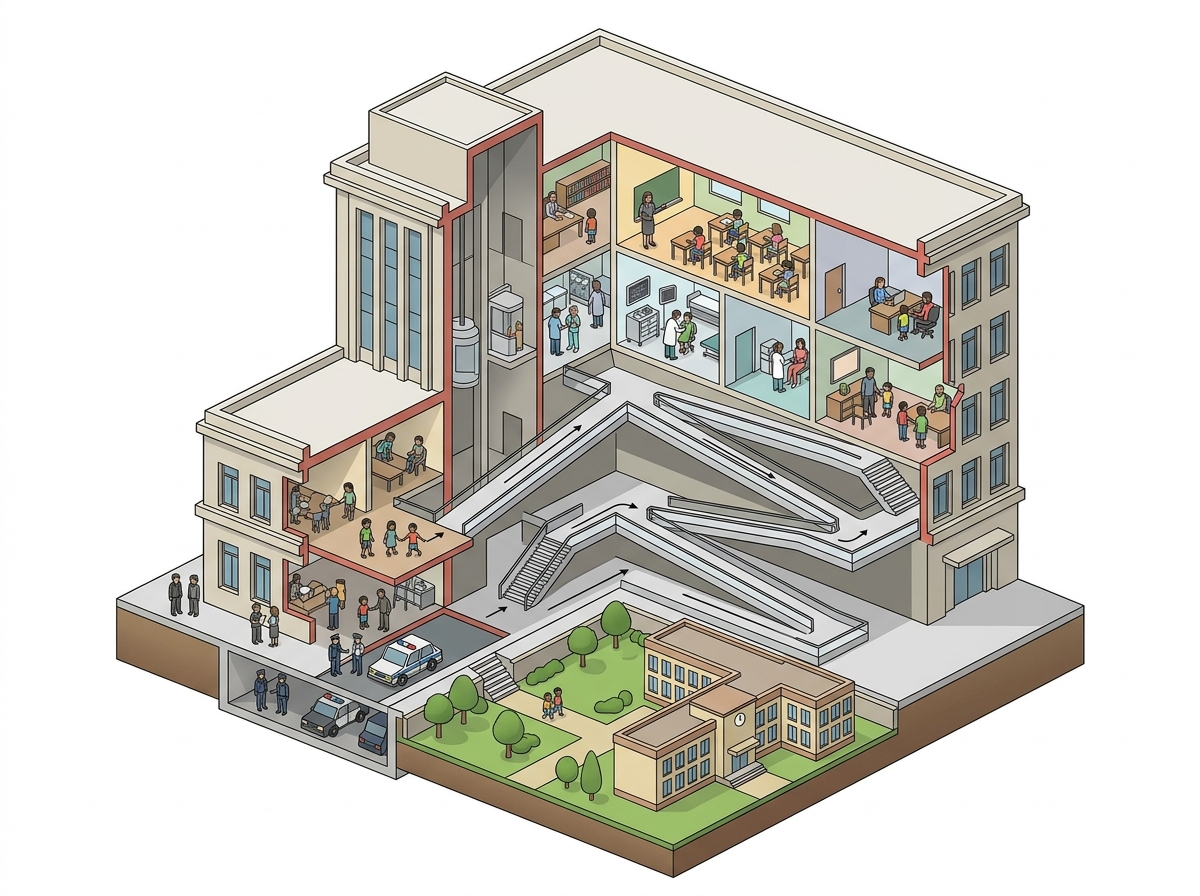
04 Sep NCPCR’s Nationwide Drive Frees 3800+ Children from Child Labour
✎ NCPCR's All-India Rescue and Rehabilitation Campaign (June–August 2026) operationalised constitutional and statutory frameworks (Articles 21A, 24, 39; Child Labour Act 1986; JJ Act 2015) through multi-stakeholder coordination…
Subject Relevance — Where This Topic Fits
- GS Paper II — Governance, Constitution, Polity, Social Justice and International Relations (Child Rights and Protection) | GS Paper III — Social Sector/Services relating to Health, Education, Human Resources
- Prelims: Child Labour (Prohibition and Regulation) Act, 1986, Juvenile Justice (Care and Protection of Children) Act, 2015, National Commission for Protection of Child Rights (NCPCR), Sampurna Scheme for Rehabilitation of Victims of Trafficking, PENCIL Portal, Section 23 of the Juvenile Justice Act, Right to Education (RTE) Act, 2009, National Child Labour Project (NCLP), Child Labour Tracking System (CLTS)
- Essay: The ethical imperative of child protection: balancing labour rights and developmental needs, State capacity in welfare delivery: lessons from child labour eradication campaigns
Quick Revision: NCPCR’s All-India Rescue and Rehabilitation Campaign (June–August 2026) operationalised constitutional and statutory frameworks (Articles 21A, 24, 39; Child Labour Act 1986; JJ Act 2015) through multi-stakeholder coordination, data-driven monitoring, and targeted rescue operations to rehabilitate 3,800+ children from labour and trafficking.
Why is this in the news?
The National Commission for Protection of Child Rights (NCPCR) concluded a nationwide ‘All-India Rescue and Rehabilitation’ campaign from 12 June to 31 August 2026, during which over 3,800 children were rescued from child labour and trafficking, alongside the registration of 575 FIRs. This initiative exemplifies the operationalisation of statutory and policy frameworks aimed at eradicating child labour and trafficking, with a focus on inter-departmental coordination, data-driven monitoring, and multi-stakeholder collaboration. The campaign underscores the evolving role of constitutional bodies in ensuring the effective implementation of child protection laws in India.
Background
- The Constitution of India guarantees fundamental rights to children under Articles 21A (Right to Education), 24 (Prohibition of Child Labour), 39(e) and (f) (Directive Principles for child protection).
- The Child Labour (Prohibition and Regulation) Act, 1986 (amended in 2016) prohibits employment of children below 14 years in ALL occupations and processes.
- The Juvenile Justice (Care and Protection of Children) Act, 2015, provides a legal framework for the rescue, rehabilitation, and social reintegration of children in need of care and protection, including victims of trafficking and child labour.
- The PENCIL Portal (Platform for Effective Enforcement for No Child Labour) was launched in 2017 to coordinate efforts among Central and State governments, civil society, and the public in eliminating child labour.
- NCPCR, established under the Commissions for Protection of Child Rights Act, 2005, functions as a statutory body to monitor the implementation of child rights instruments and investigate complaints regarding violations.
What is the ‘All-India Rescue and Rehabilitation’ Campaign by NCPCR?
- Initiated on 12 June 2026 and concluded on 31 August 2026, the campaign was a time-bound, pan-India effort to identify, rescue, and rehabilitate children engaged in labour or subjected to trafficking and exploitation.
- The campaign adopted a multi-stakeholder approach, involving district administrations, labour departments, police authorities, state governments, and civil society organisations to ensure coordinated action.
- Key operational components included targeted rescue operations at identified hotspots, real-time data collection on rescued children, FIR registration, and follow-up actions such as rehabilitation, restoration, and mainstreaming into education systems.
- NCPCR issued directives to state authorities to conduct intensive and focused rescue operations in areas with high incidences of child labour and trafficking, ensuring adherence to legal and procedural safeguards.
- The campaign emphasised data-driven monitoring, with regular reporting requirements from states/UTs on rescue operations, rehabilitation measures, compensation disbursement, and educational integration of rescued children.
- District-level coordination meetings were held to review progress, address operational bottlenecks, and ensure timely submission of Action Taken Reports (ATRs) to track accountability and outcomes.
- Awareness generation was a critical component, utilising social media and other communication channels to educate the public on reporting child labour, the importance of rehabilitation, and the legal recourse available under the Juvenile Justice Act and other statutes.
- The campaign resulted in the rescue of 3,800+ children and the registration of 575+ FIRs, highlighting the scale of child labour and trafficking in India and the need for sustained, systemic interventions.
Key Features
| Feature | Significance |
|---|---|
| Multi-stakeholder coordination | The campaign demonstrates a structured inter-departmental approach involving state governments, district administrations, labour departments, police, and civil society to address child labour and trafficking holistically. |
| Targeted rescue operations | The campaign focused on high-risk zones of child labour and trafficking, ensuring precise identification and liberation of victims rather than broad, unfocused interventions. |
| Data-driven monitoring | Regular reporting by states on rescued children, FIRs, rehabilitation, and follow-up measures enabled real-time tracking of progress and accountability. |
| Operational review mechanisms | District-level meetings were held to address operational bottlenecks, ensure timely submission of Action Taken Reports (ATRs), and strengthen inter-agency coordination. |
| Awareness and outreach | Leveraged social media and mass communication to sensitize the public on child labour reporting, rehabilitation pathways, and the importance of mainstream education for rescued children. |
Why it Matters
Legal and Institutional
- Reaffirms the constitutional mandate under Article 24 (prohibition of child labour) and Article 39(f) (protection of children from exploitation) by operationalising statutory bodies like NCPCR.
- Demonstrates the role of quasi-judicial institutions (NCPCR) in enforcing child protection laws through coordinated executive action.
- Highlights the necessity of synergy between statutory bodies (NCPCR), executive agencies (state governments), and law enforcement (police) for effective implementation of child protection frameworks.
Social and Human Development
- Addresses systemic vulnerabilities that perpetuate child labour, including poverty, lack of access to education, and social marginalisation.
- Emphasises the right to education (Article 21A) and the need for inclusive schooling to prevent re-trafficking and re-engagement in labour.
- Underscores the long-term socio-economic benefits of rehabilitating children, including breaking intergenerational cycles of poverty and exploitation.
Policy and Governance
- Illustrates the importance of periodic, time-bound campaigns in achieving measurable outcomes in child protection, as opposed to ad-hoc measures.
- Showcases the use of data analytics and monitoring tools to assess the efficacy of rescue and rehabilitation efforts across diverse geographies.
- Provides a model for scaling similar interventions in other areas of child rights violations, such as child marriage or juvenile justice.
Challenges
1. Operational Bottlenecks in Rescue Operations
- Geographical spread and logistical constraints in reaching remote or densely populated areas where child labour is prevalent.
- Resistance from employers or local communities due to economic dependencies on child labour, necessitating sensitisation and legal enforcement.
- Delays in FIR registration and legal proceedings, which can deter future rescues and allow perpetrators to evade accountability.
UPSC Link: GS-II: Governance, GS-III: Social Justice
2. Sustainable Rehabilitation and Reintegration
- Ensuring long-term financial and psychological support for rescued children to prevent re-trafficking or re-engagement in labour.
- Addressing systemic gaps in education infrastructure, especially in rural and tribal areas, to facilitate seamless mainstreaming.
- Coordination challenges between state agencies, NGOs, and local bodies in delivering consistent post-rescue services.
UPSC Link: GS-II: Social Justice, GS-IV: Ethics
3. Data Gaps and Monitoring Challenges
- Inconsistent reporting mechanisms across states, leading to underestimation or misrepresentation of child labour cases.
- Lack of standardised metrics to evaluate the success of rehabilitation programmes, complicating policy adjustments.
- Difficulty in tracking children who are rescued but later go missing due to weak follow-up systems.
UPSC Link: GS-II: Governance, GS-III: Social Justice
4. Legal and Institutional Fragmentation
- Overlapping mandates between NCPCR, state child welfare committees, and labour departments, leading to jurisdictional ambiguities.
- Inadequate capacity of local authorities to implement child protection laws due to limited resources or training.
- Slow judicial processes that delay justice for victims, undermining the deterrent effect of legal action.
UPSC Link: GS-II: Polity, GS-III: Social Justice
Challenges — UPSC Perspective
| Issue | Concern |
|---|---|
| Delayed FIR registration | Undermines legal deterrence and allows perpetrators to evade accountability, reducing the effectiveness of rescue operations. |
| Inadequate rehabilitation infrastructure | Leads to gaps in post-rescue support, increasing the risk of re-trafficking or re-engagement in child labour. |
| Geographical and logistical constraints | Hinders the reach of rescue teams to remote or high-risk areas, leaving many children vulnerable. |
| Data inconsistencies across states | Complicates national-level assessment of child labour prevalence and the impact of rescue campaigns. |
| Limited inter-agency coordination | Results in fragmented efforts, duplication of work, and inefficiencies in rescue and rehabilitation processes. |
Government Initiatives — Must-Memorise for Prelims
- National Child Labour Project (NCLP) Scheme
- Pencil Portal (Platform for Effective Enforcement for No Child Labour)
Way Forward
- Strengthen district-level coordination committees to streamline rescue operations and post-rescue rehabilitation, ensuring no child is left behind.
- Expand the use of technology, such as GIS mapping and mobile applications, to identify high-risk zones and track rescued children in real time.
- Enhance capacity-building programmes for police, labour officials, and local authorities to improve enforcement of child labour laws.
- Integrate child protection measures with existing social welfare schemes, such as mid-day meal programmes and skill development initiatives, to address root causes of child labour.
- Establish a national-level dashboard to monitor rescue operations, rehabilitation progress, and legal outcomes, ensuring transparency and accountability.
- Promote community-based awareness campaigns to sensitise families and employers about the legal and social consequences of child labour.
- Collaborate with NGOs and civil society organisations to provide psycho-social support and vocational training for rescued children, facilitating their reintegration into society.
UPSC Value Addition
Keywords for Mains Answer-Writing
National Commission for Protection of Child Rights (NCPCR) · Child Labour (Prohibition and Regulation) Act, 1986 · Juvenile Justice (Care and Protection of Children) Act, 2015 · Trafficking of Persons (Prevention, Protection and Rehabilitation) Bill, 2021 · Right to Education (RTE) Act, 2009 · Bonded Labour System (Abolition) Act, 1976 · Child Labour Action Plan (2017) · UN Convention on the Rights of the Child (UNCRC) · District Child Protection Units (DCPUs) · Rehabilitation and mainstreaming of rescued children
Constitutional & Policy Linkages
- Article 24: Prohibition of employment of children in factories, etc.
- Article 39(f): Provision for children to be given opportunities and facilities to develop in a healthy manner.
- Article 21A: Right to free and compulsory education for children aged 6-14 years.
Concept Flow
Identification of systemic gaps in child labour enforcement -> Launch of targeted rescue campaign by NCPCR -> Multi-stakeholder coordination (state, police, labour departments) -> Rescue and FIR registration -> Immediate rehabilitation and mainstream education linkage -> Long-term reintegration and prevention of re-trafficking -> Data-driven monitoring and policy refinement.
Prelims Practice Questions
Q1. Consider the following statements regarding the National Commission for Protection of Child Rights (NCPCR):
1. It is a statutory body established under the Commissions for Protection of Child Rights Act, 2005.
2. It functions under the aegis of the Ministry of Women and Child Development, Government of India.
3. The Commission is empowered to take suo motu cognisance of matters relating to child rights violations.
4. It has the authority to impose penalties on employers found employing children below the legal working age.
How many of the above statements are correct?
- Only one
- Only two
- Only three
- All four
Answer: All four — Statements 1, 2, and 3 are correct. Statement 4 is incorrect as NCPCR does not have the authority to impose penalties; it can recommend actions to competent authorities.
Q2. Assertion (A): The Juvenile Justice (Care and Protection of Children) Act, 2015, provides for the rehabilitation and social reintegration of children in conflict with law and children in need of care and protection.
Reason (R): The Act mandates the establishment of Child Protection Committees at the district level to monitor the implementation of child protection schemes.
Options:
A. Both A and R are true, and R is the correct explanation of A.
B. Both A and R are true, but R is not the correct explanation of A.
C. A is true, but R is false.
D. A is false, but R is true.
- A
- B
- C
- D
Answer: B — Both A and R are true, and R correctly explains A. The Act indeed provides for rehabilitation and mandates the establishment of Child Protection Committees at the district level.
Q3. Match the following legal provisions with their respective objectives:
Column I
1. Child Labour (Prohibition and Regulation) Act, 1986
2. Right to Education (RTE) Act, 2009
3. Bonded Labour System (Abolition) Act, 1976
4. Trafficking of Persons (Prevention, Protection and Rehabilitation) Bill, 2021
Column II
A. Ensures free and compulsory education for children aged 6-14 years
B. Prohibits the engagement of children in hazardous occupations and processes
C. Aims to prevent human trafficking and provide rehabilitation to victims
D. Seeks to abolish the practice of bonded labour and release bonded labourers
Options:
1. 1-B, 2-A, 3-D, 4-C
2. 1-A, 2-B, 3-C, 4-D
3. 1-C, 2-D, 3-A, 4-B
4. 1-D, 2-C, 3-B, 4-A
- 1
- 2
- 3
- 4
Answer: 2 — 1-B: The Child Labour Act prohibits hazardous child labour. 2-A: The RTE Act ensures free and compulsory education. 3-D: The Bonded Labour Act abolishes bonded labour. 4-C: The Trafficking Bill aims to prevent trafficking and provide rehabilitation.
Mains Practice Question
✍ The National Commission for Protection of Child Rights (NCPCR) has recently conducted a pan-India rescue and rehabilitation campaign, freeing over 3,800 children from exploitative labour and trafficking. Critically analyse the efficacy of India’s existing legal and institutional framework in addressing child labour and trafficking. Substantiate your answer with reference to constitutional provisions, statutory laws, and institutional mechanisms. Also, examine the challenges in effective implementation and suggest measures for improvement. (15 Marks)
Approach: MODEL-ANSWER SKELETON:
1. **Constitutional and Legal Framework**:
– Article 21A (Right to Education), Article 24 (Prohibition of Child Labour), and Article 39(e) & (f) (Directive Principles).
– Key statutes: Child Labour (Prohibition and Regulation) Act, 1986 (amended 2016), Juvenile Justice (Care and Protection of Children) Act, 2015, Right to Education (RTE) Act, 2009, and Bonded Labour System (Abolition) Act, 1976.
– International commitments: UN Convention on the Rights of the Child (UNCRC), ILO Convention 138 and 182.
2. **Institutional Mechanisms**:
– NCPCR and State Commissions for Protection of Child Rights (SCPCRs).
– District Child Protection Units (DCPUs), Child Welfare Committees (CWCs), and Juvenile Justice Boards (JJBs).
– Role of Ministry of Women and Child Development, Labour Ministry, and state governments.
3. **Efficacy of the Framework**:
– Strengths: Legal prohibitions, institutional setups, and rehabilitation mechanisms.
– Weaknesses: Ambiguities in definitions (e.g., ‘hazardous occupations’), weak enforcement, lack of inter-departmental coordination, and inadequate rehabilitation infrastructure.
4. **Challenges in Implementation**:
– Socio-economic factors: Poverty, lack of awareness, and migration.
– Structural issues: Under-resourced DCPUs, delays in FIR registration, and insufficient data on rescued children.
– Judicial delays and lack of specialised courts for child rights violations.
5. **Measures for Improvement**:
– Strengthening inter-departmental coordination (e.g., Labour, Police, and Education departments).
– Enhancing rehabilitation infrastructure (shelter homes, vocational training, and mainstreaming into education).
– Community awareness campaigns and strict monitoring of supply chains (e.g., in industries like brick kilns, zari work, and domestic help).
– Leveraging technology for real-time data collection and monitoring (e.g., NCPCR’s ‘TrackChild’ portal).
6. **Conclusion**:
– While the legal and institutional framework is robust in theory, its effectiveness is hindered by implementation gaps. A multi-stakeholder approach with stronger enforcement, adequate resources, and community participation is essential for sustainable change.
Source: PIB (Press Information Bureau)
Generated by AanyaAi for educational purpose.
Related guides on our sites
- Best PSIR optional coaching for upsc
- Best PSIR optional teacher for upsc
- Best teacher of PSIR optional for upsc
- Best PSIR optional coaching in delhi for UPSC

- National Unity Day 2026: Key Preparations & Significance for UPSC - October 21, 2026
- 14वां इंडिया केम 2026: मुंबई में वैश्विक रसायन उद्योग का महाकुंभ - October 21, 2026
- डीआरआई ने गुजरात में 19 करोड़ रुपये सोने की तस्करी गिरोह का भंडाफोड़ किया - October 21, 2026

No Comments