


06 Sep ISRO Clarifies: No Privatisation, Role to Remain Central in Space Reforms
✎ ISRO’s role remains central to India’s space programme under the Indian Space Policy 2023, with reforms aimed at expanding the national space ecosystem through private sector participation, not diminishing ISRO’s leadership.
Subject Relevance — Where This Topic Fits
- GS Paper III — Science and Technology — Developments and their Applications and Effects in Everyday Life | GS Paper III — Economic Development — Industrial Policy and Liberalisation | GS Paper III — Security — Space Technology and National Security
- Prelims: ISRO, Indian Space Policy 2023, Bharatiya Antariksh Station, FDI in space sector, technology transfer, space sector reforms, IN-SPACe, PSLV, GSLV, Gaganyaan, Chandrayaan, Aditya-L1
- Essay: Technological self-reliance: India’s journey in space exploration and its strategic implications, Balancing public institutions and private enterprise in national development: The case of India’s space sector
Quick Revision: ISRO’s role remains central to India’s space programme under the Indian Space Policy 2023, with reforms aimed at expanding the national space ecosystem through private sector participation, not diminishing ISRO’s leadership.
Why is this in the news?
The Indian Space Research Organisation (ISRO) issued a formal clarification on 6 September 2026, categorically rejecting media reports suggesting its role was being diminished or that the organisation was being privatised amid ongoing space sector reforms. The clarification underscores ISRO’s continued centrality to India’s space programme, while acknowledging the expanding role of the private sector within a broader national space ecosystem. This development is significant as it reaffirms the strategic direction of India’s space policy, particularly in light of the Indian Space Policy 2023 and recent liberalisation measures.
Background
- The Indian Space Research Organisation (ISRO) has been the primary agency responsible for India’s space activities since its establishment in 1969, overseeing missions such as Chandrayaan, Mangalyaan, and Gaganyaan.
- In 2020, the Government of India initiated a series of space sector reforms aimed at enhancing private sector participation, fostering innovation, and increasing India’s global competitiveness in space technology.
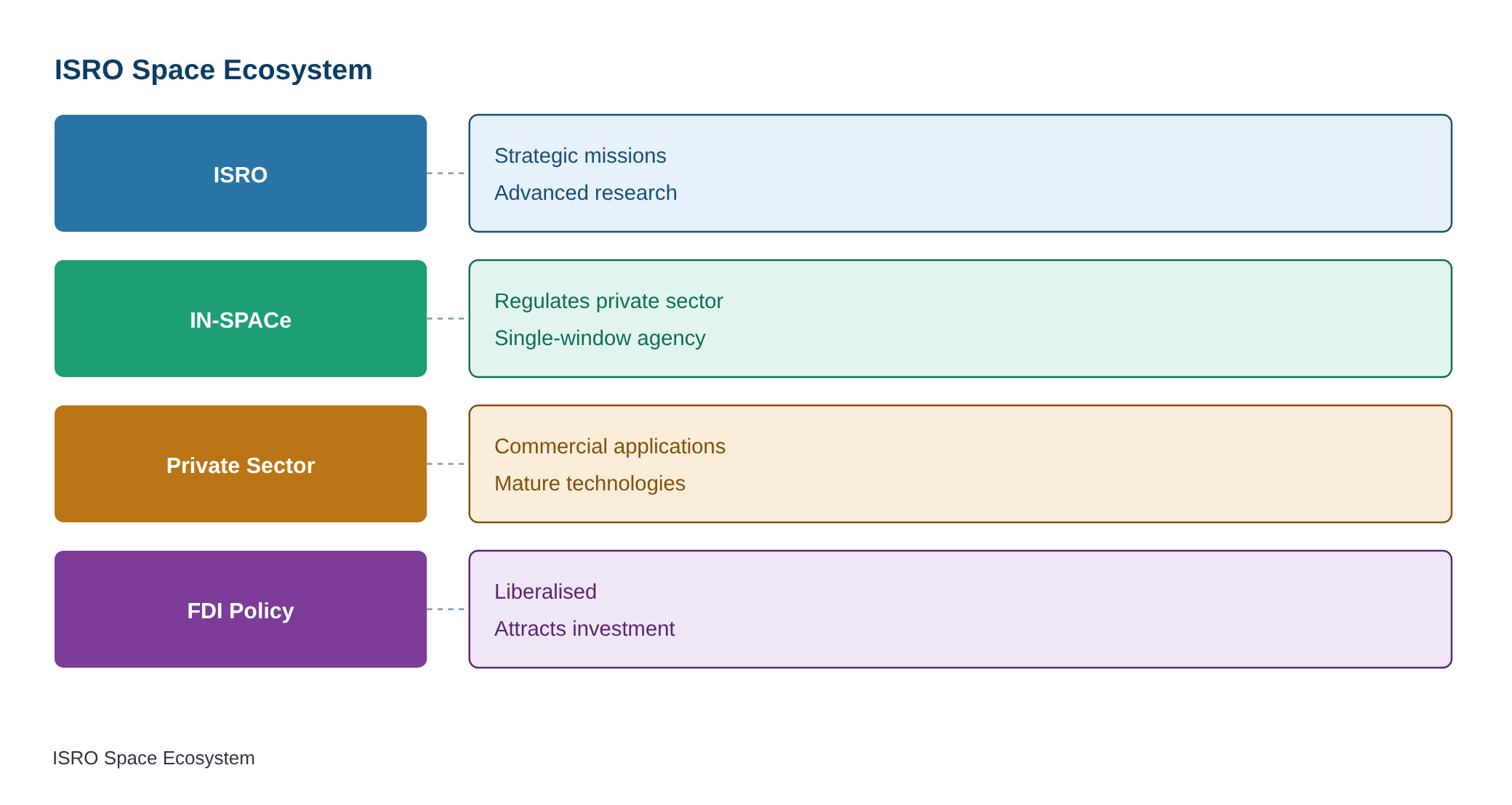
- The Indian Space Policy 2023, notified in April 2023, formalised the government’s vision for a collaborative ecosystem where ISRO focuses on advanced research and strategic missions, while the private sector scales mature technologies and commercial applications.
- The establishment of IN-SPACe (Indian National Space Promotion and Authorisation Centre) in 2020 acted as a single-window nodal agency to promote, authorise, and oversee private sector activities in the space domain.
- Foreign Direct Investment (FDI) policy in the space sector was progressively liberalised to attract investment in satellite manufacturing, launch services, and related infrastructure.
- The Bharatiya Antariksh Station (BAS), India’s planned space station, and the Gaganyaan human spaceflight programme are flagship initiatives that underscore ISRO’s continued leadership in strategic space missions.
What is the Indian Space Policy 2023 and ISRO’s evolving role?
- The Indian Space Policy 2023 is a comprehensive policy framework that redefines the roles of ISRO, the private sector, and academia within India’s space ecosystem, with a focus on collaboration and specialisation.
- Under the policy, ISRO’s primary mandate is to conduct advanced research, develop next-generation technologies, and execute strategic and national missions, including deep-space exploration and human spaceflight.
- The private sector is encouraged to participate across the entire space value chain—from satellite manufacturing and launch services to data analytics and downstream applications—thereby scaling India’s space capabilities.
- IN-SPACe serves as the regulatory and facilitative body, enabling private entities to obtain licences, access ISRO facilities, and collaborate on technology development and commercialisation.
- Technology transfer from ISRO to industry is a key component of the policy, allowing mature technologies to be scaled for commercial use while ISRO focuses on frontier research and complex missions.
- The policy aligns with India’s ‘Space Vision 2047’, which aims to position India as a global leader in space technology, exploration, and commercial applications by mid-century.
- ISRO retains ownership of critical national assets and strategic programmes, ensuring continuity in India’s space security and sovereignty.
- The reforms do not constitute privatisation of ISRO but represent a strategic shift towards an ‘ISRO-led national space ecosystem’, where the organisation’s scientific and technical expertise is leveraged for high-impact areas.
Key Features
| Feature | Significance |
|---|---|
| Indian Space Policy 2023 | Institutionalises space-sector reforms, delineates ISRO’s role as the principal agency for advanced research and strategic missions while enabling private sector participation across the value chain. |
| ISRO-led national space ecosystem | Represents a transition where ISRO focuses on frontier R&D and complex missions, while industry scales mature technologies, fostering a globally competitive domestic space sector. |
| Technology transfer to industry | ISRO’s transfer of mature technologies to private entities enables large-scale production, commercialisation, and innovation, without diminishing ISRO’s role in advanced domains. |
| FDI liberalisation in space sector | Progressive liberalisation since 2020 attracts foreign investment, enhancing India’s technological and industrial capabilities in the space domain. |
| Bharatiya Antariksh Station (BAS) | A strategic national capability under ISRO’s leadership, aimed at establishing India’s long-term presence in low Earth orbit as part of the ‘Space Vision 2047’. |
Why it Matters
Strategic Autonomy
- ISRO’s continued leadership ensures India retains control over critical space capabilities, including launch systems, deep-space missions, and national security applications.
- The reforms strengthen India’s position in the global space economy by leveraging private sector innovation while maintaining sovereign oversight through ISRO.
- Enhanced strategic capabilities, such as next-generation launch vehicles and human spaceflight, reinforce India’s status as a leading spacefaring nation.
Economic Growth
- Expansion of the space ecosystem creates high-skilled employment opportunities in R&D, manufacturing, and commercial space services.
- Technology transfer and industry participation drive cost efficiencies, enabling India to compete globally in satellite launches, manufacturing, and space-based services.
- FDI liberalisation and private sector growth attract investment, fostering a self-reliant (Atmanirbhar) space industry with export potential.
Scientific Advancement
- ISRO’s focus on frontier R&D accelerates breakthroughs in planetary exploration, lunar missions, and next-generation propulsion systems.
- Collaboration with academia and startups fosters innovation in niche areas like space medicine, AI-driven satellite operations, and sustainable space technologies.
- Human spaceflight (Gaganyaan) and deep-space missions (Chandrayaan, Aditya-L1) exemplify India’s commitment to cutting-edge scientific exploration.
Global Competitiveness
- A robust, ISRO-led ecosystem enhances India’s share in the global space market, currently valued at over $400 billion, by improving cost competitiveness and reliability.
- Participation in international collaborations (e.g., Artemis Accords) is strengthened by India’s demonstrated capability in end-to-end space missions.
- India’s space diplomacy gains traction through technology-sharing agreements and joint missions, reinforcing its role as a trusted partner in space governance.
Challenges
1. Regulatory and Compliance Gaps
- Ensuring that private sector participation aligns with national security imperatives and strategic autonomy, particularly in sensitive areas like launch vehicles and satellite communications.
- Addressing ambiguities in liability frameworks for commercial space activities to mitigate risks for private entities and protect national interests.
- Streamlining approval processes for technology transfers and industry-led projects to avoid delays in scaling up capabilities.
UPSC Link: GS-III: Space Technology
2. Human Capital and R&D Bottlenecks
- Sustaining a pipeline of skilled scientists and engineers to meet the demands of an expanded space ecosystem, including roles in advanced research and industry.
- Balancing ISRO’s focus on frontier missions with the need to mentor and support private sector innovation through collaborative R&D initiatives.
- Preventing brain drain in critical domains by offering competitive career pathways in both ISRO and the private sector.
UPSC Link: GS-III: Science & Technology
3. Infrastructure and Supply Chain Constraints
- Upgrading manufacturing and testing infrastructure to meet the scale required for commercial satellite production and launch services.
- Ensuring reliable supply chains for critical components, including semiconductors and advanced materials, to reduce dependency on imports.
- Developing indigenous capabilities in niche areas like space-grade electronics and propulsion systems to enhance self-reliance.
UPSC Link: GS-III: Industrial Policy
4. International Competition and Geopolitical Risks
- Countering the dominance of established spacefaring nations (e.g., USA, China, EU) by accelerating innovation in cost-effective launch systems and satellite technologies.
- Navigating geopolitical sensitivities in collaborations, particularly with respect to technology-sharing agreements and export controls.
- Mitigating risks of cyber threats and space debris proliferation, which could undermine India’s operational capabilities in low Earth orbit.
UPSC Link: GS-II: International Relations
5. Public-Private Partnership (PPP) Model Challenges
- Designing equitable PPP frameworks that incentivize private investment without compromising ISRO’s strategic oversight or public funding priorities.
- Ensuring transparency and accountability in resource allocation, particularly for projects with dual-use (civilian and defence) applications.
- Addressing concerns about monopolistic practices or cartelisation in the private sector that could stifle competition and innovation.
UPSC Link: GS-III: Economic Development
Challenges — UPSC Perspective
| Issue | Concern |
|---|---|
| Ambiguity in liability frameworks | Potential legal and financial risks for private entities engaging in commercial space activities. |
| Skill shortages in advanced R&D | Risk of stagnation in innovation due to insufficient human capital in critical domains. |
| Infrastructure bottlenecks | Delays in scaling up production and testing capabilities for commercial space missions. |
| Geopolitical sensitivities in collaborations | Threat to India’s strategic autonomy in space partnerships. |
| Equitable PPP frameworks | Risk of unequal resource distribution or monopolistic tendencies in the private sector. |
| Cybersecurity threats in space operations | Vulnerability of satellite networks and ground stations to cyberattacks. |
Way Forward
- Strengthen the regulatory framework for private sector participation by finalising the Space Activities Bill and clarifying liability norms for commercial missions.
- Expand ISRO’s outreach to academia and startups through dedicated funding schemes (e.g., ISRO’s Technology Transfer Programme) to foster grassroots innovation.
- Invest in upgrading indigenous manufacturing infrastructure, particularly for space-grade components, to reduce import dependency.
- Enhance international collaborations while safeguarding strategic interests, including participation in the Artemis Accords and bilateral space agreements.
- Develop a national talent pipeline by revising STEM education policies to align with the needs of the space sector, including specialised courses in aerospace engineering.
- Establish a dedicated space diplomacy cell within the Ministry of External Affairs to coordinate India’s global engagements in space governance.
- Implement a phased roadmap for the Bharatiya Antariksh Station (BAS) to ensure timely execution while leveraging private sector capabilities for modular components.
- Conduct periodic audits of PPP projects to assess their impact on ISRO’s core functions and national strategic objectives.
UPSC Value Addition
Keywords for Mains Answer-Writing
Indian Space Research Organisation (ISRO) · Space sector reforms in India · Indian Space Policy 2023 · Privatisation of space sector · Public-private partnership in space · Bharatiya Antariksh Station · Human spaceflight programme · Deep-space and planetary missions · Foreign Direct Investment (FDI) liberalisation · Space Vision 2047 · Technology transfer to industry · ISRO-led national space ecosystem · Next-generation launch systems · Strategic national space capabilities
Concept Flow
Space-sector reforms (2020–2023) → Indian Space Policy 2023 institutionalises reforms → Clarification on ISRO’s role to counter misinformation → Expansion of ISRO-led ecosystem with private sector participation → Focus on frontier R&D and strategic missions → Enhanced global competitiveness and self-reliance in space technology.
Prelims Practice Questions
Q1. Consider the following statements regarding the Indian Space Research Organisation (ISRO) and recent reforms in the space sector:
1. ISRO has categorically denied any plans to privatise itself or reduce its role in India’s space programme.
2. The Indian Space Policy 2023 institutionalised the reforms initiated since 2020 to expand the space ecosystem.
3. The reforms aim to transfer all space-related activities from ISRO to private entities.
How many of the above statements are correct?
- Only one
- Only two
- All three
- None
Answer: Only two — Statement 1 is correct as ISRO explicitly stated it will neither be privatised nor see its role diminished. Statement 2 is correct as the Indian Space Policy 2023 institutionalised reforms initiated since 2020. Statement 3 is incorrect as the reforms aim to enable industry participation while ISRO retains its central role.
Q2. Assertion (A): The Indian Space Policy 2023 liberalised Foreign Direct Investment (FDI) norms in the space sector to attract private participation.
Reason (R): The liberalisation of FDI norms is intended to enable ISRO to focus on advanced research and next-generation technologies by transferring mature technologies to industry.
In the context of the above two statements, which of the following is correct?
- Both A and R are true, and R is the correct explanation of A
- Both A and R are true, but R is not the correct explanation of A
- A is true, but R is false
- A is false, but R is true
Answer: Both A and R are true, but R is not the correct explanation of A — Assertion (A) is true as the Indian Space Policy 2023 did liberalise FDI norms. Reason (R) is also true and correctly explains the policy intent behind the reforms, which is to enable ISRO to focus on advanced research while industry scales mature technologies.
Q3. Match the following initiatives with their respective objectives in the context of ISRO’s space sector reforms:
Column I (Initiative) | Column II (Objective)
— | —
1. Bharatiya Antariksh Station | A. Development of next-generation launch systems
2. Technology transfer to industry | B. Expansion of India’s space ecosystem and commercialisation
3. Indian Space Policy 2023 | C. Establishment of India’s own space station
4. Human spaceflight programme | D. Enabling industry to scale mature technologies and capabilities
Select the correct match:
- 1-C, 2-D, 3-B, 4-A
- 1-A, 2-B, 3-C, 4-D
- 1-D, 2-A, 3-B, 4-C
- 1-B, 2-C, 3-A, 4-D
Answer: 1-C, 2-D, 3-B, 4-A — 1-C: The Bharatiya Antariksh Station is India’s planned space station. 2-D: Technology transfer to industry enables industry to scale mature technologies. 3-B: The Indian Space Policy 2023 aims to expand the space ecosystem. 4-A: The human spaceflight programme is linked to developing next-generation launch systems.
Mains Practice Question
✍ The Government of India’s space sector reforms, as institutionalised through the Indian Space Policy 2023, have been misrepresented in certain quarters as a move towards the privatisation of ISRO and a reduction in its role. Critically examine this assertion with reference to the evolving structure of India’s space ecosystem and the constitutional and statutory framework governing space activities in India. (15 Marks)
Approach: MODEL-ANSWER SKELETON:
1. **Constitutional and Statutory Framework**:
– Article 51A(h) of the Constitution: Fundamental duty to develop scientific temper and spirit of inquiry.
– Space Activities Act, 2019: Regulatory framework for space activities, including licensing and oversight.
– Department of Space (DoS): Established under the Government of India to oversee ISRO and space policies.
– Indian Space Research Organisation (ISRO): Autonomous body under DoS, mandated to conduct space research and development.
2. **Space Sector Reforms and Policy Evolution**:
– **Indian Space Policy 2023**: Institutionalises reforms initiated since 2020, emphasising an ISRO-led national space ecosystem.
– **Key Objectives**:
– Expand India’s space ecosystem by enabling industry, start-ups, and academia to participate across the space value chain.
– Focus ISRO on frontier R&D, advanced technologies, human spaceflight, next-generation launch systems, and strategic missions.
– Transfer mature technologies to industry to enable commercialisation and global market access.
– **Foreign Direct Investment (FDI) Liberalisation**: Progressive liberalisation of FDI norms to attract private investment and enhance global competitiveness.
3. **Misrepresentation of Reforms**:
– **Clarification by ISRO**: Explicit denial of privatisation or role reduction; emphasis on ISRO’s continued centrality in advanced research and strategic missions.
– **Ecosystem Expansion**: Reforms aim to create a larger, stronger, and globally competitive Indian space ecosystem, not diminish ISRO’s role.
– **Technology Transfer**: Transferring mature technologies to industry enables large-scale production and innovation while allowing ISRO to concentrate on advanced research and complex missions.
4. **Constitutional and Governance Implications**:
– **Separation of Roles**: ISRO retains its core mandate in R&D, strategic missions, and frontier exploration, while industry scales mature technologies.
– **Public-Private Partnership (PPP)**: Reforms align with the broader policy thrust towards PPP models in strategic sectors, balancing public ownership with private efficiency.
– **Accountability and Oversight**: DoS and ISRO remain accountable to the Government of India, ensuring alignment with national priorities and constitutional obligations.
5. **Comparative Perspective**:
– **Global Examples**: Contrast with space policies of other nations (e.g., NASA’s Commercial Orbital Transportation Services, ESA’s public-private partnerships) to highlight the global trend towards collaborative space ecosystems.
6. **Conclusion**:
– The reforms represent a strategic shift towards an ISRO-led national space ecosystem, where ISRO’s role is strengthened in areas of scientific expertise, while industry scales mature technologies. The misrepresentation of these reforms as privatisation or role reduction is unfounded and overlooks the constitutional and governance framework underpinning India’s space programme.
Source: orissapost.com
Generated by AanyaAi for educational purpose.
Related guides on our sites
- Best economics services coaching
- Anthropology VS PSIR
- Best PSIR optional coaching
- Best PSIR optional coaching online

- तमिलनाडु में पूमपुहार तट पर तीसरे चरण की जलमग्न पुरातत्व खोज शुरू - September 6, 2026
- Tamil Nadu’s Underwater Archaeology: Poompuhar’s 3rd Phase Explained for UPSC - September 6, 2026
- संयुक्त राष्ट्र ने 27 नवंबर को वैश्विक बाल विवाह विरोधी दिवस घोषित किया, जानिए इसके महत्व - September 6, 2026

No Comments