


28 Oct Japan Eyes India for Long-Range Missile & Drone Training: UPSC Insights
✎ Japan’s exploration of India-based training for long-range missiles and attack drones reflects the strategic imperative of Indo-Pacific defence cooperation, leveraging India’s indigenous capabilities and shared security interests.
Subject Relevance — Where This Topic Fits
- GS Paper II — International Relations: India’s Foreign Policy, Indo-Pacific Strategy, Defence Diplomacy | GS Paper III — Security — Defence Technology, Military Exercises, Strategic Partnerships
- Prelims: Indo-Pacific Strategy, Japan-India defence cooperation, Long-range missiles, Surface-to-Ship Missiles (SSM), Defence Research and Development Organisation (DRDO), Centre for Land Warfare Studies (CLAWS), Wargame Research and Development Centre (WARDEC), Japan Ground Self-Defense Force (GSDF), Indo-Pacific security architecture
- Essay: The evolving architecture of Indo-Pacific security: Challenges and opportunities, The role of defence diplomacy in shaping regional strategic partnerships
Quick Revision: Japan’s exploration of India-based training for long-range missiles and attack drones reflects the strategic imperative of Indo-Pacific defence cooperation, leveraging India’s indigenous capabilities and shared security interests.
Why is this in the news?
Japan’s Ground Self-Defense Force (GSDF) has dispatched personnel to India to coordinate defence-related training for long-range surface-to-ship missiles (SSM) and small attack drones, signalling a deepening strategic partnership between Tokyo and New Delhi. This initiative underscores the growing emphasis on operationalising Indo-Pacific defence cooperation amid evolving regional security dynamics, including the need for extended-range strike capabilities and joint military training environments.
Background
- The Japan-India defence partnership has evolved significantly since the signing of the 2008 Joint Declaration on Security Cooperation and the 2019 Acquisition and Cross-Servicing Agreement (ACSA), which facilitates mutual logistical support during joint exercises and operations.
- India and Japan are key stakeholders in the Indo-Pacific region, with shared concerns over maritime security, freedom of navigation, and the rise of China’s military assertiveness in the South China Sea and Indian Ocean.
- Japan’s National Security Strategy (2022) and National Defence Strategy (2022) prioritise strengthening defence ties with like-minded partners, including India, to counterbalance regional security challenges.
- India’s indigenous defence capabilities, particularly in missile technology and wargaming, have attracted international interest, as demonstrated by Japan’s delegation visits to DRDO, CLAWS, and WARDEC in October 2026.
- The Indo-Pacific region’s strategic significance has led to increased defence cooperation among Quad members (India, Japan, Australia, and the United States) and other regional partners.
- Japan’s long-range missile systems, such as the Type 12 SSM, require extensive training environments to validate operational readiness, prompting exploration of overseas training facilities.
What is Japan-India Defence Cooperation on Long-Range Missiles and Drones?
- Japan’s Ground Self-Defense Force (GSDF) is exploring training options for its long-range surface-to-ship missiles (SSM), including the Type 12 SSM, which has an operational range of approximately 1,000 km, necessitating specialised training environments.
- The GSDF is considering both domestic and international training facilities to address the challenges posed by extended-range missile operations, including India as a potential host for joint exercises.
- Small attack drones, such as the GSDF’s ongoing procurement of loitering munitions, also require rigorous training to ensure precision strike capabilities, further motivating defence exchanges with India.
- India’s Defence Research and Development Organisation (DRDO) has developed indigenous long-range missiles, including the BrahMos supersonic cruise missile and the Agni series of ballistic missiles, providing a complementary technological base for joint training.
- The Centre for Land Warfare Studies (CLAWS) and the Wargame Research and Development Centre (WARDEC) in India are institutions that facilitate military training, strategic studies, and wargaming, attracting international delegations for knowledge exchange.
- Japan’s delegation visit to India in October 2026 included interactions with the Indian Army and DRDO, aiming to deepen professional military ties and enhance mutual understanding of defence capabilities.
- The Japan-India defence partnership is part of a broader Indo-Pacific security architecture that emphasises multilateral cooperation, interoperability, and shared strategic interests.
- Defence cooperation between Japan and India is governed by agreements such as the 2008 Joint Declaration on Security Cooperation and the 2019 Acquisition and Cross-Servicing Agreement (ACSA), which enable logistical support and joint exercises.
Key Features
| Feature | Significance |
|---|---|
| Japan Ground Self-Defense Force (GSDF) personnel deployment to India | Facilitates bilateral defence coordination and operational training for advanced missile and drone systems |
| Exploration of long-range missile training (1,000-km range) | Addresses operational challenges in utilising extended strike capabilities within Japan’s limited training space |
| Consideration of overseas training environments | Enables realistic simulation of operational scenarios, including launch sites and firing ranges not available domestically |
| Delegation visit by 34-member GSDF Command and General Staff Course | Enhances professional military exchanges, mutual understanding, and institutional learning between Indian and Japanese armed forces |
| Interactions with DRDO, CLAWS, and WARDEC | Provides exposure to India’s indigenous defence technologies, strategic research, and wargaming capabilities |
Why it Matters
Strategic Security in the Indo-Pacific
- Demonstrates Japan’s proactive approach to enhancing operational readiness for long-range precision strike systems in response to regional security dynamics
- Strengthens Japan-India defence cooperation as part of a broader Indo-Pacific security architecture, complementing existing partnerships with Australia, the United States, and ASEAN
- Highlights the strategic value of India as a training partner due to its geographical expanse and diverse terrain, enabling realistic operational exercises
Defence Modernisation and Interoperability
- Underscores the importance of joint training and capability development to enhance interoperability between the Japanese GSDF and Indian armed forces
- Facilitates knowledge exchange on missile systems, drone warfare, and command-and-control frameworks, fostering mutual technological and doctrinal advancement
- Supports Japan’s efforts to integrate long-range strike capabilities into its defence posture, aligning with its National Security Strategy and defence industrial growth
Geopolitical and Diplomatic Implications
- Reflects deepening strategic alignment between Japan and India, particularly in the context of shared concerns over regional stability and maritime security
- Signals Japan’s willingness to collaborate with like-minded partners in the Indo-Pacific to address emerging security challenges, including those posed by China’s military modernisation
- Enhances defence diplomacy by fostering institutional ties between the two nations’ armed forces, which can serve as a foundation for future joint exercises and technology transfers
Challenges
1. Operational Constraints of Long-Range Missile Training
- Limited domestic training infrastructure in Japan to simulate the full operational range (1,000 km) of surface-to-ship missiles, necessitating overseas training options
- Logistical and regulatory hurdles in coordinating cross-border training, including airspace permissions, environmental clearances, and diplomatic clearances
- Risk of operational security breaches during training exercises, particularly when involving advanced missile systems and drone technologies
UPSC Link: GS3: Defence Technology
2. Technological and Doctrinal Adaptation
- Need for Japan to adapt its military doctrines to effectively utilise long-range strike capabilities, including integration with joint operations and electronic warfare
- Challenges in synchronising training methodologies between Japanese and Indian forces to ensure compatibility in joint operations
- Potential gaps in real-time data sharing and command-and-control systems during training exercises, requiring robust communication frameworks
UPSC Link: GS3: Security Challenges
3. Geopolitical Sensitivity and External Perceptions
- Risk of misinterpretation by third parties regarding Japan’s intentions, particularly in light of historical sensitivities and regional power dynamics
- Balancing defence cooperation with India while maintaining diplomatic equidistance with other regional stakeholders, including China and Russia
- Ensuring transparency in training activities to avoid triggering regional arms races or escalating tensions
UPSC Link: GS2: International Relations
Challenges — UPSC Perspective
| Issue | Concern |
|---|---|
| Limited domestic training space | Inability to simulate full operational range of long-range missiles |
| Regulatory and diplomatic clearances | Delays in coordinating cross-border training exercises |
| Operational security risks | Potential exposure of sensitive military technologies during training |
| Doctrinal alignment | Differences in military training philosophies between Japan and India |
| Real-time data integration | Challenges in synchronising command-and-control systems during joint exercises |
Way Forward
- Establish a joint Indo-Japanese defence training framework to institutionalise long-range missile and drone exercises
- Develop a phased roadmap for expanding training infrastructure in India, including dedicated firing ranges and simulation centres
- Enhance bilateral data-sharing protocols to ensure seamless integration of command-and-control systems during joint operations
- Conduct regular joint wargames and tabletop exercises to refine operational doctrines and interoperability standards
- Strengthen collaboration between DRDO and Japanese defence research institutions to co-develop advanced training technologies
- Facilitate exchange programmes for defence personnel to deepen mutual understanding of operational challenges and best practices
- Engage in multilateral dialogues with ASEAN and Quad partners to ensure regional transparency and confidence-building measures
UPSC Value Addition
Keywords for Mains Answer-Writing
Indo-Japan defence cooperation · Japan Ground Self-Defense Force (GSDF) · Long-range surface-to-ship missiles (SSM) · Defence technology transfer · Indo-Pacific security architecture · Defence logistics and training · Japan-India strategic partnership · Defence Research and Development Organisation (DRDO) · Centre for Land Warfare Studies (CLAWS) · Wargame Research and Development Centre (WARDEC) · Defence industrial collaboration · India’s defence exports · Military-to-military exchanges · Quadrilateral Security Dialogue (Quad) · Defence logistics agreement (LEMOA)
Concept Flow
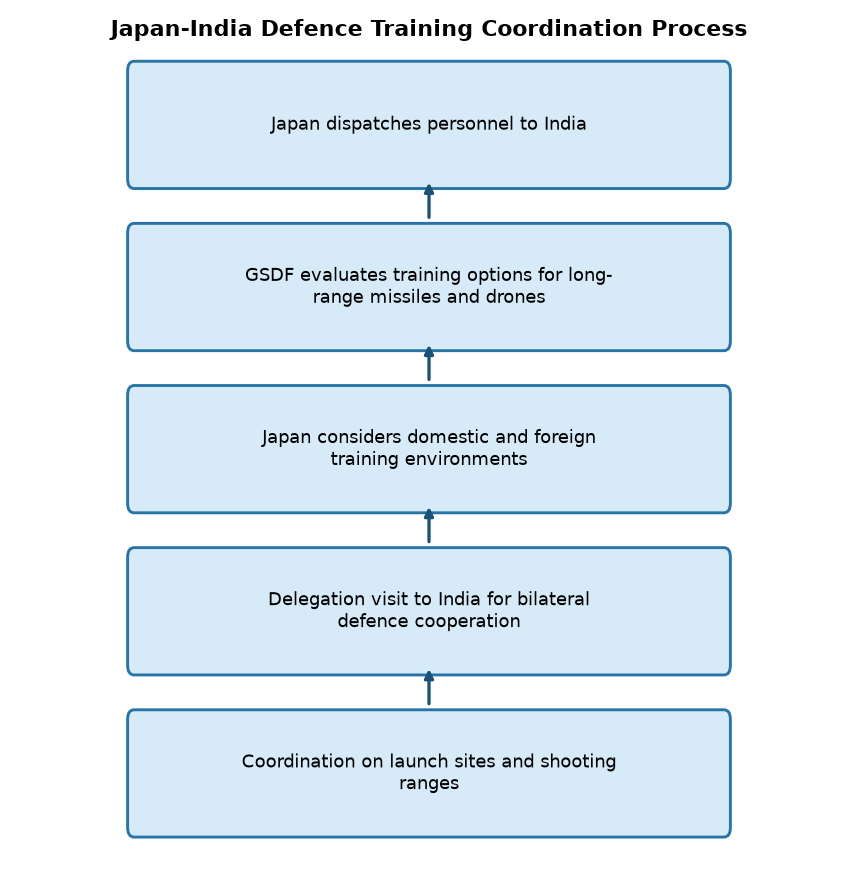
Japan’s strategic shift toward long-range strike capabilities → Requires realistic training environments → Explores overseas training options → Identifies India as a viable partner → Initiates personnel deployment for coordination → Conducts delegation visit to study India’s defence ecosystem → Enhances bilateral defence cooperation → Strengthens Indo-Pacific security architecture
Prelims Practice Questions
Q1. Consider the following statements regarding the Japan Ground Self-Defense Force (GSDF) and its recent engagements:
1. The GSDF has dispatched personnel to India to explore training options for long-range surface-to-ship missiles (SSM).
2. The GSDF’s SSM has a range of approximately 1,000 km.
3. The GSDF delegation visited India to interact exclusively with the Indian Navy.
How many of the above statements are correct?
- Only one
- Only two
- All three
- None
Answer: Only two — Statements 1 and 2 are correct as per the report. Statement 3 is incorrect because the delegation interacted with the Indian Army and DRDO, not exclusively the Indian Navy.
Q2. Assertion (A): Japan is exploring India-based training for its long-range missiles and attack drones due to the strategic importance of the Indo-Pacific region.
Reason (R): India’s defence capabilities and technological advancements, such as those showcased by DRDO and CLAWS, make it a suitable partner for Japan’s defence training needs.
- Both A and R are true, and R is the correct explanation of A
- Both A and R are true, but R is NOT the correct explanation of A
- A is true, but R is false
- A is false, but R is true
Answer: Both A and R are true, and R is the correct explanation of A — Both A and R are true, and R correctly explains A. Japan’s focus on the Indo-Pacific and India’s defence capabilities are the primary reasons for the exploration of training options in India.
Q3. Match the following Japanese defence entities with their corresponding Indian counterparts based on recent engagements:
Column I (Japanese Entity)
A. Japan Ground Self-Defense Force (GSDF)
B. Defence Research and Development Organisation (DRDO)
C. Centre for Land Warfare Studies (CLAWS)
D. Wargame Research and Development Centre (WARDEC)
Column II (Indian Entity)
1. Conducts joint military exercises and wargaming
2. Focuses on land warfare studies and strategic analysis
3. Engages in defence research and development
4. Operates long-range surface-to-ship missiles
- A-4, B-3, C-2, D-1; A-1, B-2, C-3, D-4; A-3, B-1, C-4, D-2; A-2, B-4, C-1, D-3
- answer_match_pair_indexes_to_options_indexes_0: [0, 1, 2, 3]
- explain_match_pair_indexes_to_options_indexes_0:
Answer: A-4, B-3, C-2, D-1; A-1, B-2, C-3, D-4; A-3, B-1, C-4, D-2; A-2, B-4, C-1, D-3 —
Mains Practice Question
✍ The Indo-Pacific security architecture is increasingly shaped by strategic partnerships between like-minded nations. In this context, critically examine the significance of India-Japan defence cooperation, particularly focusing on joint military training, technology transfer, and the role of institutions like DRDO, CLAWS, and WARDEC. (15 Marks)
Approach: MODEL-ANSWER SKELETON:
1. **Strategic Significance of the Indo-Pacific**:
– Define the Indo-Pacific as a geopolitical construct and its relevance to global security.
– Highlight the Quadrilateral Security Dialogue (Quad) and Japan-India’s role within it.
2. **India-Japan Defence Cooperation**:
– **Military-to-Military Exchanges**: Reference the recent GSDF delegation visit to India (October 2026) and its interactions with the Indian Army and DRDO.
– **Joint Training and Technology Transfer**: Discuss the exploration of India-based training for long-range missiles (SSM) and attack drones, including the 1,000 km range challenge and the need for suitable training environments.
– **Defence Logistics Agreement (LEMOA)**: Mention the foundational agreements that facilitate such cooperation.
3. **Role of Key Institutions**:
– **DRDO**: India’s premier defence research body; highlight its role in indigenous missile development and technological advancements.
– **CLAWS**: Centre for Land Warfare Studies; focus on land warfare research, strategic analysis, and wargaming.
– **WARDEC**: Wargame Research and Development Centre; discuss its role in developing simulation-based training and strategic decision-making tools.
4. **Challenges and Limitations**:
– **Operational Constraints**: Discuss the logistical and legal challenges in conducting joint training for long-range missiles and drones.
– **Policy and Regulatory Hurdles**: Reference India’s defence export policies and Japan’s pacifist constitution.
– **Balancing Strategic Autonomy**: Address India’s policy of strategic autonomy and its implications for defence partnerships.
5. **Broader Implications for India’s Defence Modernisation**:
– Discuss how such partnerships contribute to India’s defence modernisation goals, including indigenisation (e.g., Make in India) and self-reliance (Atmanirbhar Bharat).
– Highlight the potential for defence exports from India to Japan and other partners.
6. **Conclusion**:
– Summarise the strategic importance of India-Japan defence cooperation in the context of the Indo-Pacific.
– Provide a balanced view: while the partnership is significant, challenges remain in fully realising its potential.
Source: orissapost.com
Generated by AanyaAi for educational purpose.
Related guides on our sites
- How to prepare for GS paper 1 for UPSC CSE mains exam
- Best UPSC coaching for IFOS exam
- Best mentorship programme for upsc
- UPSC+BA degree

- Cyclone Arnab: How Storms Get Their Names in UPSC Geography - October 28, 2026
- भारत ने पाकिस्तान को एससीओ बैठक में किया आमंत्रित, पूर्वी तट पर चक्रवात अरनब से हाहाकार - October 28, 2026
- INS Sahyadri reaches Busan for India-Republic of Korea naval exercise - October 28, 2026

No Comments