


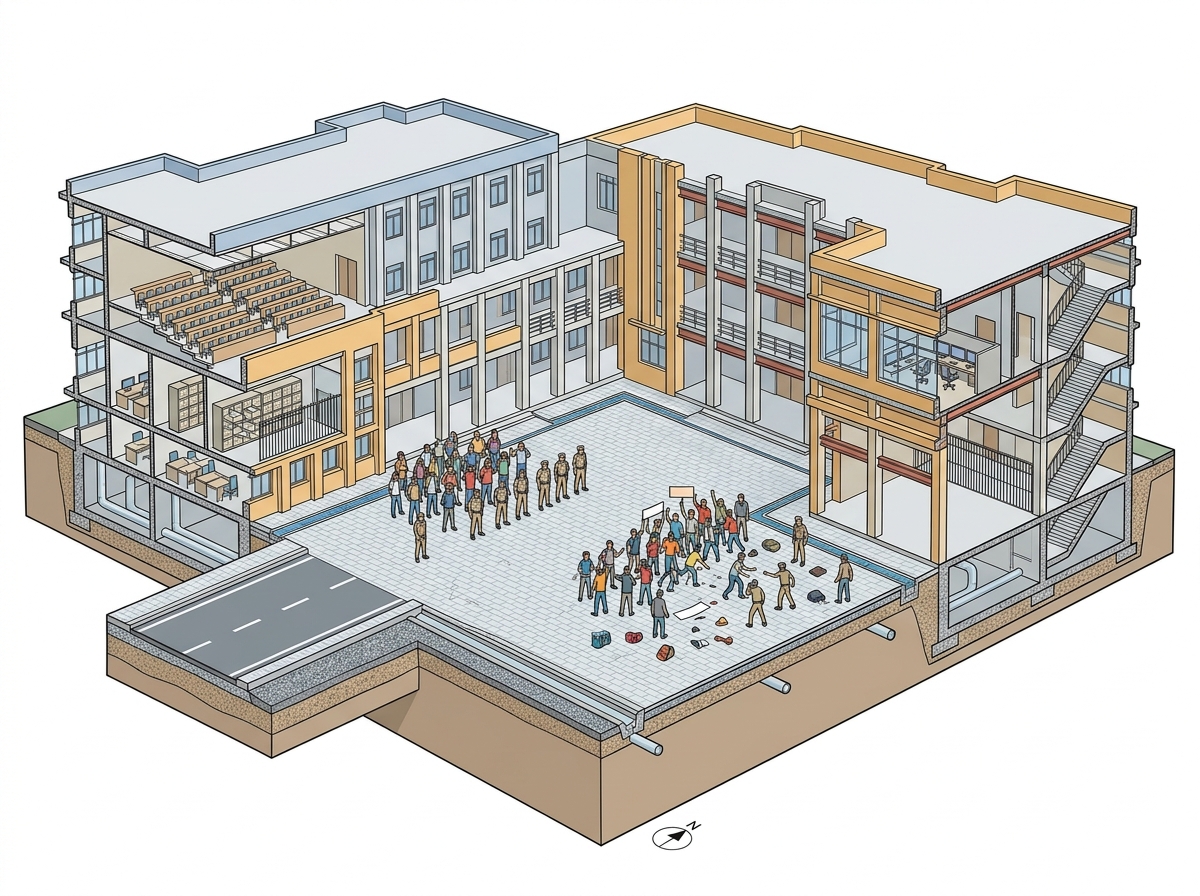
11 Aug Jharkhand Police Lathi Charge: JPSC/JSSC Protests & ED Probe Explained for UPSC
✎ The Jharkhand student agitation centres on allegations of malpractice in JPSC and JSSC examinations, with the Enforcement Directorate probing financial discrepancies under the PMLA, 2002, while invoking Article 19(1)(a) of the…
Subject Relevance — Where This Topic Fits
- GS Paper II — Functions and Responsibilities of the Union and the States, Issues and Challenges pertaining to the Federal Structure | GS Paper III — Issues related to Direct and Indirect Farm Subsidies and Minimum Support Prices, Issues of Transparency in Government
- Prelims: Enforcement Directorate (ED), Jharkhand Public Service Commission (JPSC), Jharkhand Staff Selection Commission (JSSC), Section 144 of the Code of Criminal Procedure (CrPC), Right to Protest under Article 19(1)(a)
- Essay: The Role of Democratic Protests in a Constitutional Framework, Balancing Law and Order with Fundamental Rights
Quick Revision: The Jharkhand student agitation centres on allegations of malpractice in JPSC and JSSC examinations, with the Enforcement Directorate probing financial discrepancies under the PMLA, 2002, while invoking Article 19(1)(a) of the Constitution to frame the legal and constitutional dimensions of the crisis.
Why is this in the news?
Recent lathi-charge incidents during a prolonged student agitation in Ranchi over alleged irregularities in JPSC and JSSC recruitment examinations have drawn national attention, coinciding with the initiation of Enforcement Directorate (ED) investigations into financial discrepancies linked to the state government. The episode underscores the intersection of administrative accountability, law-and-order management, and constitutional rights during mass demonstrations.
Background
- Jharkhand has witnessed sustained student protests for over two weeks, centred on allegations of malpractice in competitive examinations conducted by JPSC and JSSC.
- The agitation escalated following a reported lathi-charge by police on students attempting to surround the Jharkhand State Assembly, invoking concerns over disproportionate use of force and the right to peaceful protest.
- The Enforcement Directorate (ED), a central agency under the Department of Revenue, Ministry of Finance, initiated a probe into alleged financial irregularities in the state government, as per provisions under the Prevention of Money Laundering Act, 2002, raising questions about federal oversight and state autonomy.
- The protest has drawn attention to systemic issues in public sector recruitment, including transparency deficits in examination processes and the need for institutional safeguards against malpractice.
- The episode reflects broader challenges in balancing administrative efficiency with democratic dissent, a recurring theme in India’s constitutional jurisprudence.
What is the Jharkhand Student Agitation and Enforcement Directorate Probe?
- The agitation in Ranchi involves thousands of youth, primarily aspirants for JPSC and JSSC examinations, demanding investigations into alleged irregularities in recruitment processes and the cancellation of recently conducted examinations.
- The Enforcement Directorate (ED) probe, initiated under the Prevention of Money Laundering Act, 2002, focuses on financial discrepancies linked to the state government, including potential misappropriation of public funds, as per central government directives.
- The Jharkhand Public Service Commission (JPSC) and Jharkhand Staff Selection Commission (JSSC) are statutory bodies established under state legislation, responsible for conducting recruitment examinations for civil services and subordinate posts in the state.
- The right to protest is constitutionally protected under Article 19(1)(a) of the Indian Constitution, subject to reasonable restrictions in the interest of public order, sovereignty, and integrity of India.
- The agitation has also highlighted the role of student unions and political parties in mobilising support, with demands for a Central Bureau of Investigation (CBI) probe into the recruitment irregularities.
- The episode reflects the tension between state autonomy in administrative matters and the central government’s oversight role, particularly in cases involving financial irregularities or public order concerns.
Key Features
| Feature | Significance |
|---|---|
| Student agitation in Ranchi | Highlights systemic irregularities in JPSC/JSSC recruitment processes, reflecting broader governance failures in competitive examination systems. |
| Lathi-charge by police | Demonstrates the state’s response to dissent, raising questions about proportionality and adherence to lawful protest norms under the Indian Penal Code and Police Acts. |
| ED probe initiation | Signals central investigative oversight into alleged financial irregularities, potentially intersecting with state-level administrative lapses. |
| Political polarisation | Illustrates the intersection of governance failures with electoral politics, where opposition and ruling parties frame the issue to align with their narratives. |
| Health impact on agitators | Underscores the humanitarian dimension of prolonged protests, particularly the physical toll on participants engaged in hunger strikes. |
Why it Matters
Governance and Accountability
- Exposes systemic deficiencies in public sector recruitment examinations, necessitating structural reforms in JPSC and JSSC to restore public trust.
- Highlights the role of investigative agencies (ED) in scrutinising administrative lapses, particularly in financial and procedural compliance.
- Raises questions about the efficacy of state-level grievance redressal mechanisms for competitive examination aspirants.
Law and Order
- Demonstrates the state’s use of coercive measures (lathi-charge) to manage protests, necessitating a review of police protocols for crowd control.
- Examines the balance between maintaining public order and safeguarding citizens’ right to peaceful protest under Article 19(1)(a) of the Constitution.
- Highlights the potential for escalation in civil unrest when grievances remain unaddressed, particularly among youth populations.
Political and Electoral Implications
- Illustrates how governance failures in recruitment examinations can become electoral issues, influencing voter sentiment and party strategies.
- Demonstrates the polarising effect of such crises on political discourse, with parties framing the issue to align with their electoral narratives.
- Underscores the role of opposition parties in amplifying grievances to challenge the ruling dispensation’s legitimacy.
Human Rights and Social Justice
- Highlights the health risks faced by protestors engaged in prolonged hunger strikes, raising ethical questions about state response to dissent.
- Examines the disproportionate impact of governance failures on socio-economically marginalised youth seeking upward mobility through competitive examinations.
Challenges
1. Systemic Irregularities in Recruitment Examinations
- Allegations of paper leaks and procedural lapses in JPSC/JSSC examinations undermine the integrity of the recruitment process.
- Lack of transparent investigation mechanisms erodes public confidence in state-level institutions.
- Delays in addressing grievances exacerbate youth disillusionment, potentially leading to long-term socio-political instability.
UPSC Link: GS-II: Role of Constitutional Bodies
2. Police Response to Protests
- Use of lathi-charge and force against protestors raises concerns about proportionality and adherence to the Code of Criminal Procedure.
- Potential violation of fundamental rights under Article 19(1)(a) (freedom of speech) and Article 21 (right to life and dignity).
- Risk of escalation into larger law-and-order crises if grievances remain unaddressed.
UPSC Link: GS-III: Security Challenges
3. Central-State Investigative Coordination
- Overlap between state-level administrative failures and central investigative agencies (ED) may lead to jurisdictional conflicts.
- Need for clear protocols to ensure investigative agencies operate within constitutional and statutory boundaries.
- Risk of politicisation of investigations, undermining public trust in institutional impartiality.
UPSC Link: GS-II: Centre-State Relations
4. Political Polarisation and Governance
- Governance failures in recruitment examinations are being framed as political issues, diverting attention from structural reforms.
- Parties may exploit the crisis for electoral gains, delaying substantive solutions to systemic problems.
- Risk of normalising governance failures as routine political contests rather than addressing root causes.
UPSC Link: GS-II: Pressure Groups
5. Humanitarian Impact on Agitators
- Prolonged hunger strikes and police action pose severe health risks to protestors, raising ethical and legal concerns.
- State’s response to dissent must balance law-and-order imperatives with humanitarian considerations.
- Potential for long-term psychological and physical harm to youth engaged in protests.
UPSC Link: GS-IV: Ethics in Governance
Challenges — UPSC Perspective
| Issue | Concern |
|---|---|
| Allegations of examination irregularities | Undermines meritocracy and public trust in state institutions. |
| Police use of force during protests | Raises questions about proportionality and adherence to legal norms. |
| Central investigative oversight (ED) | Potential for jurisdictional conflicts and politicisation of investigations. |
| Political polarisation over governance failures | Risk of delaying substantive reforms in favour of electoral narratives. |
| Health risks to protestors | Ethical and legal concerns regarding state response to dissent. |
| Lack of transparent grievance redressal | Exacerbates youth disillusionment and potential for further unrest. |
Way Forward
- Constitute an independent high-powered committee to investigate allegations of examination irregularities in JPSC/JSSC, with representation from state and central agencies.
- Review and strengthen police protocols for crowd control, ensuring adherence to the Model Police Manual and Supreme Court guidelines on use of force.
- Establish a time-bound grievance redressal mechanism for competitive examination aspirants, with provisions for interim relief.
- Enhance transparency in recruitment processes by adopting technology-driven solutions (e.g., AI-based monitoring, blockchain for answer sheets) to prevent malpractices.
- Promote dialogue between student leaders, administrative authorities, and political stakeholders to address grievances through constitutional means.
- Conduct a socio-economic impact assessment of governance failures on youth, particularly marginalised sections, to inform policy corrections.
- Strengthen institutional checks and balances by empowering the Jharkhand Public Service Commission and Jharkhand Staff Selection Commission with greater autonomy and accountability.
- Encourage state governments to adopt a rights-based approach to protest management, prioritising dialogue over coercion.
UPSC Value Addition
Keywords for Mains Answer-Writing
Competitive examination reforms · Federal policing agencies · Right to peaceful assembly · Protest policing and public order · Enforcement Directorate powers · State-ED coordination · Public Service Commission accountability · Administrative law and protest management · Constitutional rights vs public order · Youth mobilisation and governance · Lathi charge and proportionality · Civil service recruitment integrity · Article 19(1)(a) and reasonable restrictions · Jharkhand PSC and SSC recruitment · Centre-State relations in law enforcement
Constitutional & Policy Linkages
- Article 19(1)(a): Freedom of speech and expression, relevant to the right to protest.
- Article 21: Right to life and personal liberty, including protection from excessive state force.
- Article 32: Writ jurisdiction of the Supreme Court for enforcement of fundamental rights.
- Seventh Schedule: Division of powers between the Union and States in matters of public order and police.
Concept Flow
Allegations of examination irregularities in JPSC/JSSC → Public outrage and student protests → Police response (lathi-charge) → Escalation of civil unrest → Initiation of ED probe → Political polarisation → Governance crisis → Calls for structural reforms.
Prelims Practice Questions
Q1. Consider the following statements regarding the powers of the Enforcement Directorate (ED) under the Prevention of Money Laundering Act (PMLA), 2002:
1. The ED can conduct search and seizure operations without prior judicial warrant.
2. The ED is empowered to arrest any person accused of money laundering without informing the accused of the grounds of arrest.
3. The ED can provisionally attach properties involved in money laundering for a maximum period of 180 days.
How many of the above statements are correct?
- Only one
- Only two
- All three
- None
Answer: All three — Statement 1 is incorrect: The ED requires a warrant or prior approval from the competent authority for search and seizure operations. Statement 2 is incorrect: The ED must inform the accused of the grounds of arrest at the time of arrest. Statement 3 is correct: The ED can provisionally attach properties for a maximum period of 180 days.
Q2. Assertion (A): The right to peaceful assembly under Article 19(1)(a) of the Constitution of India is subject to reasonable restrictions imposed by the State in the interest of public order.
Reason (R): The State may impose restrictions on the right to assembly if it anticipates breach of peace or public disorder, even if no actual breach has occurred.
- Both A and R are true and R is the correct explanation of A
- Both A and R are true but R is NOT the correct explanation of A
- A is true but R is false
- A is false but R is true
Answer: Both A and R are true but R is NOT the correct explanation of A — Both the assertion and reason are correct. The right to peaceful assembly is guaranteed under Article 19(1)(a), but it is subject to reasonable restrictions imposed by the State in the interest of public order, sovereignty, and integrity of India, as outlined in Article 19(3).
Q3. Match the following provisions of the Constitution of India with their respective articles:
Column I (Provision)
A. Right to freedom of speech and expression
B. Right to assemble peacefully and without arms
C. Right to form associations or unions
D. Right to move freely throughout the territory of India
Column II (Article Number)
1. Article 19(1)(a)
2. Article 19(1)(b)
3. Article 19(1)(c)
4. Article 19(1)(d)
- A-1, B-2, C-3, D-4
- A-2, B-1, C-4, D-3
- A-3, B-4, C-1, D-2
- A-4, B-3, C-2, D-1
Answer: A-1, B-2, C-3, D-4 — The correct matching is: A-1 (Article 19(1)(a)), B-2 (Article 19(1)(b)), C-3 (Article 19(1)(c)), D-4 (Article 19(1)(d)).
Mains Practice Question
✍ The policing of protests in India often raises questions about the balance between the right to peaceful assembly (Article 19(1)(a)) and the maintenance of public order. In the context of recent student-led protests in Jharkhand, critically examine the constitutional and statutory framework governing protest policing. Also, analyse the role of federal agencies like the Enforcement Directorate in such scenarios. (15 Marks)
Approach: MODEL-ANSWER SKELETON:
1. **Constitutional Framework**:
– Article 19(1)(a) guarantees the right to freedom of speech and expression, including the right to peaceful assembly.
– Reasonable restrictions under Article 19(3) allow the State to impose limitations in the interest of public order, morality, and sovereignty.
– Landmark judgments: *Himat Lal K. Shah v. Commissioner of Police (1973)* (right to assemble peacefully), *Babulal Parate v. State of Maharashtra (1961)* (reasonable restrictions).
2. **Statutory Framework**:
– The Code of Criminal Procedure (CrPC), 1973, empowers the police to regulate assemblies under Sections 129–132 (dispersal of unlawful assemblies).
– The Police Act, 1861, and state-specific police regulations govern protest policing.
– The Prevention of Damage to Public Property Act, 1984, and the Unlawful Activities (Prevention) Act, 1967, may apply in cases of violence.
3. **Protest Policing Practices**:
– Principles of proportionality and necessity in use of force (as per *Prakash Singh v. Union of India*, 2006, and *Common Cause v. Union of India*, 2017).
– Role of district magistrates and police commissioners in granting or denying permission for assemblies.
– Case study: Lathi charge in Ranchi (2026) — whether force was proportionate to the threat posed.
4. **Role of Federal Agencies**:
– Enforcement Directorate (ED) powers under the PMLA, 2002: investigation into financial irregularities in recruitment processes (e.g., Jharkhand PSC/SSC).
– Centre-State coordination in investigations: Article 256 (duty of States to ensure compliance with Union laws) and Article 257 (power of Union to give directions).
– Concerns about overreach: *Vineet Narain v. Union of India (1998)* (independence of investigative agencies).
5. **Accountability and Reform**:
– Need for independent oversight mechanisms (e.g., Police Complaints Authority under *Prakash Singh v. Union of India*).
– Role of the judiciary in reviewing police actions (e.g., *Shreya Singhal v. Union of India*, 2015, on free speech).
– Recommendations of the Second Administrative Reforms Commission (2005) on protest management.
6. **Balancing Rights and Order**:
– The State’s duty to facilitate peaceful protest vs. its obligation to prevent violence.
– Lessons from international frameworks (e.g., UN Human Rights Committee General Comment No. 34 on Article 19).
**Concluding Perspective**:
– The Ranchi incident highlights the need for a nuanced approach that respects constitutional rights while ensuring public order. The involvement of federal agencies like the ED underscores the intersection of law enforcement, governance, and accountability in competitive examination reforms.
Source: amarujala.com
Generated by AanyaAi for educational purpose.

- KWML’s Feasibility Reports for Water Metro in 18 Cities: UPSC & PCS Insights - October 3, 2026
- ओडिशा में वन्यजीव अनुसंधान अनुदान कार्यक्रम शुरू, सिमिलिपाल में 300 कैमरे और बढ़ेंगे - October 3, 2026
- India Summons Pakistan High Commission Official Over Violation - October 3, 2026

No Comments