


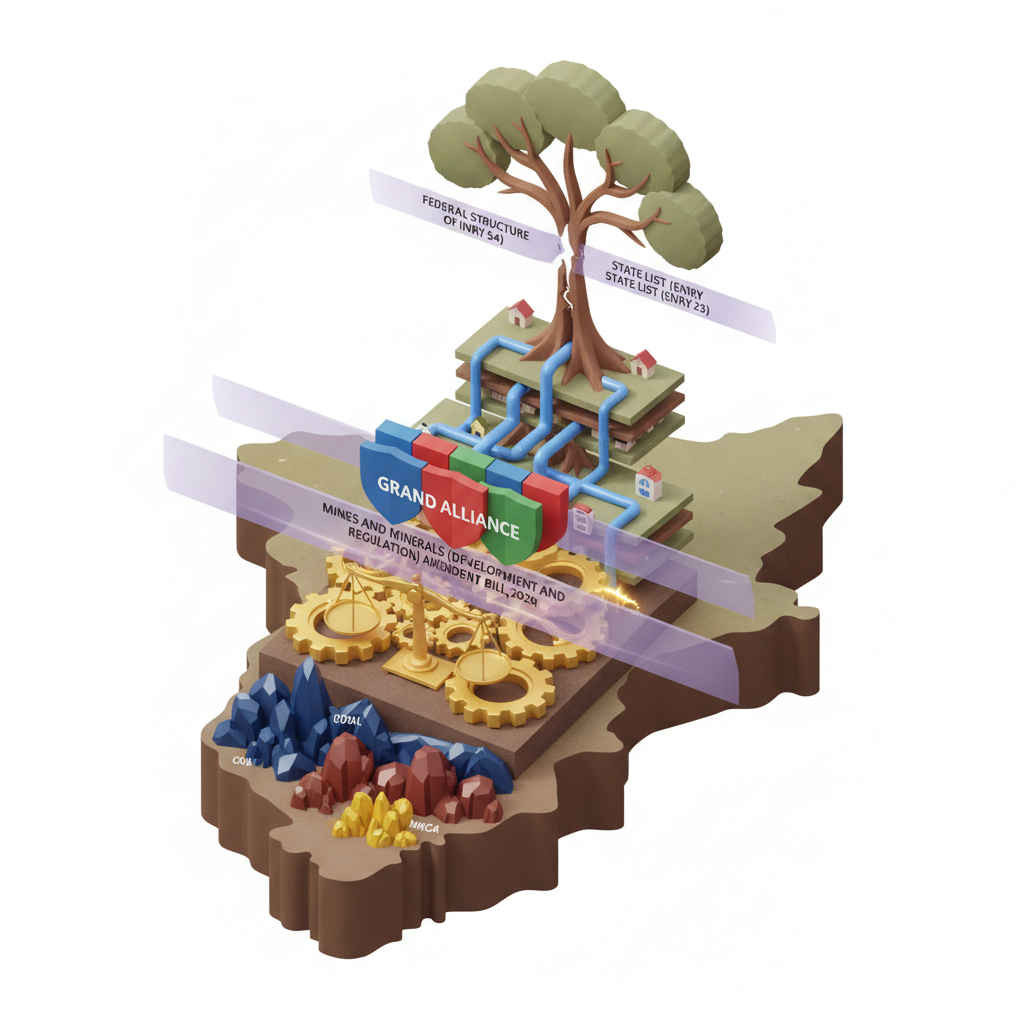
17 Aug Jharkhand’s Opposition to Mines Amendment Bill 2026: A Federal Rights Battle
Mines and Minerals ActState ListFederal structure✎ The Mines and Minerals (Development and Regulation) Amendment Bill, 2026, raises critical questions about the balance between centralisation and state autonomy in mineral resource governance, with implications for fiscal…
Subject Relevance — Where This Topic Fits
- GS Paper II — Polity: Federalism, Constitutional Provisions, and Centre-State Relations | GS Paper III — Economy: Resource Mobilisation, Taxation, and Public Finance
- Prelims: Federalism, Mines and Minerals (Development and Regulation) Act, 1957, Concurrent List, Union List, State List, Article 246, Article 268, Article 293, Supreme Court’s constitutional bench rulings on federalism, Compensatory Afforestation Fund Management and Planning Authority (CAMPA), National Mineral Exploration Policy
- Essay: Federalism: Unity in Diversity vs. Centralisation, Resource Nationalism and Sustainable Development
Quick Revision: The Mines and Minerals (Development and Regulation) Amendment Bill, 2026, raises critical questions about the balance between centralisation and state autonomy in mineral resource governance, with implications for fiscal federalism and sustainable development.
Why is this in the news?
The Jharkhand Grand Alliance has organised a joint press conference opposing the Mines and Minerals (Development and Regulation) Amendment Bill, 2026, alleging that it encroaches upon the constitutional and fiscal rights of states, particularly their authority to levy taxes and royalties on mineral resources. The controversy centres on the Bill’s potential to dilute state powers over mineral revenue, which could impact social welfare schemes and the federal structure of India.
Background
- The Mines and Minerals (Development and Regulation) Act, 1957 (MMDR Act) governs the regulation of mines and minerals in India, with the Union List (Entry 54) and State List (Entry 23) delineating legislative and administrative jurisdictions.
- States like Jharkhand, Odisha, and Chhattisgarh, rich in mineral resources, derive significant revenue from royalties, taxes, and other levies on mining activities, which fund social welfare and development programmes.
- In 2024, a nine-judge Constitution Bench of the Supreme Court of India reaffirmed the constitutional right of states to levy taxes and royalties on mineral-bearing lands, reinforcing the principle of fiscal federalism.
- The proposed amendment seeks to centralise certain aspects of mineral resource management, raising concerns about the erosion of state autonomy in revenue generation and policy-making.
- The MMDR Act has undergone multiple amendments (e.g., 2015, 2021) to align with evolving economic and environmental priorities, but the 2026 amendment has triggered a federalism debate.
What is the Mines and Minerals (Development and Regulation) Amendment Bill, 2026?
- The Bill seeks to amend the MMDR Act, 1957, to introduce provisions that may centralise certain aspects of mineral resource regulation, including royalty fixation, auction mechanisms, and environmental clearances.
- It proposes to empower the Central Government to intervene in mineral-related disputes between states and private entities, potentially limiting state discretion in resolving such conflicts.
- The Bill may introduce a uniform national framework for mineral auctions, reducing the autonomy of state governments in designing auction policies tailored to local socio-economic conditions.
- Critics argue that the Bill could restrict states’ ability to levy additional taxes or royalties on minerals, thereby constraining their fiscal space for welfare and development expenditures.
- The Bill is framed within the broader discourse on sustainable mining, with provisions aimed at promoting responsible resource extraction and reducing environmental degradation.
- The Union Government’s rationale for the amendment includes enhancing transparency, reducing litigation, and ensuring equitable resource distribution across states, though these objectives are contested.
- The Bill has sparked a debate on the balance between national resource security and state autonomy, with stakeholders emphasising the need for cooperative federalism.
- Legal experts highlight that the Bill’s provisions must align with the Supreme Court’s rulings on federalism and the constitutional division of powers to avoid judicial scrutiny.
Key Features
| Feature | Significance |
|---|---|
| Constitutional division of powers (Article 246 and Seventh Schedule) | Establishes the legal framework for legislative competence between the Union and States in mineral resource governance. |
| Supreme Court’s 2024 Constitution Bench ruling (W.P.(C) No. 114 of 2022) | Reaffirmed states’ exclusive authority to levy taxes, duties, and cesses on mineral-bearing lands, reinforcing federal autonomy. |
| Mines and Minerals (Development and Regulation) Amendment Bill, 2026 | Proposes centralised regulatory mechanisms that may encroach upon state prerogatives in mineral resource management. |
| State revenue from mineral royalties and cess | Primary fiscal instrument for resource-rich states like Jharkhand to fund welfare schemes and developmental expenditures. |
| Cooperative federalism (Article 263, Inter-State Council) | Doctrine guiding Centre-State relations; requires mutual respect for institutional autonomy in resource governance. |
Why it Matters
Economic Implications
- Mineral-rich states like Jharkhand derive 20-30% of their revenue from mineral royalties and cess, critical for social welfare schemes such as MNREGA and PM-KISAN.
Fiscal Federalism
- Centralisation risks erosion of state fiscal autonomy, potentially leading to revenue shortfalls in resource-dependent regions.
Strategic Resource Governance
- Minerals such as coal, iron ore, and bauxite are vital for India’s industrial and energy security, necessitating balanced Centre-State coordination.
Judicial Precedent
- The 2024 Supreme Court ruling (W.P.(C) No. 114 of 2022) sets a binding precedent that any amendment must not violate the constitutional division of powers.
Welfare Impact
- Reduction in state revenue from minerals could directly affect funding for schemes like MUKHYA MANTRI SANMAN YOJANA, impacting marginalised communities.
Challenges
1. Constitutional Validity of Centralised Regulation
- The Amendment Bill may face judicial scrutiny under Article 246 and the Seventh Schedule, risking legal invalidation if it oversteps Centre’s legislative competence.
UPSC Link: GS-II: Federalism
2. Fiscal Divergence and State Revenue Loss
- Resource-rich states may face revenue erosion, exacerbating fiscal imbalances and widening inter-state disparities in developmental outcomes.
UPSC Link: GS-III: Resource Mobilisation
3. Implementation and Compliance Burden
- Centralised regulatory mechanisms could impose administrative complexities, delaying mineral extraction and revenue generation for states.
UPSC Link: GS-II: Governance
4. Political Consensus and Centre-State Relations
- Lack of consensus between Centre and states may lead to policy paralysis, undermining cooperative federalism and economic stability.
UPSC Link: GS-II: Federalism
5. Judicial Overreach vs. Legislative Competence
- The Supreme Court’s 2024 ruling may be invoked to challenge the Amendment Bill, raising questions about judicial vs. legislative supremacy in resource governance.
UPSC Link: GS-II: Separation of Powers
Challenges — UPSC Perspective
| Issue | Concern |
|---|---|
| Centralisation of mineral regulation | Erosion of state autonomy in resource governance and revenue collection. |
| Potential legal challenge under Article 246 | Risk of judicial invalidation if the Amendment Bill exceeds Centre’s legislative competence. |
| Revenue loss for mineral-rich states | Direct impact on state budgets, affecting welfare schemes and developmental expenditures. |
| Administrative delays in mineral extraction | Centralised processes may slow down project approvals and revenue generation. |
| Political friction between Centre and states | Lack of consensus may hinder policy implementation and economic planning. |
| Judicial scrutiny of federal balance | Supreme Court’s 2024 ruling may be used to test the Amendment Bill’s constitutional validity. |
Way Forward
- Convene an Inter-State Council meeting under Article 263 to deliberate on Centre-State concerns regarding mineral governance and fiscal federalism.
- Incorporate state representatives in the drafting and review process of the Mines and Minerals Amendment Bill, 2026 to ensure cooperative federalism.
- Establish a constitutional bench of the Supreme Court to clarify the division of powers in mineral resource governance, if disputes arise.
- Develop a revenue-sharing mechanism between Centre and states for mineral-rich regions to mitigate fiscal imbalances.
- Enhance capacity-building initiatives for state governments in mineral resource management and revenue administration.
- Promote multi-stakeholder consultations with industry, civil society, and local communities to balance economic growth and environmental sustainability.
- Strengthen the role of the National Mineral Exploration Policy (NMEP) in facilitating Centre-State collaboration without infringing on state rights.
UPSC Value Addition
Keywords for Mains Answer-Writing
Mines and Minerals (Development and Regulation) Amendment Bill 2026 · federalism · State List (Seventh Schedule) · Article 246 · cooperative federalism · mineral revenue · Supreme Court constitutional bench · seventh schedule distribution of powers · fiscal federalism · mineral taxation powers · federal structure of India · Union-State relations · mineral rights · taxation powers of States · intergovernmental fiscal relations
Constitutional & Policy Linkages
- {‘Article 246 (Distribution of Legislative Powers) and Seventh Schedule (Union, State, Concurrent Lists)’: ‘Defines Centre-State legislative competence over minerals.’}
- {‘Article 263 (Inter-State Council)’: ‘Facilitates Centre-State coordination in resource governance.’}
- {‘Article 280 (Finance Commission)’: ‘Determines principles for revenue sharing between Centre and states.’}
- {‘Article 300A (Right to Property)’: ‘Protects states’ ownership of mineral-bearing lands.’}
Concept Flow
Supreme Court’s 2024 ruling on states’ mineral rights → Centre introduces Mines and Minerals Amendment Bill, 2026 → States oppose Bill citing erosion of constitutional rights → Legal and fiscal implications emerge → Centre-State dialogue required under cooperative federalism → Potential judicial review or constitutional amendment to resolve disputes
Prelims Practice Questions
Q1. Consider the following statements regarding the distribution of legislative powers between the Union and the States in India:
1. The Union List includes subjects on which only Parliament can make laws.
2. The State List includes subjects on which only State Legislatures can make laws.
3. The Concurrent List includes subjects on which both Parliament and State Legislatures can make laws.
4. The residuary powers of legislation are vested exclusively with the Parliament under Article 248.
How many of the above statements are correct?
- Only one
- Only two
- Only three
- All
Answer: All — Statements 1, 2, and 3 are correct as per the Seventh Schedule of the Constitution. Statement 4 is incorrect because residuary powers are vested in Parliament under Article 248, but they are not exclusive; residual subjects can also be legislated upon by State Legislatures if not covered under Union or Concurrent Lists.
Q2. Assertion (A): The Supreme Court of India, in a Constitution Bench judgment, held that States possess constitutional power to levy taxes and cess on minerals.
Reason (R): This power is derived from the State List under the Seventh Schedule of the Constitution.
Options:
- Both A and R are true and R is the correct explanation of A.
- Both A and R are true but R is not the correct explanation of A.
- A is true but R is false.
- A is false but R is true.
Answer: Both A and R are true and R is the correct explanation of A. — Both the Assertion and Reason are true. The Supreme Court, in its 2024 judgment, affirmed that States have the constitutional power to levy taxes and cess on minerals, which is derived from the State List (Entry 50) under the Seventh Schedule.
Q3. Match the following entries from the Seventh Schedule of the Indian Constitution with their respective lists:
Column I (Entries)
A. Industries
B. Regulation of mines and mineral development
C. Taxes on mineral rights
D. Trade and commerce
Column II (Lists)
1. Union List
2. State List
3. Concurrent List
Options:
- A-3, B-2, C-2, D-1
- A-1, B-2, C-2, D-3
- A-3, B-1, C-2, D-1
- A-2, B-3, C-1, D-2
Answer: A-1, B-2, C-2, D-3 — A. Industries — Concurrent List (Entry 33); B. Regulation of mines and mineral development — State List (Entry 50); C. Taxes on mineral rights — State List (Entry 50); D. Trade and commerce — Concurrent List (Entry 42).
Mains Practice Question
✍ The proposed Mines and Minerals (Development and Regulation) Amendment Bill, 2026 seeks to centralise regulatory and fiscal powers over minerals, thereby encroaching upon the constitutional domain of States. Critically examine the constitutional validity of such centralisation in the context of India’s federal structure. Also, analyse the implications for fiscal federalism and cooperative governance. (15 Marks)
Approach: MODEL-ANSWER SKELETON:
1. **Constitutional Framework of Federalism** (2 marks):
– Seventh Schedule: Union List (Entry 54: regulation of mines and mineral development), State List (Entry 50: taxes on mineral rights), Concurrent List (Entry 23: trade and commerce).
– Article 246: Distribution of legislative powers.
– Cooperative federalism as a basic feature of the Constitution (S.R. Bommai v. Union of India).
2. **Judicial Precedents** (3 marks):
– Supreme Court’s 2024 Constitution Bench judgment affirming State’s power to levy taxes and cess on minerals (citing constitutional bench authority).
– Doctrine of federal supremacy vs. State autonomy (e.g., State of West Bengal v. Union of India).
3. **Proposed Amendment’s Impact** (4 marks):
– Centralisation of regulatory powers (licensing, auction, royalty fixation) under Entry 54.
– Potential conflict with State’s fiscal autonomy (Entry 50: taxes on mineral rights).
– Risk of undermining State revenue streams critical for welfare schemes (e.g., MNREGA, social sector spending).
4. **Fiscal Federalism Implications** (3 marks):
– Vertical imbalance: States’ dependence on mineral revenue for development and social welfare.
– Horizontal equity: Disparities in mineral endowments across States.
– Article 279A: GST Council as a model for cooperative fiscal governance.
5. **Balancing Views and Way Forward** (3 marks):
– Need for harmonised national policy vs. State autonomy.
– Recommendations: Consultative process with States, inclusion of State representatives in regulatory bodies, safeguarding State fiscal powers.
– Reference to NITI Aayog’s cooperative federalism framework.
Source: amarujala.com
Generated by AanyaAi for educational purpose.

- KWML’s Feasibility Reports for Water Metro in 18 Cities: UPSC & PCS Insights - October 3, 2026
- ओडिशा में वन्यजीव अनुसंधान अनुदान कार्यक्रम शुरू, सिमिलिपाल में 300 कैमरे और बढ़ेंगे - October 3, 2026
- India Summons Pakistan High Commission Official Over Violation - October 3, 2026

No Comments