


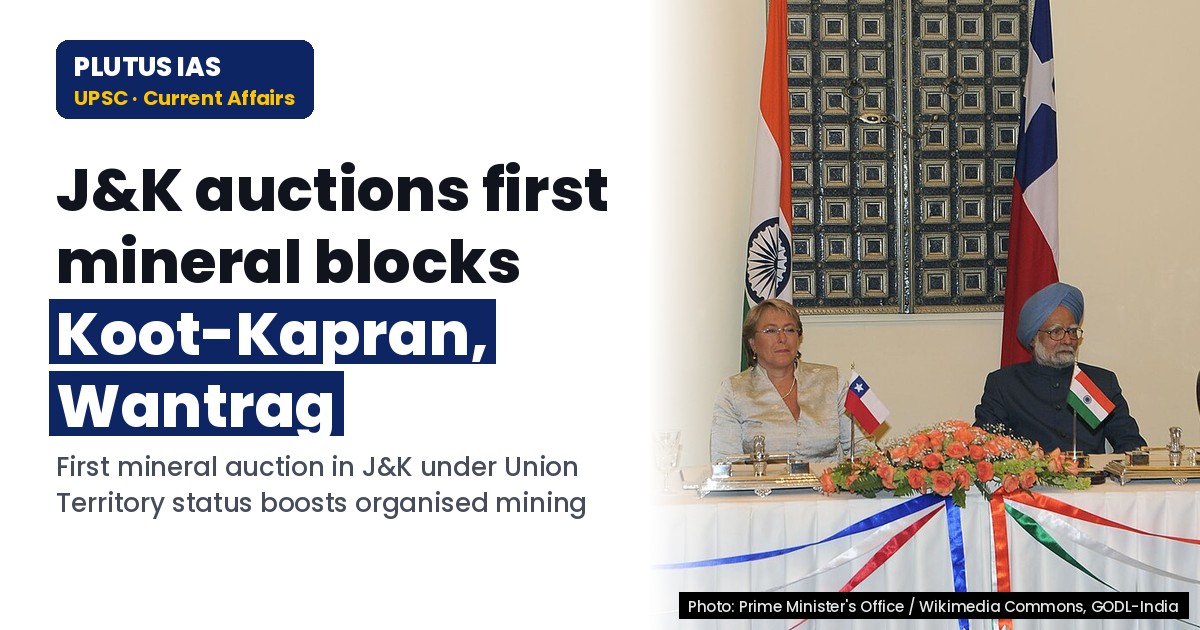
02 Oct J&K’s First Mineral Auction: Historic Milestone for UPSC & State PCS
✎ Mineral block auctions in Jammu & Kashmir represent a transition from unorganised mineral exploitation to a transparent, competitive, and sustainable mining regime, aligning with the National Mineral Exploration Policy and Union…
Subject Relevance — Where This Topic Fits
- GS Paper II — Governance, Constitution and Polity (Union Territories and their administrative evolution) | GS Paper III — Economic Development (Mineral Resources, Auction Mechanism, Employment Generation)
- Prelims: Mineral Concession Rules, 1960, National Mineral Exploration Policy (NMEP), Union Territory of Jammu & Kashmir, Article 239A, Geological Survey of India (GSI), Mineral Auction Process, Limestone reserves, Employment generation through mining
- Essay: Resource nationalism and sustainable development: Balancing economic growth with environmental conservation, The role of Union Territories in India’s federal economic framework
Quick Revision: Mineral block auctions in Jammu & Kashmir represent a transition from unorganised mineral exploitation to a transparent, competitive, and sustainable mining regime, aligning with the National Mineral Exploration Policy and Union Government’s infrastructure-led development strategy.
Why is this in the news?
The Ministry of Mines, Government of India, successfully auctioned two limestone blocks in the Union Territory of Jammu & Kashmir on 2 October 2026. This marks the first-ever mineral block auctions in the UT, signifying a paradigm shift from ad hoc mineral exploitation to a structured, transparent, and competitive auction-based development model. The initiative aligns with the Union Government’s broader strategy to integrate Jammu & Kashmir into India’s economic mainstream post the abrogation of Article 370, by leveraging its mineral endowment for infrastructure development, employment generation, and industrial growth.
Background
- Jammu & Kashmir was granted Union Territory status under Article 239A of the Constitution of India following the abrogation of Article 370 in August 2019, which necessitated a reorientation of its administrative and economic governance.
- The Union Territory is endowed with significant mineral resources, including limestone, gypsum, bauxite, and coal, but prior to 2026, mineral development remained largely unorganised and fragmented, with limited systematic exploration or exploitation.
- The National Mineral Exploration Policy (NMEP), 2016, introduced a framework for transparent and competitive mineral auctions to attract private investment and enhance resource efficiency.
- The Geological Survey of India (GSI) has conducted preliminary geological surveys in Jammu & Kashmir, identifying substantial limestone deposits in Anantnag district, but systematic exploration and commercial exploitation were hitherto absent.
- The Union Government’s focus on infrastructure development in Jammu & Kashmir, including the construction of the Z-Morh tunnel and the expansion of the railway network, has created a demand for locally sourced construction materials such as limestone.
What are mineral block auctions and why are they significant for Jammu & Kashmir?
- Mineral block auctions are a competitive bidding process conducted by the Union Government to allocate mineral-bearing areas (blocks) to private entities for exploration and mining, ensuring transparency, revenue maximisation, and optimal resource utilisation.
- The two limestone blocks auctioned in Jammu & Kashmir—the Koot-Kapran block (22.43 hectares, 4.75 million tonnes) and the Wantarag block (5.36 hectares, 10.853 million tonnes)—are located in Anantnag district and have been preliminarily surveyed up to G-4 and G-3 stages, respectively.
- Limestone is a critical raw material for the cement industry, construction, and steel manufacturing, making its systematic development essential for industrialisation and infrastructure projects in the UT.
- The auction outcome is expected to generate direct and indirect employment opportunities, stimulate local entrepreneurship, and foster ancillary industries such as transportation, logistics, and small-scale manufacturing.
- Sustainable mining practices, including environmental impact assessments (EIAs) and mine closure plans, are integral to the auction process to mitigate ecological degradation and ensure post-mining land rehabilitation.
- The successful auction of these blocks demonstrates the viability of Jammu & Kashmir’s mineral sector and sets a precedent for future auctions of other mineral resources, including gypsum and bauxite.
Key Features
| Feature | Significance |
|---|---|
| First-ever mineral block auction in Jammu & Kashmir | Demonstrates the operationalisation of mineral development in a Union Territory post-Article 370 abrogation, marking a shift from ad-hoc extraction to systematic governance. |
| Transparent and competitive auction process | Ensures market-driven allocation of mineral resources, minimising discretionary allocation and enhancing investor confidence. |
| Two limestone blocks auctioned (Kut-Kapran and Wantarag) | Represents the utilisation of geological surveys (G-4 and G-3 stages) to identify commercially viable mineral deposits for industrial use. |
| Estimated mineral reserves: 4.75 million tonnes (Kut-Kapran) and 10.853 million tonnes (Wantarag) | Highlights the economic potential of the Union Territory’s mineral wealth, particularly for cement and construction industries. |
| Focus on organised mineral development | Aligns with the broader objective of integrating Jammu & Kashmir’s economy into national supply chains through sustainable resource exploitation. |
Why it Matters
Economic
- Stimulates investment in mining and allied sectors, creating direct and indirect employment opportunities in a region with historically limited industrial activity.
- Enhances revenue generation for the Union Territory through royalty, taxes, and lease premiums, contributing to local infrastructure and social development.
- Supports the cement and construction industries by securing limestone supply, reducing import dependency and fostering backward integration in manufacturing.
- Promotes ancillary industries such as logistics, equipment manufacturing, and environmental monitoring, diversifying the local economy.
Strategic
- Reduces reliance on external mineral sources for critical industries, enhancing supply chain resilience and national self-sufficiency in limestone.
- Strengthens the Union Territory’s integration into the national economy by linking local resource endowments with pan-India industrial demand.
- Demonstrates the efficacy of the Union Government’s mineral auction framework in peripheral regions, setting a precedent for similar initiatives in other Union Territories.
Governance and Policy
- Validates the Union Government’s post-Article 370 policy shift towards systematic resource governance, replacing erstwhile ambiguous frameworks.
- Showcases the role of the Mines Ministry in facilitating transparent resource allocation through e-auction platforms, ensuring compliance with the Mineral Auctions Rules, 2015.
- Highlights the collaborative federalism model, where the Union Territory government entrusted the Union Government with the auction process to ensure standardisation and scale.
Geological and Environmental
- Leverages pre-existing geological surveys (G-3 and G-4 stages) to minimise exploration risks, ensuring that auctioned blocks are commercially viable.
- Emphasises the need for sustainable mining practices, including environmental impact assessments and rehabilitation plans, to mitigate ecological degradation.
Challenges
1. Environmental Degradation and Rehabilitation
- Risk of unregulated mining activities leading to soil erosion, water pollution, and biodiversity loss in ecologically sensitive Himalayan regions.
- Requirement for stringent compliance with the Environmental Impact Assessment (EIA) Notification, 2006, and the Forest (Conservation) Act, 1980, to balance development with conservation.
- Ensuring post-mining land rehabilitation and afforestation to restore ecological balance, as mandated under the Mineral Conservation and Development Rules, 2017.
UPSC Link: Environmental laws and policies
2. Infrastructure and Logistics Bottlenecks
- Limited road and rail connectivity in remote mining areas (e.g., Anantnag) may hinder the transportation of extracted minerals to industrial hubs.
- Dependence on seasonal weather conditions (e.g., snowfall, landslides) for logistics, necessitating investments in all-weather infrastructure.
- Need for dedicated mineral corridors and storage facilities to streamline supply chains and reduce transit losses.
UPSC Link: Infrastructure development
3. Community Engagement and Local Participation
- Ensuring that local communities derive equitable benefits from mineral development through employment quotas, skill development, and revenue-sharing mechanisms.
- Addressing potential conflicts between mining activities and indigenous land rights, particularly in areas with customary land ownership.
- Mitigating socio-economic disruptions by providing alternative livelihoods to communities dependent on traditional occupations.
UPSC Link: Tribal welfare and land rights
4. Regulatory and Compliance Challenges
- Ensuring strict adherence to the Mineral Auctions Rules, 2015, and the Mines and Minerals (Development and Regulation) Act, 1957, to prevent illegal mining and revenue leakage.
- Streamlining the process of obtaining clearances under multiple laws (e.g., Forest Rights Act, 2006; Water (Prevention and Control of Pollution) Act, 1974) to avoid project delays.
- Strengthening the capacity of local regulatory bodies to monitor and enforce compliance with mining laws.
UPSC Link: Regulatory frameworks for mining
5. Market and Price Volatility
- Fluctuations in global limestone prices may impact the profitability of mining operations, necessitating hedging strategies or diversification into value-added products.
- Dependence on domestic demand from the construction and cement sectors, which are sensitive to economic cycles and policy changes.
UPSC Link: Mineral economics
Challenges — UPSC Perspective
| Issue | Concern |
|---|---|
| Environmental degradation | Risk of soil erosion, water pollution, and biodiversity loss in Himalayan regions due to unregulated mining. |
| Infrastructure gaps | Limited road/rail connectivity and seasonal disruptions hinder mineral transportation and supply chain efficiency. |
| Community resistance | Potential conflicts over land rights and unequal benefit-sharing may delay or disrupt mining projects. |
| Regulatory delays | Multiple clearances under diverse laws (e.g., EIA, Forest Rights Act) can cause project stagnation. |
| Price volatility | Global limestone price fluctuations may affect the economic viability of mining operations. |
| Local capacity constraints | Insufficient technical and administrative capacity in the Union Territory to monitor and enforce mining regulations. |
Way Forward
- Strengthen environmental safeguards by mandating real-time monitoring of mining activities using satellite imagery and IoT-based sensors to track compliance with EIA norms.
- Invest in all-weather road and rail connectivity to mining sites, prioritising projects that link Anantnag and other mineral-rich areas to national highways and industrial corridors.
- Establish a dedicated skill development programme in partnership with ITIs and polytechnics to train local youth in mining operations, equipment handling, and safety protocols.
- Formulate a revenue-sharing mechanism with local panchayats and tribal councils to ensure equitable distribution of mineral royalties and lease premiums.
- Develop a mineral corridor policy to streamline logistics, including dedicated storage yards, weighbridges, and customs clearance facilities near mining hubs.
- Conduct periodic geological surveys to identify additional mineral deposits, leveraging technologies like remote sensing and geophysical mapping to reduce exploration costs.
- Promote value addition by incentivising the establishment of limestone-based industries (e.g., cement plants, calcium carbonate manufacturing) within the Union Territory to maximise job creation.
- Enhance the capacity of the Union Territory’s mining department through training programmes on auction processes, regulatory compliance, and environmental management.
UPSC Value Addition
Keywords for Mains Answer-Writing
Mineral Auction Policy · Union Territory of Jammu and Kashmir · Transparent Mineral Development · National Mineral Policy 2019 · Mining Sector Reforms · Geological Survey of India · Sustainable Mining · Investment in Mineral Exploration · Employment Generation through Mining · Article 370 and Post-Ablation Development
Constitutional & Policy Linkages
- [‘Article 239A – Administration of Union Territories’, ‘Provides the legal framework for governance structures in Jammu & Kashmir post-Article 370 abrogation.’]
- [‘Seventh Schedule – State List (Entry 23)’, “Reserves ‘mines and minerals’ for legislative control, though the Union Government may intervene in Union Territories.”]
- [‘Article 297 – Property of the Union’, ‘Vests all minerals in the Union Government, enabling its role in auctioning mineral blocks in Union Territories.’]
Concept Flow
Post-Article 370 abrogation → Shift from ambiguous state governance to Union Territory administration → Systematic resource governance through mineral auctions. → Geological surveys (G-3/G-4 stages) → Identification of commercially viable limestone deposits → Auction of mineral blocks via transparent e-auction process. → Auction proceeds → Revenue generation for Union Territory → Investment in infrastructure and social development. → Mining operations → Employment generation and skill development → Growth of ancillary industries (logistics, equipment manufacturing). → Resource extraction → Supply to cement/construction industries → Reduction in import dependency and enhancement of national self-sufficiency. → Economic integration of Jammu & Kashmir → Strengthening of Union Territory’s role in national supply chains → Long-term socio-economic development.
Prelims Practice Questions
Q1. Consider the following statements regarding the Mineral Auction Process in India:
1. The Mineral Auction Process is conducted by the Ministry of Mines under the provisions of the Mines and Minerals (Development and Regulation) Act, 1957.
2. The process ensures transparent and competitive bidding for mineral blocks.
3. The Geological Survey of India (GSI) is responsible for conducting the auction of mineral blocks.
How many of the above statements are correct?
- Only one
- Only two
- All
- None
Answer: Only two — Statement 1 is correct as the Mineral Auction Process is governed by the MMDR Act, 1957. Statement 2 is correct as the process is designed to be transparent and competitive. Statement 3 is incorrect as the auction is conducted by the Ministry of Mines, not GSI.
Q2. Assertion (A): The recent auction of two limestone blocks in the Union Territory of Jammu and Kashmir marks a significant milestone in the systematic exploration and development of mineral resources.
Reason (R): The auction process aligns with the National Mineral Policy 2019, which emphasizes sustainable and responsible mining practices.
Code:
- Both A and R are true, and R is the correct explanation of A.
- Both A and R are true, but R is not the correct explanation of A.
- A is true, but R is false.
- A is false, but R is true.
Answer: Both A and R are true, and R is the correct explanation of A. — Both the Assertion (A) and Reason (R) are true. The auction of mineral blocks in Jammu and Kashmir is indeed a milestone in systematic mineral development. The Reason (R) correctly explains that this process aligns with the National Mineral Policy 2019, which promotes sustainable and responsible mining.
Q3. Match the following mineral blocks with their respective geological stages of exploration as reported in the recent auction:
Column I (Mineral Block) | Column II (Geological Stage)
————————-|—————————
1. Koot-Kapran Limestone Block | A. G-3 Stage
2. Wantarag Limestone Block | B. G-4 Stage
Select the correct match:
- 1-A, 2-B
- 1-B, 2-A
- 1-A, 2-A
- 1-B, 2-B
Answer: 1-B, 2-A — The Koot-Kapran Limestone Block is at the G-4 stage, while the Wantarag Limestone Block is at the G-3 stage of exploration.
Mains Practice Question
✍ The successful auction of two limestone blocks in the Union Territory of Jammu and Kashmir under the Mineral Auction Process represents a transformative step in the systematic and sustainable development of mineral resources in India. Critically examine the significance of this development in the context of India’s mineral policy framework and its implications for economic growth and employment generation. (15 Marks)
Approach: Introduction: Briefly state the context of the auction and its significance in the broader framework of mineral policy and economic development. Mineral Policy Framework: Discuss the National Mineral Policy 2019 and the MMDR Act, 1957, highlighting their objectives of transparency, sustainability, and economic growth. Significance of the Auction: Analyze how the auction of limestone blocks in Jammu and Kashmir aligns with these policy objectives, including the role of systematic exploration and sustainable mining practices. Economic and Employment Implications: Examine the potential for economic growth and employment generation through the development of these mineral blocks, including direct and indirect job creation and local business opportunities. Challenges and Considerations: Discuss the challenges in implementing sustainable mining practices, such as environmental concerns, regulatory compliance, and community engagement. Conclusion: Summarize the transformative potential of this development and the need for continued focus on systematic and sustainable mineral development to achieve broader economic goals.
Source: PIB (Press Information Bureau)
Jammu & Kashmir PCS (JKPSC (KAS)) — State PCS Practice
Prelims: Which of the following is the FIRST historical achievement of Jammu & Kashmir (Union Territory) in the mining sector as per recent developments?
- Successful auction of two mineral blocks under the new mining policy
- Discovery of lithium reserves in the Kargil region
- Launch of a state-owned mining corporation
- Signing of MoUs with international mining firms for exploration
Answer: Successful auction of two mineral blocks under the new mining policy — The first-ever auction of two mineral blocks in J&K under the new mining policy marks a historic milestone in the UT’s mining sector development.
Mains: Discuss the significance of the successful auction of two mineral blocks in Jammu & Kashmir (Union Territory) for the state’s economic development and resource governance. Highlight the challenges and policy reforms that enabled this achievement.
Generated by AanyaAi for educational purpose.
Related guides on our sites
- Current affairs for upsc 2026
- How to prepare for GS paper 1 for UPSC CSE mains exam
- Best UPSC coaching for IFOS exam
- Best mentorship programme for upsc

- Kerala’s IT Parks Affiliation Scheme: Boosting Tech Ecosystem & Job Opportunities - October 2, 2026
- ‘विशेष स्वच्छता अभियान 6.0’ से सरकारी कार्यालयों में क्रांतिकारी बदलाव - October 2, 2026
- J&K’s First Mineral Auction: Historic Milestone for UPSC & State PCS - October 2, 2026

No Comments