


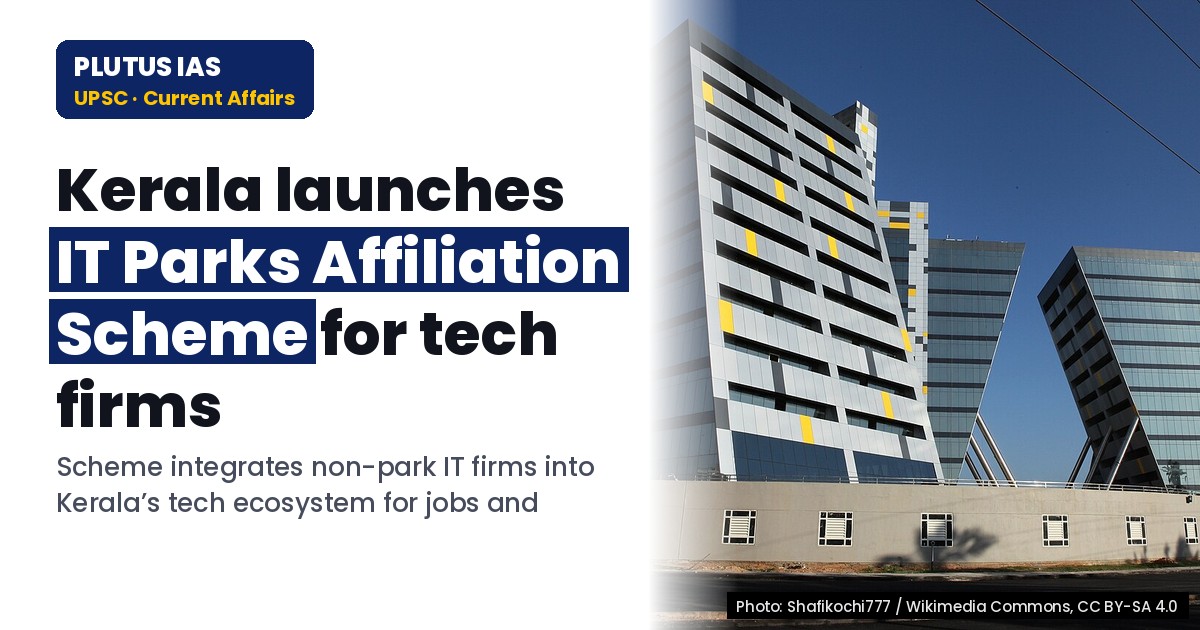
02 Oct Kerala’s IT Parks Affiliation Scheme: Boosting Tech Ecosystem & Job Opportunities
✎ The IT Parks Affiliation Scheme seeks to integrate decentralised IT firms into Kerala’s technology ecosystem by providing them access to institutional resources, government engagement, and industry collaboration through an online…
Subject Relevance — Where This Topic Fits
- GS Paper II — Government Policies and Interventions for Development in various sectors | GS Paper III — Role of Information Technology in the Indian Economy
- Prelims: IT Parks Affiliation Scheme, Technopark Thiruvananthapuram, Kerala Tech Brand, Digital India Mission, Startup India
- Essay: Digital transformation and inclusive growth in India, The role of state governments in fostering innovation ecosystems
Quick Revision: The IT Parks Affiliation Scheme seeks to integrate decentralised IT firms into Kerala’s technology ecosystem by providing them access to institutional resources, government engagement, and industry collaboration through an online affiliation portal.
Why is this in the news?
The Kerala government’s announcement of the IT Parks Affiliation Scheme on 2 October 2026 underscores a strategic initiative to integrate IT enterprises operating outside formal government-owned IT parks into the state’s broader technology ecosystem. This policy response addresses the fragmentation in the state’s IT sector by enabling decentralised firms to access institutional resources, government engagement, and industry collaboration, thereby enhancing their growth potential and Kerala’s technological competitiveness.
Background
- Kerala has emerged as a significant hub for Information Technology (IT) in India, with Technopark in Thiruvananthapuram being one of the largest and oldest IT parks in the country, established in 1990.
- The state’s IT sector contributes substantially to its economy, with over 1,200 IT companies and a workforce exceeding 100,000 professionals as of recent estimates.
- Despite the presence of major IT parks like Technopark, Infopark Kochi, and Cyberpark Kozhikode, a significant number of IT firms operate outside these formal ecosystems, often in smaller towns or standalone facilities.
- The COVID-19 pandemic accelerated the adoption of remote work and decentralised IT operations, highlighting the need for inclusive policies to integrate such entities into the broader technological and governance framework.
- Kerala’s IT policy frameworks, including the Kerala IT Policy 2017 and subsequent updates, have consistently emphasised the development of a robust, inclusive, and globally competitive IT ecosystem.
- The scheme aligns with the Digital India Mission’s objectives of promoting digital infrastructure, digital services, and digital empowerment across regions.
What is the IT Parks Affiliation Scheme?
- The IT Parks Affiliation Scheme is a policy initiative by the Government of Kerala to integrate IT enterprises operating outside government-owned IT parks into the state’s technology ecosystem, enabling them to access institutional resources, government services, and industry networks.
- Under the scheme, eligible IT firms located outside formal IT parks can register through an online portal and become affiliated members, thereby gaining access to benefits such as shared infrastructure, government schemes, and collaborative opportunities.
- The scheme aims to enhance the visibility and growth prospects of decentralised IT firms by connecting them with the broader technological and governance framework of Kerala, fostering innovation and competitiveness.
- The affiliation portal, launched ahead of the scheme’s formal inauguration on 6 October 2026, serves as a single-window interface for registration, verification, and access to affiliated benefits.
- The scheme is expected to facilitate greater engagement between IT firms, government agencies, industry associations, and academic institutions, thereby strengthening Kerala’s position as a technology-driven economy.
- The Kerala Tech Brand, unveiled alongside the scheme, is designed to unify companies, co-working spaces, and private technology infrastructure into a connected state-level ecosystem, promoting collaboration in emerging technologies such as artificial intelligence, blockchain, and cybersecurity.
- The scheme also includes infrastructure development components, such as the launch of a 2 lakh square feet prefabricated IT building and recreational facilities at Technopark Phase-III, to support the growing demand for IT space and amenities.
- The initiative reflects Kerala’s commitment to inclusive growth in the IT sector, ensuring that the benefits of technological advancement are accessible to firms across the state, regardless of their physical location.
Key Features
| Feature | Significance |
|---|---|
| Affiliation Portal | Facilitates registration and integration of IT firms outside major parks into the State’s technology ecosystem, enabling streamlined access to benefits and opportunities. |
| State-level Technology Ecosystem | Creates a unified network connecting affiliated IT firms, co-working spaces, and private infrastructure, fostering collaboration and innovation. |
| Kerala Tech Brand | Aims to enhance the visibility and branding of Kerala’s technology sector, attracting investment and talent through a cohesive identity. |
| Prefabricated IT Building | Expands physical infrastructure at Technopark Phase-III, providing additional workspace and supporting the growth of the IT sector. |
| Common Recreational Areas | Enhances the work environment within Technopark Phase-III, improving employee well-being and productivity. |
Why it Matters
Economic Growth and Employment
- Expands the reach of Kerala’s IT sector beyond traditional hubs, unlocking economic potential in peripheral regions.
- Encourages the establishment and scaling of IT firms outside major parks, diversifying the State’s industrial base.
- Generates employment opportunities in technology and allied sectors, contributing to Kerala’s economic development.
Industry Integration and Collaboration
- Bridges the gap between IT firms operating outside government-owned parks and the broader technology ecosystem, fostering synergy.
- Promotes knowledge-sharing and innovation through a connected network of companies, co-working spaces, and infrastructure providers.
- Enhances government-industry engagement, enabling policy alignment with sectoral needs and challenges.
Infrastructure Development
- Augments physical infrastructure through the establishment of new IT buildings and recreational facilities, improving operational efficiency.
- Supports the growth of Technopark Phase-III, reinforcing Kerala’s position as a key IT destination in India.
- Encourages private sector participation in infrastructure development, reducing the burden on public resources.
Branding and Visibility
- Strengthens Kerala’s technology brand, positioning the State as a competitive and innovative hub for IT and emerging technologies.
- Attracts investment and talent by showcasing a unified and dynamic technology ecosystem.
- Enhances the State’s global competitiveness in the IT sector, aligning with national and international technology trends.
Challenges
1. Equitable Access and Inclusion
- Ensuring that all eligible IT firms, including those in Tier-2 and Tier-3 cities, can access the benefits of the scheme without exclusion.
- Addressing disparities in infrastructure and connectivity that may hinder participation from remote or underdeveloped regions.
UPSC Link: GS3: Inclusive growth
2. Sustainability and Scalability
- Balancing rapid expansion of the IT ecosystem with sustainable resource management, particularly in energy and water consumption.
- Ensuring that the infrastructure additions (e.g., IT buildings) are scalable to meet future demand without overcapacity.
UPSC Link: GS3: Sustainable development
3. Talent Acquisition and Retention
- Addressing the challenge of attracting and retaining skilled IT professionals, especially in a competitive national and global market.
- Ensuring that the growth of the IT sector does not exacerbate brain drain from Kerala.
UPSC Link: GS3: Human resource development
4. Regulatory and Compliance Hurdles
- Streamlining regulatory processes for IT firms to ensure smooth integration into the affiliation scheme without bureaucratic delays.
- Harmonising State-level policies with national regulations to avoid conflicts or redundancies.
UPSC Link: GS2: Centre-State relations
5. Digital Divide and Infrastructure Gaps
- Mitigating disparities in digital infrastructure across regions to ensure that all affiliated firms can leverage the scheme’s benefits effectively.
- Investing in last-mile connectivity and digital literacy initiatives to support inclusive participation.
UPSC Link: GS3: Digital infrastructure
Challenges — UPSC Perspective
| Issue | Concern |
|---|---|
| Regulatory Delays | Potential bottlenecks in approvals and clearances for IT firms seeking affiliation. |
| Infrastructure Deficits | Lack of adequate digital and physical infrastructure in non-urban areas hindering participation. |
| Talent Shortages | Difficulty in recruiting skilled IT professionals to meet the growing demand. |
| Policy Fragmentation | Risk of misalignment between State and national policies affecting the scheme’s implementation. |
| Resource Constraints | Sustainable management of resources (e.g., energy, water) amid rapid IT sector growth. |
Way Forward
- Conduct targeted awareness campaigns to ensure maximum participation from eligible IT firms across Kerala.
- Develop a robust monitoring and evaluation framework to assess the scheme’s impact on economic growth and employment.
- Invest in digital infrastructure upgrades in Tier-2 and Tier-3 cities to bridge the digital divide.
- Collaborate with educational institutions to align skill development programs with the needs of the IT sector.
- Establish a grievance redressal mechanism to address regulatory and compliance challenges faced by affiliated firms.
- Promote public-private partnerships to accelerate infrastructure development in emerging IT hubs.
- Encourage R&D initiatives within the affiliated network to foster innovation and technological advancement.
- Align the Kerala Tech Brand with national and global technology trends to enhance competitiveness.
UPSC Value Addition
Keywords for Mains Answer-Writing
IT Parks Affiliation Scheme · Kerala Technology Ecosystem · State-level innovation policy · Digital Public Infrastructure · Start-up and innovation ecosystem · Technology Parks in India · State government initiatives in IT · E-governance and industry linkage · Public-private partnership in technology · Emerging technologies and governance
Concept Flow
State government identifies gaps in IT sector integration outside major parks. → Designs IT Parks Affiliation Scheme to connect dispersed IT firms to a State-level ecosystem. → Launches affiliation portal for registration and integration of eligible firms. → Introduces Kerala Tech Brand to unify and promote the State’s technology sector. → Expands infrastructure at Technopark Phase-III to support growth and collaboration. → Fosters economic growth, employment, and innovation through a connected IT ecosystem. → Enhances Kerala’s position as a competitive IT destination in India.
Prelims Practice Questions
Q1. Consider the following statements regarding the IT Parks Affiliation Scheme launched by the Keralam government:
1. The scheme aims to link IT companies operating outside major IT parks to a State-level technology ecosystem.
2. The scheme provides benefits only to IT firms located within government-owned IT parks.
3. An affiliation portal has been opened for eligible companies to register.
How many of the above statements are correct?
- Only one
- Only two
- Only three
- None
Answer: Only two — Statements 1 and 3 are correct. Statement 2 is incorrect as the scheme extends benefits to IT firms outside government-owned IT parks as well.
Q2. Assertion (A): The Kerala Tech Brand aims to create a connected State-level technology ecosystem.
Reason (R): It seeks to integrate companies, co-working spaces, and private technology infrastructure into a unified network.
- Both A and R are true, and R is the correct explanation of A
- Both A and R are true, but R is not the correct explanation of A
- A is true, but R is false
- A is false, but R is true
Answer: Both A and R are true, and R is the correct explanation of A — Both the assertion and reason are true, and the reason correctly explains the assertion by detailing the objective of the Kerala Tech Brand.
Q3. Match the following initiatives with their respective objectives:
Column I (Initiative) | Column II (Objective)
— | —
A. IT Parks Affiliation Scheme | 1. To set up a prefabricated IT building of 2 lakh square feet
B. Kerala Tech Brand | 2. To link IT companies outside major IT parks to a State-level technology ecosystem
C. Technopark Phase-III expansion | 3. To integrate companies and private infrastructure into a connected network
D. Common recreational areas | 4. To provide shared amenities for IT park employees
- A-2, B-3, C-1, D-4
- A-1, B-2, C-3, D-4
- A-3, B-1, C-2, D-4
- A-4, B-3, C-1, D-2
Answer: A-2, B-3, C-1, D-4 — The correct pairing is: A-2 (IT Parks Affiliation Scheme aims to link IT companies outside major IT parks), B-3 (Kerala Tech Brand integrates companies and private infrastructure), C-1 (Technopark Phase-III expansion includes a prefabricated IT building), and D-4 (common recreational areas provide shared amenities).
Mains Practice Question
✍ The Keralam government’s IT Parks Affiliation Scheme represents a strategic shift towards integrating dispersed IT enterprises into a unified State-level technology ecosystem. Critically examine the potential benefits and challenges of such a scheme in the context of India’s broader digital governance and innovation policy framework. (15 Marks)
Approach: MODEL-ANSWER SKELETON:
1. **Introduction (2 marks)**
– Define the IT Parks Affiliation Scheme and its core objective: bridging the gap between IT firms outside formal IT parks and the State’s technology ecosystem.
– Contextualise within India’s broader digital governance framework, referencing initiatives like Digital India, Startup India, and State-led innovation policies (e.g., Tamil Nadu’s TANSCHE, Karnataka’s IT Policy).
2. **Benefits (5 marks)**
– **Economic Growth**: Enhanced visibility and access to government schemes, funding, and industry networks for affiliated firms, fostering job creation and economic diversification in non-metropolitan regions.
– **Innovation Ecosystem**: Integration of startups, co-working spaces, and private infrastructure under the Kerala Tech Brand, promoting collaboration and knowledge spillovers.
– **Governance Efficiency**: Streamlined engagement between IT firms and the government, reducing bureaucratic hurdles and enabling targeted policy interventions.
– **Infrastructure Utilisation**: Optimal use of existing IT park infrastructure (e.g., Technopark Phase-III’s prefabricated building and recreational areas) by affiliated firms.
– **State Branding**: The Kerala Tech Brand as a tool for attracting investment and positioning Keralam as a hub for emerging technologies (e.g., AI, blockchain, IoT).
3. **Challenges (5 marks)**
– **Regulatory and Compliance Issues**: Ensuring uniformity in benefits and compliance standards across diverse IT firms, including those in informal or unorganised sectors.
– **Digital Divide**: Risk of excluding smaller or rural-based IT enterprises due to digital literacy gaps or lack of awareness about the affiliation process.
– **Infrastructure Bottlenecks**: Potential strain on existing IT park facilities (e.g., Technopark) if demand exceeds capacity, necessitating phased expansion.
– **Policy Coordination**: Need for seamless integration with national schemes (e.g., Production-Linked Incentive (PLI) for IT hardware) and alignment with State industrial policies.
– **Data Privacy and Security**: Ensuring robust cybersecurity frameworks for affiliated firms, particularly those handling sensitive data.
4. **Comparative Perspective (2 marks)**
– Contrast with other State-led IT integration models (e.g., Maharashtra’s Maharashtra State Electronics Corporation Limited (MSEDCL) or Telangana’s T-Hub) to highlight Kerala’s unique approach.
5. **Conclusion (1 mark)**
– Reiterate the scheme’s potential to democratise access to technology ecosystems while acknowledging the need for adaptive governance and infrastructure planning. Emphasise the role of such schemes in achieving the broader goals of Atmanirbhar Bharat and inclusive growth.
Source: The Hindu
Generated by AanyaAi for educational purpose.
Related guides on our sites
- Best PSIR optional coaching for upsc
- Best PSIR optional teacher for upsc
- Best teacher of PSIR optional for upsc
- Best PSIR optional coaching in delhi for UPSC

- Kerala’s IT Parks Affiliation Scheme: Boosting Tech Ecosystem & Job Opportunities - October 2, 2026
- ‘विशेष स्वच्छता अभियान 6.0’ से सरकारी कार्यालयों में क्रांतिकारी बदलाव - October 2, 2026
- J&K’s First Mineral Auction: Historic Milestone for UPSC & State PCS - October 2, 2026

No Comments