


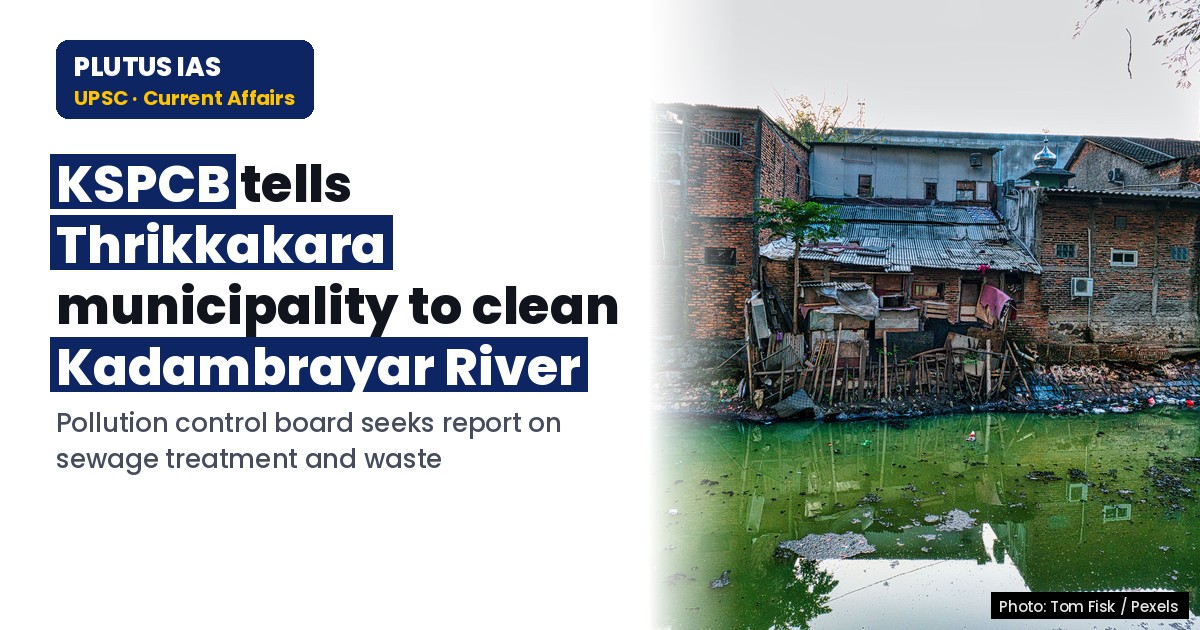
27 Oct Kadambrayar River Pollution: PCB Demands Action Report from Thrikkakara Municipality
✎ The Water (Prevention and Control of Pollution) Act, 1974, empowers State Pollution Control Boards to regulate water pollution, issue notices, and take legal action against violators, including municipalities failing to prevent…
Subject Relevance — Where This Topic Fits
- GS Paper II — Governance, Constitution, Polity, Social Justice and International Relations (Local Governance and Environmental Governance) | GS Paper III — Environment, Disaster Management and Climate Change (Environmental Pollution and Control)
- Prelims: Water (Prevention and Control of Pollution) Act, 1974, Central Pollution Control Board (CPCB), State Pollution Control Boards (SPCBs), 32 polluted river stretches in Kerala, Local Self-Government Department (Kerala), Sewage Treatment Plant (STP), Surveillance mechanisms for illegal dumping, Non-point source pollution, Municipal Solid Waste (Management and Handling) Rules, 2000
- Essay: The Role of Institutions in Environmental Conservation: A Case Study of River Rejuvenation Efforts in Kerala, Balancing Urban Development and Environmental Sustainability: Lessons from the Kadambrayar River Pollution Crisis
Quick Revision: The Water (Prevention and Control of Pollution) Act, 1974, empowers State Pollution Control Boards to regulate water pollution, issue notices, and take legal action against violators, including municipalities failing to prevent illegal sewage discharge into rivers.
Why is this in the news?
The Kerala State Pollution Control Board (KSPCB) has issued a notice to the Thrikkakara municipality under the Water (Prevention and Control of Pollution) Act, 1974, seeking an action-taken report on measures to address the persistent pollution of the Kadambrayar River. Inspections revealed continued illegal discharge of untreated sewage and solid waste into the river, which is among the 32 polluted river stretches identified by the Central Pollution Control Board (CPCB) in Kerala. This case underscores the challenges in urban river rejuvenation, the enforcement of environmental laws, and the coordination required between local bodies, regulatory agencies, and urban development authorities.
Background
- The Kadambrayar River, a tributary of the Periyar River in Kerala, has been classified as one of the 32 polluted river stretches in the state by the Central Pollution Control Board (CPCB), indicating severe degradation due to anthropogenic activities.
- Urbanisation, unplanned industrial growth, and inadequate waste management infrastructure in the Thrikkakara municipality and surrounding areas have contributed to the pollution of the river, primarily through untreated sewage and solid waste dumping.
- The Water (Prevention and Control of Pollution) Act, 1974, empowers State Pollution Control Boards (SPCBs) to regulate and monitor water pollution, issue notices, and take legal action against violators.
- The KSPCB is responsible for implementing environmental laws at the state level, including the Water Act, 1974, and the Environmental Protection Act, 1986.
- Local Self-Government institutions, such as municipalities and panchayats, are mandated to manage urban infrastructure, including waste management and sewage treatment, under the Kerala Municipality Act, 1994, and the Kerala Panchayat Raj Act, 1994.
- The issue highlights the broader challenge of non-point source pollution in urban areas, where pollution originates from diffuse sources such as residential, commercial, and institutional establishments rather than a single identifiable point.
What is the Legal and Institutional Framework for River Pollution Control in India?
- The **Water (Prevention and Control of Pollution) Act, 1974** is the primary legislation governing the prevention and control of water pollution in India. It establishes the **Central Pollution Control Board (CPCB)** at the national level and **State Pollution Control Boards (SPCBs)** at the state level to implement its provisions.
- Under the Act, SPCBs are empowered to issue notices to polluting entities, conduct inspections, and take legal action, including prosecution, against violators. The Act also mandates the establishment of effluent treatment plants and the regulation of sewage discharge.
- The **Environment (Protection) Act, 1986** provides a broader framework for environmental protection, empowering the central government to take measures to protect and improve the environment, including the prevention of water pollution.
- The **National River Conservation Plan (NRCP)**, launched in 1995, aims to reduce pollution in identified polluted river stretches through the implementation of sewage treatment plants, riverfront development, and public awareness campaigns. The Kadambrayar River is one of the 32 polluted stretches in Kerala identified under this plan.
- Local Self-Government institutions, such as municipalities and panchayats, play a critical role in managing urban infrastructure, including waste management, sewage treatment, and enforcement of environmental regulations under state-specific laws like the Kerala Municipality Act, 1994.
- The **Municipal Solid Waste (Management and Handling) Rules, 2000**, mandate the segregation, collection, transportation, processing, and disposal of municipal solid waste. These rules are crucial for preventing illegal dumping of solid waste into water bodies.
- Surveillance mechanisms, such as the installation of CCTV cameras and regular monitoring by SPCBs, are essential tools for detecting and deterring illegal dumping and untreated sewage discharge into rivers.
- Public participation and awareness campaigns are integral to the success of river rejuvenation efforts, as they foster a sense of ownership and responsibility among local communities and stakeholders.
Key Features
| Feature | Significance |
|---|---|
| Kadambrayar River Pollution | A critical environmental issue affecting a river stretch identified by the CPCB, necessitating urgent remediation to restore ecological balance and prevent further degradation. |
| Thrikkakara Municipality’s Role | The civic body is legally mandated under the Water (Prevention and Control of Pollution) Act, 1974 to prevent and control pollution in local water bodies, including the Kadambrayar River. |
| KSPCB’s Regulatory Authority | The Kerala State Pollution Control Board exercises statutory powers to monitor compliance with pollution control norms and issue directives for corrective action. |
| Sewage Treatment Infrastructure | The proposed sewage treatment plant (1 million litres/day) and waste management facilities are essential for reducing untreated sewage discharge into the river. |
| Surveillance and Enforcement | Installation of surveillance cameras and imposition of penalties are key enforcement tools to deter illegal dumping and ensure compliance with environmental laws. |
UPSC Value Addition
Keywords for Mains Answer-Writing
Kadambrayar River · Water (Prevention and Control of Pollution) Act, 1974 · State Pollution Control Boards (SPCBs) · Central Pollution Control Board (CPCB) · River rejuvenation · Sewage Treatment Plants (STPs) · Local Self-Government institutions · Non-point source pollution · Surveillance mechanisms for pollution monitoring · Penalties under environmental laws · Urban waste management · Integrated river basin management · Water quality monitoring · Polluter Pays Principle · Public participation in environmental governance
Prelims Practice Questions
Q1. Consider the following statements regarding the Water (Prevention and Control of Pollution) Act, 1974:
1. It empowers State Pollution Control Boards (SPCBs) to issue directions for the prevention and control of water pollution.
2. The Act mandates the establishment of Sewage Treatment Plants (STPs) in all urban local bodies.
3. The Act provides for the appointment of a Water Inspector to monitor compliance with its provisions.
4. The Act does not apply to rural areas or gram panchayats.
How many of the above statements are correct?
- Only one
- Only two
- Only three
- All four
Answer: Only three — Statements 1 and 3 are correct as the Act empowers SPCBs to issue directions and appoint Water Inspectors. Statement 2 is incorrect because the Act does not mandate STPs in all urban local bodies but encourages their establishment. Statement 4 is incorrect as the Act applies to all areas, including rural regions, under its jurisdiction.
Q2. Assertion (A): The Central Pollution Control Board (CPCB) identifies polluted river stretches in India.
Reason (R): The CPCB is empowered under the Water (Prevention and Control of Pollution) Act, 1974, to monitor and regulate water pollution across the country.
Options:
A. Both A and R are true, and R is the correct explanation of A.
B. Both A and R are true, but R is not the correct explanation of A.
C. A is true but R is false.
D. A is false but R is true.
Answer: ? — Both Assertion (A) and Reason (R) are true. The CPCB, as the national apex body, identifies polluted river stretches under its mandate. However, the Reason (R) is not the sole explanation for Assertion (A), as the identification process also involves State Pollution Control Boards and other stakeholders.
Q3. Match the following provisions of the Water (Prevention and Control of Pollution) Act, 1974 with their respective functions:
Column I (Provision) | Column II (Function)
— | —
1. Section 25 | A. Powers of State Pollution Control Boards to take samples
2. Section 26 | B. Prohibition of new outlets and new discharges without prior consent
3. Section 27 | C. Power to take samples of effluents
4. Section 33 | D. Power to take action against persons causing water pollution
Options:
A. 1-A, 2-B, 3-C, 4-D
B. 1-B, 2-A, 3-D, 4-C
C. 1-C, 2-D, 3-A, 4-B
D. 1-D, 2-C, 3-B, 4-A
Answer: ? — The correct match is: Section 25 (B) – Prohibition of new outlets and new discharges without prior consent; Section 26 (A) – Powers of State Pollution Control Boards to take samples; Section 27 (C) – Power to take samples of effluents; Section 33 (D) – Power to take action against persons causing water pollution.
Mains Practice Question
✍ The discharge of untreated sewage into rivers remains a critical challenge to India’s water governance framework. Critically examine the efficacy of the legal and institutional mechanisms under the Water (Prevention and Control of Pollution) Act, 1974, in addressing this issue. Also, outline the role of Local Self-Government institutions in mitigating river pollution through sustainable urban waste management. (15 Marks)
Approach: MODEL-ANSWER SKELETON:
1. **Legal Framework Overview**:
– Water (Prevention and Control of Pollution) Act, 1974: Key provisions (Sections 25, 26, 27, 33) and their objectives.
– Role of State Pollution Control Boards (SPCBs) and the Central Pollution Control Board (CPCB) in monitoring and enforcement.
– Judicial precedents (e.g., M.C. Mehta v. Union of India) affirming the Act’s constitutional validity and the doctrine of absolute liability.
2. **Challenges in Implementation**:
– **Institutional Constraints**: Limited capacity of SPCBs, delayed enforcement, and lack of coordination among agencies.
– **Non-compliance**: Persistent illegal discharge of untreated sewage despite statutory provisions (e.g., Kadambrayar River case).
– **Urbanisation Pressures**: Rapid urban growth outpacing the establishment of Sewage Treatment Plants (STPs) and waste management infrastructure.
– **Data Gaps**: Inadequate monitoring mechanisms and surveillance systems to detect violations.
3. **Role of Local Self-Government Institutions**:
– **Constitutional Mandate**: 73rd and 74th Constitutional Amendments empowering local bodies in environmental governance.
– **Waste Management Initiatives**: Case study of Thrikkakara municipality’s proposed STP and Green Park project.
– **Penalties and Surveillance**: Imposition of penalties on violators and installation of surveillance cameras to curb illegal dumping.
– **Limitations**: Financial constraints, lack of technical expertise, and political interference in local governance.
4. **Way Forward**:
– **Strengthening Institutional Capacity**: Augmenting SPCBs with technological tools (e.g., GIS-based monitoring) and adequate staffing.
– **Public-Private Partnerships (PPPs)**: Leveraging private sector expertise for STPs and waste management.
– **Community Participation**: Engaging local communities in monitoring and reporting violations (e.g., citizen science initiatives).
– **Policy Integration**: Aligning river rejuvenation plans with urban development policies (e.g., Smart Cities Mission, Namami Gange Programme).
5. **Conclusion**:
– The Act provides a robust legal framework, but its efficacy hinges on effective implementation, inter-institutional coordination, and sustained political will. Local bodies must be empowered with resources and autonomy to address non-point source pollution comprehensively.
Source: The Hindu
Generated by AanyaAi for educational purpose.
Related guides on our sites
- Best economics services coaching
- Anthropology VS PSIR
- Best PSIR optional coaching
- Best PSIR optional coaching online

- Kadambrayar River Pollution: PCB Demands Action Report from Thrikkakara Municipality - October 27, 2026
- ‘टाइमलेस इंडिया’ पहल: भारतीय संस्कृति की रक्षा एवं पुनरुद्धार - October 27, 2026
- SIMBEX-2026: India-Singapore Maritime Exercise Enhances Strategic Ties - October 27, 2026

No Comments