


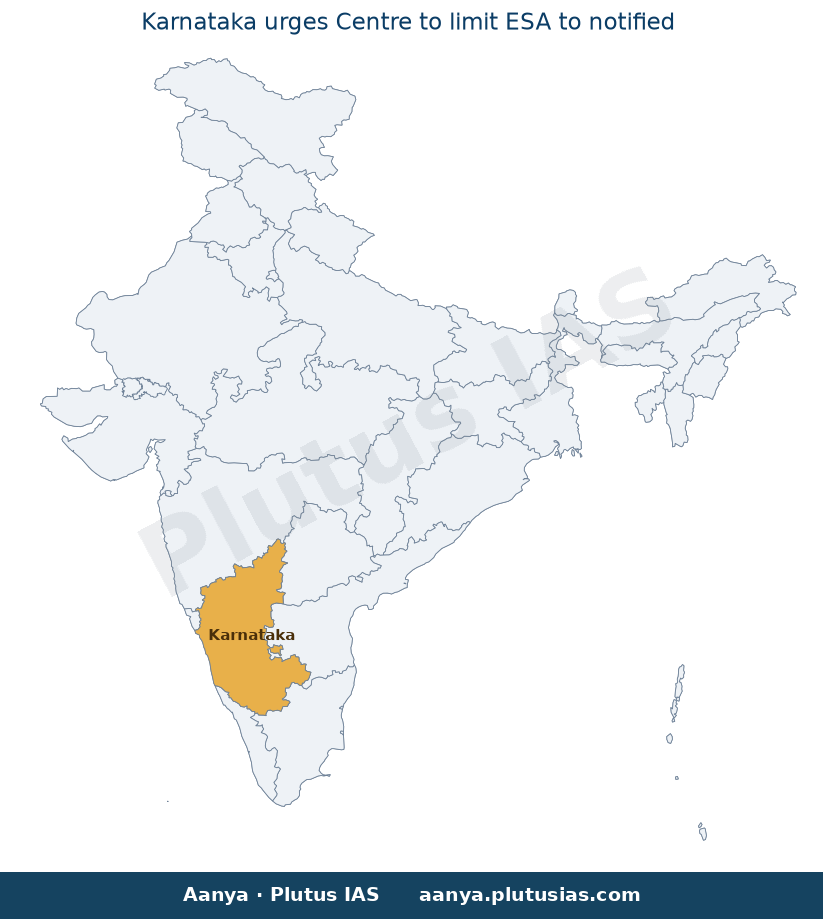
22 Sep Karnataka Assembly urges Centre to limit ESA to notified forests only
✎ The Kasturirangan Report recommends ESAs in the Western Ghats to balance conservation with development, but Karnataka’s legislature has resolved to confine ESA designation to notified forests, citing livelihood and land-use…
Subject Relevance — Where This Topic Fits
- GS Paper III — Environment and Biodiversity | GS Paper II — Functions and Responsibilities of the Union and the States
- Prelims: Ecologically Sensitive Areas (ESA), Kasturirangan Report, Western Ghats, biodiversity hotspot, notified forests, revenue survey numbers, physical survey
- Essay: Conservation vs. Development: Balancing Ecological Priorities with Human Livelihoods
Quick Revision: The Kasturirangan Report recommends ESAs in the Western Ghats to balance conservation with development, but Karnataka’s legislature has resolved to confine ESA designation to notified forests, citing livelihood and land-use concerns.
Why is this in the news?
On September 22, 2026, the Karnataka Legislative Assembly and Council unanimously adopted a resolution urging the Union Government to confine the Ecologically Sensitive Area (ESA) identified under the Kasturirangan Report to only notified forests. The resolution seeks a one-year extension for a physical survey of affected areas and proposes a high-power committee to address perceived lacunae in the report, reflecting the State’s emphasis on reconciling conservation with local livelihoods and land-use realities.
Background
- The Western Ghats, a UNESCO World Heritage Site and one of the world’s eight biodiversity hotspots, spans six States in India, including Karnataka.
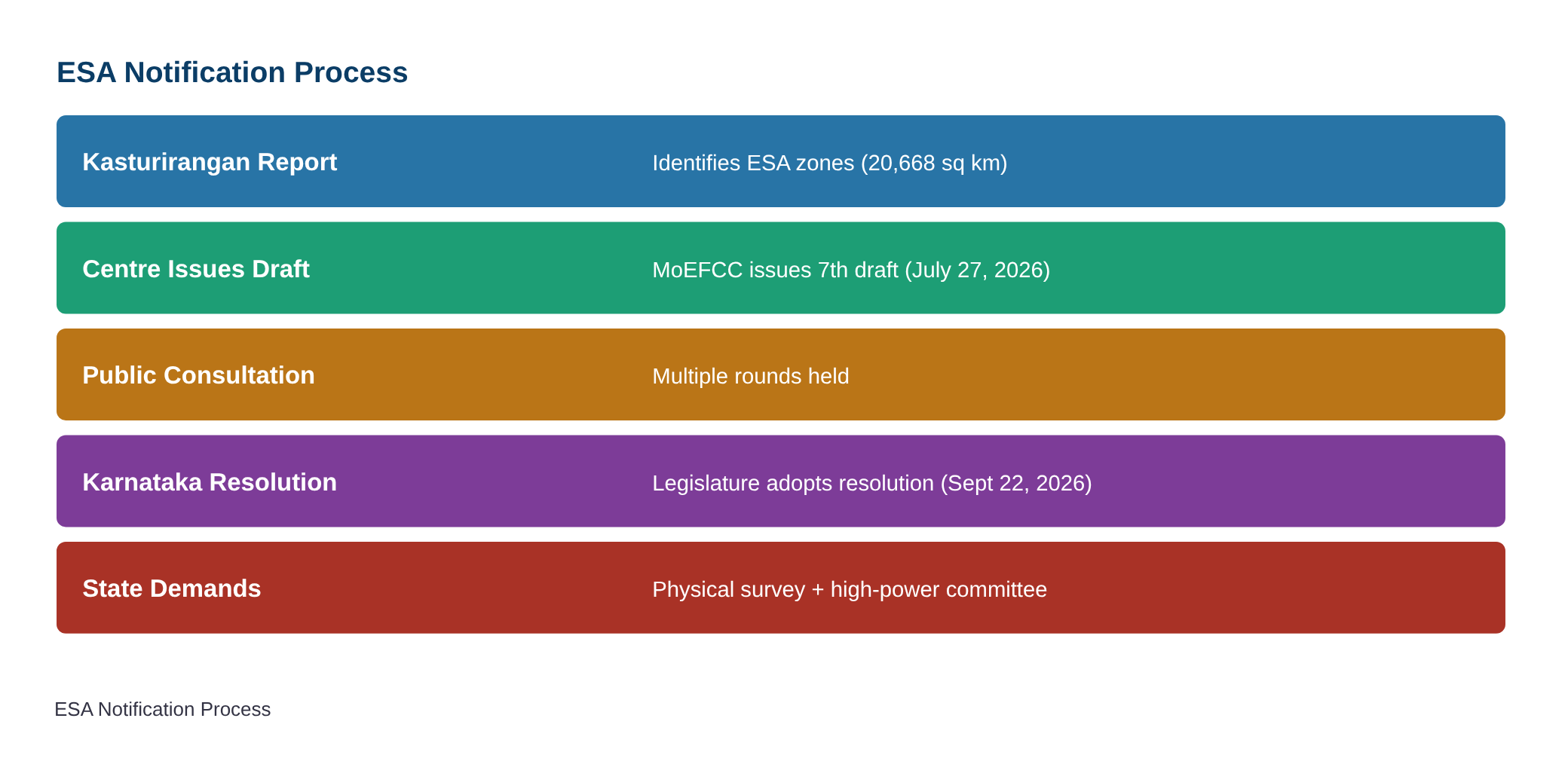
- In Karnataka, the report identified 20,668 sq km across 1,449 villages in 10 districts for ESA designation, triggering debates over land-use restrictions and livelihood impacts.
- The Union Ministry of Environment, Forest and Climate Change (MoEFCC) issued its seventh draft notification for Karnataka’s ESA on July 27, 2026, following multiple rounds of public consultation.
- State governments have historically contested ESA notifications due to concerns over agricultural lands, human settlements, and economic activities falling under restrictive regulatory purview.
- Karnataka’s resolution aligns with a broader pattern of State-level pushback against centrally notified ESAs, citing socio-economic and administrative constraints.
What is the Kasturirangan Report and Ecologically Sensitive Areas (ESA)?
- The report proposed a three-tiered approach: (1) inviolate areas (no developmental activities), (2) ESAs (regulated activities), and (3) cultural landscapes (traditional land-use practices).
- Ecologically Sensitive Areas (ESAs) are designated under Section 3(2)(v) of the Environment Protection Act, 1986, to protect regions of exceptional ecological value from unregulated development.
- ESAs impose restrictions on land-use changes, industrial activities, and infrastructure projects, requiring prior environmental clearance from the MoEFCC.
- The Western Ghats ESA notification aims to address threats such as deforestation, mining, and agricultural expansion that endanger biodiversity and ecosystem services.
- Karnataka’s resolution seeks to limit ESA designation to notified forests, excluding agricultural, horticultural, and plantation lands, as well as human settlements and public infrastructure areas.
- The resolution also highlights the need for a physical survey based on revenue survey numbers to accurately demarcate forest boundaries and human settlements, addressing longstanding grievances over land records.
- The proposed high-power committee, led by a retired judge, will review the Kasturirangan Report’s recommendations and suggest modifications to align with ground realities.
Key Features
| Feature | Significance |
|---|---|
| Unanimous Legislative Resolution | Demonstrates state-level consensus on Western Ghats conservation, ensuring unified political stance for policy implementation. |
| Physical Survey Requirement | Mandates ground-truthing of Ecologically Sensitive Area (ESA) boundaries to reconcile administrative records with on-ground realities. |
| High-Power Committee Formation | Institutes a judicial-led body to address perceived deficiencies in the Kasturirangan Report through expert and stakeholder consultations. |
| Exclusion of Non-Forest Lands | Proposes limiting ESA designation to notified forests, thereby protecting agricultural, horticultural, and settlement areas from conservation restrictions. |
| Revenue Survey-Based Demarcation | Advocates using official land records to delineate forest boundaries, reducing disputes over land ownership and usage rights. |
Why it Matters
Ecological
- The resolution seeks to balance conservation imperatives with livelihood concerns by restricting ESA to notified forests, thereby preserving biodiversity hotspots while minimising socio-economic disruptions.
- Western Ghats, a UNESCO World Heritage Site, hosts critical ecological services including water catchment, carbon sequestration, and endemic biodiversity, necessitating precise conservation strategies.
- The Kasturirangan Report’s original ESA proposal (20,668 sq km) was criticised for potentially over-extending conservation zones, risking displacement of local communities and economic activities.
Administrative
- The resolution underscores the Centre-State coordination required in environmental governance, particularly under the Environment Protection Act, 1986, and the National Green Tribunal’s directives.
- The demand for a one-year moratorium on finalising the ESA draft notification allows Karnataka to conduct a comprehensive physical survey, ensuring data accuracy and stakeholder participation.
- Formation of a high-power committee reflects the need for evidence-based policymaking, integrating judicial, administrative, and expert inputs to address lacunae in conservation reports.
Economic
- Restricting ESA to notified forests safeguards agricultural and horticultural lands, which are vital for Karnataka’s agrarian economy, particularly in districts like Kodagu, Chikkamagaluru, and Dakshina Kannada.
- The resolution mitigates potential losses to plantation-based industries (e.g., coffee, tea, spices) by excluding privately held lands from stringent conservation measures.
- A streamlined ESA framework could reduce litigation and regulatory uncertainty, fostering sustainable economic activities in the Western Ghats region.
Legal
- The resolution invokes the constitutional principle of cooperative federalism, asserting state autonomy in environmental governance while adhering to central directives.
- The demand for revenue survey-based demarcation aligns with the Land Revenue Code and Forest Rights Act, ensuring alignment with statutory land records and tenure rights.
Challenges
1. Balancing Conservation and Livelihoods
- The Kasturirangan Report’s ESA proposal risks alienating local communities dependent on forest resources, necessitating participatory approaches to demarcation.
- Agricultural and plantation lands in Western Ghats are often interspersed with forest patches, complicating boundary delineation and conservation enforcement.
- Historical land grants and tenurial disputes may resurface during physical surveys, requiring transparent dispute resolution mechanisms.
UPSC Link: GS Paper 3: Environmental Conservation; Forest Rights Act, 2006
2. Data Accuracy and Survey Challenges
- Physical surveys over 1,449 villages across 10 districts will require significant logistical and financial resources, with potential delays due to terrain and weather constraints.
- Discrepancies between revenue records and on-ground realities (e.g., encroachments, unrecorded land use changes) may undermine the survey’s reliability.
- The high-power committee’s recommendations must be evidence-based to withstand legal scrutiny, particularly under the National Green Tribunal’s jurisdiction.
UPSC Link: GS Paper 3: Environmental Governance; National Green Tribunal Act, 2010
3. Centre-State Coordination Gaps
- Divergent interpretations of the Kasturirangan Report’s recommendations between the Centre and Karnataka may lead to prolonged negotiations, delaying final ESA notification.
- The Centre’s draft notification (July 27, 2026) may not fully accommodate Karnataka’s demands, necessitating robust intergovernmental dialogue.
- Federal tensions could arise if Karnataka’s modifications are perceived as diluting conservation efforts, risking judicial intervention.
UPSC Link: GS Paper 2: Federalism; Environment Protection Act, 1986
4. Stakeholder Participation and Equity
- Ensuring equitable representation of farmers, tribal communities, and industrial stakeholders in the high-power committee is critical to avoid marginalisation of vulnerable groups.
- Historical injustices in land allocation (e.g., colonial-era grants) may resurface, requiring restorative justice mechanisms within the survey process.
- Industrial units in the Western Ghats (e.g., mining, hydropower) may resist exclusion from ESA, necessitating balanced policy compromises.
UPSC Link: GS Paper 3: Forest Rights Act, 2006; Tribal Sub-Plan
Challenges — UPSC Perspective
| Issue | Concern |
|---|---|
| Overlapping Land Uses | Agricultural/plantation lands interspersed with forests complicate ESA demarcation and enforcement. |
| Historical Land Disputes | Colonial-era land grants and encroachments may resurface during physical surveys, delaying progress. |
| Resource Constraints | Conducting surveys across 20,668 sq km requires substantial funding, manpower, and logistical planning. |
| Legal Ambiguities | Discrepancies between revenue records and on-ground realities may lead to litigation under forest and land laws. |
| Centre-State Divergence | Differing interpretations of conservation priorities may prolong negotiations over ESA boundaries. |
| Stakeholder Exclusion | Marginalised groups (e.g., tribal communities, small farmers) risk being sidelined in decision-making processes. |
Way Forward
- Constitute the high-power committee with a retired judge as chair, ensuring representation from Revenue, Forest, and Agriculture Departments, along with farmers, industrialists, and ecologists.
- Initiate a phased physical survey of ESA boundaries, prioritising districts with the highest land-use conflicts (e.g., Kodagu, Chikkamagaluru) to expedite data collection.
- Engage local panchayats and gram sabhas in the survey process to ensure community participation and transparency in boundary demarcation.
- Address historical land disputes through a dedicated grievance redressal mechanism, leveraging revenue and forest records to resolve tenure conflicts.
- Conduct multi-stakeholder consultations to reconcile conservation imperatives with livelihood concerns, particularly for plantation and agricultural communities.
- Submit the committee’s report and survey findings to the Centre within the one-year moratorium period, accompanied by a detailed action plan for ESA implementation.
- Collaborate with the National Remote Sensing Centre (NRSC) and Indian Space Research Organisation (ISRO) to validate survey data using satellite imagery and GIS mapping.
- Develop a grievance redressal portal for stakeholders to report discrepancies in land records or conservation violations, ensuring accountability in ESA enforcement.
UPSC Value Addition
Keywords for Mains Answer-Writing
Western Ghats conservation · Ecologically Sensitive Areas (ESA) · Kasturirangan Committee Report · Environmental governance in India · Forest Rights Act 2006 · Western Ghats Ecology Expert Panel (WGEEP) · Environmental Impact Assessment (EIA) 2006 · Constitutional provisions for environmental protection (Article 48A, 51A(g)) · Inter-state ecological governance · Stakeholder participation in environmental policy · Forest survey and demarcation · Environmental policy conflicts · Sustainable development in ecologically fragile regions
Concept Flow
Kasturirangan Report identifies ESA zones in Western Ghats (20,668 sq km) → Centre issues draft notification (July 27, 2026) → Karnataka Legislature adopts resolution → State demands physical survey and committee to address lacunae → Resolution seeks exclusion of non-forest lands from ESA → Physical survey and committee report to inform Centre’s final ESA notification.
Prelims Practice Questions
Q1. Consider the following statements regarding the Kasturirangan Committee Report on Western Ghats:
1. The report identified 20,668 square km of Ecologically Sensitive Areas (ESA) across 10 districts of Karnataka.
2. The report recommended a blanket ban on all developmental activities in the Western Ghats.
3. The report proposed that agricultural and plantation lands should be excluded from ESA demarcation.
How many of the above statements are correct?
- Only one
- Only two
- All three
- None
Answer: Only two — Statement 1 is correct as per the report’s findings. Statement 2 is incorrect as the report did not propose a blanket ban but sought regulated development. Statement 3 is correct as the report recommended excluding agricultural and plantation lands from ESA.
Q2. Assertion (A): The Western Ghats Ecology Expert Panel (WGEEP) and the Kasturirangan Committee both recommended the declaration of Ecologically Sensitive Areas (ESA) in the Western Ghats.
Reason (R): The Western Ghats is a globally recognized biodiversity hotspot and requires stringent conservation measures to protect its ecological integrity.
In the context of the above two statements, which one of the following is correct?
- Both A and R are true, and R is the correct explanation of A
- Both A and R are true, but R is NOT the correct explanation of A
- A is true, but R is false
- A is false, but R is true
Answer: Both A and R are true, but R is NOT the correct explanation of A — Both WGEEP and the Kasturirangan Committee recommended ESA declaration for Western Ghats conservation. The assertion is true. The reason is also true and correctly explains the assertion, as the Western Ghats’ ecological significance necessitates such measures.
Q3. Match the following committees with their primary recommendations regarding Western Ghats conservation:
Column I (Committee)
A. Western Ghats Ecology Expert Panel (WGEEP)
B. Kasturirangan Committee
C. Gadgil Committee
Column II (Recommendation)
1. Recommended 37% of Western Ghats as ESA with stringent regulations
2. Suggested a graded approach with 64% of Western Ghats as ESA
3. Proposed exclusion of agricultural and plantation lands from ESA
Select the correct match:
- A-1, B-2, C-3
- A-2, B-1, C-3
- A-3, B-1, C-2
- A-2, B-3, C-1
Answer: A-2, B-3, C-1 — WGEEP (A) recommended 64% of Western Ghats as ESA (2). Kasturirangan Committee (B) proposed 37% as ESA (1). The Karnataka resolution aligns with excluding agricultural lands (3), which was a key recommendation of the Kasturirangan Committee.
Mains Practice Question
✍ The Government of Karnataka has adopted a resolution urging the Union Government to confine the Ecologically Sensitive Areas (ESA) identified under the Kasturirangan Committee Report exclusively to notified forests, excluding agricultural and plantation lands. Critically examine the constitutional, ecological, and governance dimensions of this demand. Also, analyse the implications of such exclusions for sustainable development in ecologically fragile regions. (15 Marks)
Approach: MODEL-ANSWER SKELETON:
1. **Constitutional and Legal Framework** (5 marks):
– Article 48A (DPSP) and Article 51A(g) (Fundamental Duty) — State’s obligation to protect and improve environment.
– Forest Rights Act 2006 — Recognition of rights of forest-dwelling communities; conflict with ESA demarcation.
– Environmental Impact Assessment (EIA) Notification 2006 — Role in regulating developmental activities in ecologically sensitive zones.
– Doctrine of public trust — State as trustee of natural resources (M.C. Mehta v. Union of India, 1997).
2. **Ecological Imperatives** (4 marks):
– Western Ghats as a UNESCO World Heritage Site and biodiversity hotspot — ecological connectivity and fragility.
– Role of ESA in maintaining hydrological cycles, preventing soil erosion, and supporting endemic species.
– Risks of excluding agricultural/plantation lands — potential for monoculture expansion, pesticide runoff, and fragmentation of habitats.
– Kasturirangan Committee’s rationale for ESA — balance between conservation and livelihoods.
3. **Governance and Stakeholder Dynamics** (4 marks):
– Federalism and inter-state ecological governance — Centre-State coordination in environmental policy.
– Participatory decision-making — inclusion of local communities, farmers, and experts in demarcation processes (as proposed by Karnataka resolution).
– Role of judicial review — judicial interventions in ESA-related disputes (e.g., Goa Foundation v. Union of India, 2019).
– Karnataka’s high-level committee led by a retired judge — institutional mechanism for addressing lacunae.
4. **Sustainable Development and Policy Trade-offs** (2 marks):
– Tension between conservation and livelihoods — need for integrated land-use planning.
– Agroforestry and sustainable agriculture as alternatives to exclusionary ESA policies.
– Role of scientific surveys (physical survey of ESA) in evidence-based policymaking.
Balanced conclusion: ESA demarcation must balance ecological imperatives with livelihood security, ensuring that exclusions do not undermine the Western Ghats’ ecological integrity or violate constitutional obligations.
Source: The Hindu
Karnataka PCS (KPSC) — State PCS Practice
Prelims: Which of the following statements is correct regarding the Kasturirangan Report and its implications for Karnataka’s Ecologically Sensitive Areas (ESA)?
- Both Houses of the Karnataka Legislature adopted a resolution urging the Centre to confine the ESA to only notified forests as per the Kasturirangan Report.
- The Kasturirangan Report proposed declaring the entire Western Ghats as an Ecologically Sensitive Area (ESA) without any exemptions.
- The Karnataka Legislature rejected the Kasturirangan Report outright and demanded its complete withdrawal.
- The Kasturirangan Report was implemented in Karnataka without any legislative resolution or debate.
Answer: Both Houses of the Karnataka Legislature adopted a resolution urging the Centre to confine the ESA to only notified forests as per the Kasturirangan Report. — The Karnataka Legislature unanimously adopted a resolution urging the Centre to restrict the ESA to notified forests, aligning with the state’s concerns over the Kasturirangan Report’s recommendations.
Mains: Critically analyze the significance of the Karnataka Legislature’s resolution on the Kasturirangan Report for the state’s socio-economic and environmental policies. How does this resolution reflect Karnataka’s approach to balancing conservation and development?
Generated by AanyaAi for educational purpose.
Related guides on our sites
- Best economics services coaching
- Anthropology VS PSIR
- Best PSIR optional coaching
- Best PSIR optional coaching online

- NAMASTE Scheme: Enhancing Sanitation Workers’ Livelihoods & Safety - November 14, 2026
- एमएसएमई का विशेष अभियान 6.0: स्वच्छता और लंबित मामलों का निपटारा - November 14, 2026
- Sea Vigil-26: Coastal Defence Drills Off Visakhapatnam - November 14, 2026

No Comments