


08 Aug Karnataka Bike Taxi Crisis: Associations Demand Policy Clarity from Government
✎ Bike taxis in Karnataka operate under a regulatory vacuum: commercial use requires yellow-board registration and permits, but the state lacks clear conversion guidelines for white-board motorcycles, leaving gig workers vulnerable…
Subject Relevance — Where This Topic Fits
- GS Paper II — Governance, Transparency and Accountability in Administration | GS Paper III — Infrastructure: Transport and Logistics | GS Paper III — Issues Relating to Development and Management of Social Sector/Services relating to Health, Education, Human Resources
- Prelims: Bike taxi, gig economy, Regional Transport Office (RTO), yellow-board registration, Karnataka High Court, Namma Bike Taxi Association, white-board motorcycle, commercial permit, enforcement drive, livelihood rights
- Essay: The tension between technological innovation and regulatory frameworks in emerging economies, The socio-economic implications of precarious employment in the gig economy
Quick Revision: Bike taxis in Karnataka operate under a regulatory vacuum: commercial use requires yellow-board registration and permits, but the state lacks clear conversion guidelines for white-board motorcycles, leaving gig workers vulnerable to arbitrary enforcement.
Why is this in the news?
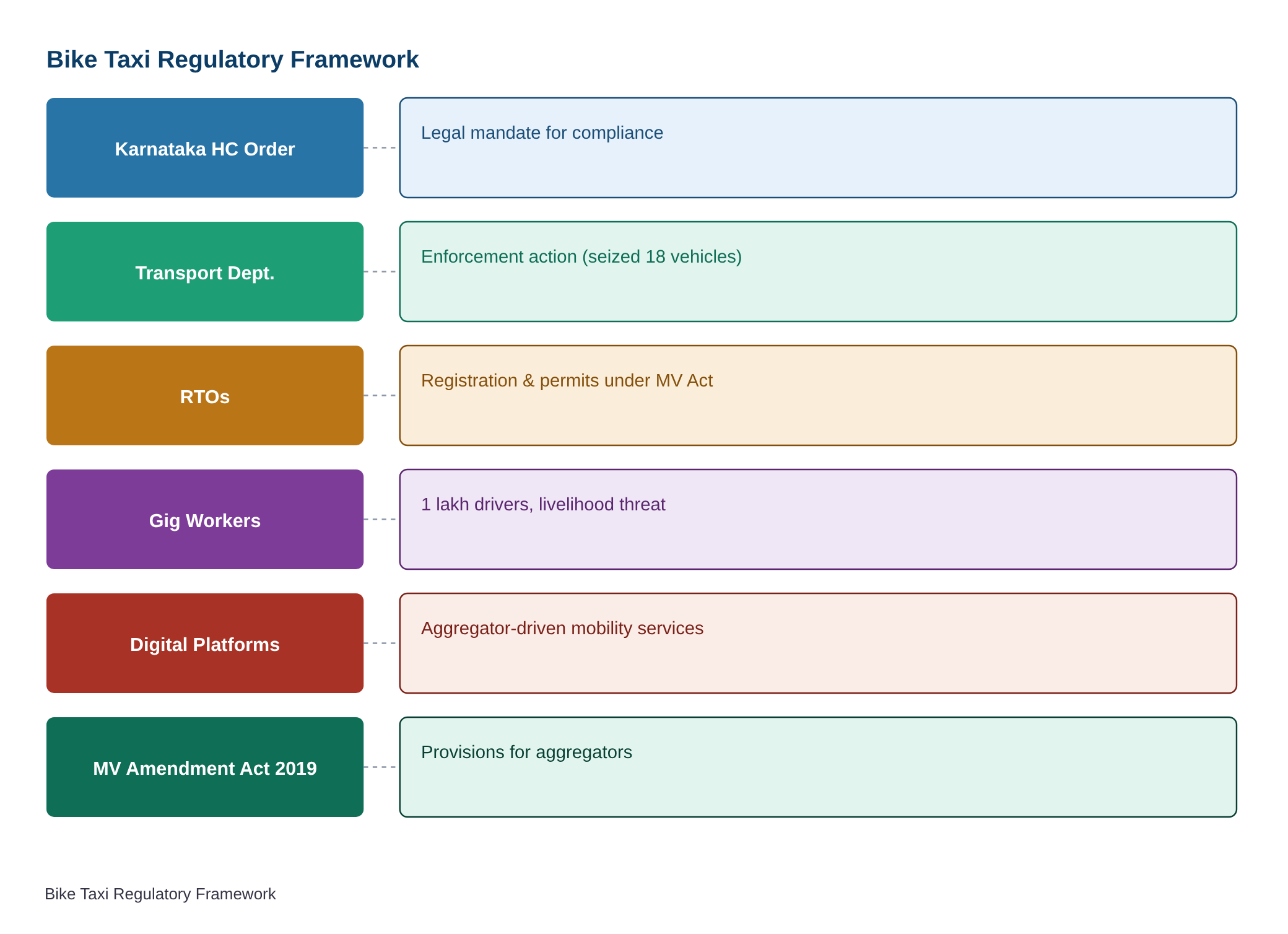
The Namma Bike Taxi Association has petitioned the Karnataka government to halt enforcement action against bike-taxi drivers, citing the absence of a legal compliance framework despite a Karnataka High Court order and repeated representations to the Transport Department. The association, representing over one lakh gig workers, argues that penalisation without prior guidance on registration, permits, and safety norms constitutes administrative injustice and threatens livelihoods. Concurrently, transport authorities conducted enforcement drives across Bengaluru, seizing 18 vehicles, underscoring the urgency of policy resolution.
Background
- Bike taxis operate as part of the gig economy, providing on-demand two-wheeler transport services through digital platforms, often utilising personal motorcycles repurposed for commercial use.
- The Karnataka High Court’s order catalysed demands for legal clarity, as it necessitated compliance with existing motor vehicle regulations, including registration, permits, and safety standards.
- Regional Transport Offices (RTOs) are statutorily responsible for vehicle registration and permit issuance under the Motor Vehicles Act, 1988, and the Karnataka Motor Vehicles Rules, 1989.
- The Motor Vehicles (Amendment) Act, 2019, introduced provisions for aggregator-driven mobility services, though implementation remains fragmented across states.
- Gig workers in the transport sector face precarious employment conditions, with limited access to social security and labour protections.
- The enforcement drives in Bengaluru reflect a broader trend of ad-hoc regulatory responses to emerging mobility solutions, often without prior stakeholder consultation.
What are bike taxis and their regulatory challenges?
- Bike taxis are app-based two-wheeler transport services that bridge gaps in last-mile connectivity, particularly in urban and peri-urban areas where traditional public transport is sparse.
- Under the Motor Vehicles Act, 1988, commercial use of vehicles requires registration under the ‘yellow board’ category, distinct from private ‘white board’ registration, with additional permits and insurance requirements.
- The Karnataka Motor Vehicles Rules, 1989, mandate commercial permits for vehicles operating as taxis, including bike taxis, but do not explicitly address app-based two-wheeler services.
- The gig economy’s growth has outpaced regulatory frameworks, creating ambiguity in the classification of bike-taxi drivers as employees, contractors, or self-employed individuals.
- Safety norms for bike taxis include helmet mandates, vehicle fitness certificates, and driver background verification, but enforcement is inconsistent due to lack of standardised guidelines.
- Digital platforms act as intermediaries, facilitating ride matching but complicating liability frameworks in cases of accidents or regulatory violations.
- The absence of a unified national policy on bike taxis has led to state-level inconsistencies, with some states (e.g., Delhi, Maharashtra) introducing pilot schemes while others remain unresponsive.
- Stakeholder consultations are critical to balance innovation with public safety, worker rights, and urban mobility goals, as mandated by the 2019 Motor Vehicles Amendment Act.
Key Features
| Feature | Significance |
|---|---|
| Legal ambiguity in bike taxi operations | Lack of clear guidelines on registration, commercial permits, and safety norms creates operational uncertainty for gig workers and transport authorities alike. |
| Enforcement drives without compliance framework | Penalising drivers without prior establishment of a legal framework violates principles of natural justice and disproportionately affects livelihoods of gig workers. |
| Stakeholder exclusion in policy formulation | Absence of bike taxi unions in consultations undermines participatory governance and risks policy outcomes being impractical or unenforceable. |
| Regional disparities in enforcement intensity | Disproportionate crackdown in Bengaluru East RTO (9 seizures out of 27 inspections) highlights administrative inconsistency and potential misuse of discretionary powers. |
| Conversion mechanism for white-board to yellow-board vehicles | A transparent process for re-registering personal motorcycles as commercial vehicles is essential for legalising bike taxi operations without disrupting existing transport infrastructure. |
Why it Matters
Economic
- Bike taxis constitute a significant segment of the gig economy in Karnataka, employing over one lakh drivers whose livelihoods are directly threatened by enforcement actions lacking legal clarity.
- The sector provides affordable last-mile connectivity, particularly in urban and peri-urban areas, and its disruption could exacerbate transport inequities.
- Uncertainty in policy discourages investment in the sector, stifling innovation and economic growth in the gig-work ecosystem.
Social
- Gig workers, predominantly from marginalised socio-economic backgrounds, face immediate economic precarity due to the crackdown, raising concerns about social security and labour rights.
- The absence of a formal framework for bike taxis perpetuates informality, denying workers access to social security benefits such as provident fund, insurance, or grievance redressal mechanisms.
- Urban mobility for low-income commuters may be adversely affected if bike taxis are driven out of the formal transport ecosystem.
Administrative
- Transport authorities must balance enforcement with the provision of clear, accessible compliance mechanisms to avoid arbitrary penalisation and ensure administrative accountability.
- The Karnataka High Court’s order necessitates a structured response from the state, highlighting the judiciary’s role in ensuring policy coherence in emerging sectors like gig economy transport.
Policy
- The incident underscores the need for a national-level regulatory framework for gig economy platforms, given the inter-state mobility of such services and the risk of regulatory arbitrage.
- State governments must adopt a consultative approach in policy formulation to prevent policy failures arising from top-down imposition without ground-level insights.
Challenges
1. Regulatory Vacuum in Emerging Sectors
- The absence of a statutory or executive framework for bike taxis leaves drivers in legal limbo, vulnerable to arbitrary enforcement actions.
- Transport departments lack standardised procedures for converting personal vehicles into commercial ones, delaying legalisation of existing operators.
UPSC Link: GS-II: Regulatory frameworks for emerging sectors
2. Gig Worker Vulnerability and Informality
- Gig workers lack formal employment contracts, social security, or dispute resolution mechanisms, exacerbating their precarious economic status.
- Enforcement actions without prior legalisation disproportionately target workers who lack the resources to navigate bureaucratic compliance.
UPSC Link: GS-II: Labour reforms and gig economy
3. Judicial Activism vs. Executive Inaction
- Judicial directives (e.g., Karnataka High Court order) often outpace executive preparedness, creating a governance gap where courts mandate action without administrative infrastructure.
- Delays in translating judicial orders into executive action undermine public trust in governance institutions.
UPSC Link: GS-II: Role of judiciary in policy implementation
4. Urban Mobility and Last-Mile Connectivity
- Disruption of bike taxi services could lead to increased reliance on informal or unsafe transport options, undermining urban mobility goals.
- Lack of integrated public transport planning risks fragmenting urban mobility solutions, particularly for low-income commuters.
UPSC Link: GS-III: Urban planning and transport infrastructure
5. Administrative Inconsistency and Discretionary Powers
- Variations in enforcement intensity across RTO jurisdictions (e.g., Bengaluru East vs. Bengaluru West) suggest arbitrary use of discretion, raising concerns about fairness and transparency.
- Absence of standardised SOPs for enforcement actions leads to inconsistent implementation, fostering corruption and harassment of drivers.
UPSC Link: GS-II: Good governance and administrative reforms
Challenges — UPSC Perspective
| Issue | Concern |
|---|---|
| Lack of statutory recognition for bike taxis | Operators operate in legal grey areas, risking sudden penalisation without recourse. |
| Absence of standardised conversion procedures | Delays in re-registering vehicles as commercial discourage formalisation. |
| Exclusion of stakeholders in policy formulation | Policies may become impractical or unenforceable without ground-level insights. |
| Disproportionate enforcement in specific RTO zones | Administrative inconsistency undermines fairness and transparency. |
| Gig workers’ lack of social security coverage | Informal employment status denies access to welfare benefits and legal protections. |
| Judicial directives outpacing executive action | Governance gaps delay implementation, eroding public trust in institutions. |
Way Forward
- The Karnataka government must immediately suspend enforcement actions against bike taxis until a transparent compliance framework is notified, ensuring no further penalisation of drivers.
- The Transport Department should issue detailed guidelines for converting white-board motorcycles into commercial yellow-board vehicles, including eligibility criteria, documentation, and timelines.
- Bike taxi unions must be included in all stakeholder consultations to ensure policies reflect ground realities and are practically implementable.
- A state-level task force comprising transport officials, gig worker representatives, and urban planners should be constituted to draft a comprehensive policy for bike taxis within three months.
- The task force should prioritise the integration of bike taxis with existing public transport systems, ensuring last-mile connectivity without disrupting formal transport networks.
- The government should explore the establishment of a grievance redressal mechanism for gig workers, including access to social security benefits such as insurance and provident fund.
- Pilot projects for bike taxi regulation in select urban areas (e.g., Bengaluru, Mysuru) should be initiated to test the efficacy of proposed frameworks before statewide implementation.
- The Centre should consider framing a Model Gig Economy Act to provide a uniform regulatory framework for states, addressing inter-state mobility and preventing regulatory arbitrage.
UPSC Value Addition
Keywords for Mains Answer-Writing
Gig economy regulation · Bike taxi policy framework · Regional Transport Offices (RTOs) · Karnataka High Court order · Commercial vehicle registration · Gig workers’ livelihood rights · Transport policy and enforcement · Public transport integration · Regulatory compliance mechanisms · Stakeholder consultations in policy-making
Constitutional & Policy Linkages
- Article 19(1)(g) – Freedom to practise any profession or occupation (right to livelihood)
- Article 21 – Right to life and personal liberty (includes right to livelihood and dignity of work)
- Article 41 – Directive Principle of State Policy (right to work and public assistance in case of unemployment)
Concept Flow
Karnataka High Court order on bike taxis → Transport Department’s inaction in providing compliance framework → Namma Bike Taxi Association’s representations → Crackdown and seizures without legal clarity → Gig workers’ livelihoods threatened → Demand for policy framework and stakeholder inclusion.
Prelims Practice Questions
Q1. Consider the following statements regarding the regulation of bike taxis in Karnataka:
1. The Namma Bike Taxi Association represents over one lakh bike taxi drivers and gig workers in Karnataka.
2. The Karnataka High Court has directed the state government to immediately halt enforcement action against bike taxi riders.
3. Regional Transport Offices (RTOs) in Karnataka have issued clear guidelines for converting white-board motorcycles into commercial yellow-board vehicles.
How many of the above statements are correct?
- Only one
- Only two
- All three
- None
Answer: Only two — Statement 1 is correct as per the report. Statement 2 is incorrect because the association has urged the government to halt enforcement action, not the High Court. Statement 3 is incorrect as the association alleges no guidelines have been issued by RTOs.
Q2. Assertion (A): The Namma Bike Taxi Association has sought the suspension of enforcement action against bike taxi riders until an official conversion mechanism is notified.
Reason (R): The association argues that penalising drivers without a legal compliance framework is unjust and threatens the livelihoods of gig workers.
Options:
A. Both A and R are true, and R is the correct explanation of A.
B. Both A and R are true, but R is not the correct explanation of A.
C. A is true, but R is false.
D. A is false, but R is true.
Answer: ? — Both Assertion (A) and Reason (R) are true, and R correctly explains A as the association’s demand for suspension is rooted in the absence of a legal compliance framework.
Q3. Match the following columns regarding the regulatory framework for bike taxis in Karnataka:
Column I
1. Namma Bike Taxi Association
2. Regional Transport Offices (RTOs)
3. Karnataka High Court
4. Joint Commissioner of Transport (Bengaluru Urban Division)
Column II
A. Issued clear guidelines for commercial vehicle registration
B. Represented by Mohammed Salim
C. Conducted inspections and seizures of bike taxis
D. Issued an order leading to enforcement actions
Options:
1-B, 2-A, 3-D, 4-C
1-A, 2-B, 3-D, 4-C
1-B, 2-D, 3-A, 4-C
1-D, 2-A, 3-B, 4-C
Answer: ? — 1-B: The association is represented by Mohammed Salim. 2-A: RTOs are alleged to have not issued clear guidelines. 3-D: The High Court’s order led to enforcement actions. 4-C: The Joint Commissioner conducted inspections and seizures.
Mains Practice Question
✍ The absence of a clear policy framework for bike taxis in Karnataka has led to a regulatory vacuum, adversely affecting gig workers’ livelihoods. Critically examine the challenges in regulating the gig economy in India, with reference to the constitutional and statutory provisions governing public transport and labour rights. Also, analyse the role of judicial interventions in shaping such regulatory frameworks. (15 Marks)
Approach: MODEL-ANSWER SKELETON:
1. **Introduction (2 Marks)**
– Define the gig economy and its significance in India (e.g., NITI Aayog’s 2021 report on gig workers).
– Contextualise the Karnataka bike taxi issue as a case study of regulatory gaps.
2. **Constitutional and Statutory Framework (4 Marks)**
– **Entry 24, List II (State List)**: Public health, safety, and transport fall under state jurisdiction (e.g., Motor Vehicles Act, 1988).
– **Article 19(1)(g)**: Right to practise any profession/occupation, subject to reasonable restrictions (e.g., State regulations under Entry 24).
– **Article 21**: Right to livelihood and dignity, requiring regulatory clarity to avoid arbitrary enforcement (e.g., Maneka Gandhi v. Union of India).
– **Code on Social Security, 2020**: Provisions for gig workers but lack of implementation mechanisms.
3. **Challenges in Regulating the Gig Economy (5 Marks)**
– **Fragmented Regulatory Approach**: Overlapping jurisdictions (Centre vs. State; RTOs vs. municipal bodies).
– **Lack of Standardisation**: Absence of uniform guidelines for commercial vehicle registration (e.g., white-board to yellow-board conversion).
– **Enforcement Arbitrariness**: Crackdowns without prior notice or compliance frameworks (e.g., Karnataka High Court’s order leading to ad-hoc enforcement).
– **Gig Workers’ Vulnerability**: Informal employment status, lack of social security, and collective bargaining rights (e.g., NITI Aayog’s 2021 report).
– **Technological and Operational Gaps**: Difficulty in tracking compliance (e.g., app-based aggregators vs. traditional RTO mechanisms).
4. **Judicial Interventions and Their Impact (3 Marks)**
– **Karnataka High Court Order (2026)**: Catalyst for enforcement actions but also highlighted the need for policy clarity.
– **Supreme Court’s Role**: Precedents on labour rights (e.g., PUDR v. Union of India) and public interest litigation (e.g., Bandhua Mukti Morcha v. Union of India).
– **Balancing Act**: Courts must ensure enforcement does not violate constitutional rights (e.g., proportionality principle in State of Punjab v. Mohinder Singh).
5. **Way Forward (1 Mark)**
– **Stakeholder Consultations**: Inclusion of gig workers’ unions in policy-making (e.g., NITI Aayog’s 2021 recommendations).
– **National-Level Framework**: Harmonisation of state laws under the Motor Vehicles Act (e.g., 2019 amendments).
– **Social Security Net**: Expansion of welfare schemes (e.g., PM Garib Kalyan Yojana) to cover gig workers.
Source: The Hindu
Generated by AanyaAi for educational purpose.

- आईआईडब्ल्यूडब्ल्यू 2026: जल सुरक्षा के लिए नवाचार, जलवायु-लचीलेपन और डिजिटल समाधान - September 24, 2026
- IIWW 2026: AI & Climate-Resilient Water Solutions for UPSC Mains - September 24, 2026
- राजस्थान पंचायत चुनाव 2026: सरपंच-वार्ड पदों की आरक्षण लॉटरी आज, जानिए आरक्षण तय करने की प्रक्रिया - September 24, 2026

No Comments