


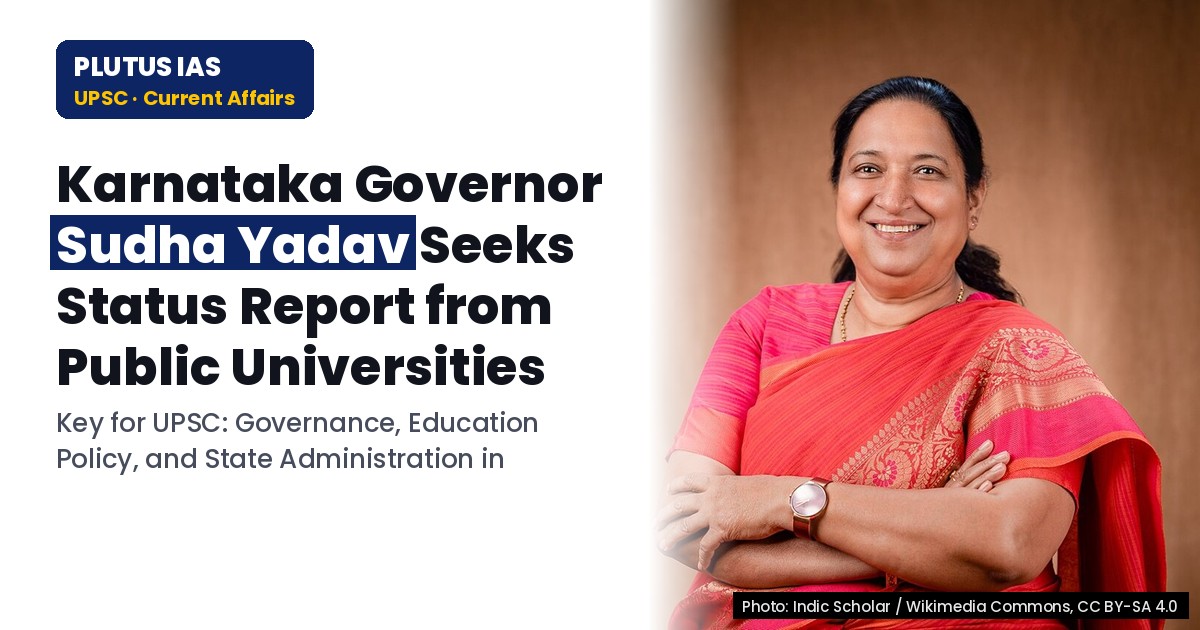
07 Nov Karnataka Governor Seeks Status Report on Public Universities
✎ The Governor, as Chancellor of state universities, holds statutory powers to oversee university administration, ensure accountability, and promote educational reforms, including the implementation of national and state education…
Subject Relevance — Where This Topic Fits
- GS Paper II — Polity and Governance | GS Paper II — Social Justice (Education)
- Prelims: Governor’s powers, Chancellor of Universities, State Higher Education Council, National Education Policy (NEP), State Education Policy, University governance
- Essay: The role of constitutional offices in promoting good governance, Higher education as a cornerstone of national development, Accountability and transparency in public institutions
Quick Revision: The Governor, as Chancellor of state universities, holds statutory powers to oversee university administration, ensure accountability, and promote educational reforms, including the implementation of national and state education policies.
Why is this in the news?
The Governor of Karnataka, acting in her capacity as Chancellor of state universities, has directed all public universities to undertake a comprehensive review of their operations. This directive mandates the submission of detailed reports outlining current status, achievements, challenges, shortcomings, and proposed improvements, with an emphasis on strengthening quality, transparency, accountability, and overall performance, alongside effective implementation of educational policies and industry-academia collaboration.
Background
- The Governor of a state serves as the ex-officio Chancellor of most state universities, a role distinct from their constitutional duties as Head of the State Executive.
- As Chancellor, the Governor typically holds powers related to appointments (e.g., Vice-Chancellors), overseeing university administration, and ensuring adherence to statutory provisions and academic standards.
- The National Education Policy (NEP) 2020 advocates for significant reforms in higher education, including multidisciplinary learning, skill development, research, and enhanced institutional autonomy coupled with accountability.
- State Education Policies are formulated to align with national objectives while addressing specific regional educational needs and priorities.
- The Karnataka State Higher Education Council plays a crucial role in advising the state government on higher education matters, coordinating university activities, and promoting quality and excellence.
- Regular reviews and status reports are essential mechanisms for assessing the efficacy of educational institutions, identifying areas for reform, and ensuring public accountability in the utilisation of resources.
The Governor as Chancellor of State Universities
- The Governor of a state is typically designated as the Chancellor of state universities by the respective state university acts.
- This role is statutory, meaning it is defined and conferred by specific legislation, rather than being an inherent constitutional function.
- As Chancellor, the Governor exercises supervisory powers over the universities, which may include presiding over convocations, approving statutes, and intervening in cases of maladministration or academic irregularities.
- A primary responsibility of the Chancellor is to uphold the academic standards and autonomy of the universities while ensuring their accountability to the public.
- The Chancellor often plays a critical role in the appointment of Vice-Chancellors, who are the principal academic and executive officers of a university.
- The powers and functions of the Chancellor are generally outlined in the university acts and statutes, varying slightly from one state to another.
- The Chancellor acts as a link between the state government and the universities, facilitating coordination while safeguarding institutional independence.
- The current directive from the Karnataka Governor exemplifies the Chancellor’s role in driving governance reforms and policy implementation within the state’s higher education system.
Key Features
| Feature | Significance |
|---|---|
| Governor’s Directive | The Governor, in her capacity as Chancellor of state universities, has mandated a comprehensive review of operations across all public universities in Karnataka. |
| Scope of Report | The required report from Vice-Chancellors must detail current status, key achievements, existing challenges, identified shortcomings, and proposed remedial measures for improvement. |
| Emphasis on Quality and Accountability | The directive underscores the imperative to enhance quality, transparency, accountability, and overall performance within the higher education system. |
| Policy Implementation Focus | Specific attention is directed towards the effective implementation of the National Education Policy (NEP) and the State Education Policy. |
| Industry-Academia Linkage | The Governor stressed the importance of robust coordination between industries and universities to foster skill development, research, innovation, and employability. |
| Collaborative Approach | A call for coordinated efforts between Vice-Chancellors and the Karnataka State Higher Education Council aims to strengthen the state’s higher education framework. |
Why it Matters
Governance and Administration
- The Governor’s intervention highlights the constitutional role of the Governor as Chancellor, ensuring oversight and accountability in state-funded educational institutions.
- The directive aims to streamline administrative processes and identify systemic inefficiencies within public universities, promoting good governance practices.
- It reinforces the principle of accountability for public funds and resources allocated to higher education, demanding transparent reporting on institutional performance.
Educational Quality and Standards
- The initiative is crucial for elevating the academic quality and research output of state universities, aligning them with national and international benchmarks.
- By focusing on challenges and shortcomings, the review facilitates targeted interventions to improve curriculum design, pedagogical methods, and faculty development.
- Emphasis on NEP and State Education Policy implementation ensures that higher education reforms are actively pursued and integrated into university operations.
Skill Development and Employability
- The push for stronger industry-university coordination is vital for bridging the skill gap and enhancing the employability of graduates.
- Promoting research and innovation within universities directly contributes to a knowledge-based economy and addresses contemporary societal and industrial needs.
- By aligning educational outcomes with market demands, the initiative supports human resource development critical for economic growth and competitiveness.
Challenges
1. Funding and Resource Allocation
- Public universities often face constraints in financial resources, impacting infrastructure development, research facilities, and faculty remuneration.
- Inefficient allocation or underutilisation of existing funds can hinder institutional growth and the implementation of quality improvement initiatives.
UPSC Link: Social Justice: Issues relating to development and management of Social Sector/Services relating to Education
2. Quality of Faculty and Research Output
- Attracting and retaining high-quality faculty members, especially in specialised fields, remains a persistent challenge for many state universities.
- The volume and quality of research publications, patents, and innovations may not consistently meet desired national or global standards.
UPSC Link: Human Resources: Issues relating to development and management of Social Sector/Services relating to Education
3. Curriculum Relevance and Employability
- Curricula in some universities may not be adequately updated to reflect contemporary industry requirements and emerging technological advancements.
- A disconnect between academic programs and industry needs can lead to a significant proportion of graduates lacking relevant skills for employment.
UPSC Link: Social Justice: Issues relating to development and management of Social Sector/Services relating to Education
4. Governance and Accountability Mechanisms
- Ensuring transparency in administrative decisions, financial management, and academic processes can be challenging in large public institutions.
- Establishing effective accountability frameworks to monitor performance and address grievances is crucial for maintaining public trust and institutional integrity.
UPSC Link: Governance: Transparency & Accountability and institutional and other measures.
5. Implementation of Education Policies
- Translating the broad objectives of national and state education policies into actionable strategies at the university level can encounter bureaucratic hurdles.
- Resistance to change, lack of adequate training, and insufficient resources can impede the effective adoption of new policy frameworks like the NEP.
UPSC Link: Social Justice: Issues relating to development and management of Social Sector/Services relating to Education
Challenges — UPSC Perspective
| Issue | Concern |
|---|---|
| Financial Autonomy and Dependence | Limited financial autonomy often makes public universities heavily reliant on state grants, potentially restricting innovation and strategic planning. |
| Bureaucratic Delays | Administrative processes within public universities can be characterised by delays, impacting timely decision-making and project implementation. |
| Infrastructure Deficiencies | Many institutions face challenges related to outdated infrastructure, inadequate laboratory facilities, and insufficient digital resources. |
| Faculty Shortages and Quality | Vacancies in faculty positions and the need for continuous professional development for existing faculty are critical issues affecting academic standards. |
| Research and Innovation Ecosystem | Developing a robust ecosystem that fosters high-quality research, patent generation, and entrepreneurial ventures remains an ongoing challenge. |
| Student Support Services | Ensuring adequate student support services, including career counselling, mental health support, and grievance redressal, is essential for holistic development. |
Government Initiatives — Must-Memorise for Prelims
- National Education Policy (NEP) 2020
Way Forward
- Implement a robust, data-driven performance evaluation framework for all public universities, linking funding to demonstrated outcomes and improvements.
- Facilitate greater financial autonomy for universities while ensuring stringent audit mechanisms to promote responsible resource management.
- Invest in faculty development programs, including training in modern pedagogy, research methodologies, and industry-relevant skills, to enhance teaching quality.
- Strengthen industry-academia linkages through collaborative research projects, internships, and curriculum co-creation to improve graduate employability.
- Leverage technology for administrative efficiency, digital learning resources, and transparent communication within universities and with stakeholders.
- Establish an independent higher education regulatory body with clear mandates for quality assurance, accreditation, and grievance redressal.
- Promote a culture of research and innovation by providing adequate funding, infrastructure, and incentives for faculty and students.
- Regularly review and update curricula to align with global trends, national priorities, and the evolving demands of the job market.
UPSC Value Addition
Keywords for Mains Answer-Writing
Governor’s role · Chancellor of universities · Higher education governance · National Education Policy (NEP) · State Education Policy · University autonomy · Accountability in higher education · Quality assurance in education · Skill development · Industry-academia collaboration · Research and innovation · Employability
Constitutional & Policy Linkages
- {‘article’: ‘Article 15 (3)’, ‘note’: ‘Special provisions for women and children’}
- {‘article’: ‘Article 21A’, ‘note’: ‘Right to Education for children’}
- {‘article’: ‘Article 41’, ‘note’: ‘Right to education, public assistance’}
- {‘article’: ‘Article 45’, ‘note’: ‘Provision for early childhood care’}
- {‘article’: ‘Article 46’, ‘note’: ‘Promotion of educational interests’}
Concept Flow
Governor, as Chancellor, mandates review of public universities. → Vice-Chancellors submit reports on status, achievements, challenges. → Reports inform assessment of quality, transparency, accountability. → Focus on NEP, State Education Policy implementation and industry linkage. → Identified areas for improvement lead to targeted reforms. → Enhanced higher education system promotes skill development and employability.
Prelims Practice Questions
Q1. Consider the following statements regarding the role of a State Governor in India:
1. The Governor acts as the Chancellor of state universities by virtue of their office.
2. The Governor is bound by the aid and advice of the Council of Ministers in all matters, including their functions as Chancellor.
3. The National Education Policy (NEP) 2020 advocates for increased governmental control over university administration.
How many of the above statements are correct?
- Only one
- Only two
- Only three
- None
Answer: Only one — Statement 1 is correct: In most states, the Governor is ex-officio Chancellor of state universities, a role distinct from their constitutional duties. Statement 2 is incorrect: The Governor’s role as Chancellor is generally considered statutory and not always subject to the aid and advice of the Council of Ministers, leading to debates on the extent of their discretionary powers in this capacity. Statement 3 is incorrect: The NEP 2020 emphasizes greater autonomy for higher education institutions, aiming to reduce external interference and promote self-governance, rather than increasing governmental control.
Q2. Which of the following committees or commissions is primarily associated with recommending reforms in higher education and university governance in India?
- Kothari Commission
- Sarkaria Commission
- Punchhi Commission
- Rajamannar Committee
Answer: Kothari Commission — The Kothari Commission (1964-66) extensively reviewed the entire education sector, including higher education, and made significant recommendations for its reform and development. The Sarkaria Commission and Punchhi Commission dealt with Centre-State relations, while the Rajamannar Committee also focused on Centre-State relations, specifically from Tamil Nadu’s perspective.
Mains Practice Question
✍ Critically examine the constitutional and statutory role of the Governor as Chancellor of state universities. Discuss the implications of this dual role for university autonomy and the quality of higher education in India. (15 Marks)
Approach: Introduction: Briefly introduce the Governor’s dual role as constitutional head of the state and ex-officio Chancellor of state universities.
Constitutional Role: Explain the Governor’s constitutional powers and functions under Articles 153-161, including acting on the aid and advice of the Council of Ministers (Article 163).
Statutory Role as Chancellor: Detail the Governor’s powers as Chancellor derived from state university acts, which often include appointing Vice-Chancellors, presiding over university convocations, and overseeing university administration. Highlight that this role is distinct from their constitutional duties.
Implications for University Autonomy: Discuss how the Chancellor’s extensive powers can potentially impinge on the academic and administrative autonomy of universities. Mention arguments for and against the Governor’s active involvement, including concerns about political interference versus ensuring accountability.
Implications for Quality of Higher Education: Analyze how the Chancellor’s oversight can contribute to or detract from the quality of education, transparency, and accountability. Refer to the objectives of the National Education Policy (NEP) 2020 regarding institutional autonomy and governance reforms.
Judicial Pronouncements/Committees: Briefly mention relevant Supreme Court judgments or recommendations by commissions (e.g., Punchhi Commission) that have commented on the Governor’s role as Chancellor.
Conclusion: Offer a balanced perspective on the need to balance accountability with autonomy, suggesting reforms to streamline the governance structure of state universities.
Source: The Hindu
Karnataka PCS (KPSC) — State PCS Practice
Prelims: The Governor of Karnataka recently sought a status report on all public universities in the state. Under which constitutional provision does the Governor typically act as the Chancellor of state universities?
- Article 153
- Article 163
- State University Acts
- Article 356
Answer: State University Acts — The Governor’s role as Chancellor of state universities is primarily derived from the specific State University Acts enacted by the respective state legislatures, not directly from the Constitution.
Mains: Analyze the constitutional and statutory powers of the Governor of Karnataka with respect to public universities in the state, particularly in the context of seeking status reports. Discuss the implications of such actions for university autonomy and governance.
Generated by AanyaAi for educational purpose.
Related guides on our sites
- Best PSIR optional coaching for upsc
- Best economics optional coaching for upsc
- Best PSIR optional teacher for upsc
- Best teacher of PSIR optional for upsc

- Karnataka Governor Seeks Status Report on Public Universities - November 7, 2026
- बॉम्बे हाई कोर्ट ने अनन्या पांडे के व्यक्तित्व अधिकारों की रक्षा की - November 7, 2026
- Bombay HC Upholds Personality Rights, Curbs AI Misuse - November 7, 2026

No Comments