


21 Sep Karnataka HC forms SIT to probe KPSC recruitment scam: Key facts for UPSC
✎ The KPSC functions under constitutional provisions (Articles 315-323), and its integrity is safeguarded by judicial review, investigative agencies like the ED under PMLA, and institutional mechanisms such as SITs to address…
Subject Relevance — Where This Topic Fits
- GS Paper II — Functions and Responsibilities of the Union and the States, Constitutional and Statutory Bodies | GS Paper II — Structure, Organization and Functioning of the Executive and the Judiciary | GS Paper III — Ethics and Integrity in Governance | GS Paper IV — Probity in Governance: Challenges of Corruption
- Prelims: Karnataka Public Service Commission (KPSC), Special Investigation Team (SIT), Prevention of Money Laundering Act (PMLA), Enforcement Directorate (ED), Constitutional provisions under Article 315-323, First Information Report (FIR), CBI vs State Police vs SIT, Group C and Group B posts in civil services, Industrial Extension Officer, Veterinary Officer, Money laundering, Criminal conspiracy under IPC, Constitutional morality, Judicial review of administrative actions
- Essay: The Role of Institutions in Upholding Constitutional Morality: A Case Study of KPSC Recruitment Scams, Ethics in Governance: Balancing Transparency and Efficiency in Civil Services Recruitment
Quick Revision: The KPSC functions under constitutional provisions (Articles 315-323), and its integrity is safeguarded by judicial review, investigative agencies like the ED under PMLA, and institutional mechanisms such as SITs to address allegations of corruption and irregularities in civil services recruitment.
Why is this in the news?
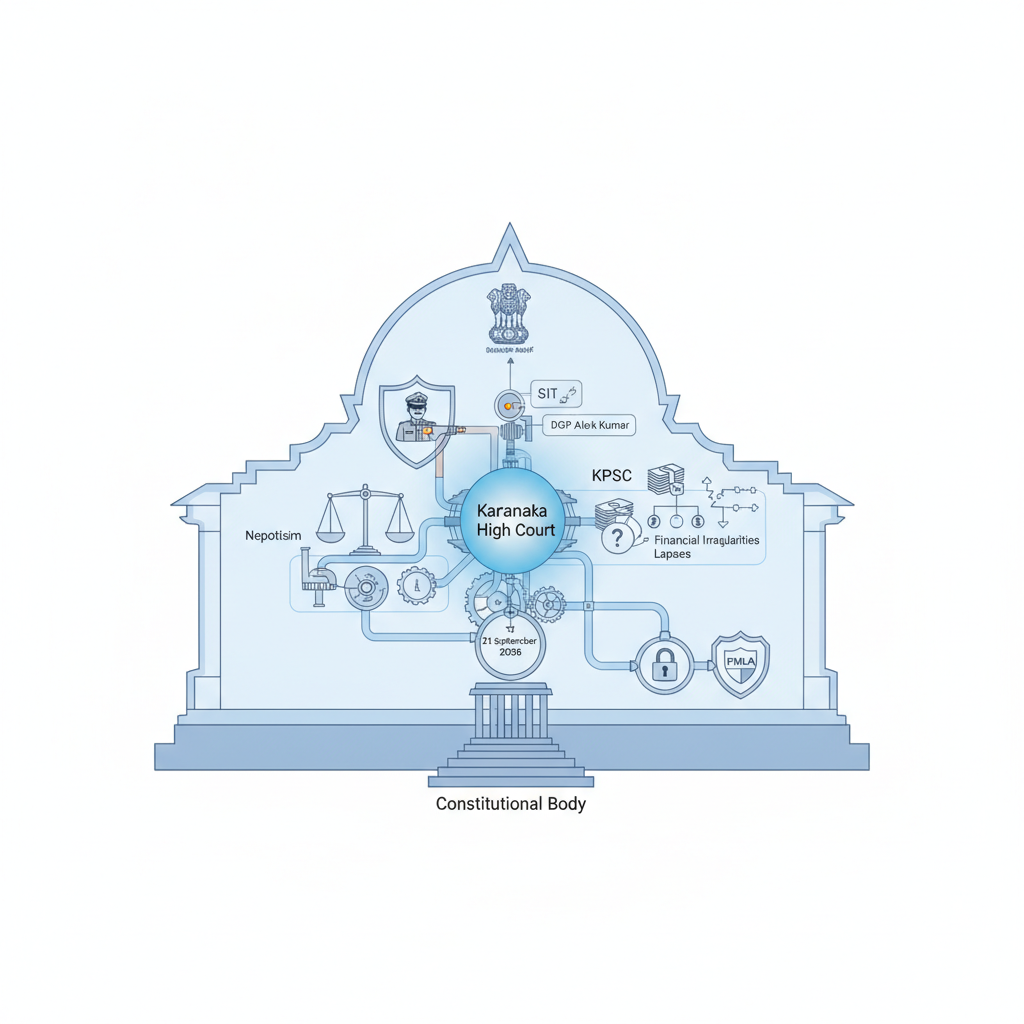
The Karnataka High Court’s constitution of a Special Investigation Team (SIT) headed by the Director General of Police to probe alleged irregularities in the Karnataka Public Service Commission (KPSC) recruitment process underscores the critical importance of institutional integrity in civil services examinations. The order, passed on 21 September 2026, directs a de novo investigation into cases involving nepotism, financial irregularities, and procedural lapses, while mandating cooperation with the Enforcement Directorate (ED) under the Prevention of Money Laundering Act (PMLA). This development highlights the interplay between constitutional bodies, investigative agencies, and judicial oversight in addressing governance failures.
Background
- The Karnataka Public Service Commission (KPSC) is a constitutional body established under Article 315 of the Constitution of India, responsible for conducting recruitment examinations for state civil services, including Group A, B, and C posts.
- Allegations of irregularities in KPSC recruitments have surfaced periodically, with specific concerns raised about the selection of candidates for posts such as Industrial Extension Officer (Group C) and Veterinary Officer (Group B), including instances of alleged nepotism and financial malpractices.
- The Enforcement Directorate (ED) has been investigating certain aspects of the KPSC recruitment scam under the Prevention of Money Laundering Act (PMLA), indicating potential money laundering linked to job allocations.
- The High Court’s intervention follows petitions filed by legislators and student associations, seeking a thorough and independent probe into the alleged irregularities, including the transfer of two First Information Reports (FIRs) from local police to the SIT for further investigation.
- The KPSC chairperson’s suspension and subsequent legal proceedings reflect the institutional mechanisms available to address misconduct within constitutional bodies, including executive and judicial oversight.
- This case exemplifies the broader challenge of maintaining probity in governance, particularly in recruitment processes that are susceptible to corruption and favoritism.
Constitutional Framework and Institutional Safeguards for Public Service Commissions
- The KPSC operates under the provisions of the Constitution of India, specifically Articles 315 to 323, which establish Public Service Commissions for the Union and States, ensuring their independence and impartiality in recruitment processes.
- Article 320 mandates that the functions of a Public Service Commission shall include conducting examinations for appointments to services and posts under the State, and advising the State Government on matters relating to methods of recruitment and disciplinary matters.
- The KPSC is empowered to frame rules for recruitment, conduct examinations, and recommend candidates for appointment, thereby acting as a critical gatekeeper for merit-based civil service recruitment.
- The Constitution provides for the removal and suspension of the Chairperson or members of a Public Service Commission under Article 317, which includes misbehaviour or incapacity, ensuring accountability within the institution.
- The Prevention of Corruption Act, 1988, and the Indian Penal Code (IPC) provide legal frameworks to address bribery, criminal conspiracy, and abuse of official position, applicable to both candidates and officials involved in recruitment irregularities.
- The Prevention of Money Laundering Act (PMLA), 2002, empowers the Enforcement Directorate (ED) to investigate financial trails linked to corrupt practices, including those in recruitment processes, where illicit funds may be involved.
- Judicial review, as exercised by the Karnataka High Court, ensures that constitutional bodies and investigative agencies adhere to due process, transparency, and the rule of law, reinforcing public trust in governance institutions.
- Special Investigation Teams (SITs) are constituted by courts or governments to conduct impartial and time-bound investigations into complex or sensitive cases, often involving high-ranking officials or systemic failures.
Key Features
| Feature | Significance |
|---|---|
| Constitution of Special Investigation Team (SIT) | Ensures a structured, time-bound, and high-level inquiry into alleged irregularities in KPSC recruitment processes, enhancing public trust in institutional integrity. |
| De novo investigation mandate | Directs the SIT to conduct a fresh probe, independent of prior investigations, to uncover systemic flaws or malfeasance in KPSC operations. |
| Coordination with Enforcement Directorate (ED) | Facilitates cross-agency synergy to address potential financial crimes under the Prevention of Money Laundering Act (PMLA), ensuring comprehensive legal coverage. |
| Transfer of FIRs to SIT | Centralises investigative authority, preventing duplication of efforts and ensuring focused scrutiny of specific allegations, such as nepotism and bribery. |
| 100-day completion timeline | Imposes a strict deadline to expedite justice, mitigate delays, and restore credibility to the recruitment process. |
Why it Matters
Institutional Integrity
- The SIT’s formation underscores the judiciary’s proactive role in safeguarding the credibility of constitutional bodies like the KPSC, which are pivotal for merit-based public service recruitment.
- Allegations of nepotism and financial irregularities threaten the foundational principle of fairness in public employment, necessitating impartial oversight.
- The probe’s outcome will influence public perception of the KPSC’s autonomy and the state’s commitment to anti-corruption measures.
Legal and Procedural Rigour
- The de novo investigation mandate ensures that prior probes, if flawed, do not prejudice the current inquiry, aligning with the rule of law.
- Coordination with the ED highlights the intersection of administrative and financial crimes, reinforcing the state’s capacity to tackle systemic corruption.
- The transfer of FIRs to the SIT centralises accountability, preventing jurisdictional conflicts and ensuring focused legal action.
Governance and Accountability
- The High Court’s intervention demonstrates the judiciary’s role as a check on executive and administrative bodies, upholding constitutional governance.
- The 100-day deadline imposes accountability on investigating agencies, reducing the risk of protracted inquiries that erode public trust.
- The probe’s findings could lead to structural reforms in KPSC’s recruitment processes, enhancing transparency and reducing vulnerabilities to malpractice.
Challenges
1. Systemic Corruption in Recruitment Bodies
- Deep-rooted irregularities in public service commissions erode public confidence in merit-based recruitment, undermining the social contract between citizens and the state.
- Nepotism and favouritism in appointments distort equal opportunity, contravening constitutional guarantees of fairness under Articles 14 and 16.
- Financial irregularities, such as bribery or embezzlement, divert public resources and compromise the integrity of institutions tasked with nation-building.
UPSC Link: GS-II: Role of Constitutional Bodies
2. Coordination Among Investigative Agencies
- Ensuring seamless collaboration between the SIT, ED, and other agencies (e.g., CID, SHRC) is critical to avoid duplication, conflicts, or gaps in evidence gathering.
- Differences in investigative mandates or legal frameworks may hinder unified action, necessitating clear protocols for inter-agency cooperation.
- Delays in sharing intelligence or evidence could impede the probe’s progress, particularly given the 100-day deadline.
UPSC Link: GS-II: Federalism and Cooperative Federalism
3. Public Perception and Trust Deficit
- Allegations of corruption in KPSC recruitment have already sparked public outrage, requiring transparent communication to restore faith in the institution.
- Politicisation of the issue risks overshadowing the legal and administrative dimensions, potentially polarising stakeholders.
- The probe’s findings must be communicated effectively to the public to demonstrate accountability and deter future malpractices.
UPSC Link: GS-IV: Ethics in Governance
4. Legal and Constitutional Safeguards
- Balancing the need for a thorough probe with the rights of accused individuals (e.g., presumption of innocence) is a delicate challenge for investigating agencies.
- Ensuring that the SIT operates within the bounds of the Constitution and statutory provisions (e.g., PMLA) is essential to avoid legal challenges.
- The probe must adhere to due process to prevent misuse of investigative powers, which could undermine its credibility.
UPSC Link: GS-II: Judiciary and Constitutional Framework
5. Structural Reforms in Recruitment Processes
- Identifying systemic flaws in KPSC’s recruitment processes (e.g., transparency in selection, anti-nepotism policies) is critical to prevent recurrence.
- Implementing technological solutions (e.g., AI-driven candidate screening, blockchain for record-keeping) could reduce human interference and enhance integrity.
- Strengthening whistleblower protections and internal audits may deter future irregularities and foster a culture of accountability.
UPSC Link: GS-II: Public Policy and Governance
Challenges — UPSC Perspective
| Issue | Concern |
|---|---|
| Nepotism and favouritism | Undermines meritocracy and equal opportunity in public employment, violating constitutional principles. |
| Financial irregularities (e.g., bribery) | Compromises the integrity of recruitment processes and diverts public resources. |
| Inter-agency coordination gaps | Risk of duplication, conflicts, or delays in investigations, impeding justice. |
| Public trust deficit | Erodes confidence in constitutional bodies and governance, necessitating transparent communication. |
| Legal and procedural safeguards | Balancing investigative rigour with due process to avoid misuse of power or legal challenges. |
| Structural vulnerabilities in KPSC | Identifying and rectifying systemic flaws to prevent recurrence of irregularities. |
Way Forward
- Conduct a comprehensive audit of KPSC’s recruitment processes to identify systemic vulnerabilities and recommend structural reforms.
- Implement transparent, technology-driven solutions (e.g., digital record-keeping, AI-based candidate screening) to minimise human interference.
- Strengthen whistleblower protections and establish an independent oversight body to monitor KPSC’s operations periodically.
- Ensure seamless coordination between the SIT, ED, and other agencies through joint task forces and shared intelligence protocols.
- Communicate the probe’s progress and findings transparently to the public to restore trust in the institution.
- Enact anti-nepotism policies and strict conflict-of-interest rules for KPSC members and staff.
- Develop a grievance redressal mechanism for candidates to report irregularities without fear of retaliation.
- Collaborate with civil society organisations and academic institutions to design ethical recruitment frameworks.
UPSC Value Addition
Keywords for Mains Answer-Writing
Karnataka Public Service Commission (KPSC) · Special Investigation Team (SIT) · Constitutional bodies and their accountability · Probe into irregularities in public service commissions · Judicial oversight of executive bodies · Enforcement Directorate (ED) and PMLA · Constitutional provisions for public service commissions · Checks and balances in governance · Administrative reforms in recruitment processes · Judicial activism in administrative matters
Constitutional & Policy Linkages
- Article 14: Equality before law and equal protection of laws (applicable to fair recruitment processes).
- Article 16: Equality of opportunity in public employment (directly relevant to KPSC’s mandate).
- Article 323: Functions and powers of Public Service Commissions (KPSC’s constitutional basis).
Concept Flow
Allegations of irregularities in KPSC recruitment → Public interest litigation and petitions filed in Karnataka High Court → Court orders constitution of SIT headed by DGP Alok Kumar → SIT undertakes de novo investigation and coordinates with ED → Probe uncovers systemic flaws or malfeasance → Findings inform structural reforms in KPSC → Recommendations implemented to restore integrity and public trust
Prelims Practice Questions
Q1. Consider the following statements regarding the Special Investigation Team (SIT) constituted by the Karnataka High Court to probe KPSC irregularities:
1. The SIT is headed by the Director General of Police (DGP) of Karnataka.
2. The SIT has been granted 100 days to complete its investigation and submit a report.
3. The SIT is empowered to investigate offences under the Prevention of Money Laundering Act (PMLA) independently, without coordination with the Enforcement Directorate (ED).
How many of the above statements are correct?
- Only one
- Only two
- All three
- None
Answer: Only two — Statement 1 is correct as the SIT is headed by DGP Alok Kumar. Statement 2 is correct as the High Court has given 100 days to the SIT. Statement 3 is incorrect as the SIT is required to cooperate with the ED, which is already investigating the cases under PMLA.
Q2. Assertion (A): The Constitution of India empowers the High Courts to constitute Special Investigation Teams (SITs) for probing irregularities in state-level institutions.
Reason (R): The High Courts derive this power from Article 226 of the Constitution, which grants them the authority to issue writs for enforcement of fundamental rights and for other purposes.
In the context of the above two statements, which of the following is correct?
- Both A and R are true, and R is the correct explanation of A.
- Both A and R are true, but R is not the correct explanation of A.
- A is true, but R is false.
- A is false, but R is true.
Answer: Both A and R are true, but R is not the correct explanation of A. — The High Courts can constitute SITs under Article 226 for probing irregularities, including those in state institutions like the KPSC. The power to issue writs under Article 226 is broad and includes directing investigations, making R the correct explanation of A.
Q3. Match the following columns related to the KPSC irregularities case:
Column I (Entity) | Column II (Role/Action)
——————|———————–
A. Karnataka High Court | 1. Constituted an SIT headed by DGP Alok Kumar
B. Enforcement Directorate (ED) | 2. Investigating cases under the Prevention of Money Laundering Act (PMLA)
C. KPSC Chairperson | 3. Suspended for alleged irregularities in recruitment
D. All Karnataka State Students’ Association | 4. Filed a petition seeking probe into KPSC irregularities
Select the correct match:
- A-1, B-2, C-3, D-4
- A-2, B-1, C-3, D-4
- A-3, B-2, C-1, D-4
- A-4, B-1, C-2, D-3
Answer: A-1, B-2, C-3, D-4 — The Karnataka High Court (A) constituted the SIT (1). The ED (B) is investigating under PMLA (2). The KPSC Chairperson (C) was suspended (3). The All Karnataka State Students’ Association (D) filed a petition (4).
Mains Practice Question
✍ The establishment of a Special Investigation Team (SIT) by the Karnataka High Court to probe alleged irregularities in the Karnataka Public Service Commission (KPSC) reflects the judiciary’s expanding role in ensuring accountability of constitutional bodies. Critically examine the constitutional and administrative implications of such judicial interventions in the functioning of public service commissions. Also, discuss the mechanisms available under the Constitution to address systemic failures in such institutions. (15 Marks)
Approach: MODEL-ANSWER SKELETON:
1. **Judicial Intervention and Constitutional Framework**
– Article 226 of the Constitution: Power of High Courts to issue writs, including directions for investigations.
– Judicial activism vs. separation of powers: Balancing judicial oversight with executive autonomy.
– Precedents: Reference to cases like Vineet Narain v. Union of India (1996) on judicial supervision of investigative agencies.
2. **Role of Public Service Commissions**
– Constitutional mandate under Article 315-323: Independence and functions of State Public Service Commissions (SPSCs).
– KPSC’s constitutional status and its role in recruitment to civil services.
– Systemic issues: Allegations of nepotism, corruption, and lack of transparency in KPSC recruitments.
3. **Administrative and Institutional Reforms**
– Need for structural reforms: Strengthening internal accountability mechanisms in SPSCs.
– Role of the Union Public Service Commission (UPSC) in guiding state commissions.
– Recommendations of committees like the Second Administrative Reforms Commission (2005) on civil service reforms.
4. **Mechanisms for Addressing Failures**
– Article 323: Power of Parliament/State Legislatures to regulate SPSCs.
– Role of the Governor in suspending or removing chairpersons (Article 317).
– Judicial review under Article 226 and Article 32: Ensuring constitutional governance.
5. **Contemporary Context and Way Forward**
– Recent reforms in other states (e.g., Tamil Nadu’s Public Service Commission reforms).
– Importance of transparency in recruitment processes: Use of technology (AI, blockchain) for fair selection.
– Role of civil society and media in exposing irregularities.
6. **Balancing Views**
– Argument for judicial intervention: Ensures accountability and public trust.
– Counter-argument: Overreach may undermine institutional autonomy and lead to executive-legislative friction.
Source: The Hindu
Karnataka PCS (KPSC) — State PCS Practice
Prelims: Which of the following is the primary objective of the Special Investigation Team (SIT) constituted by the Karnataka High Court to probe KPSC irregularities?
- To investigate alleged irregularities in the KPSC Group A and Group B examinations
- To review the administrative functioning of the KPSC Secretariat
- To assess the eligibility criteria for KPSC recruitments
- To recommend reforms in the KPSC examination evaluation process
Answer: To investigate alleged irregularities in the KPSC Group A and Group B examinations — The SIT, headed by DGP Alok Kumar, was formed to probe alleged irregularities specifically in the KPSC Group A and Group B examinations.
Mains: Critically analyze the role of the Karnataka High Court in constituting the SIT to investigate KPSC irregularities. How does this intervention reflect on the autonomy and accountability of the Karnataka Public Service Commission (KPSC)? Discuss with reference to constitutional provisions and judicial precedents.
Generated by AanyaAi for educational purpose.
Related guides on our sites
- Current affairs for upsc 2026
- Best PSIR optional coaching for upsc
- Best PSIR optional teacher for upsc
- Best teacher of PSIR optional for upsc

- कुल्लू: NHPC की पार्वती-2 परियोजना के खिलाफ एफआईआर, 12 सदस्यीय जांच समिति गठित - September 21, 2026
- NHPC Tunnel Leak in Kullu: FIR Filed, 5-Day Probe Deadline for Project Failures - September 21, 2026
- भारत ने जी20 ऊर्जा सहमति में किया शामिल, जानिए प्रमुख समझौते - September 21, 2026

No Comments