


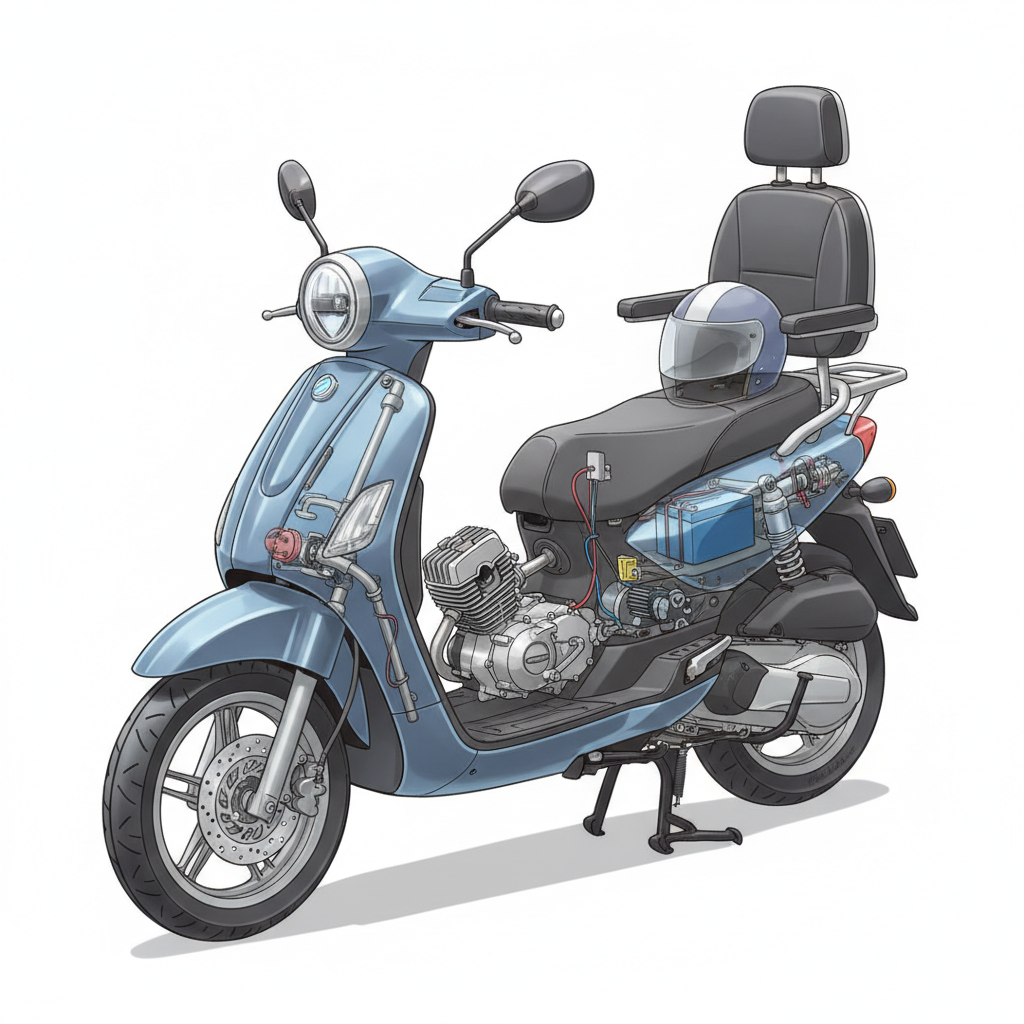
11 Aug Karnataka Tells Supreme Court: Bike Taxis Not Public Transport Vehicles
✎ Under the Motor Vehicles Act, 1988, the grant of permits for contract carriages is a discretionary power of Regional Transport Authorities, subject to public safety and regulatory scrutiny, and motorcycles are not automatically…
Subject Relevance — Where This Topic Fits
- GS Paper II — Governance, Constitution and Polity (Statutory Interpretation, Judicial Review) | GS Paper III — Infrastructure, Transport and Services Sector (Regulation of Transport Services, Public Safety Standards)
- Prelims: Motor Vehicles Act, 1988, Contract Carriage Permit, Regional Transport Authority (RTA), Karnataka Platform-Based Gig Workers (Social Security and Welfare) Act, 2025, Public Transport Vehicle, Statutory Framework for Permits, Judicial Review of State Regulations
- Essay: The Role of Judicial Review in Balancing Innovation and Public Safety in Transport Regulation, Ethical Governance: Reconciling Economic Opportunities with Public Welfare in the Gig Economy
Quick Revision: Under the Motor Vehicles Act, 1988, the grant of permits for contract carriages is a discretionary power of Regional Transport Authorities, subject to public safety and regulatory scrutiny, and motorcycles are not automatically classified as transport vehicles eligible for such permits.
Why is this in the news?
The Karnataka government’s submission to the Supreme Court on 11 August 2026, asserting that motorised two-wheelers (bike taxis) do not qualify as public transport vehicles and that their regulation must prioritise public safety and statutory scrutiny, has brought into sharp focus the legal and policy challenges surrounding the integration of gig-economy transport services within India’s existing regulatory framework. The case underscores the tension between commercial innovation, judicial interpretation of statutory definitions, and the state’s duty to ensure safety and order in public transport systems.
Background
- The Motor Vehicles Act, 1988 (MVA, 1988) governs the regulation of transport vehicles in India, including the issuance of permits for contract carriages, which are vehicles adapted for the carriage of passengers for hire or reward.
- Public transport vehicles are typically defined under the MVA as those used for carrying passengers on hire, including buses, taxis, and auto-rickshaws, and are subject to stringent safety and operational standards.
- The Karnataka High Court, in a Division Bench judgment in January 2026, held that motorcycles could be classified as ‘transport vehicles’ under the MVA and directed the State to consider grant of contract carriage permits for bike taxis, overturning an earlier Single Bench order that had stayed such services pending policy formulation.
- The State government has argued that the High Court’s interpretation dilutes the discretionary powers of Regional Transport Authorities (RTAs) to refuse permits based on public safety concerns, regulatory preparedness, and the suitability of vehicles for public transport.
- Karnataka’s stance aligns with the broader policy objective of ensuring that only vehicles meeting prescribed safety standards are permitted for commercial passenger transport, thereby mitigating risks associated with higher accident fatality rates and congestion.
- The case also intersects with the Karnataka Platform-Based Gig Workers (Social Security and Welfare) Act, 2025, which provides a statutory framework for the welfare and social security of gig workers, though it does not extend to regulating the vehicles used for such work.
What are Bike Taxis and How Are They Regulated Under Indian Law?
- Bike taxis refer to motorised two-wheelers used for transporting passengers on hire, typically facilitated through digital platforms or aggregators, and fall within the broader category of gig-economy transport services.
- Under the Motor Vehicles Act, 1988, the term ‘transport vehicle’ encompasses vehicles used for carrying passengers for hire or reward, including contract carriages, stage carriages, and auto-rickshaws; motorcycles are not explicitly listed as transport vehicles.
- The MVA empowers Regional Transport Authorities (RTAs) to grant or refuse permits for contract carriages based on considerations such as public safety, suitability of the vehicle, and regulatory preparedness, rather than granting permits automatically.
- A ‘contract carriage’ is defined under the MVA as a motor vehicle used for the purpose of carrying passengers on hire for a fixed or agreed route or distance, and for a fixed or agreed fare, which may or may not include a return journey.
- The Karnataka High Court’s January 2026 judgment interpreted motorcycles as falling within the ambit of ‘transport vehicles’ by equating them with motor cabs and contract carriages, a decision contested by the State on grounds of statutory misconstruction.
- The State’s argument hinges on the distinction between vehicles designed for passenger safety (e.g., taxis with enclosed cabins) and motorcycles, which lack structural protections for passengers and are inherently riskier in the event of accidents.
- The MVA does not provide a blanket prohibition on the use of motorcycles for commercial purposes, but it does restrict their use for carrying passengers for hire, thereby protecting public safety and ensuring compliance with vehicle-specific safety standards.
- The case highlights the need for a clear policy framework to govern emerging transport services, balancing economic opportunities for gig workers with the state’s obligation to ensure public safety and order.
Key Features
| Feature | Significance |
|---|---|
| Statutory definition of ‘transport vehicles’ under the Motor Vehicles Act, 1988 | Determines the legal classification of vehicles eligible for passenger transport permits, impacting operational legitimacy of bike taxis. |
| Permit regime for contract carriage services | Ensures regulatory oversight over passenger transport, balancing commercial viability with public safety and infrastructure constraints. |
| State discretion in permit issuance | Allows regional authorities to assess vehicle suitability, safety standards, and traffic conditions before granting permits. |
| Public safety considerations in two-wheeler operations | Highlights accident fatality rates, vulnerability of riders/passengers, and congestion impacts in urban transport planning. |
| Gig economy welfare frameworks (Karnataka Platform-Based Gig Workers Act, 2025) | Provides statutory safeguards for alternative livelihoods in platform-based services, distinct from traditional public transport models. |
Why it Matters
Regulatory Governance
- Delineates the boundary between commercial and public transport operations under the Motor Vehicles Act, 1988, ensuring uniform application of safety norms.
- Reinforces the principle of subsidiarity in transport regulation, empowering State Transport Authorities to tailor policies to local conditions.
- Clarifies the role of judicial review in statutory interpretation, particularly where High Court judgments conflict with executive policy.
Urban Mobility and Safety
- Exposes the trade-offs between informal transport solutions (bike taxis) and formal public transport systems in congested urban centres.
- Underscores the need for data-driven policy on accident risks associated with two-wheelers in commercial passenger services.
- Highlights the tension between economic inclusion (livelihood opportunities) and safety imperatives in gig economy regulation.
Judicial-Executive Interface
- Illustrates the dynamics of judicial review over administrative discretion in permit regimes, especially in emerging sectors like platform-based mobility.
- Demonstrates the Supreme Court’s role in resolving conflicts between High Court rulings and State policies, ensuring constitutional harmony.
Challenges
1. Regulatory Arbitrage vs. Public Interest
- Risk of States adopting inconsistent approaches to bike taxi operations, leading to regulatory arbitrage and safety lacunae.
- Challenge of balancing commercial flexibility for gig workers with mandatory safety and welfare standards.
- Potential for judicial overreach in redefining statutory categories, undermining executive policymaking.
UPSC Link: GS-II: Government Policies and Interventions
2. Safety Standardisation for Two-Wheelers
- Absence of uniform safety protocols for two-wheelers in passenger transport, despite higher fatality rates in accidents.
- Need for retrofitting solutions (e.g., safety harnesses, helmet mandates) to mitigate risks in bike taxi operations.
- Data gaps on accident patterns involving bike taxis, impeding evidence-based policy formulation.
UPSC Link: GS-III: Infrastructure and Safety
3. Policy Fragmentation in Gig Economy
- Overlap between transport regulations and gig worker welfare laws, creating ambiguity in compliance requirements.
- Challenge of integrating informal transport sectors into formal regulatory frameworks without stifling innovation.
- Requirement for inter-departmental coordination between Transport and Labour Departments to address dual compliance burdens.
UPSC Link: GS-II: Welfare Schemes for Vulnerable Sections
4. Judicial Review and Policy Primacy
- Tension between judicial interpretation of statutory definitions and executive policy objectives in transport governance.
- Risk of High Court judgments preempting legislative or executive action, leading to policy paralysis.
- Need for clear legislative guidance on the classification of emerging mobility solutions under existing transport laws.
UPSC Link: GS-II: Judiciary and Constitutional Framework
5. Urban Congestion and Alternate Mobility
- Bike taxis as a stopgap solution in cities with inadequate public transport infrastructure, complicating regulatory enforcement.
- Challenge of designing multi-modal transport policies that integrate informal and formal systems without compromising safety.
- Requirement for investment in last-mile connectivity solutions to reduce reliance on unregulated transport modes.
UPSC Link: GS-III: Urbanisation and Infrastructure
Challenges — UPSC Perspective
| Issue | Concern |
|---|---|
| Statutory ambiguity in vehicle classification | Creates legal uncertainty for operators and regulators, leading to conflicting judicial interpretations. |
| Safety risks in two-wheeler passenger transport | Higher fatality rates and lack of structural safety features in motorcycles pose public health risks. |
| Policy incoherence between transport and labour laws | Overlapping jurisdictions create compliance burdens and regulatory gaps for gig workers. |
| Judicial interference in executive policymaking | High Court rulings may encroach on State’s discretionary powers under the Motor Vehicles Act. |
| Urban mobility gaps and informal transport reliance | Inadequate public transport infrastructure fuels demand for unregulated bike taxi services. |
| Data paucity on accident patterns in bike taxis | Lack of empirical evidence hinders evidence-based policy formulation and safety standardisation. |
Way Forward
- Constitute an inter-ministerial task force (Transport, Labour, Urban Development) to harmonise gig economy regulations with transport safety norms.
- Amend the Motor Vehicles Act, 1988, to explicitly define ‘transport vehicles’ and clarify eligibility criteria for two-wheelers in passenger services.
- Mandate retrofitting standards for two-wheelers in commercial passenger operations, including safety harnesses, helmet compliance, and GPS tracking.
- Develop a national safety protocol for bike taxis, incorporating accident data analysis and periodic audits by State Transport Authorities.
- Launch a public consultation process to draft model State-level guidelines for bike taxi operations, balancing livelihood and safety.
- Invest in last-mile connectivity infrastructure (e.g., feeder buses, cycle lanes) to reduce reliance on informal transport modes.
- Strengthen the Karnataka Platform-Based Gig Workers Act, 2025, with dedicated provisions for transport-sector gig workers, including insurance and grievance redressal.
- Empower State Transport Authorities to conduct periodic safety audits of bike taxi operators and suspend permits for non-compliance.
UPSC Value Addition
Keywords for Mains Answer-Writing
Motor Vehicles Act, 1988 · public transport vehicles · contract carriage permits · regulatory discretion · public safety · Karnataka Platform-Based Gig Workers (Social Security and Welfare) Act, 2025 · Supreme Court of India · High Court jurisdiction · statutory framework for transport regulation · two-wheeler taxis · permit system · regional transport authorities · safety standards in transport · commercial vehicle classification
Constitutional & Policy Linkages
- Article 246 (Seventh Schedule, List II – State List: Transport) – Grants States exclusive legislative competence over transport services.
- Article 256 (Obligation of States and the Union) – Requires States to ensure compliance with Central transport laws.
- Article 257 (Control of the Union over States in certain cases) – Allows Union intervention where State actions impede national transport policy.
Concept Flow
Emergence of bike taxis as informal urban mobility solutions → High Court ruling equating motorcycles with contract carriages → State challenges ruling citing safety and regulatory concerns → Supreme Court examines statutory definitions and State discretion → Policy dilemma: livelihood vs. public safety → Need for legislative/executive clarity → Framework for harmonised gig economy and transport regulations.
Prelims Practice Questions
Q1. Consider the following statements regarding the classification of vehicles under the Motor Vehicles Act, 1988:
1. Motorcycles are classified as ‘transport vehicles’ under the Act.
2. The Act empowers Regional Transport Authorities to grant or refuse permits based on public interest.
3. Contract carriage permits are mandatory for all commercial vehicles, including motorcycles used for passenger transport.
How many of the above statements are correct?
- Only one
- Only two
- All
- None
Answer: Only two — Statement 1 is incorrect as motorcycles are not automatically classified as ‘transport vehicles’ under the Act. Statement 2 is correct as the Act vests discretionary powers in RTAs for permit issuance. Statement 3 is incorrect as contract carriage permits are not mandatory for all commercial vehicles; the Act allows for regulatory scrutiny.
Q2. Assertion (A): The Karnataka government argued that restricting two-wheelers from operating as taxis is a reasonable and proportionate measure in public interest.
Reason (R): The Motor Vehicles Act, 1988, mandates that the grant of permits for public transport vehicles must prioritise safety and regulatory preparedness.
- Both A and R are true, and R is the correct explanation of A
- Both A and R are true, but R is not the correct explanation of A
- A is true, but R is false
- A is false, but R is true
Answer: Both A and R are true, and R is the correct explanation of A — Both the assertion and reason are correct. The Act empowers state authorities to impose restrictions based on safety and regulatory considerations, and Karnataka cited these grounds to justify its restriction on two-wheelers as taxis.
Q3. Match the following provisions of the Motor Vehicles Act, 1988 with their correct descriptions:
Column I — Provisions
A. Section 66
B. Section 67
C. Section 70
D. Section 72
Column II — Descriptions
1. Power of State Government to control road transport
2. Grant of permits by Regional Transport Authorities
3. Power to make rules for the grant of permits
4. Power of State Government to prohibit or restrict the use of vehicles in certain areas
- A-2, B-3, C-4, D-1
- A-3, B-1, C-4, D-2
- A-1, B-2, C-3, D-4
- A-4, B-3, C-1, D-2
Answer: A-3, B-1, C-4, D-2 — Section 66 empowers State Governments to control road transport (D-1). Section 67 grants power to make rules for permit issuance (B-3). Section 70 empowers State Governments to prohibit or restrict vehicle use in certain areas (C-4). Section 72 pertains to the grant of permits by RTAs (A-2).
Mains Practice Question
✍ The Supreme Court is currently examining the permissibility of two-wheelers operating as taxis under the Motor Vehicles Act, 1988. Critically analyse the legal and policy dimensions of classifying motorcycles as public transport vehicles, with reference to the principles of regulatory discretion, public safety, and the statutory framework. Also, examine the implications of the High Court’s interpretation of the Act in this context. (15 Marks)
Approach: MODEL-ANSWER SKELETON:
1. **Statutory Framework**:
– Briefly outline the Motor Vehicles Act, 1988, focusing on Sections 66, 67, 70, and 72, which govern the power of State Governments and Regional Transport Authorities (RTAs) to regulate transport vehicles.
– Highlight the discretionary nature of permit issuance under the Act, emphasizing public safety and regulatory preparedness as key considerations (Section 72).
2. **Classification of Vehicles**:
– Discuss the legal definition of ‘transport vehicles’ and ‘contract carriages’ under the Act.
– Argue whether motorcycles can be classified as ‘transport vehicles’ or ‘contract carriages’ based on their construction and intended use.
3. **High Court’s Interpretation**:
– Summarize the High Court’s decision in January 2026, which held that motorcycles fall within the category of ‘transport vehicles’ and possess a ‘crystallised right’ to obtain permits.
– Critically examine the reasoning: Did the Court misconstrue statutory definitions? Did it overlook the Act’s emphasis on regulatory discretion?
4. **Public Safety and Regulatory Concerns**:
– Cite data on accident fatality rates and safety risks associated with two-wheelers as taxis.
– Discuss Karnataka’s argument that allowing motorcycles as taxis could lead to congestion and undermine the integrity of the permit system.
5. **Alternative Frameworks**:
– Reference the Karnataka Platform-Based Gig Workers (Social Security and Welfare) Act, 2025, as an alternative regulatory mechanism for motorcycle-based gig workers.
6. **Judicial Precedents**:
– Briefly cite relevant Supreme Court judgments on regulatory discretion in transport matters (e.g., *State of Gujarat v. Ramanlal S. Patel* (2008) on permit systems).
7. **Balanced View**:
– Present both sides: the need for innovation in urban mobility versus the imperative of public safety and regulatory control.
8. **Conclusion**:
– Argue that the statutory framework supports Karnataka’s position, as it prioritises public safety and regulatory preparedness over an automatic grant of permits. Suggest that the Supreme Court may uphold the State’s discretionary powers while ensuring that alternative livelihood avenues are protected.
Source: The Hindu
Generated by AanyaAi for educational purpose.

- KWML’s Feasibility Reports for Water Metro in 18 Cities: UPSC & PCS Insights - October 3, 2026
- ओडिशा में वन्यजीव अनुसंधान अनुदान कार्यक्रम शुरू, सिमिलिपाल में 300 कैमरे और बढ़ेंगे - October 3, 2026
- India Summons Pakistan High Commission Official Over Violation - October 3, 2026

No Comments