


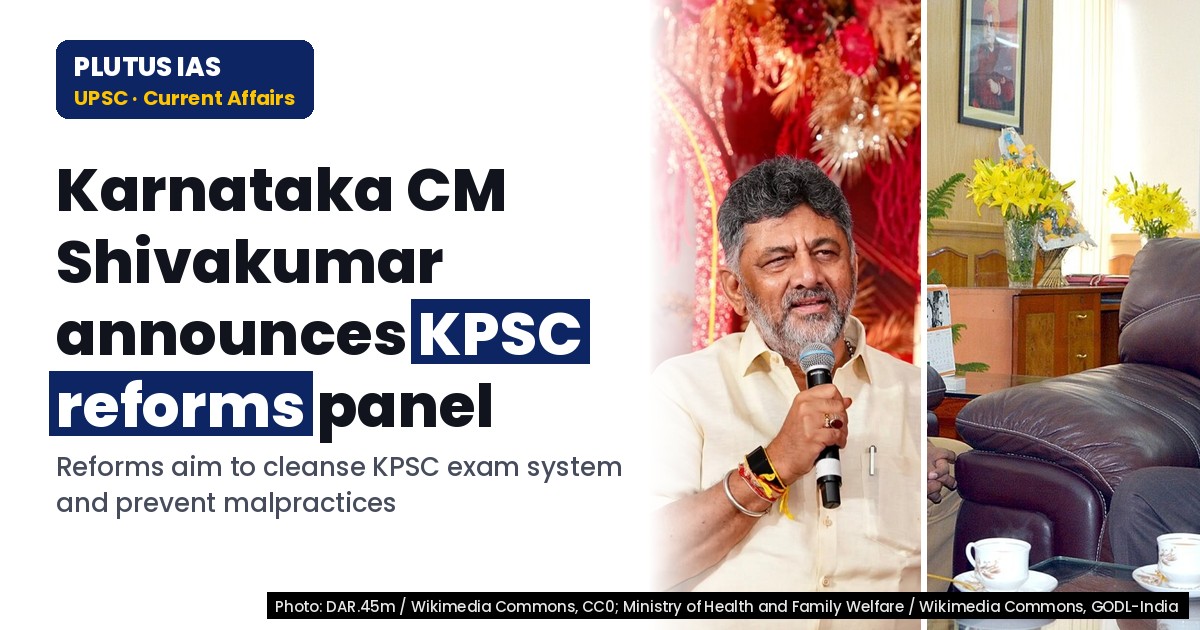
25 Oct Karnataka to Reform KPSC: Cabinet Panel to Oversee Reforms
✎ The Karnataka Public Service Commission (KPSC) is a constitutional body under Article 315, responsible for merit-based recruitment to state civil services, and its reforms aim to enhance examination integrity and institutional…
Subject Relevance — Where This Topic Fits
- GS Paper II — Functions and Responsibilities of the Union and the States, Constitutional and Statutory Bodies | GS Paper II — Appointment to Various Constitutional Posts, Powers, Functions and Responsibilities of Various Constitutional Bodies | GS Paper IV — Ethics and Integrity in Governance — Challenges and Solutions
- Prelims: Karnataka Public Service Commission (KPSC), Constitutional bodies under Article 315-323, Public Service Commission reforms, Examination malpractice and integrity, Cabinet sub-committee, Prosecution sanction under Prevention of Corruption Act, Directorate of Enforcement (ED), IAS officer accountability
- Essay: The integrity of public institutions: A prerequisite for democratic governance, Balancing administrative efficiency with ethical accountability in civil services
Quick Revision: The Karnataka Public Service Commission (KPSC) is a constitutional body under Article 315, responsible for merit-based recruitment to state civil services, and its reforms aim to enhance examination integrity and institutional accountability.
Why is this in the news?
The Chief Minister of Karnataka has announced that a Cabinet sub-committee, led by the Health Minister, will deliberate on reforms to the Karnataka Public Service Commission (KPSC) to address concerns of examination malpractice and institutional integrity. This follows the suspension of a senior IAS officer and former Controller of Examination at the KPSC, against whom prosecution sanction has been granted in connection with alleged irregularities. The move underscores the state’s commitment to upholding the sanctity of competitive examinations and ensuring transparent, merit-based recruitment processes.
Background
- The Karnataka Public Service Commission (KPSC) is a constitutional body established under Article 315 of the Constitution of India, responsible for conducting recruitment examinations for state civil services.
- The KPSC operates under the provisions of the Constitution (Article 315-323) and the Karnataka Public Service Commission (Functions) Rules, 1959, which delineate its powers, functions, and procedural autonomy.
- Recent years have seen heightened scrutiny of public service commissions across India due to allegations of examination malpractice, irregularities in appointment processes, and political interference.
- The suspension of a now-suspended IAS officer and former Controller of Examination at the KPSC, Gynanendra Kumar Gangwar, and the subsequent prosecution sanction against him highlight systemic vulnerabilities in examination administration.
- The establishment of a Cabinet sub-committee to reform the KPSC reflects a governance-driven response to institutional challenges, aligning with broader national initiatives to enhance transparency and accountability in public institutions.
- The Chief Minister’s emphasis on preventing monetary influence in examinations aligns with constitutional principles of fairness and meritocracy in civil service recruitment.
What is the Karnataka Public Service Commission (KPSC)?
- The KPSC is a statutory body constituted under Article 315 of the Constitution of India, tasked with conducting recruitment examinations for state civil services, including the Karnataka Administrative Service (KAS), Karnataka Police Service (KPS), and other Group A and Group B posts.
- It functions as an autonomous entity under the administrative control of the Government of Karnataka, with its composition and powers defined by the Constitution and relevant state legislation.
- The Commission is responsible for framing and amending recruitment rules, conducting examinations, and recommending appointments based on merit and reservation policies as enshrined in Articles 14, 15, and 16 of the Constitution.
- The KPSC operates under the oversight of the State Legislature and is subject to judicial review, ensuring adherence to constitutional and legal provisions in its functioning.
- The Commission’s role is critical in maintaining the integrity of the civil services recruitment process, which is a cornerstone of democratic governance and administrative efficiency.
- The KPSC’s examination processes are designed to assess candidates’ knowledge, aptitude, and suitability for public service roles, with transparency and fairness as guiding principles.
- Recent controversies involving the KPSC have raised questions about the robustness of its internal controls, examination security protocols, and mechanisms for addressing malpractice.
Key Features
| Feature | Significance |
|---|---|
| Cabinet sub-committee under Health Minister U.T. Khader | Institutional mechanism for systemic reform of KPSC examination processes, ensuring structured deliberation and multi-stakeholder input. |
| Reform of KPSC examination system | Aims to eliminate malpractices such as influence-peddling and financial irregularities, restoring credibility to the recruitment process. |
| Prosecution sanction against former Controller of Examination (Gynanendra Kumar Gangwar) | Demonstrates institutional commitment to accountability and transparency in public service appointments. |
| Emphasis on merit-based recruitment | Aligns with constitutional principles of equality and fairness, ensuring that diligent candidates are not disadvantaged by extraneous factors. |
| Guidance from Home Minister and Chief Minister | Signals high-level political prioritisation of governance reforms in public service commissions. |
Why it Matters
Governance & Institutional Integrity
- Reinforces the constitutional mandate for fair and transparent recruitment in public services under Article 320.
- Demonstrates the state government’s proactive stance on addressing systemic vulnerabilities in recruitment examinations.
- Sets a precedent for other states to emulate similar institutional reforms in their public service commissions.
Economic & Social Equity
- Ensures that socio-economically disadvantaged candidates are not disproportionately affected by corrupt practices in examinations.
- Promotes social justice by upholding meritocracy, thereby enhancing public trust in government institutions.
Legal & Procedural Rigour
- The prosecution sanction against the suspended officer underscores the application of legal and disciplinary frameworks to uphold institutional norms.
- The reform process aligns with the principles of natural justice and due process in administrative actions.
Challenges
1. Systemic Corruption in Recruitment Examinations
- Entrenched malpractices such as leakage of question papers, impersonation, and financial inducements undermine the integrity of examinations.
- The nexus between examination officials, coaching centres, and candidates poses a persistent challenge to reform efforts.
UPSC Link: GS-II: Role of Civil Services in Governance
2. Institutional Resistance to Change
- Bureaucratic inertia and vested interests within examination bodies may impede the pace of reforms.
- Lack of consensus among stakeholders on the scope and modalities of reform could dilute the effectiveness of measures.
UPSC Link: GS-II: Functions and Responsibilities of the Union and the States
3. Capacity Building and Technological Upgrades
- Modernising examination infrastructure, including digital platforms and secure assessment methods, requires significant investment and expertise.
- Training examination officials and staff to adapt to new systems and technologies is a resource-intensive endeavour.
UPSC Link: GS-III: Science and Technology in Governance
4. Balancing Transparency with Confidentiality
- Ensuring transparency in examination processes without compromising the confidentiality of question papers and evaluation criteria.
- Maintaining public trust while protecting sensitive operational details from misuse.
UPSC Link: GS-II: Transparency and Accountability in Governance
5. Legal and Constitutional Constraints
- Reforms must comply with constitutional provisions such as Article 16 (equality of opportunity) and Article 320 (functions of Public Service Commissions).
- Any changes to examination procedures must be legally defensible and withstand judicial scrutiny.
UPSC Link: GS-II: Constitutional Provisions Related to Civil Services
Challenges — UPSC Perspective
| Issue | Concern |
|---|---|
| Leakage of examination papers | Compromises the fairness of recruitment and undermines public trust in the selection process. |
| Influence of coaching centres | Creates an uneven playing field, favouring candidates with financial resources over those with merit. |
| Delayed disciplinary actions | Erodes confidence in the accountability mechanisms of public service commissions. |
| Lack of standardised evaluation criteria | Leads to inconsistencies in assessment, raising concerns about objectivity and fairness. |
| Political interference in appointments | Undermines the autonomy of public service commissions and the meritocratic ethos of civil services. |
Way Forward
- Constitute a high-powered committee with domain experts to draft a comprehensive reform blueprint for KPSC, including technological and procedural changes.
- Implement secure digital examination platforms with AI-based monitoring to detect malpractices such as impersonation and answer-key tampering.
- Strengthen the grievance redressal mechanism for candidates, ensuring timely resolution of disputes and transparency in evaluation processes.
- Undertake capacity-building initiatives for examination officials, focusing on ethical conduct, anti-corruption protocols, and modern assessment techniques.
- Introduce periodic audits of examination processes by independent agencies to identify vulnerabilities and recommend corrective measures.
- Enhance collaboration with central agencies like the Union Public Service Commission (UPSC) to adopt best practices in examination reforms.
- Establish a dedicated helpline and whistle-blower mechanism for reporting irregularities in examination processes.
- Formulate a time-bound action plan with clear milestones and accountability frameworks for monitoring progress.
UPSC Value Addition
Keywords for Mains Answer-Writing
Karnataka Public Service Commission · KPSC reforms · Constitutional bodies · examination reforms · Cabinet sub-committee · public service appointments · institutional integrity · executive accountability · Constitution of India Article 320 · UPSC model · transparency in recruitment · ethics in governance · investigative processes · sanction for prosecution · Directorate of Enforcement · civil services examination · governance reforms · public trust in institutions
Constitutional & Policy Linkages
- Article 320: Functions of Public Service Commissions (constitutional mandate for fair recruitment processes)
- Article 16: Equality of opportunity in matters of public employment (ensuring non-discrimination and meritocracy)
- Article 311: Safeguards for civil servants against arbitrary dismissal (protecting officials from politically motivated actions)
Concept Flow
Allegations of malpractice in KPSC examinations → Public scrutiny and demand for reform → Formation of Cabinet sub-committee → Prosecution sanction against officials → Deliberation on systemic changes → Implementation of reform measures → Enhanced credibility of recruitment process.
Prelims Practice Questions
Q1. Consider the following statements regarding the Karnataka Public Service Commission (KPSC):
1. The KPSC is a constitutional body established under Article 320 of the Constitution of India.
2. The Chief Minister of Karnataka is the ex-officio Chairperson of the KPSC.
3. The KPSC conducts examinations for recruitment to state civil services.
How many of the above statements are correct?
- Only one
- Only two
- All three
- None
Answer: All three — Statement 1 and 3 are correct. The KPSC is indeed a constitutional body under Article 320, and it conducts examinations for state civil services. Statement 2 is incorrect because the Chief Minister is not the ex-officio Chairperson of the KPSC; the Chairperson is appointed by the Governor of Karnataka.
Q2. Assertion (A): The Directorates of Enforcement in India operate under the administrative control of the Ministry of Home Affairs.
Reason (R): The Directorate of Enforcement is tasked with investigating offences under the Prevention of Money Laundering Act, 2002.
- Both A and R are true, and R is the correct explanation of A
- Both A and R are true, but R is NOT the correct explanation of A
- A is true, but R is false
- A is false, but R is true
Answer: ? — Assertion (A) is false because the Directorate of Enforcement functions under the Department of Revenue, Ministry of Finance, not the Ministry of Home Affairs. Reason (R) is true as the Directorate of Enforcement investigates offences under the PMLA, 2002.
Q3. Match the following constitutional provisions with their respective subjects:
Column I (Provision)
A. Article 320
B. Article 315
C. Article 316
D. Article 317
Column II (Subject)
1. Appointment and term of office of members of Public Service Commissions
2. Conditions of service of members of Public Service Commissions
3. Functions of Public Service Commissions
4. Removal of members of Public Service Commissions
- A-3, B-2, C-1, D-4; A-1, B-3, C-2, D-4; A-3, B-1, C-4, D-2; A-2, B-3, C-1, D-4
- answer_list_indexes_in_order_to_match_pairing_correctly
Answer: A-3, B-2, C-1, D-4; A-1, B-3, C-2, D-4; A-3, B-1, C-4, D-2; A-2, B-3, C-1, D-4 — A-3 (Article 320 deals with the functions of Public Service Commissions), B-1 (Article 315 establishes State Public Service Commissions), C-2 (Article 316 deals with the appointment and term of office of members), D-4 (Article 317 deals with the removal of members).
Mains Practice Question
✍ The Karnataka Public Service Commission (KPSC) has been identified for reform in the context of ensuring transparency and integrity in public service appointments. Critically examine the constitutional framework governing Public Service Commissions in India and the challenges they face in maintaining institutional credibility. Also, assess the role of executive accountability in this process. (15 Marks)
Approach: MODEL-ANSWER SKELETON:
1. **Constitutional Framework (4 points)**
– Article 315: Establishment of State Public Service Commissions (SPSCs) and Union Public Service Commission (UPSC).
– Article 320: Functions of Public Service Commissions, including conducting examinations for appointments to civil services.
– Article 316: Appointment and term of office of members of SPSCs (Governor’s role in appointment and removal under Article 317).
– Article 323: Reports of Public Service Commissions to be laid before the state legislature.
2. **Challenges to Institutional Credibility (5 points)**
– Allegations of malpractice in recruitment processes (e.g., KPSC scams involving suspended officials like Gynanendra Kumar Gangwar).
– Political interference in appointments and transfers, undermining meritocracy.
– Lack of transparency in examination processes and answer key evaluations.
– Delay in filling vacancies and backlog in recruitment, affecting governance efficiency.
– Erosion of public trust due to perceived corruption and lack of accountability.
3. **Executive Accountability and Reform Measures (4 points)**
– Role of the executive in initiating reforms (e.g., Karnataka’s Cabinet sub-committee under Health Minister U.T. Khader).
– Need for independent oversight mechanisms (e.g., judicial scrutiny, CBI/Directorate of Enforcement investigations).
– Comparative analysis with the UPSC model: Autonomy in conducting examinations and insulating recruitment from political influence.
– Recommendations from committees (e.g., Second Administrative Reforms Commission) on strengthening SPSCs.
4. **Conclusion (2 points)**
– Balancing executive accountability with institutional autonomy to restore credibility.
– Emphasise the need for systemic reforms, including digitalization of recruitment processes and stricter anti-corruption measures.
Source: The Hindu
Karnataka PCS (KPSC) — State PCS Practice
Prelims: Which of the following is TRUE regarding the proposed reforms in the Karnataka State Police Commission (KSPC) as per the recent statement by the Karnataka Chief Minister?
- A. The reforms will be implemented without any consultation with the Cabinet sub-committee.
- B. The opinion of a Cabinet sub-committee will be sought before finalizing the reforms in KSPC.
- C. The KSPC reforms will be solely decided by the Chief Minister without any committee involvement.
- D. The Cabinet sub-committee has already finalized the reforms for KSPC.
Answer: B. The opinion of a Cabinet sub-committee will be sought before finalizing the reforms in KSPC. — The Karnataka Chief Minister stated that the opinion of a Cabinet sub-committee will be taken before reforming the Karnataka State Police Commission (KSPC).
Mains: Critically analyze the significance of involving a Cabinet sub-committee in the reform process of the Karnataka State Police Commission (KSPC). How does this approach align with the principles of good governance and administrative efficiency in Karnataka?
Generated by AanyaAi for educational purpose.
Related guides on our sites
- Anthropology VS PSIR
- Best PSIR optional coaching
- Best PSIR optional coaching online
- Best PSIR optional teacher

- Karnataka to Reform KPSC: Cabinet Panel to Oversee Reforms - October 25, 2026
- विकसित भारत 2047: राष्ट्रीय शहरी सम्मेलन 2026 में उठे प्रमुख सुधार और नीति सुझाव - October 25, 2026
- PM Modi inaugurates RBI’s new Data Centre & Cyber Security Institute in Bhubaneswar - October 25, 2026

No Comments