


08 Aug Karnataka’s Amrit Bharat Station Scheme: Only 12 of 61 Stations Completed
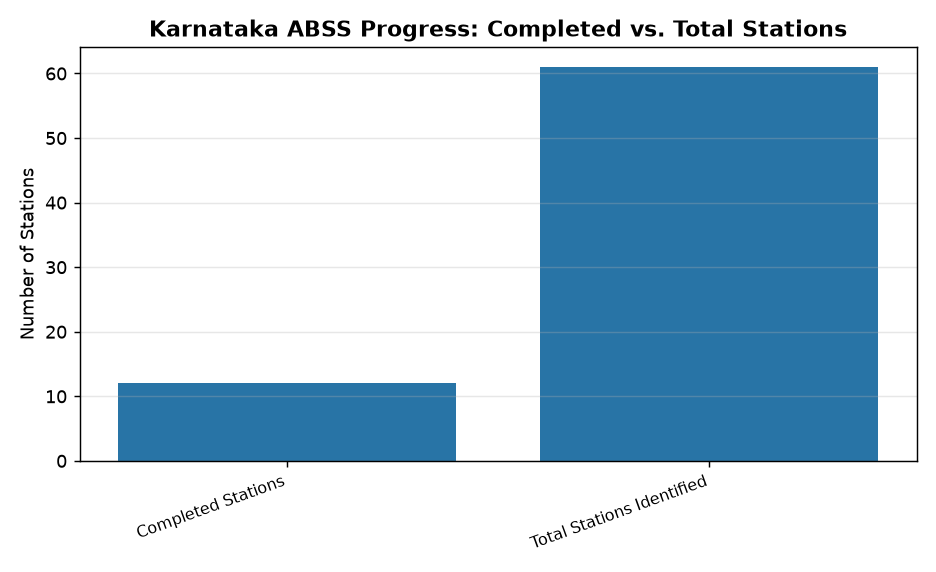
✎ The Amrit Bharat Station Scheme (ABSS), launched in December 2022, seeks to redevelop 1,340 railway stations, but only 19% of work is complete nationally, with Karnataka at 19% (12/61 stations), highlighting implementation gaps…
Subject Relevance — Where This Topic Fits
- GS Paper III — Infrastructure: Railways and Stations | GS Paper III — Government Budgeting and Expenditure
- Prelims: Amrit Bharat Station Scheme (ABSS), Rajya Sabha, Railway Ministry, Mangaluru Junction, infrastructure development, public expenditure, transparency in governance, unstarred question, Railway Minister Ashwini Vaishnaw
- Essay: Infrastructure development and public accountability: Balancing ambition with execution, The role of parliamentary oversight in ensuring transparency in government schemes
Quick Revision: The Amrit Bharat Station Scheme (ABSS), launched in December 2022, seeks to redevelop 1,340 railway stations, but only 19% of work is complete nationally, with Karnataka at 19% (12/61 stations), highlighting implementation gaps and the need for greater transparency and accountability in infrastructure governance.
Why is this in the news?
The Rajya Sabha reply on August 7, 2026, revealed that only 19% of railway stations identified under the Amrit Bharat Station Scheme (ABSS) across India, including just 12 out of 61 stations in Karnataka, have seen work completion as of August 8, 2026. This underscores significant implementation delays, raising concerns about the scheme’s efficacy, transparency, and parliamentary accountability in infrastructure development.
Background
- The Amrit Bharat Station Scheme (ABSS) was launched by the Ministry of Railways in December 2022 to modernise 1,340 railway stations across India, including 61 in Karnataka, through redevelopment, improved passenger amenities, and enhanced connectivity.
- The scheme aims to transform railway stations into ‘world-class’ facilities with modern infrastructure, better passenger amenities, and improved accessibility, aligning with broader national infrastructure goals under the ‘Viksit Bharat’ vision.
- Railway infrastructure development is a critical component of India’s logistics and transportation network, directly impacting economic growth, regional connectivity, and public welfare.
- Parliamentary questions, particularly unstarred ones, serve as a mechanism for holding the executive accountable for scheme implementation, expenditure, and progress reporting.
- The slow pace of completion in Karnataka and nationally highlights systemic challenges in large-scale infrastructure projects, including bureaucratic delays, land acquisition issues, and contractor performance.
What is the Amrit Bharat Station Scheme (ABSS)?
- Launched by the Ministry of Railways in December 2022 as a pan-India initiative to redevelop 1,340 railway stations, including 61 in Karnataka, into modern, passenger-friendly hubs.
- The scheme prioritises station redevelopment through a ‘whole-station’ approach, integrating passenger amenities, accessibility, aesthetics, and sustainability in a single project.
- Key objectives include enhancing passenger experience, improving last-mile connectivity, integrating multimodal transport hubs, and promoting local economic activity around stations.
- ABSS is distinct from earlier schemes like the ‘Adarsh Station Scheme’ (2009) and ‘Railway Station Development Programme’ (2018), as it focuses on holistic, long-term redevelopment rather than piecemeal upgrades.
- The redevelopment includes modern passenger amenities such as lifts, escalators, waiting halls, digital signage, cleanliness initiatives, and improved safety and security measures.
- The scheme also aims to integrate stations with other modes of transport, such as metro rail, bus terminals, and pedestrian pathways, to enhance multimodal connectivity.
Key Features
| Feature | Significance |
|---|---|
| Amrit Bharat Station Scheme (ABSS) | A centrally sponsored scheme launched in December 2022 under the Ministry of Railways for the comprehensive redevelopment of 1,340 railway stations across India, including 61 in Karnataka, with a focus on modernisation, passenger amenities, and sustainability. |
| Progress Metrics (as of August 2026) | Only 19% (261 out of 1,340) of stations nationwide and 12 out of 61 in Karnataka have achieved completion, indicating a significant lag in implementation despite the scheme’s ambitious targets. |
| Transparency Concerns | Lack of station-wise project costs, contract award dates, and year-wise progress data raises questions about accountability and public scrutiny over the utilisation of allocated funds and timelines. |
| Public Sentiment and Parliamentary Scrutiny | The response to an unstarred question in the Rajya Sabha highlights growing dissatisfaction among legislators and the public regarding the discrepancy between announcements and ground-level progress. |
| Infrastructure Modernisation Focus | ABSS aims to transform railway stations into ‘world-class’ facilities by integrating multi-modal connectivity, green energy solutions, and enhanced passenger amenities, aligning with broader national infrastructure goals. |
UPSC Value Addition
Keywords for Mains Answer-Writing
Amrit Bharat Station Scheme (ABSS) · Railway station redevelopment · Infrastructure governance · Parliamentary accountability · Rajya Sabha unstarred questions · Public accountability in infrastructure projects · Railway Ministry performance · Transparency in public expenditure · Karnataka railway infrastructure · Multi-modal connectivity
Prelims Practice Questions
Q1. Consider the following statements regarding the Amrit Bharat Station Scheme (ABSS):
1. The scheme was launched in December 2022.
2. Under ABSS, 1,340 railway stations across India have been identified for redevelopment.
3. The scheme mandates the completion of redevelopment works within 18 months of project sanction.
4. The Railway Ministry has furnished station-wise project costs and contract award dates in response to parliamentary queries.
How many of the above statements are correct?
- Only one
- Only two
- Only three
- All four
Answer: Only two — Only statements 1 and 2 are correct. Statement 3 is incorrect as no fixed timeline of 18 months is mandated under ABSS. Statement 4 is incorrect as the Ministry did not furnish station-wise project costs or contract award dates in response to parliamentary queries.
Q2. Assertion (A): The Amrit Bharat Station Scheme (ABSS) aims to transform railway stations into multi-modal hubs with improved passenger amenities, better connectivity, and enhanced aesthetics.
Reason (R): The scheme is part of the Railway Ministry’s broader strategy to modernise Indian Railways by 2030, aligning with the National Rail Plan.
Code:
- Both A and R are true, and R is the correct explanation of A
- Both A and R are true, but R is not the correct explanation of A
- A is true but R is false
- A is false but R is true
Answer: Both A and R are true, but R is not the correct explanation of A — Both the assertion and reason are correct. ABSS does aim to transform railway stations into multi-modal hubs with improved amenities and connectivity. The reason correctly explains that ABSS is part of the Railway Ministry’s modernisation strategy under the National Rail Plan 2030.
Q3. Match the following railway stations in Karnataka with their respective districts:
Column I (Station) | Column II (District)
——————-|——————-
A. Alnavar | 1. Udupi
B. Badami | 2. Bagalkot
C. Bantwal | 3. Dharwad
D. Subrahmanya Road| 4. Dakshina Kannada
Options:
- A-3, B-2, C-4, D-1
- A-2, B-3, C-1, D-4
- A-3, B-2, C-1, D-4
- A-1, B-4, C-2, D-3
Answer: A-3, B-2, C-4, D-1 — A. Alnavar is in Dharwad district. B. Badami is in Bagalkot district. C. Bantwal is in Dakshina Kannada district. D. Subrahmanya Road is in Udupi district.
Mains Practice Question
✍ The Amrit Bharat Station Scheme (ABSS) represents a significant initiative for the redevelopment of railway stations in India. Critically analyse the implementation challenges faced by the scheme, with particular reference to issues of transparency, accountability, and pace of progress. Also, discuss the potential socio-economic benefits that could accrue from the successful implementation of ABSS. (15 Marks)
Approach: MODEL-ANSWER SKELETON:
1. **Introduction** (2 marks)
– Brief context: Launch of ABSS in December 2022 under the Railway Ministry to redevelop 1,340 stations, including 61 in Karnataka.
– Objective: Transform stations into multi-modal hubs with improved passenger amenities, better connectivity, and enhanced aesthetics.
2. **Implementation Challenges** (6 marks)
– **Transparency Issues**:
– Lack of station-wise project costs, contract award dates, and year-wise progress data in parliamentary responses (as highlighted by MP Mansoor Ali Khan).
– Absence of public dashboards or real-time tracking mechanisms for project monitoring.
– **Accountability Concerns**:
– Slow pace of progress: Only 19% (261/1,340) stations completed nationwide; 12/61 in Karnataka as of August 2026.
– Repeated announcements and foundation-laying ceremonies without commensurate completion (criticism by MP Mansoor Ali Khan).
– **Operational Bottlenecks**:
– Land acquisition delays, coordination issues among multiple stakeholders (Railway Ministry, State governments, contractors).
– Resource constraints: Limited budgetary allocations or diversion of funds to other priorities.
– **Governance Gaps**:
– Weak parliamentary oversight due to lack of granular data in responses to unstarred questions.
– Absence of a dedicated nodal agency for end-to-end project management.
3. **Socio-Economic Benefits of Successful Implementation** (5 marks)
– **Economic Growth**:
– Enhanced multi-modal connectivity (rail-road-air-water) can boost local economies, tourism, and trade.
– Job creation in construction, hospitality, and allied sectors during and after redevelopment.
– **Social Inclusion**:
– Improved passenger amenities (toilets, waiting halls, digital signage) enhance inclusivity for elderly, differently-abled, and low-income passengers.
– Better safety and security measures at stations.
– **Urban Development**:
– Stations as catalysts for urban renewal and smart city integration (e.g., Gandhinagar Capital Railway Station).
– Reduced congestion and improved last-mile connectivity through integrated transport hubs.
– **Environmental Sustainability**:
– Energy-efficient buildings, solar power integration, and waste management systems.
– Promotion of green mobility options (e.g., cycling infrastructure).
4. **Conclusion** (2 marks)
– ABSS holds transformative potential but requires urgent reforms in transparency, accountability, and project execution.
– Strengthening parliamentary oversight, leveraging technology for real-time monitoring, and ensuring inter-ministerial coordination are critical for success.
– Successful implementation can serve as a model for other infrastructure schemes, aligning with the National Rail Plan 2030.
Source: The Hindu
Generated by AanyaAi for educational purpose.

- Jal Arpan: 1850+ Gram Panchayats Join Hands for Rural Water Supply - October 3, 2026
- भारत ने किया 5.56 किमी मुक्त अंतरिक्ष क्वांटम की वितरण लिंक का सफल परीक्षण - October 3, 2026
- Great Indian Bustard Reintroduction: 10-Year Effort Bears Fruit in Rajasthan - October 3, 2026

No Comments