


07 Aug Kashmiri Pandits Rehabilitation Bill 2025: Key Provisions for UPSC & State PCS
✎ The Kashmiri Pandits (Recourse, Restitution, Rehabilitation and Resettlement) Bill, 2025, seeks to provide a statutory framework for the return, safety, and restoration of rights of displaced Kashmiri Pandits, addressing their…
Subject Relevance — Where This Topic Fits
- GS Paper II — Polity and Governance (Rehabilitation Policies, Constitutional Provisions for Minorities) | GS Paper III — Social Justice and Welfare (Displaced Communities, Minority Rights)
- Prelims: Kashmiri Pandits, Article 370, Displacement, Rehabilitation Policy, Minority Rights, Jammu and Kashmir Reorganisation Act 2019, Article 371, PM’s Development Package for Kashmiri Pandits, Prime Minister’s Reconstruction Plan for J&K
- Essay: The moral imperative of rehabilitation: Balancing justice, identity, and national integration in post-conflict societies
Quick Revision: The Kashmiri Pandits (Recourse, Restitution, Rehabilitation and Resettlement) Bill, 2025, seeks to provide a statutory framework for the return, safety, and restoration of rights of displaced Kashmiri Pandits, addressing their long-standing grievances through legal, financial, and administrative measures.
Why is this in the news?
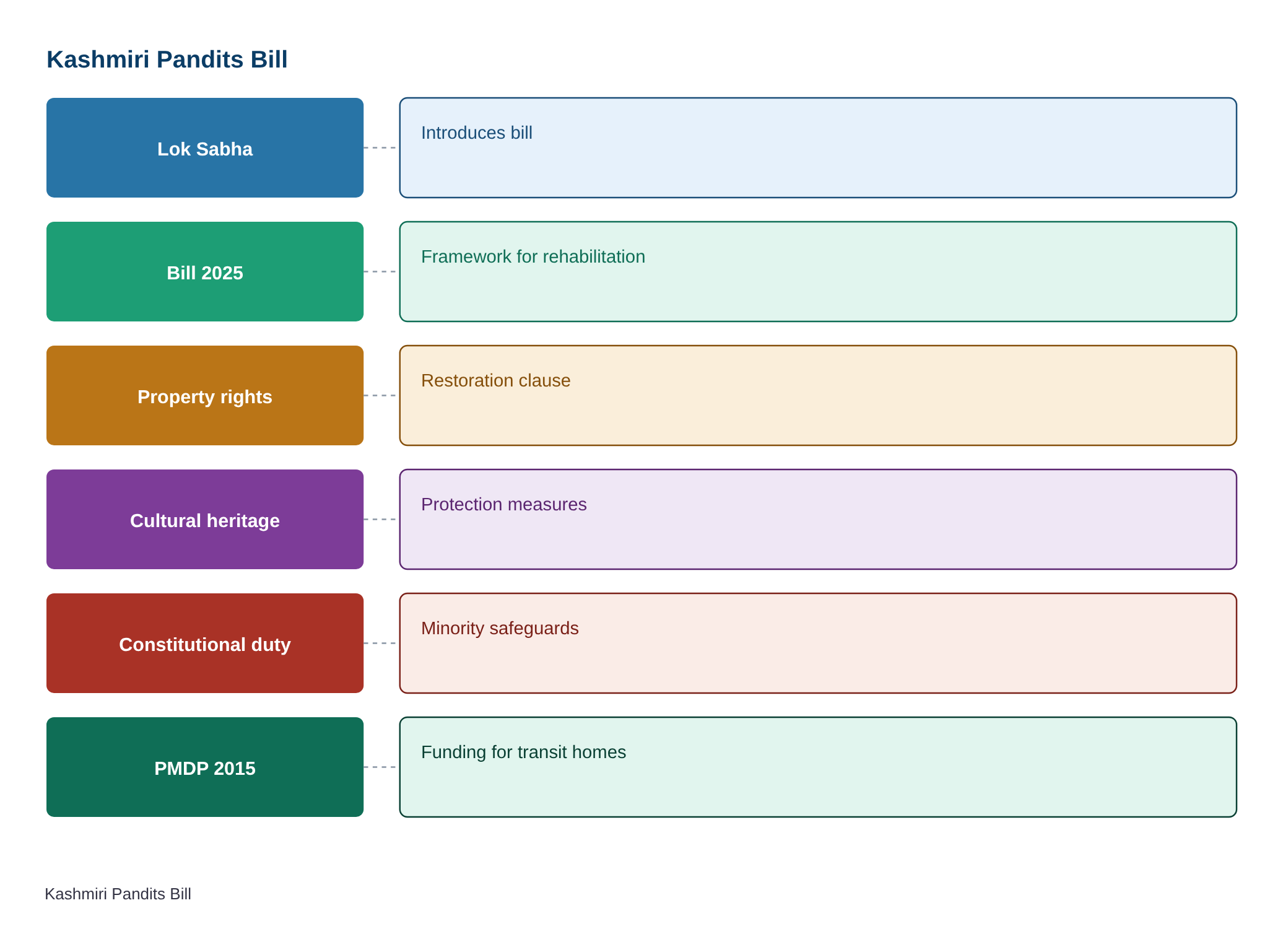
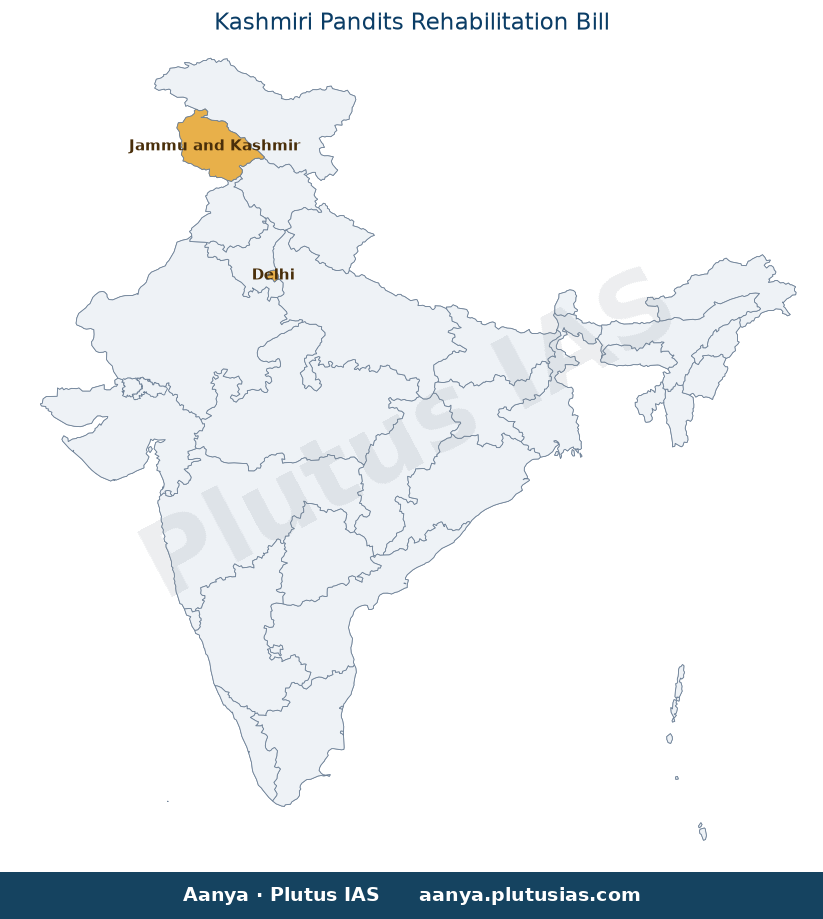
The Kashmiri Pandits (Recourse, Restitution, Rehabilitation and Resettlement) Bill, 2025, is slated for introduction in the Lok Sabha during the Monsoon Session of Parliament, 2026. This legislative initiative assumes significance as it seeks to address the long-standing grievances of the Kashmiri Pandit community, which was displaced from the Kashmir Valley in the early 1990s due to insurgency and terrorism. The Bill aims to provide a comprehensive framework for their social, political, and economic rehabilitation, restoration of property, and protection of cultural heritage, thereby aligning with constitutional obligations toward minority communities and the principles of restorative justice.
Background
- The displacement of Kashmiri Pandits, a Hindu minority community, from the Kashmir Valley began in the late 1980s and peaked in the early 1990s due to targeted violence, intimidation, and forced exodus by militants. Over 400,000 Kashmiri Pandits were displaced, leading to a demographic shift in the Valley.
- The Jammu and Kashmir Reorganisation Act, 2019, which bifurcated the erstwhile state into two Union Territories, included provisions for the welfare and rehabilitation of displaced communities, including Kashmiri Pandits, through the Prime Minister’s Reconstruction Plan for Jammu and Kashmir.
- Successive governments have implemented various schemes for the return and rehabilitation of Kashmiri Pandits, such as the Prime Minister’s Development Package (PMDP) for J&K, which allocated funds for the construction of transit accommodations, employment generation, and financial assistance for return and rehabilitation.
- The Supreme Court of India, in its judgment in *Dr. Farooq Abdullah v. Union of India* (2020), highlighted the constitutional duty of the state to protect the rights of minorities and ensure their safe return to the Valley, emphasizing the need for a holistic rehabilitation policy.
- The Kashmiri Pandits have consistently demanded legal guarantees for their safety, restoration of property rights, and political representation in the Valley’s governance, citing the lack of a comprehensive legislative framework addressing their grievances.
- The Bill is introduced in the backdrop of ongoing debates on minority rights, internal displacement, and the implementation of constitutional safeguards in conflict-affected regions.
What is the Kashmiri Pandits (Recourse, Restitution, Rehabilitation and Resettlement) Bill, 2025?
- The Bill seeks to provide a **legal framework** for the recourse, restitution, rehabilitation, and resettlement of Kashmiri Pandits, who were displaced from the Kashmir Valley in the 1990s due to insurgency and terrorism.
- It aims to **restore property rights** of displaced Kashmiri Pandits, including land, houses, and business establishments, through a transparent mechanism for identification, verification, and restitution of immovable property.
- The Bill proposes the **establishment of a Rehabilitation Authority** at the Union and Union Territory levels to oversee the implementation of rehabilitation schemes, monitor progress, and address grievances of the displaced community.
- It mandates the **protection of cultural heritage**, including temples, shrines, and manuscripts, and provides for the revival of traditional practices, languages, and educational institutions of the Kashmiri Pandit community.
- The Bill includes provisions for **safety and security** of returnees, including police protection, community policing initiatives, and legal recourse against threats or intimidation.
- It seeks to ensure **political representation** for Kashmiri Pandits in the governance of Jammu and Kashmir through reserved seats in local bodies, legislative assemblies, and advisory councils, in line with constitutional provisions for minority representation.
- The Bill proposes a **financial package** for rehabilitation, including employment generation schemes, skill development programs, housing assistance, and compensation for loss of livelihood, funded through the Union and Union Territory budgets.
- It aligns with the **constitutional principles** enshrined in Articles 14, 15, 21, and 29 of the Constitution of India, which guarantee equality, non-discrimination, protection of life and liberty, and cultural and educational rights of minorities.
- The Bill is expected to complement existing schemes such as the **Prime Minister’s Development Package (PMDP) for Jammu and Kashmir** and the **Prime Minister’s Reconstruction Plan**, by providing a statutory basis for their implementation and addressing gaps in coverage.
Key Features
| Feature | Significance |
|---|---|
| Kashmiri Pandits (Recourse, Restitution, Rehabilitation and Resettlement) Bill, 2025 | Proposes a comprehensive legislative framework for the socio-economic and political rehabilitation of displaced Kashmiri Pandits, including property restoration, cultural heritage preservation, and security guarantees. |
| Micro, Small and Medium Enterprises (Amendment) Bill, 2026 | Aims to amend the MSME Development Act, 2006, to enhance the ease of doing business for MSMEs, potentially boosting employment and industrial growth in India. |
| Foreign Contribution (Regulation) Amendment Bill, 2026 | Seeks to tighten regulations on foreign funding to NGOs and associations, addressing concerns of national security and transparency in financial inflows. |
| Taxation and Other Laws (Amendment) Bill, 2026 | Introduces tax reforms to provide certainty, incentivize investment, and support manufacturing, replacing an ordinance to ensure continuity in fiscal policy. |
Why it Matters
Social Justice
- The Kashmiri Pandits Rehabilitation Bill addresses historical injustices faced by a displaced community, aligning with constitutional principles of equity and social welfare under Articles 14, 15, and 21.
- Proposes institutional mechanisms for restitution, including property rights restoration and cultural heritage protection, which are critical for long-term reconciliation and communal harmony.
- Highlights the government’s commitment to addressing the grievances of minority communities, particularly in conflict-affected regions, as part of broader nation-building efforts.
Economic
- The MSME Amendment Bill is expected to streamline regulatory compliance, reduce transaction costs, and enhance credit access for small enterprises, fostering entrepreneurship and employment generation.
- Taxation reforms in the Taxation and Other Laws Bill aim to improve investor confidence by providing clarity on tax liabilities, which is essential for sustaining economic growth and attracting FDI.
- The FCRA Amendment Bill, while restrictive, ensures that foreign contributions are channeled transparently, preventing misuse and safeguarding India’s economic sovereignty.
Legislative Process
- The introduction of multiple Bills in a single session underscores the government’s legislative agenda, reflecting priorities such as economic reform, minority welfare, and regulatory oversight.
- Opposition protests during the session highlight the contentious nature of certain Bills, particularly those related to police action and foreign funding, which may face scrutiny in parliamentary debates.
Institutional Accountability
- The presence of Union Ministers in Parliament during protests demonstrates the government’s responsiveness to legislative scrutiny and public grievances, reinforcing democratic accountability.
- Parliamentary adjournments due to protests indicate the need for structured dialogue mechanisms to prevent disruptions and ensure productive legislative sessions.
Challenges
1. Implementation of Rehabilitation Policies
- Historical displacement of Kashmiri Pandits has left enduring socio-economic scars, requiring sustained political will and resource allocation for effective rehabilitation.
- Ensuring property rights restoration and cultural heritage preservation demands robust administrative mechanisms and judicial support to prevent disputes and delays.
UPSC Link: GS-II: Social Justice – Displaced Communities
2. Balancing Economic Reforms with Regulatory Oversight
- Taxation reforms must balance revenue generation with incentives for investment, avoiding regressive measures that could stifle economic growth.
- FCRA amendments risk over-regulation, potentially curtailing legitimate NGO activities that contribute to social welfare and grassroots development.
UPSC Link: GS-III: Economic Reforms – Regulatory Framework
3. Parliamentary Disruptions and Legislative Efficiency
- Persistent protests and adjournments disrupt the legislative process, delaying critical Bills and undermining parliamentary productivity.
- The need for structured dialogue mechanisms to address grievances without resorting to disruptions, ensuring constructive debate and consensus-building.
UPSC Link: GS-II: Parliament – Legislative Process
4. Security and Law-and-Order Concerns
- Police action against protesters, particularly student-led movements, raises questions about proportionality and adherence to democratic norms.
- Ensuring public order while protecting fundamental rights (e.g., freedom of expression) remains a persistent challenge for the executive and judiciary.
UPSC Link: GS-II: Governance – Law and Order
5. Transparency in Donations and Financial Governance
- Allegations of mismanagement in the Ram Mandir donation controversy highlight the need for stringent auditing and disclosure norms for religious and charitable funds.
- Ensuring accountability in financial governance to prevent misuse of public or private funds, particularly in the context of religious and socio-cultural institutions.
UPSC Link: GS-II: Governance – Financial Transparency
Challenges — UPSC Perspective
| Issue | Concern |
|---|---|
| Displacement of Kashmiri Pandits | Long-term socio-economic and psychological impact on the community, requiring holistic rehabilitation measures. |
| Police Action Against Protesters | Potential violation of fundamental rights and erosion of public trust in law enforcement agencies. |
| FCRA Amendments | Risk of over-regulation stifling legitimate NGO activities that contribute to social welfare and development. |
| Taxation Reforms | Need to balance revenue generation with incentives for investment to sustain economic growth. |
| Parliamentary Disruptions | Delay in legislative processes and erosion of parliamentary efficiency due to persistent protests. |
| Donation Transparency | Lack of accountability in financial governance of religious and charitable institutions, raising ethical concerns. |
Way Forward
- Strengthen institutional mechanisms for the implementation of the Kashmiri Pandits Rehabilitation Bill, including dedicated funds and grievance redressal cells.
- Conduct a comprehensive review of the MSME Amendment Bill to ensure it addresses key bottlenecks in credit access, compliance, and market integration.
- Engage in structured dialogues with Opposition parties to address grievances related to police action and NEET paper leak protests, fostering consensus on legislative priorities.
- Enhance transparency in the FCRA Amendment Bill by defining clear criteria for permissible foreign contributions and establishing independent oversight bodies.
- Implement robust auditing and disclosure norms for religious and charitable donations to prevent financial mismanagement and restore public trust.
- Develop a national framework for disaster-resilient infrastructure in coastal states, integrating the proposed Fishermen Welfare Board’s recommendations.
- Promote multi-stakeholder consultations to refine taxation reforms, ensuring they align with economic growth objectives and do not disproportionately burden any sector.
UPSC Value Addition
Keywords for Mains Answer-Writing
Kashmiri Pandits Rehabilitation Bill 2025 · Article 370 abrogation · Internal Displacement in India · Right to Resettlement · Protection of Minorities · Rehabilitation Policy Framework · Kashmir Valley Exodus 1990 · Jammu & Kashmir Reorganisation Act 2019
Constitutional & Policy Linkages
- Article 14: Equality before law and equal protection of laws – Ensures non-discriminatory rehabilitation policies for displaced communities.
- Article 15: Prohibition of discrimination – Mandates inclusive policies for minority communities like Kashmiri Pandits.
- Article 21: Right to life and personal liberty – Includes the right to live with dignity and security, applicable to rehabilitation efforts.
- Article 29: Protection of interests of minorities – Safeguards cultural and educational rights of minority communities.
- Seventh Schedule: State List (Item 1) – Empowers states to legislate on matters related to welfare and rehabilitation of displaced communities.
Concept Flow
Displacement of Kashmiri Pandits post-1989 insurgency → Long-term socio-economic marginalization and cultural erosion → Introduction of Rehabilitation Bill → Legislative debate on restitution and security → Implementation challenges due to administrative and judicial hurdles. → NEET paper leak protests and police action → Public outrage and Opposition protests → Demand for accountability and transparency → Parliamentary adjournments and legislative disruptions → Need for structured dialogue mechanisms. → Allegations of donation theft at Ram Mandir → Scrutiny of financial governance in religious institutions → Calls for auditing and disclosure norms → Legislative and judicial responses to ensure transparency. → Taxation reforms to boost investment → Introduction of Taxation and Other Laws Bill → Replacement of ordinance to ensure continuity → Debate on fiscal policy and economic growth. → FCRA amendments to regulate foreign contributions → Introduction of FCRA Amendment Bill → Concerns over over-regulation of NGOs → Balancing transparency with grassroots development needs. → MSME sector challenges → Introduction of MSME Amendment Bill → Streamlining compliance and credit access → Expected boost to employment and industrial growth.
Prelims Practice Questions
Q1. Consider the following statements regarding the Kashmiri Pandits (Recourse, Restitution, Rehabilitation and Resettlement) Bill, 2025:
1. The Bill seeks to provide for the social, political, and economic rehabilitation of Kashmiri Pandits.
2. It includes provisions for the protection of their property and restoration of cultural heritage.
3. The Bill mandates the creation of a Fishermen Welfare Board for coastal states.
4. It proposes a rehabilitation package for displaced Kashmiri Pandits.
How many of the above statements are correct?
- Only one
- Only two
- Only three
- All four
Answer: Only three — Statements 1, 2, and 4 are correct as per the Bill’s objectives. Statement 3 is incorrect as it pertains to the Fishermen (Protection and Welfare) Bill, 2024, not the Kashmiri Pandits Bill.
Q2. Assertion (A): The Jammu & Kashmir Reorganisation Act, 2019, aimed to address the rehabilitation of displaced Kashmiri Pandits.
Reason (R): The Act provided for the establishment of a Commission for the welfare of displaced persons from the erstwhile State of Jammu & Kashmir.
In the context of the above two statements, which one of the following is correct?
- Both A and R are true, and R is the correct explanation of A.
- Both A and R are true, but R is not the correct explanation of A.
- A is true, but R is false.
- A is false, but R is true.
Answer: A is true, but R is false. — Assertion (A) is true as the Act included provisions for displaced persons. Reason (R) is also true but does not directly explain the rehabilitation of Kashmiri Pandits, as the Commission’s mandate was broader.
Q3. Match the following pairs related to the rehabilitation of displaced communities in India:
Column I
A. Kashmiri Pandits
B. Chakmas
C. Sri Lankan Tamils
D. Bru Tribals
Column II
1. Tripura
2. Jammu & Kashmir
3. Arunachal Pradesh
4. Tamil Nadu
Select the correct match:
- A-2, B-3, C-4, D-1
- A-1, B-2, C-3, D-4
- A-3, B-4, C-2, D-1
- A-4, B-1, C-2, D-3
Answer: A-2, B-3, C-4, D-1 — A. Kashmiri Pandits are associated with Jammu & Kashmir (2). B. Chakmas are primarily in Arunachal Pradesh (3). C. Sri Lankan Tamils are rehabilitated in Tamil Nadu (4). D. Bru Tribals are in Tripura (1).
Mains Practice Question
✍ The Kashmiri Pandits (Recourse, Restitution, Rehabilitation and Resettlement) Bill, 2025, seeks to address the long-standing issue of the exodus of Kashmiri Pandits from the Kashmir Valley. Critically examine the constitutional and policy framework required for the effective implementation of such a rehabilitation initiative. (15 Marks)
Approach: MODEL-ANSWER SKELETON:
1. **Constitutional Framework**:
– Article 29 (Protection of interests of minorities) and Article 30 (Right of minorities to establish and administer educational institutions) as foundational rights.
– Article 14 (Right to Equality) and Article 21 (Right to Life and Personal Liberty) for ensuring non-discrimination and dignified living conditions.
– Directive Principles of State Policy (DPSP): Articles 38, 39, and 46 mandate state responsibility for social justice and welfare of weaker sections.
2. **Policy Framework**:
– **Rehabilitation Policy**: Reference the National Policy on Resettlement and Rehabilitation for Project-Affected Persons, 2007, and its limitations for non-project-affected displaced communities.
– **Jammu & Kashmir Reorganisation Act, 2019**: Provisions for displaced persons (Section 69) and the establishment of the Jammu & Kashmir Grant of Domicile Certificate (Procedure) Rules, 2020.
– **State Responsibility**: Role of the Union Territory administration in ensuring security, economic rehabilitation, and cultural preservation (e.g., Kashmiri Pandit Migrant Employees (Special Provisions) Act, 1996).
3. **Challenges**:
– **Security Concerns**: Persistent threats and lack of confidence in return, as highlighted by the 1990 exodus.
– **Economic Rehabilitation**: Need for job creation, housing, and livelihood support in the Kashmir Valley.
– **Cultural Restoration**: Protection of temples, shrines, and cultural institutions (e.g., Martand Sun Temple).
– **Legal Gaps**: Absence of a dedicated constitutional or statutory framework for internally displaced persons (IDPs) in India.
4. **Comparative Insights**:
– Lessons from international frameworks (e.g., UN Guiding Principles on Internal Displacement) and India’s obligations under the International Covenant on Civil and Political Rights (ICCPR).
5. **Way Forward**:
– Enactment of a dedicated Rehabilitation and Resettlement Act for IDPs in India.
– Strengthening of institutional mechanisms (e.g., a dedicated commission for Kashmiri Pandits).
– Integration of rehabilitation measures with the broader agenda of conflict resolution in Jammu & Kashmir.
Source: The Indian Express
Generated by AanyaAi for educational purpose.

- KWML’s Feasibility Reports for Water Metro in 18 Cities: UPSC & PCS Insights - October 3, 2026
- ओडिशा में वन्यजीव अनुसंधान अनुदान कार्यक्रम शुरू, सिमिलिपाल में 300 कैमरे और बढ़ेंगे - October 3, 2026
- India Summons Pakistan High Commission Official Over Violation - October 3, 2026

No Comments