


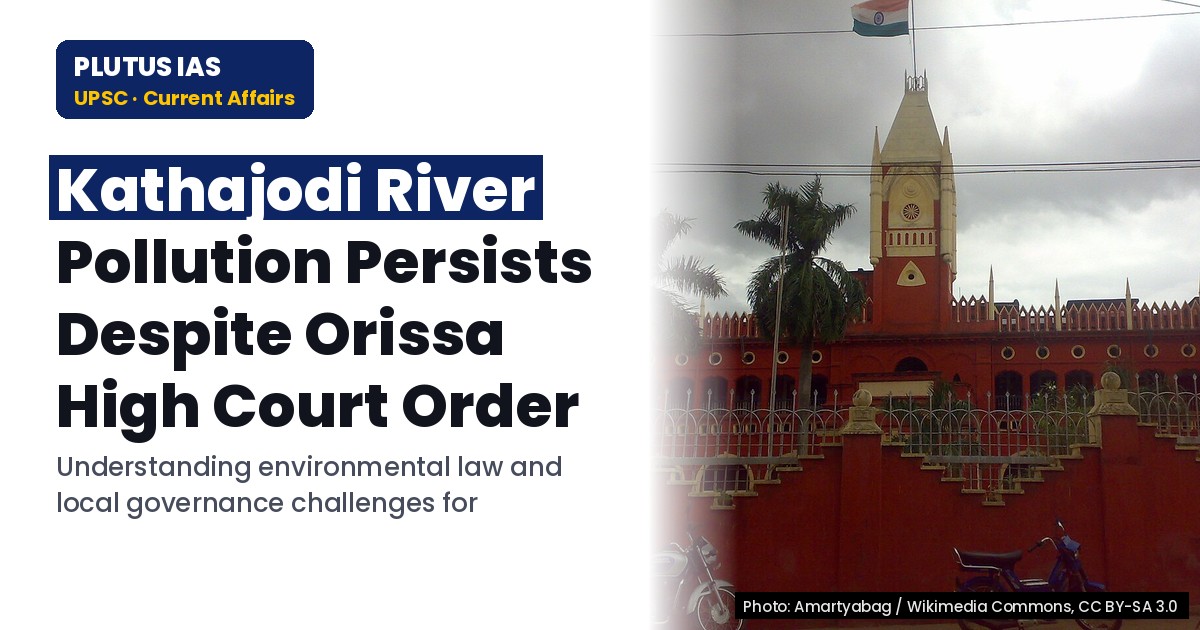
12 Nov Kathajodi River Pollution: HC Order Defiance & Impact
✎ The Kathajodi River pollution case underscores the critical importance of effective implementation of judicial directives and robust environmental governance mechanisms to address urban wastewater management and safeguard public…
Subject Relevance — Where This Topic Fits
- GS Paper II — Governance, Constitution, and Polity; Social Justice | GS Paper III — Environment, Ecology, and Disaster Management
- Prelims: Kathajodi River, Orissa High Court, Water (Prevention and Control of Pollution) Act, 1974, Environmental Protection Act, 1986, Municipal Solid Waste Management Rules, Polluter Pays Principle, National Green Tribunal, Central Pollution Control Board
- Essay: Environmental Degradation and Sustainable Development, Role of Judiciary in Environmental Protection and Governance, Challenges in Urban Waste Management and Public Health
Quick Revision: The Kathajodi River pollution case underscores the critical importance of effective implementation of judicial directives and robust environmental governance mechanisms to address urban wastewater management and safeguard public health and ecosystems.
Why is this in the news?
The Kathajodi River in Kataka continues to experience pollution due to the discharge of untreated city wastewater, allegedly in contravention of a directive issued by the Orissa High Court. This ongoing non-compliance has raised significant public health concerns and adversely impacts aquatic ecosystems, highlighting persistent challenges in environmental governance and the enforcement of judicial orders.
Background
- The Kathajodi River is a distributary of the Mahanadi River, flowing through the city of Kataka, Odisha.
- Local residents, through the Khan Nagar-Khapuria Industrial Area Anchal Puja Committee, had previously petitioned the Orissa High Court regarding the discharge of untreated wastewater into the river.
- The Orissa High Court subsequently issued a directive to the local administration, specifically the Kataka Municipal Corporation, to cease the discharge of pollutants into the Kathajodi River.
- Despite the judicial order, allegations persist that wastewater continues to enter the river from certain drains, indicating a failure in effective implementation and enforcement.
- The pollution poses risks to public health, affecting individuals who use the river for bathing, as well as livestock and the aquatic biodiversity within the river system.
- Urbanisation and inadequate wastewater treatment infrastructure often contribute to river pollution in many Indian cities, necessitating robust municipal waste management strategies.
Legal and Institutional Framework for Environmental Protection in India
- The Water (Prevention and Control of Pollution) Act, 1974, is the primary legislation for preventing and controlling water pollution, establishing the Central Pollution Control Board (CPCB) and State Pollution Control Boards (SPCBs).
- The Environmental Protection Act, 1986, is an umbrella legislation providing for the protection and improvement of the environment, empowering the central government to take measures to protect and improve environmental quality.
- The National Green Tribunal (NGT) was established in 2010 under the National Green Tribunal Act, 2010, to provide effective and expeditious disposal of cases relating to environmental protection and conservation of forests and other natural resources.
- Municipal Corporations are mandated under various statutes, including the Water (Prevention and Control of Pollution) Act, 1974, and the Solid Waste Management Rules, 2016, to manage urban solid waste.
- The ‘Polluter Pays Principle’, as adopted by Indian courts, holds that the party responsible for causing pollution should bear the costs of its abatement and remediation.
- Judicial activism, particularly through Public Interest Litigations (PILs), has played a crucial role in compelling governmental bodies to address environmental degradation and enforce environmental laws.
- Article 21 of the Indian Constitution, guaranteeing the Right to Life, has been interpreted by the Supreme Court to include the right to a clean environment, making environmental protection a fundamental right.
Key Features
| Feature | Significance |
|---|---|
| Kathajodi River Pollution | Indicates persistent environmental degradation despite judicial intervention, impacting public health and ecological balance. |
| Discharge of City Wastewater | Highlights inadequate urban wastewater management infrastructure and non-compliance with environmental regulations. |
| Orissa High Court Directive | Demonstrates the judiciary’s role in environmental protection and the enforcement of environmental norms. |
| Non-implementation of Court Order | Reveals challenges in governance, administrative accountability, and the effective execution of judicial pronouncements. |
| Public Health Concerns | Underscores the direct adverse impact of environmental pollution on human well-being, livestock, and aquatic ecosystems. |
Why it Matters
Environmental Significance
- The pollution of the Kathajodi River exemplifies the broader issue of urban river degradation in India, primarily due to untreated sewage discharge.
- It highlights the critical need for robust wastewater treatment infrastructure and stringent enforcement mechanisms to protect aquatic ecosystems and biodiversity.
- The incident underscores the interconnectedness of environmental health with public health, as contaminated water sources pose risks to human populations and livestock.
Governance and Administrative Significance
- The non-compliance with a High Court order reflects systemic challenges in administrative accountability and the implementation of judicial directives by local bodies.
- It points to potential gaps in coordination between various governmental agencies responsible for urban planning, sanitation, and environmental protection.
- The situation underscores the importance of effective grievance redressal mechanisms and public participation in environmental governance.
Judicial Significance
- The High Court’s intervention reiterates the judiciary’s role as a guardian of environmental rights and its power to issue directives for environmental protection.
- The ongoing non-compliance raises questions about the efficacy of judicial orders in the absence of strong executive will and robust enforcement mechanisms.
- It highlights the concept of environmental jurisprudence and the principle of ‘polluter pays’ and ‘public trust doctrine’ in environmental law.
Challenges
1. Inadequate Wastewater Treatment Infrastructure
- Many urban centers lack sufficient capacity for sewage collection, treatment, and disposal, leading to the discharge of raw or partially treated wastewater into water bodies.
- The existing infrastructure often fails to keep pace with rapid urbanisation and population growth, exacerbating pollution loads.
UPSC Link: Urbanisation; Environmental Pollution
2. Enforcement and Compliance Deficiencies
- Despite judicial directives and environmental regulations, there is often a lack of stringent enforcement by regulatory bodies and local administrations.
- This leads to continued violations and a failure to achieve environmental protection goals.
UPSC Link: Environmental Governance; Judicial Activism
3. Administrative Accountability and Coordination
- The incident reveals challenges in ensuring accountability of municipal corporations and other administrative bodies for environmental non-compliance.
- Poor coordination among different government departments (e.g., urban development, environment, public health) can hinder integrated solutions.
UPSC Link: Local Self-Government; Public Administration
4. Public Health and Ecological Impact
- Persistent river pollution poses significant risks to public health through waterborne diseases and affects the ecological balance of aquatic ecosystems.
- This includes harm to aquatic life and the broader biodiversity dependent on healthy river systems.
UPSC Link: Environmental Impact Assessment; Health Issues
Challenges — UPSC Perspective
| Issue | Concern |
|---|---|
| Untreated Sewage Discharge | Direct contamination of river water, leading to elevated pathogen levels and eutrophication. |
| Non-compliance with Court Orders | Undermines the authority of the judiciary and delays environmental remediation efforts. |
| Public Health Risks | Exposure to contaminated water for bathing and other uses can cause waterborne diseases. |
| Ecological Damage | Harm to aquatic flora and fauna, disruption of riverine ecosystems, and loss of biodiversity. |
| Administrative Inertia | Lack of proactive measures and delayed response from local authorities in addressing environmental violations. |
Way Forward
- Implement comprehensive urban wastewater management plans, including the construction and upgrade of Sewage Treatment Plants (STPs) with adequate capacity.
- Strengthen the monitoring and enforcement mechanisms of environmental regulatory bodies to ensure strict compliance with pollution control norms and judicial directives.
- Enhance inter-agency coordination among municipal corporations, pollution control boards, and urban development authorities for integrated river rejuvenation efforts.
- Promote public awareness and participation in river conservation initiatives, fostering a sense of community ownership and responsibility.
- Utilise advanced technologies for real-time monitoring of river water quality and effluent discharge, enabling prompt identification and remediation of pollution sources.
- Establish a robust grievance redressal system to address public complaints regarding environmental pollution effectively and transparently.
- Impose stringent penalties for non-compliance with environmental regulations and judicial orders, ensuring accountability of defaulting entities and officials.
UPSC Value Addition
Keywords for Mains Answer-Writing
River pollution · Environmental governance · Judicial directives · Municipal solid waste management · Water (Prevention and Control of Pollution) Act, 1974 · Environmental Protection Act, 1986 · National Green Tribunal · Public health concerns · Aquatic ecosystem degradation · Urban wastewater management · Polluter Pays Principle · Sustainable Development Goals
Constitutional & Policy Linkages
- Article 21: Right to life, implicitly includes the right to a clean environment.
- Article 48A: State’s duty to protect and improve the environment and safeguard forests and wildlife.
- Article 51A(g): Fundamental duty of every citizen to protect and improve the natural environment.
- Article 226: High Courts’ power to issue writs for enforcement of fundamental rights and other legal rights.
Concept Flow
Urbanisation and population growth lead to increased wastewater generation. → Inadequate sewage treatment infrastructure results in discharge of untreated wastewater. → Untreated wastewater enters rivers, causing severe water pollution. → River pollution leads to public health issues and ecological damage. → Public complaints and judicial intervention (High Court order) direct remedial action. → Non-compliance with judicial orders perpetuates pollution and its adverse impacts. → Continued pollution necessitates stronger enforcement and administrative accountability.
Prelims Practice Questions
Q1. Consider the following statements regarding environmental governance in India:
1. The Water (Prevention and Control of Pollution) Act, 1974, provides for the establishment of Central and State Pollution Control Boards.
2. The National Green Tribunal (NGT) was established under the Environmental Protection Act, 1986.
3. Article 21 of the Indian Constitution guarantees the right to a clean environment as an integral part of the right to life.
How many of the above statements are correct?
- Only one
- Only two
- Only three
- None
Answer: Only two — Statement 1 is correct. The Water (Prevention and Control of Pollution) Act, 1974, indeed provides for the constitution of Central and State Pollution Control Boards for the prevention and control of water pollution. Statement 2 is incorrect. The National Green Tribunal (NGT) was established under the National Green Tribunal Act, 2010, not the Environmental Protection Act, 1986. Statement 3 is correct. The Supreme Court of India has interpreted Article 21 (Right to Life and Personal Liberty) to include the right to a clean and healthy environment.
Q2. Which of the following principles is primarily associated with holding polluters accountable for the environmental damage they cause?
- Precautionary Principle
- Polluter Pays Principle
- Sustainable Development Principle
- Public Trust Doctrine
Answer: Polluter Pays Principle — The Polluter Pays Principle dictates that the party responsible for causing pollution should bear the costs of its prevention, control, and remediation. The Precautionary Principle advocates for taking preventive measures when there is a threat of serious or irreversible environmental damage, even without full scientific certainty. The Sustainable Development Principle emphasizes development that meets the needs of the present without compromising the ability of future generations to meet their own needs. The Public Trust Doctrine holds that certain natural resources are held by the government in trust for the public.
Mains Practice Question
✍ Despite judicial directives, instances of river pollution persist in various urban areas of India, posing significant environmental and public health challenges. Critically examine the institutional and legal frameworks for river pollution control in India. Also, suggest measures to enhance their effectiveness in ensuring compliance with environmental norms. (15 Marks)
Approach: Introduction: Briefly contextualise the issue of persistent river pollution despite judicial intervention, as highlighted by the news. Thesis: The existing frameworks are robust but face implementation challenges.
Part 1: Institutional and Legal Frameworks for River Pollution Control:
* **Legal Frameworks:**
* Water (Prevention and Control of Pollution) Act, 1974: Provisions for pollution control boards, consent mechanisms, and penalties.
* Environmental Protection Act, 1986: Umbrella legislation, power to issue directions.
* National Green Tribunal Act, 2010: Establishment of NGT for expeditious environmental justice.
* Constitutional Provisions: Article 21 (Right to Life including clean environment), Article 48A (Protection and improvement of environment), Article 51A(g) (Fundamental Duty to protect environment).
* **Institutional Frameworks:**
* Central Pollution Control Board (CPCB) and State Pollution Control Boards (SPCBs): Regulatory, monitoring, and enforcement roles.
* Ministry of Environment, Forest and Climate Change (MoEFCC): Policy formulation and oversight.
* National Green Tribunal (NGT): Adjudicatory body for environmental disputes.
* Urban Local Bodies (ULBs) / Municipal Corporations: Primary responsibility for urban wastewater management and solid waste disposal.
* Judiciary: Role of High Courts and Supreme Court in issuing directives and ensuring compliance through Public Interest Litigations (PILs).
Part 2: Critical Examination of Effectiveness and Challenges:
* **Strengths:** Comprehensive legal backing, dedicated environmental courts (NGT), judicial activism.
* **Weaknesses/Challenges:**
* **Implementation Gaps:** Lack of effective enforcement by regulatory bodies.
* **Inadequate Infrastructure:** Insufficient wastewater treatment plants (STPs), outdated sewerage networks, lack of solid waste management facilities.
* **Inter-agency Coordination:** Poor coordination between ULBs, SPCBs, and other government departments.
* **Funding Constraints:** Limited financial resources for infrastructure development and maintenance.
* **Capacity Deficiencies:** Shortage of technical staff and expertise in regulatory bodies and ULBs.
* **Public Participation and Awareness:** Low public awareness and participation in pollution control efforts.
* **Judicial Overburden:** Difficulty in monitoring compliance with numerous court orders.
Part 3: Measures to Enhance Effectiveness:
* **Strengthening Enforcement:** Empowering SPCBs with greater autonomy and resources, strict imposition of penalties.
* **Infrastructure Development:** Prioritising and investing in modern STPs, decentralised wastewater treatment, and efficient solid waste management systems.
* **Inter-agency Convergence:** Establishing clear mandates and robust coordination mechanisms among all stakeholders (ULBs, SPCBs, state governments, judiciary).
* **Technological Adoption:** Utilizing advanced monitoring technologies (e.g., real-time water quality monitoring) and data analytics.
* **Financial Mechanisms:** Exploring innovative financing models, ‘polluter pays’ principle enforcement, and dedicated environmental funds.
* **Capacity Building:** Training and upskilling personnel in ULBs and regulatory bodies.
* **Public Awareness and Participation:** Promoting citizen engagement, environmental education, and incentivizing responsible waste disposal.
* **Judicial Review and Contempt:** Expediting contempt proceedings for non-compliance with court orders.
Conclusion: Reiterate the need for a multi-pronged approach combining robust legal enforcement, infrastructural upgrades, inter-agency synergy, and public participation to achieve effective river pollution control and ensure environmental sustainability.
Source: orissapost.com
Generated by AanyaAi for educational purpose.
Related guides on our sites
- Anthropology VS PSIR
- Best PSIR optional coaching
- Best PSIR optional coaching online
- Best geography optional coaching

- Andhra Pradesh Seeks WIPO Support for Innovation & IPR - November 12, 2026
- पटना नगर निगम को ‘स्टेट फर्स्ट स्वच्छ सिटी’ पुरस्कार: एक विश्लेषण - November 12, 2026
- Kathajodi River Pollution: HC Order Defiance & Impact - November 12, 2026

No Comments