


21 Jul Kerala forms panel to select Child Rights Commission chief before August deadline
Subject Relevance — Where This Topic Fits
- GS Paper II — Governance, Constitution, Polity, Social Justice and International Relations (Constitutional bodies, statutory bodies, child rights)
- Prelims: Child Rights Protection Act, 2005, Juvenile Justice (Care and Protection of Children) Act, 2015, National Commission for Protection of Child Rights (NCPCR), State Commission for Protection of Child Rights (SCPCR), Article 15(3), Article 39(f), Directive Principles of State Policy, Protection of Children from Sexual Offences (POCSO) Act, 2012, Rights of Children to Free and Compulsory Education Act, 2009, Kendriya Vidyalaya Sangathan v. Union of India (2014) SC judgment on child rights
- Essay: The Role of Constitutional and Statutory Bodies in Safeguarding Child Rights in India, Balancing State Autonomy and Central Oversight in Child Protection Mechanisms
Quick Revision: The Kerala State Commission for Protection of Child Rights (KSCPCR) is a statutory body established under the Commissions for Protection of Child Rights Act, 2005, to monitor child rights violations and recommend policy measures in Kerala.
Why is this in the news?
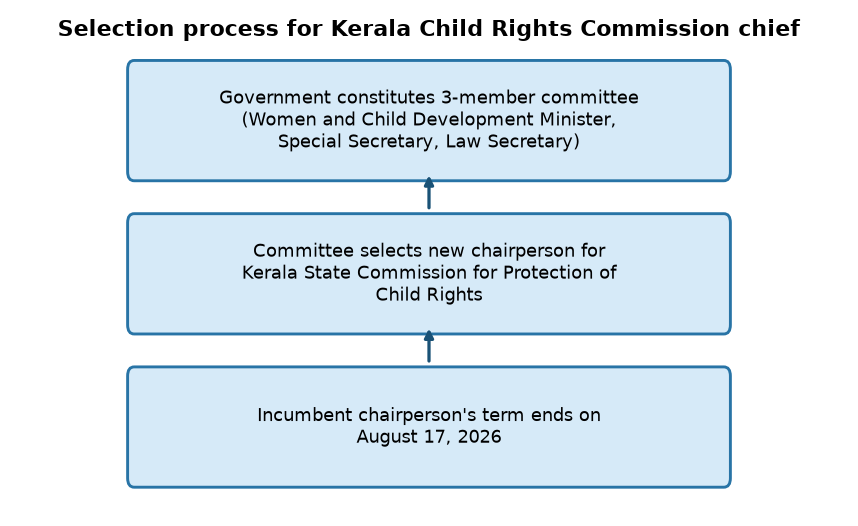
The formation of a three-member committee by the Kerala government to select the chairperson of the Kerala State Commission for Protection of Child Rights (KSCPCR) assumes significance in the context of the impending expiry of the incumbent chairperson’s term on August 17, 2026. This process highlights the institutional mechanisms for child rights protection at the state level, the composition and functions of state commissions under the Commissions for Protection of Child Rights Act, 2005, and the broader framework of constitutional and statutory safeguards for children in India.
Background
- The Kerala State Commission for Protection of Child Rights (KSCPCR) was established on June 3, 2013, under the provisions of the Commissions for Protection of Child Rights Act, 2005, which mandates the creation of such commissions in every state and union territory.
- The KSCPCR operates as a statutory body with the mandate to monitor the implementation of laws, policies, and programmes for the protection and promotion of child rights in Kerala, as well as to inquire into complaints regarding violations of child rights.
- The term of four members of the KSCPCR is set to expire in March 2027, indicating the periodic renewal of membership to ensure dynamism and accountability in the commission’s functioning.
- State commissions for child rights are integral to the decentralised implementation of child protection policies, complementing the role of the National Commission for Protection of Child Rights (NCPCR) at the central level.
What is the Kerala State Commission for Protection of Child Rights (KSCPCR)?
- The KSCPCR is a statutory body constituted under the Commissions for Protection of Child Rights Act, 2005, to protect and promote child rights in Kerala in accordance with the United Nations Convention on the Rights of the Child (UNCRC).
- The commission is mandated to examine and review the safeguards provided by or under any law for the time being in force for the protection of child rights and recommend measures for their effective implementation.
- It has the power to inquire into complaints regarding the deprivation and violation of child rights and take suo motu cognisance of matters relating to child rights violations.
- The KSCPCR is composed of a chairperson and six members, with a statutory requirement that at least two members must be women, ensuring gender representation in its functioning.
- The commission plays a pivotal role in monitoring the implementation of national and state-level child protection schemes, such as the Integrated Child Protection Scheme (ICPS), POCSO Act, and RTE Act.
- It conducts awareness programmes, undertakes research, and collaborates with civil society organisations to sensitise stakeholders on child rights issues.
- The KSCPCR submits annual reports to the state government and the NCPCR, which are placed before the state legislature and Parliament, respectively, ensuring transparency and accountability.
- The commission’s functions are aligned with constitutional provisions such as Article 15(3) (special provisions for women and children), Article 39(f) (directive principles for child development), and the Fundamental Duties under Article 51A(e) (to promote harmony and the spirit of common brotherhood).
Key Features
| Feature | Significance |
|---|---|
| Constitution of a three-member selection committee | Ensures a structured, transparent, and multi-stakeholder process for appointing the chairperson, aligning with principles of good governance and institutional integrity. |
| Inclusion of Women and Child Development Minister and officials | Reflects the commission’s focus on child rights and gender parity, ensuring policy coherence between executive decision-making and statutory bodies. |
| Term limits and staggered appointments | Prevents institutional stagnation by ensuring regular renewal of membership, while maintaining continuity through overlapping terms. |
| Legal Secretariat’s involvement | Highlights the constitutional and statutory underpinnings of the commission’s functioning, ensuring adherence to legal frameworks. |
| State-specific statutory body under the Commissions for Protection of Child Rights (CPCR) Act, 2005 | Demonstrates Kerala’s compliance with national legislation, reinforcing the state’s commitment to child welfare within a federal framework. |
Why it Matters
Constitutional and Statutory Significance
- The Kerala State Commission for Protection of Child Rights operates under the Commissions for Protection of Child Rights (CPCR) Act, 2005, which mandates the establishment of such bodies at the state level to monitor child rights violations.
- The commission’s role includes inquiring into complaints, conducting investigations, and recommending measures for the protection of child rights, thereby acting as a quasi-judicial authority.
- The selection process for the chairperson is critical to maintaining the commission’s independence and effectiveness, as the chairperson’s leadership directly influences its functioning and credibility.
- The inclusion of senior bureaucrats in the selection committee underscores the state’s commitment to institutionalising child rights protection within the administrative framework.
Policy and Governance Implications
- The commission’s work is aligned with the United Nations Convention on the Rights of the Child (UNCRC), which India ratified in 1992, and the National Policy for Children, 2013, which emphasizes the state’s obligation to protect and promote child rights.
- The commission serves as a bridge between the state and civil society, enabling grassroots-level monitoring of child welfare schemes such as the Integrated Child Protection Scheme (ICPS).
- The selection process reflects Kerala’s proactive approach to governance, where statutory bodies are given due importance in policy implementation and oversight.
Societal and Developmental Impact
- The commission plays a pivotal role in addressing issues such as child labour, trafficking, abuse, and neglect, which are critical for achieving Sustainable Development Goal (SDG) 16.2 (end abuse, exploitation, trafficking, and all forms of violence against and torture of children).
- By ensuring the appointment of a competent chairperson, the state can enhance the delivery of child-centric services, including education, healthcare, and nutrition, thereby contributing to human capital development.
- The commission’s work is particularly significant in Kerala, a state with high literacy rates but persistent challenges in child protection, such as child marriage and cyberbullying.
Challenges
1. Ensuring Independence and Impartiality of the Commission
- Risk of political interference in the selection process, which could compromise the commission’s autonomy and effectiveness.
- Potential lack of consensus among committee members due to differing priorities or affiliations, leading to delays in appointment.
- Need to balance representation while ensuring the selection of a chairperson with proven expertise in child rights and legal matters.
UPSC Link: GS-II: Statutory, regulatory and various quasi-judicial bodies
2. Addressing Institutional Capacity Gaps
- Limited financial and human resources allocated to the commission, which may hinder its ability to conduct thorough investigations and monitor child rights violations.
- Inadequate training and sensitization of commission members on emerging issues such as digital abuse, online exploitation, and mental health challenges among children.
- Dependence on state government for administrative support, which may create conflicts of interest or bureaucratic delays.
UPSC Link: GS-II: Functions and responsibilities of various Constitutional bodies
3. Coordination with Central and Local Authorities
- Fragmented implementation of child protection schemes due to lack of coordination between state commissions, district child protection units (DCPUs), and central agencies such as the National Commission for Protection of Child Rights (NCPCR).
- Delays in redressal of complaints due to procedural bottlenecks and lack of standardized protocols across states.
- Need for a robust grievance redressal mechanism to ensure timely intervention in cases of child rights violations.
UPSC Link: GS-II: Government policies and interventions for development in various sectors
4. Public Awareness and Participation
- Low awareness among the public about the commission’s role and functions, leading to underutilization of its services.
- Stigma and reluctance among victims or witnesses to report child rights violations due to fear of retaliation or lack of trust in the system.
- Need for proactive outreach programs to educate communities about child rights and the commission’s mandate.
UPSC Link: GS-II: Issues relating to development and management of Social Sector/Services relating to Health, Education, Human Resources
5. Emerging Challenges in Child Protection
- Rise in cybercrimes against children, including online grooming, sextortion, and exposure to harmful content, which requires specialized expertise to address.
- Increasing instances of child labour in informal sectors despite legal prohibitions, necessitating stronger enforcement mechanisms.
- Impact of climate change and disasters on child welfare, including displacement, malnutrition, and loss of access to education.
UPSC Link: GS-III: Disaster and disaster management
6. Data Gaps and Monitoring Mechanisms
- Lack of real-time data on child rights violations, which hampers evidence-based policymaking and targeted interventions.
- Inconsistent reporting mechanisms across states, leading to disparities in the identification and resolution of child protection issues.
- Need for a national-level database to track child rights violations and monitor the performance of state commissions.
UPSC Link: GS-II: Issues relating to poverty and hunger
Challenges — UPSC Perspective
| Issue | Concern |
|---|---|
| Political interference in appointments | Compromises the commission’s autonomy and credibility, undermining its quasi-judicial role. |
| Inadequate funding and staffing | Limits the commission’s ability to investigate complaints and implement protective measures effectively. |
| Lack of inter-departmental coordination | Leads to fragmented implementation of child protection policies and delayed redressal of grievances. |
| Low public awareness | Results in underreporting of child rights violations and reduced utilization of the commission’s services. |
| Emerging digital threats to child safety | Requires specialized expertise and updated legal frameworks to address cybercrimes against children. |
| Data inconsistencies across states | Hinders national-level monitoring and comparative analysis of child protection outcomes. |
Government Initiatives — Must-Memorise for Prelims
- Commissions for Protection of Child Rights (CPCR) Act, 2005
- Integrated Child Protection Scheme (ICPS)
- National Policy for Children, 2013
- Protection of Children from Sexual Offences (POCSO) Act, 2012
Way Forward
- Constitute a transparent and merit-based selection process with clear criteria for the chairperson’s appointment, including expertise in child rights and legal matters.
- Ensure adequate financial and administrative autonomy for the commission to function independently and effectively.
- Strengthen coordination between the state commission, district child protection units (DCPUs), and central agencies like the NCPCR to streamline implementation of child protection policies.
- Launch nationwide awareness campaigns to educate the public about child rights and the role of the commission in redressing violations.
- Develop specialized training programs for commission members to address emerging challenges such as cyberbullying, online exploitation, and mental health issues among children.
- Establish a national-level database to track child rights violations and monitor the performance of state commissions, ensuring data consistency and evidence-based policymaking.
- Enhance the commission’s investigative powers by providing it with dedicated personnel, forensic capabilities, and legal support to conduct thorough inquiries.
- Promote multi-stakeholder partnerships involving NGOs, civil society, and educational institutions to strengthen child protection mechanisms at the grassroots level.
UPSC Value Addition
Keywords for Mains Answer-Writing
Kerala State Commission for Protection of Child Rights · Child Rights Protection Mechanisms · Constitutional and Statutory Bodies for Child Welfare · Juvenile Justice Act, 2015 · National Commission for Protection of Child Rights (NCPCR) · State Commissions for Protection of Child Rights (SCPCRs) · Role of Women and Child Development Department · Selection Process for Constitutional Positions · Protection of Children from Sexual Offences (POCSO) Act, 2012 · UN Convention on the Rights of the Child (UNCRC) · Child Welfare Committees · District Child Protection Units
Concept Flow
Inception of the Kerala State Commission for Protection of Child Rights under the CPCR Act, 2005 → Formation of a three-member selection committee by the state government → Termination of the incumbent chairperson’s tenure → Selection process for a new chairperson → Appointment of a qualified chairperson → Commission’s quasi-judicial functions in monitoring child rights violations → Implementation of protective measures and recommendations → Public awareness and grievance redressal → Evaluation of outcomes and feedback for policy refinement → Long-term impact on child welfare and SDG achievement.
Prelims Practice Questions
Q1. Consider the following statements regarding the Kerala State Commission for Protection of Child Rights (KSCPCR):
1. It is a statutory body established under the Juvenile Justice (Care and Protection of Children) Act, 2015.
2. The Commission comprises a chairperson and six members, with at least two members being women.
3. The term of the chairperson is co-terminus with the term of the State Legislative Assembly.
Which of the statements given above is/are correct?
- 1 only
- 1 and 2 only
- 2 and 3 only
- 1, 2 and 3
Answer: 1 and 2 only — Statement 1 is correct as KSCPCR is established under the Juvenile Justice Act, 2015. Statement 2 is correct as per the government order cited. Statement 3 is incorrect as the term of the chairperson is fixed and not co-terminus with the Legislative Assembly.
Q2. The selection committee for the chairperson of the Kerala State Commission for Protection of Child Rights includes which of the following officials?
1. Minister for Women and Child Development
2. Chief Secretary of Kerala
3. Law Secretary of Kerala
4. Director of the State Council for Educational Research and Training (SCERT)
Select the correct answer using the code given below:
- 1 and 2 only
- 1 and 3 only
- 2 and 4 only
- 1, 3 and 4 only
Answer: 1 and 3 only — The selection committee comprises the Minister for Women and Child Development, the Women and Child Development Special Secretary, and the Law Secretary. The Chief Secretary and Director of SCERT are not part of this committee.
Mains Practice Question
✍ Analyse the constitutional and statutory framework governing the State Commissions for Protection of Child Rights (SCPCRs) in India. Discuss the significance of such commissions in the context of child protection and welfare, with particular reference to the Kerala State Commission for Protection of Child Rights.
Approach: Begin by outlining the legal basis for SCPCRs under the Juvenile Justice (Care and Protection of Children) Act, 2015, and their alignment with the UN Convention on the Rights of the Child. Highlight the composition, functions, and powers of SCPCRs, including their role in monitoring implementation of child protection laws like the POCSO Act. Discuss the Kerala model, including its selection process for the chairperson and the challenges it may face. Conclude with the importance of SCPCRs in ensuring accountability and child-centric governance.
Source: The Hindu
Generated by AanyaAi for educational purpose.

- Rajya Sabha Bypoll on November 12: Key Dates & Process Explained - October 22, 2026
- सिम्बेक्स-2026: भारत-सिंगापुर नौसैनिक अभ्यास विशाखापत्तनम में शुरू, जानिए महत्वपूर्ण बिंदु - October 22, 2026
- PM-DAKSH Scheme: Key Features for UPSC & State PCS Aspirants - October 22, 2026

No Comments