


17 Sep Kerala HC Reserves Verdict on Patented Life-Saving Drug Pricing
✎ The Patents Act, 1970, read with the TRIPS Agreement, provides flexibilities like compulsory licensing (Section 84) to balance patent rights with public health, while the NPPA and DPCO regulate prices of essential medicines…
Subject Relevance — Where This Topic Fits
- GS Paper II — Governance, Constitution, Polity, Social Justice and International Relations (Intellectual Property Rights, Right to Health) | GS Paper III — Science and Technology, Health, and Economic Development (Pharmaceutical Pricing, Patent Law, Public Health Policy)
Quick Revision: The Patents Act, 1970, read with the TRIPS Agreement, provides flexibilities like compulsory licensing (Section 84) to balance patent rights with public health, while the NPPA and DPCO regulate prices of essential medicines, though their jurisdiction over patented drugs is limited unless included in the NLEM.
Why is this in the news?
The Kerala High Court’s suo motu consideration of exorbitant pricing of patented life-saving medicines, particularly Ribociclib for breast cancer, underscores the tension between patent rights and public health imperatives. The case highlights the judiciary’s role in addressing affordability of essential drugs, the feasibility of compulsory licensing, and the substitution of patented drugs with cheaper alternatives, all within the ambit of India’s patent regime and constitutional guarantees of health rights.
Background
- India’s patent regime, governed by the Patents Act, 1970 (amended in 2005 to comply with WTO’s TRIPS Agreement), balances innovation incentives with public health needs by allowing compulsory licensing under Section 84 for drugs deemed unaffordable or inadequately supplied.
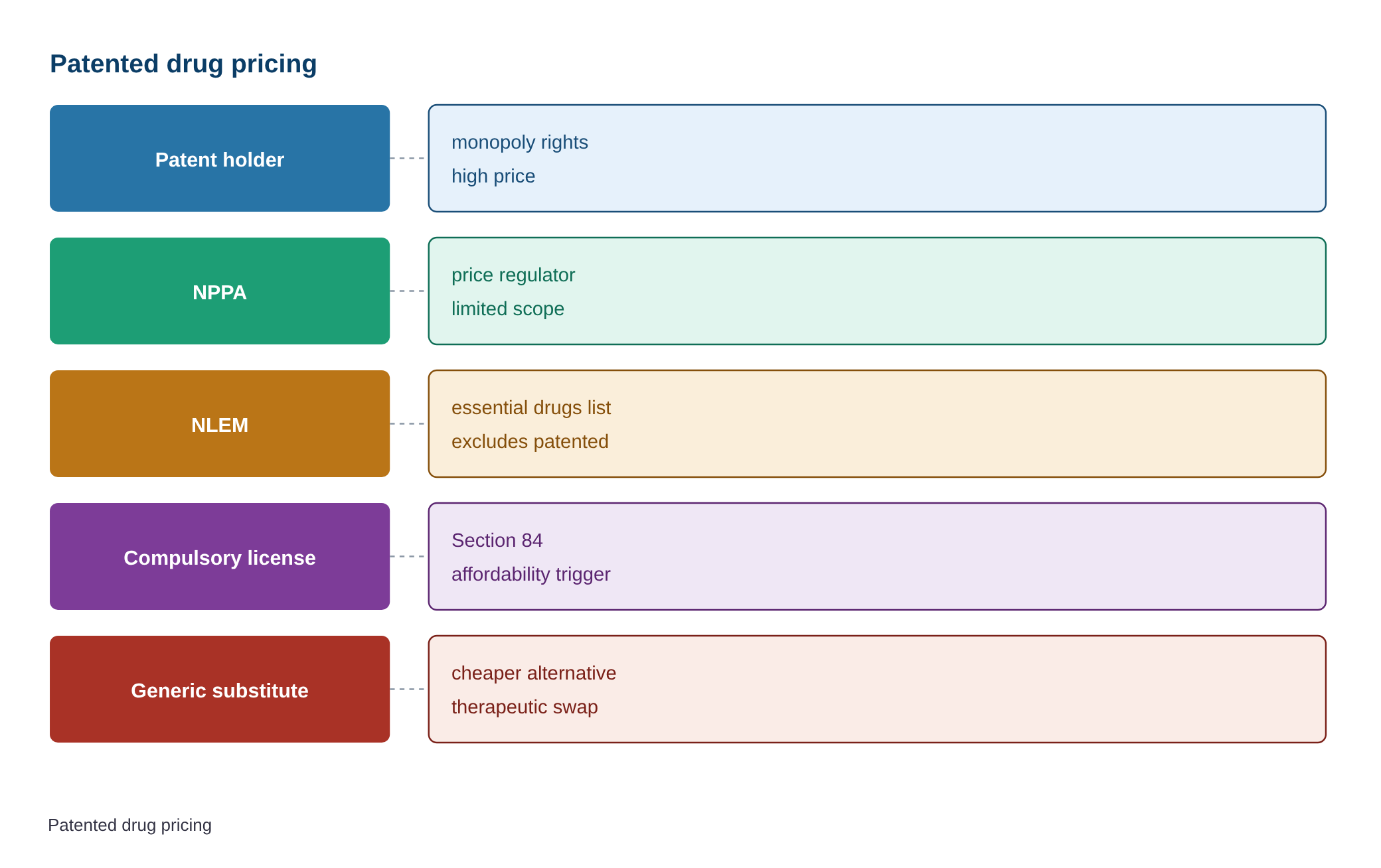
- The National Pharmaceutical Pricing Authority (NPPA) regulates prices of essential medicines under the Drug Price Control Order (DPCO), but its jurisdiction excludes patented drugs unless they are included in the National List of Essential Medicines (NLEM).
- The case involves Ribociclib, a patented drug used in breast cancer treatment, priced exorbitantly in India compared to other markets, raising concerns over affordability and access for economically vulnerable patients.
- The Kerala High Court’s suo motu intervention reflects judicial activism in public health governance, particularly when executive or legislative measures are perceived as inadequate.
- The court’s consideration of expert opinions on the substitutability of patented drugs with cheaper, locally manufactured alternatives (e.g., generic versions of older, off-patent drugs) introduces a critical debate on clinical equivalence and therapeutic substitution.
- The petitioner’s demise during the pendency of the case underscores the urgency of judicial intervention in life-saving matters, where delays can have irreversible consequences.
What is the legal and policy framework governing patented medicines in India?
- The Patents Act, 1970 (as amended in 2005) governs patentability, duration, and enforcement of pharmaceutical patents in India, ensuring compliance with the WTO’s TRIPS Agreement while retaining flexibilities for public health.
- Section 84 of the Patents Act allows for compulsory licensing if a patented drug is not available at a reasonable price, not worked in India, or not supplied to meet public demand, subject to judicial or executive approval.
- The National Pharmaceutical Pricing Authority (NPPA), established under the Essential Commodities Act, 1955, regulates prices of essential medicines but has limited jurisdiction over patented drugs unless they are included in the NLEM.
- The Drug Price Control Order (DPCO) empowers the government to fix ceiling prices for essential drugs, but its scope excludes patented drugs unless they are deemed critical for public health.
- The Right to Health, interpreted under Article 21 of the Constitution, imposes a positive obligation on the state to ensure access to affordable and quality healthcare, including essential medicines.
- Judicial precedents, such as the Novartis AG vs. Union of India (2013) case, have reinforced India’s stance on patentability criteria (e.g., Section 3(d)) to prevent evergreening and ensure affordability of life-saving drugs.
- The WTO’s Doha Declaration on TRIPS and Public Health (2001) allows member states to issue compulsory licenses for public health emergencies, including HIV/AIDS, tuberculosis, malaria, and other epidemics.
- The Kerala High Court’s suo motu jurisdiction in this case exemplifies the judiciary’s role in safeguarding constitutional rights when executive or legislative measures are perceived as inadequate or delayed.
Key Features
| Feature | Significance |
|---|---|
| Suo Motu Jurisdiction of Kerala High Court | Demonstrates judicial activism in safeguarding public interest, particularly in matters of public health and affordability of essential medicines. |
| Expert Opinion on Drug Substitution | Highlights the technical complexity of substituting patented drugs with generics, requiring clinical and toxicological validation to ensure patient safety. |
| Impleadment of Additional Petitioner | Expands the scope of judicial scrutiny to include broader public health concerns beyond the original petitioner’s case. |
| Focus on Patented Life-Saving Medicines | Underscores the tension between intellectual property rights and the right to affordable healthcare, a critical issue in public health governance. |
| Judicial Intervention in Pricing | Reflects the judiciary’s role in addressing market failures where regulatory mechanisms may be inadequate. |
Why it Matters
Constitutional and Legal
- The case invokes the constitutional mandate under Article 21 (Right to Life and Personal Liberty) to ensure access to affordable and life-saving medicines.
- It engages with the balance between Article 19(1)(g) (Right to Practice any Profession) and Article 21, particularly in the context of patent rights and public health.
- The suo motu jurisdiction exercised by the Kerala High Court aligns with the broader judicial responsibility to protect fundamental rights, even in the absence of a formal petition.
Economic
- The case highlights the economic burden on patients due to high prices of patented medicines, which can lead to catastrophic health expenditures and impoverishment.
- It underscores the need for regulatory frameworks that prevent monopolistic pricing practices in the pharmaceutical sector.
- The reliance on imported patented drugs versus locally manufactured generics raises questions about India’s pharmaceutical trade balance and self-reliance.
Public Health
- The case brings attention to the accessibility and affordability of cancer treatments, a critical public health challenge in India.
- It raises questions about the efficacy and safety of substituting patented drugs with generics, a common practice in resource-constrained settings.
- The judicial intervention may set a precedent for future cases involving high-cost essential medicines.
Judicial
- The suo motu case reflects the judiciary’s proactive role in addressing systemic issues affecting public welfare, particularly in health governance.
- The reliance on expert opinions in judicial decisions highlights the importance of evidence-based adjudication in complex technical matters.
- The case may influence future judicial interpretations of patent laws in the context of public health emergencies.
Policy
- The case may prompt the government to revisit policies on drug pricing, particularly for patented life-saving medicines.
- It could lead to reforms in the regulation of pharmaceutical patents to balance innovation incentives with public health needs.
- The judiciary’s intervention may encourage the executive to strengthen existing schemes aimed at reducing the cost of essential medicines.
Challenges
1. Balancing Patent Rights and Public Health
- The need to respect intellectual property rights while ensuring affordable access to life-saving medicines creates a policy dilemma.
- The absence of a clear regulatory mechanism to cap prices of patented drugs exacerbates the problem.
- The reliance on judicial intervention to address this issue highlights the limitations of existing governance structures.
UPSC Link: GS2: Government Policies and Interventions
2. Ensuring Drug Substitution Safety
- The technical complexity of substituting patented drugs with generics requires robust clinical and toxicological validation.
- The lack of standardized protocols for drug substitution in public health emergencies poses a risk to patient safety.
- The judicial reliance on expert opinions underscores the need for transparent and evidence-based decision-making in healthcare.
UPSC Link: GS3: Science and Technology
3. Judicial Activism vs. Separation of Powers
- The suo motu jurisdiction exercised by the Kerala High Court raises questions about the appropriate limits of judicial activism.
- The judiciary’s intervention in policy matters may encroach upon the executive’s domain, leading to potential conflicts.
- The case highlights the need for a clear framework governing the judiciary’s role in public health governance.
UPSC Link: GS2: Judiciary
4. Affordability of Cancer Treatments
- The high cost of cancer drugs disproportionately affects low-income and marginalized communities, exacerbating health inequities.
- The lack of universal health coverage in India limits access to essential cancer treatments for a significant portion of the population.
- The case underscores the urgent need for policies that make cancer treatments more affordable and accessible.
UPSC Link: GS2: Health
5. Regulatory Gaps in Drug Pricing
- The absence of a comprehensive drug pricing policy for patented medicines leaves patients vulnerable to exploitative pricing practices.
- The reliance on judicial intervention to address pricing issues highlights the inadequacy of existing regulatory mechanisms.
- The case may prompt the government to strengthen the National Pharmaceutical Pricing Authority (NPPA) to regulate drug prices more effectively.
UPSC Link: GS2: Government Policies and Interventions
Challenges — UPSC Perspective
| Issue | Concern |
|---|---|
| Patent Rights vs. Public Health | Balancing innovation incentives with the need for affordable medicines. |
| Drug Substitution Safety | Ensuring that generic substitutes are clinically and toxicologically equivalent to patented drugs. |
| Judicial Activism in Policy | Determining the appropriate limits of judicial intervention in public health governance. |
| Affordability of Cancer Treatments | Addressing the disproportionate burden of high-cost cancer drugs on patients. |
| Regulatory Gaps in Drug Pricing | Strengthening mechanisms to prevent exploitative pricing of essential medicines. |
| Access to Life-Saving Medicines | Ensuring equitable distribution and affordability of patented drugs across socio-economic strata. |
Way Forward
- The government should expedite the formulation of a comprehensive drug pricing policy for patented medicines, incorporating mechanisms to cap prices and ensure affordability.
- The National Pharmaceutical Pricing Authority (NPPA) should be empowered to regulate prices of patented life-saving drugs, drawing on global best practices.
- The Ministry of Health and Family Welfare should collaborate with the Department of Pharmaceuticals to develop guidelines for safe and effective drug substitution in public health emergencies.
- The judiciary should establish clear criteria for suo motu interventions in public health matters to ensure consistency and prevent overreach.
- The government should explore the possibility of compulsory licensing for patented life-saving drugs in cases of public health necessity, as permitted under the TRIPS Agreement.
- The Indian Council of Medical Research (ICMR) should conduct independent clinical and toxicological studies to validate the safety and efficacy of generic substitutes for patented drugs.
- Public health advocates and civil society organizations should engage in advocacy to raise awareness about the affordability crisis in cancer treatments and push for policy reforms.
- The government should consider expanding the scope of the Ayushman Bharat scheme to include coverage for high-cost cancer treatments, particularly for low-income households.
UPSC Value Addition
Keywords for Mains Answer-Writing
Patent Act, 1970 · Compulsory Licensing under Section 84 · Price control of essential drugs · Right to Health under Article 21 · Kerala High Court suo motu jurisdiction · Life-saving drugs accessibility · Intellectual Property Rights (IPR) and public health · Drugs (Prices Control) Order, 2013 · National Pharmaceutical Pricing Authority (NPPA) · Clinical equivalence of generic vs patented drugs · Right to life vs patent rights · Judicial activism in public health · Affordable Cancer Treatment · Public Interest Litigation (PIL) in healthcare
Constitutional & Policy Linkages
- [‘Article 21: Right to Life and Personal Liberty’, ‘Ensures access to affordable healthcare as part of fundamental rights.’]
- [‘Article 19(1)(g): Right to Practice any Profession’, ‘Balanced against public health needs in patent regulation.’]
- [‘Article 38: Directive Principles of State Policy’, ‘Emphasizes equitable distribution of resources, including healthcare.’]
- [‘Article 47: Duty of the State to Raise Public Health Standards’, ‘Directs the state to ensure affordable and accessible healthcare.’]
Concept Flow
High prices of patented life-saving medicines → Judicial intervention via suo motu case → Expert evaluation of drug substitution → Debate on patent rights vs. public health → Policy implications for drug pricing regulation → Potential reforms in pharmaceutical governance.
Prelims Practice Questions
Q1. Consider the following statements regarding compulsory licensing under the Patents Act, 1970:
1. Compulsory licensing can be granted if the patented invention is not available to the public at a reasonably affordable price.
2. The Controller General of Patents, Designs and Trademarks is empowered to grant compulsory licences.
3. The grounds for granting a compulsory licence include failure to meet the reasonable requirements of the public or failure to work the invention in India.
How many of the above statements are correct?
- Only one
- Only two
- All three
- None
Answer: All three — Statements 1 and 3 are correct as per Section 84 of the Patents Act, 1970. Statement 2 is incorrect; the power to grant compulsory licences lies with the Controller General of Patents, Designs and Trademarks under Section 84(1).
Q2. Assertion (A): The National Pharmaceutical Pricing Authority (NPPA) regulates the prices of essential drugs under the Drugs (Prices Control) Order, 2013.
Reason (R): The NPPA is empowered to fix the ceiling prices of scheduled formulations to ensure their affordability.
Options:
A. Both A and R are true, and R is the correct explanation of A.
B. Both A and R are true, but R is NOT the correct explanation of A.
C. A is true, but R is false.
D. A is false, but R is true.
Answer: ? — Both Assertion (A) and Reason (R) are correct. The NPPA, under the Drugs (Prices Control) Order, 2013, fixes ceiling prices of essential drugs to ensure affordability. R correctly explains A.
Q3. Match the following provisions with their respective legal frameworks:
Column I (Provision)
1. Compulsory Licensing
2. Price Control of Drugs
3. Right to Health
4. Patent Opposition
Column II (Legal Framework)
A. Patents Act, 1970
B. Drugs (Prices Control) Order, 2013
C. Article 21 of the Constitution
D. Patents Act, 1970
Options:
1. 1-A, 2-B, 3-C, 4-D
2. 1-B, 2-A, 3-C, 4-D
3. 1-C, 2-B, 3-A, 4-D
4. 1-D, 2-A, 3-B, 4-C
- 1
- 2
- 3
- 4
Answer: 1 — 1 (Compulsory Licensing) is under the Patents Act, 1970 (A). 2 (Price Control of Drugs) is under the Drugs (Prices Control) Order, 2013 (B). 3 (Right to Health) is a fundamental right under Article 21 (C). 4 (Patent Opposition) is also under the Patents Act, 1970 (D).
Mains Practice Question
✍ The exorbitant pricing of patented life-saving medicines poses a fundamental conflict between intellectual property rights and the constitutional right to health. Critically examine the legal and policy mechanisms available in India to address this issue, with particular reference to compulsory licensing and price control mechanisms. Also, analyse the role of judicial intervention in ensuring equitable access to essential drugs. (15 Marks)
Approach: MODEL-ANSWER SKELETON:
1. **Introduction (2 marks)**
– Briefly define the conflict: IPR (Patents Act, 1970) vs. Right to Health (Article 21).
– Contextualise with the Kerala High Court case on exorbitant pricing of Ribociclib.
2. **Legal Mechanisms to Address Pricing Issues (5 marks)**
– **Compulsory Licensing (Section 84, Patents Act, 1970)**:
– Grounds: Failure to meet reasonable requirements of the public, non-working of the invention in India, or failure to provide the invention at a reasonably affordable price.
– Procedural aspects: Application to the Controller General of Patents, Designs and Trademarks, hearing, and decision.
– Case reference: Bayer v. Natco (2012) where Natco was granted a compulsory licence for Nexavar.
– **Price Control Mechanisms (Drugs (Prices Control) Order, 2013)**:
– Role of the National Pharmaceutical Pricing Authority (NPPA) in fixing ceiling prices of essential drugs.
– Scheduled formulations and non-scheduled formulations under price control.
– Example: NPPA’s intervention in capping prices of cancer drugs.
3. **Judicial Intervention and suo motu Jurisdiction (4 marks)**
– **Judicial Activism in Public Health**: Courts have historically intervened to ensure access to essential medicines (e.g., Paschim Banga Khet Mazdoor Samity v. State of West Bengal, 1996).
– **Kerala High Court’s Role**: suo motu case on exorbitant pricing of life-saving drugs; expert opinions on clinical equivalence and substitution.
– **Balancing IPR and Public Interest**: Courts must weigh patent rights against the right to health, ensuring that life-saving drugs remain accessible without undermining innovation incentives.
4. **Challenges and Limitations (3 marks)**
– **Clinical Equivalence**: Amicus curiae’s submission in the Kerala case highlights the complexity of substituting patented drugs with generics (e.g., Ribociclib vs. alternative therapies).
– **Procedural Delays**: Lengthy processes for compulsory licensing and price control appeals.
– **Global IPR Regimes**: TRIPS Agreement and its flexibilities (e.g., Doha Declaration on Public Health).
5. **Conclusion (1 mark)**
– Synthesis: Need for a balanced approach that protects IPR while ensuring equitable access to life-saving medicines.
– Policy suggestions: Strengthening NPPA’s powers, expediting compulsory licensing processes, and promoting indigenous drug manufacturing.
Source: The Hindu
Kerala PCS (Kerala PSC (KAS)) — State PCS Practice
Prelims: The Kerala High Court recently reserved its verdict on a PIL challenging the exorbitant pricing of a life-saving patented medicine in Kerala. Which of the following is the most likely legal provision invoked in such cases to ensure affordable access to essential drugs?
- Article 21 of the Indian Constitution (Right to Life and Personal Liberty)
- Section 3(d) of the Indian Patents Act, 1970 (preventing evergreening of patents)
- The Essential Commodities Act, 1955 (regulation of prices of essential goods)
- The Drugs (Prices Control) Order, 2013 (price regulation of scheduled drugs)
Answer: Article 21 of the Indian Constitution (Right to Life and Personal Liberty) — Article 21 of the Indian Constitution has been interpreted by the Supreme Court to include the right to affordable healthcare, making it a key legal provision in cases involving exorbitant pricing of life-saving medicines.
Mains: Critically examine the role of the Kerala High Court in ensuring affordable access to patented life-saving medicines in the state. Discuss the legal provisions and judicial precedents that could influence the court’s verdict in this case.
Generated by AanyaAi for educational purpose.
Related guides on our sites
- Anthropology VS PSIR
- Best PSIR optional coaching
- Best PSIR optional coaching online
- Best PSIR optional teacher

- विधायकों की चुप्पी को न्यायालय कैसे मान सकता है शून्य? मद्रास हाईकोर्ट का महत्वपूर्ण फैसला - September 23, 2026
- वायुसेना को मिला बड़ा हथियार: ₹811 करोड़ के 160 स्मार्ट एंटी-एयरफील्ड वेपन समझौता - September 23, 2026
- UPSC Exam Alert: Defence Ministry signs ₹811 Crore SAT-SAAW deal for IAF - September 23, 2026

No Comments