


08 Aug Kerala LIFE Mission Case: Anil Akkara Demands CBI Probe Transfer
✎ The Kerala LIFE Mission case exemplifies the constitutional and operational challenges in federal investigations, where parallel probes by state and central agencies risk diluting the efficacy of justice delivery and eroding…
Subject Relevance — Where This Topic Fits
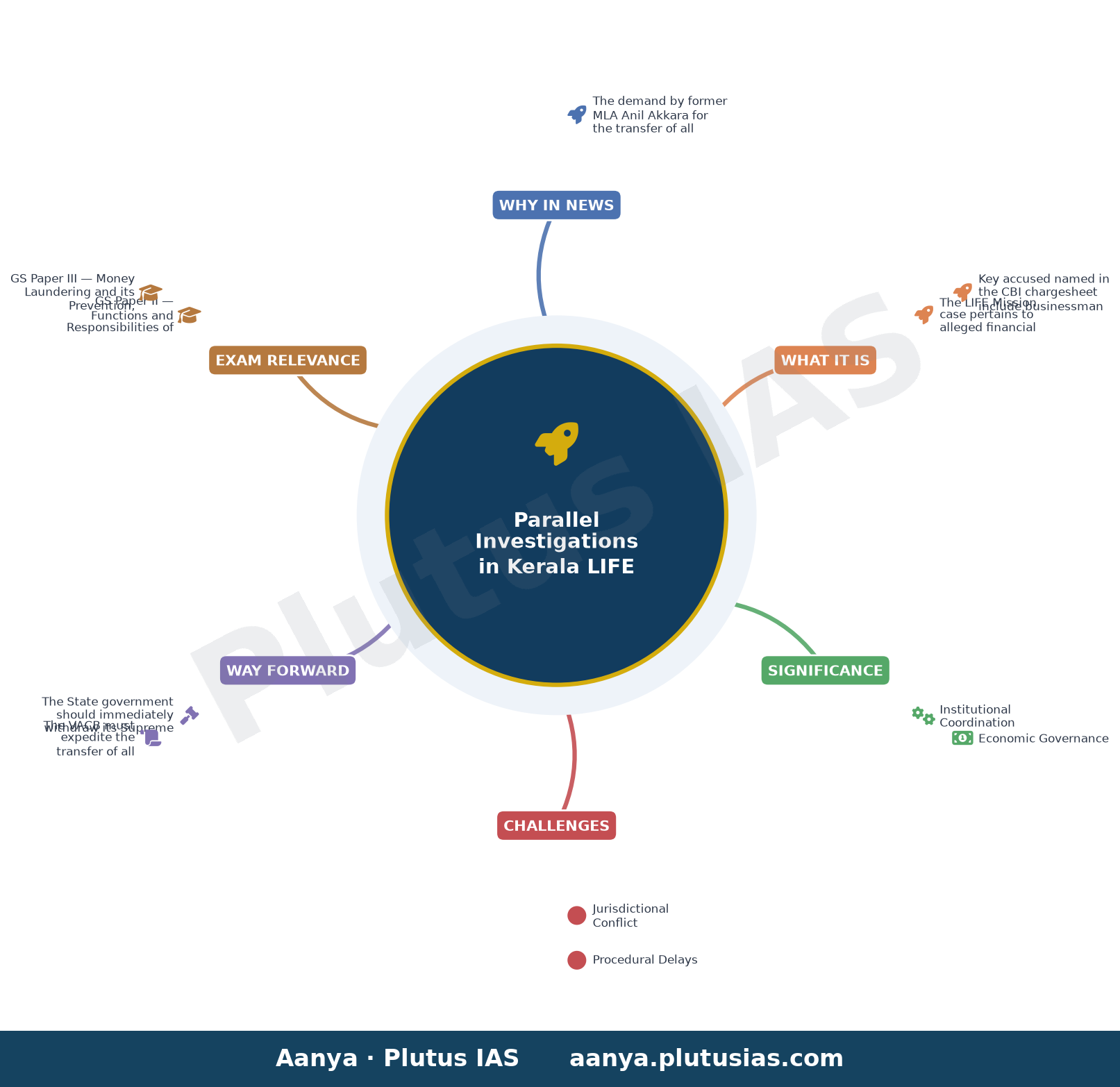
- GS Paper II — Functions and Responsibilities of the Union and the States, Issues and Challenges Pertaining to the Federal Structure | GS Paper III — Money Laundering and its Prevention, Challenges to Internal Security through Communication Networks
- Prelims: Vigilance and Anti-Corruption Bureau (VACB), Central Bureau of Investigation (CBI), LIFE Mission, 2018 Kerala floods, Supreme Court of India, Money laundering (PMLA), Federalism in India
- Essay: Federalism and the Balance of Power: Lessons from Parallel Investigations in Corruption Cases, Rule of Law vs. Political Expediency: The Case of Kerala LIFE Mission Scam
Quick Revision: The Kerala LIFE Mission case exemplifies the constitutional and operational challenges in federal investigations, where parallel probes by state and central agencies risk diluting the efficacy of justice delivery and eroding public confidence in anti-corruption mechanisms.
Why is this in the news?
The demand by former MLA Anil Akkara for the transfer of all Vigilance files to the CBI in the Kerala LIFE Mission case underscores the systemic challenges posed by parallel investigations in high-profile corruption cases. This development highlights the friction between state and central investigative agencies, the need for coordination in federal investigations, and the broader implications for the integrity of the justice delivery system. The case also brings into focus the role of political executive oversight in corruption probes and the legal framework governing inter-agency transfers of investigation files.
Background
- The LIFE Mission was launched in 2018 as a rehabilitation initiative by the Kerala government following the devastating floods that year, aimed at providing housing and infrastructure for flood-affected communities.
- The project involved a bilateral agreement between the Kerala LIFE Mission and the UAE Red Crescent for the construction of a housing complex and a hospital in Wadakkanchery, with a sanctioned amount of ₹21 crore.
- Allegations of financial irregularities, including contract manipulation and embezzlement, surfaced in 2020, leading to multiple investigations by state agencies, including the Vigilance and Anti-Corruption Bureau (VACB).
- The Central Bureau of Investigation (CBI) has filed a chargesheet, naming key accused including businessman Santhosh Eappen, firms Sane Ventures and Unitac Builders, and officials from the LIFE Mission and the state government.
- The case has become emblematic of the challenges in coordinating multi-agency investigations in India, particularly where state and central agencies operate under distinct legal and constitutional mandates.
- The Supreme Court is currently seized of a petition filed by the Kerala government, which has been urged to withdraw it to facilitate a unified investigation by the CBI.
What is the LIFE Mission Case?
- The LIFE Mission case pertains to alleged financial irregularities in the awarding of contracts for the construction of housing and a hospital in Wadakkanchery, Kerala, under a rehabilitation programme post the 2018 floods.
- Key accused named in the CBI chargesheet include businessman Santhosh Eappen, firms Sane Ventures and Unitac Builders, and the LIFE Mission itself, alongside officials and middlemen.
- The investigation has implicated former Principal Secretary to the Chief Minister, M. Sivasankar, and former LIFE Mission CEO U.V. Jose, with the CBI probing their alleged roles in the irregularities.
- The Kerala government’s Vigilance and Anti-Corruption Bureau (VACB) had been conducting parallel investigations, which the complainant argues have led to inefficiencies and coordination challenges in the legal proceedings.
- The case raises critical questions about the division of investigative powers between state and central agencies, the legal framework for inter-agency transfers, and the accountability of political executives in corruption cases.
- The demand for transferring all Vigilance files to the CBI reflects broader concerns about the need for a unified, transparent, and credible investigation to uphold public trust in the justice system.
Key Features
| Feature | Significance |
|---|---|
| Parallel Investigations | Undermines efficiency, risks conflicting findings, and complicates legal coordination, necessitating a single investigating agency for credibility. |
| CBI Chargesheet | Formal accusation filed by the CBI, naming accused parties and detailing alleged irregularities in the LIFE Mission housing project. |
| Vigilance Bureau Files | Documents and evidence held by the State Vigilance and Anti-Corruption Bureau (VACB), including records from former Principal Secretary M. Sivasankar. |
| Rule of Law Emphasis | Demand for transparent, unhindered investigation to preserve public trust in the justice delivery system. |
| Supreme Court Petition | State government’s pending plea before the Supreme Court, which the complainant urges to withdraw to facilitate CBI investigation. |
Why it Matters
Institutional Coordination
- Highlights the need for seamless inter-agency cooperation in high-stakes corruption cases to avoid jurisdictional conflicts.
- Demonstrates the Centre-State dynamics in investigative agencies, particularly when central agencies like the CBI are involved.
- Raises questions about the autonomy of State Vigilance Bureaus in cases with potential political implications.
Economic Governance
- Exposes systemic vulnerabilities in public procurement and fund disbursement under rehabilitation programmes post-disaster.
- Underscores the risks of crony capitalism in infrastructure projects funded by international aid agencies (e.g., UAE Red Crescent).
- Reinforces the importance of transparent financial audits in disaster relief schemes to prevent misappropriation.
Judicial Process
- Illustrates the procedural challenges when multiple agencies investigate overlapping aspects of the same case.
- Emphasizes the judiciary’s role in ensuring a single, credible investigating agency to uphold due process.
- Highlights the balance between State autonomy in investigations and the Centre’s constitutional authority to supervise the CBI.
Challenges
1. Jurisdictional Conflict
- Parallel investigations by State Vigilance and CBI risk conflicting narratives, delaying justice and eroding public confidence.
- Delays in transferring files to the CBI may lead to loss of critical evidence or tampering.
- Political interference in investigations can compromise the integrity of the probe.
UPSC Link: GS-II: Federalism, Cooperative Federalism
2. Procedural Delays
- Pending Supreme Court petitions by the State government may obstruct the CBI’s investigative mandate.
- Lack of immediate cooperation from State agencies can hinder the CBI’s timeline for filing chargesheets.
- Legal wrangling over evidence custody may prolong the trial process.
UPSC Link: GS-II: Judiciary, Judicial Activism
3. Transparency and Accountability
- Opaque handling of documents by State agencies raises concerns about selective disclosure or suppression of evidence.
- Allegations of high-level involvement (e.g., former Principal Secretary, Chief Minister) necessitate stringent oversight.
- Public perception of bias in investigations can undermine trust in anti-corruption frameworks.
UPSC Link: GS-IV: Probity in Governance
4. Financial Mismanagement
- Misuse of ₹21 crore sanctioned for flood rehabilitation highlights gaps in fund utilization audits.
- Collusion between contractors and officials in awarding contracts points to systemic failures in procurement processes.
- Lack of real-time monitoring of project execution enables fraudulent practices.
UPSC Link: GS-III: Public Finance Management
Challenges — UPSC Perspective
| Issue | Concern |
|---|---|
| Multi-Agency Investigations | Risk of conflicting findings, delayed justice, and compromised evidence integrity. |
| State-Centre Coordination | Potential friction over investigative autonomy and Centre’s supervisory role over the CBI. |
| Political Interference | Allegations of high-level involvement may influence the probe’s objectivity. |
| Evidence Custody | Delays in transferring files to the CBI could lead to loss or tampering of critical documents. |
| Public Trust | Perceived bias or opacity in investigations may erode confidence in anti-corruption mechanisms. |
Way Forward
- The State government should immediately withdraw its Supreme Court petition to facilitate a single, unobstructed CBI investigation.
- The VACB must expedite the transfer of all documents, including those related to former Principal Secretary M. Sivasankar, to the CBI without delay.
- The CBI should conduct a forensic audit of the ₹21 crore fund flow to identify irregularities and recover misappropriated amounts.
- Strengthen real-time monitoring mechanisms for disaster relief fund disbursement to prevent future misappropriation.
- Enhance transparency in public procurement by mandating e-tendering and third-party audits for all rehabilitation projects.
- The Union Home Ministry should issue a directive to States on seamless coordination between State Vigilance Bureaus and the CBI in corruption cases.
- Conduct a capacity-building exercise for State Vigilance agencies to align their investigative protocols with CBI standards.
- The judiciary should prioritize trials in corruption cases involving public funds to ensure timely justice and deter similar offences.
UPSC Value Addition
Keywords for Mains Answer-Writing
CBI autonomy · Vigilance and Anti-Corruption Bureau (VACB) · LIFE Mission scam · federal investigative agencies · cooperative federalism in investigation · Rule of Law · parallel investigations · Supreme Court intervention in investigative agencies · corruption in housing projects · UAE-based charitable organisations in India · sanction of public funds · judicial accountability of investigative agencies
Concept Flow
Kerala floods (2018) → Rehabilitation scheme (LIFE Mission) → Sanction of ₹21 crore → Contract awarded to Unitac Builders → Allegations of irregularities → CBI investigation → Chargesheet filed → Parallel State Vigilance probe → Demand for file transfer to CBI → Jurisdictional conflict → Need for single investigating agency → Call for transparency and rule of law.
Prelims Practice Questions
Q1. Consider the following statements regarding the Central Bureau of Investigation (CBI) in India:
1. The CBI is a constitutional body established under Article 312 of the Constitution.
2. The CBI derives its powers from the Delhi Special Police Establishment Act, 1946.
3. The CBI can investigate cases referred to it by the Supreme Court or High Courts.
4. The CBI is under the administrative control of the Ministry of Home Affairs, Government of India.
How many of the above statements are correct?
- Only one
- Only two
- Only three
- All four
Answer: Only three — Statement 1 is incorrect: The CBI is not a constitutional body. Statement 2 is correct: The CBI’s legal basis is the Delhi Special Police Establishment Act, 1946. Statement 3 is correct: The CBI can investigate cases referred by courts. Statement 4 is incorrect: The CBI is under the administrative control of the Department of Personnel and Training, Ministry of Personnel, Public Grievances and Pensions.
Q2. Assertion (A): The Vigilance and Anti-Corruption Bureau (VACB) in Kerala is a state-level agency tasked with investigating corruption cases within the state.
Reason (R): The VACB operates under the administrative control of the state government and derives its powers from the Kerala Lok Ayukta Act, 1999.
Options:
A. Both A and R are true, and R is the correct explanation of A.
B. Both A and R are true, but R is not the correct explanation of A.
C. A is true, but R is false.
D. A is false, but R is true.
Answer: ? — Assertion (A) is true: The VACB is a state-level agency investigating corruption cases in Kerala. Reason (R) is also true: The VACB operates under state control and is empowered by the Kerala Lok Ayukta Act, 1999. However, the Act is not the sole source of its powers; it also derives authority from the Kerala Police Act and other relevant laws.
Q3. Match the following investigative agencies with their respective jurisdictions:
Column I (Agency)
1. Central Bureau of Investigation (CBI)
2. Vigilance and Anti-Corruption Bureau (VACB)
3. Enforcement Directorate (ED)
4. National Investigation Agency (NIA)
Column II (Jurisdiction)
A. Exclusively for offences against the State and terrorism
B. Economic offences and money laundering
C. Corruption and vigilance cases within a state
D. Offences affecting the sovereignty, security, and integrity of India, or against international treaties
Options:
1. 1-D, 2-C, 3-B, 4-A
2. 1-B, 2-A, 3-D, 4-C
3. 1-A, 2-B, 3-C, 4-D
4. 1-C, 2-D, 3-A, 4-B
Answer: ? — 1-CBI (1) is a multi-state agency investigating offences affecting sovereignty, security, and integrity of India, or against international treaties (D). 2-VACB (2) investigates corruption and vigilance cases within a state (C). 3-ED (3) handles economic offences and money laundering (B). 4-NIA (4) exclusively investigates offences against the State and terrorism (A).
Mains Practice Question
✍ The demand for transfer of all Vigilance files to the CBI in the Kerala LIFE Mission case underscores the tension between state autonomy and the imperative of a unified, credible investigation. Critically examine the constitutional and institutional dimensions of such parallel investigations, with reference to the principles of cooperative federalism and the Rule of Law. Also, analyse the consequences if state agencies refuse to cooperate with central investigative bodies. (15 Marks)
Approach: MODEL-ANSWER SKELETON:
1. **Introduction (2 Marks)**
– Briefly contextualise the Kerala LIFE Mission case and the demand for file transfer to the CBI.
– State the core tension: state autonomy vs. central investigative authority.
2. **Constitutional and Institutional Framework (4 Marks)**
– **Cooperative Federalism**: Explain the doctrine as a balance between state and central powers (e.g., Sarkaria Commission, Punchhi Commission recommendations).
– **Investigative Agencies**:
– CBI’s legal basis: Delhi Special Police Establishment Act, 1946; constitutional status (not a constitutional body but statutory).
– State agencies (e.g., VACB): Powers under state laws (e.g., Kerala Lok Ayukta Act, 1999) and their jurisdictional limits.
– **Supreme Court’s Role**: Reference Article 142 (enforcement of decrees) and judicial precedents (e.g., Vineet Narain v. Union of India, 1998; State of West Bengal v. Committee for Protection of Democratic Rights, 2010) on CBI’s autonomy and court-monitored investigations.
3. **Parallel Investigations: Legal and Practical Challenges (4 Marks)**
– **Legal Issues**: Conflict of jurisdiction, duplication of efforts, and potential violation of the principle of ‘single investigating agency’ (e.g., CBI’s 2013 guidelines on avoiding parallel probes).
– **Practical Issues**: Erosion of evidence integrity, conflicting testimonies, and delays in justice delivery.
– **Judicial Precedents**: Cite cases where courts have directed transfer of cases to CBI (e.g., 2G spectrum case, Sohrabuddin Sheikh case) to ensure fair investigation.
4. **Rule of Law and Public Confidence (3 Marks)**
– **Rule of Law**: Emphasise the need for a single, credible agency to uphold public trust in the justice system.
– **Transparency and Accountability**: Argue that parallel probes undermine transparency and may lead to forum shopping.
– **Public Perception**: Reference the erosion of faith in institutions if investigations are perceived as politically motivated or fragmented.
5. **Consequences of Non-Cooperation (2 Marks)**
– **Legal Consequences**: Courts may intervene under Article 32 or 226, directing transfer or monitoring investigations (e.g., Supreme Court’s intervention in the Sohrabuddin case).
– **Institutional Consequences**: Erosion of federal trust, potential misuse of investigative powers by states, and weakening of the CBI’s operational autonomy.
6. **Conclusion (2 Marks)**
– Summarise the need for a balanced approach: respecting state autonomy while ensuring the primacy of central investigative agencies in cases of national importance or where state agencies are perceived as compromised.
– Suggest reforms: Strengthening inter-agency coordination (e.g., MoUs between CBI and state agencies), statutory safeguards for CBI autonomy, and judicial oversight to prevent abuse.
Source: The Hindu
Generated by AanyaAi for educational purpose.

- KWML’s Feasibility Reports for Water Metro in 18 Cities: UPSC & PCS Insights - October 3, 2026
- ओडिशा में वन्यजीव अनुसंधान अनुदान कार्यक्रम शुरू, सिमिलिपाल में 300 कैमरे और बढ़ेंगे - October 3, 2026
- India Summons Pakistan High Commission Official Over Violation - October 3, 2026

No Comments