


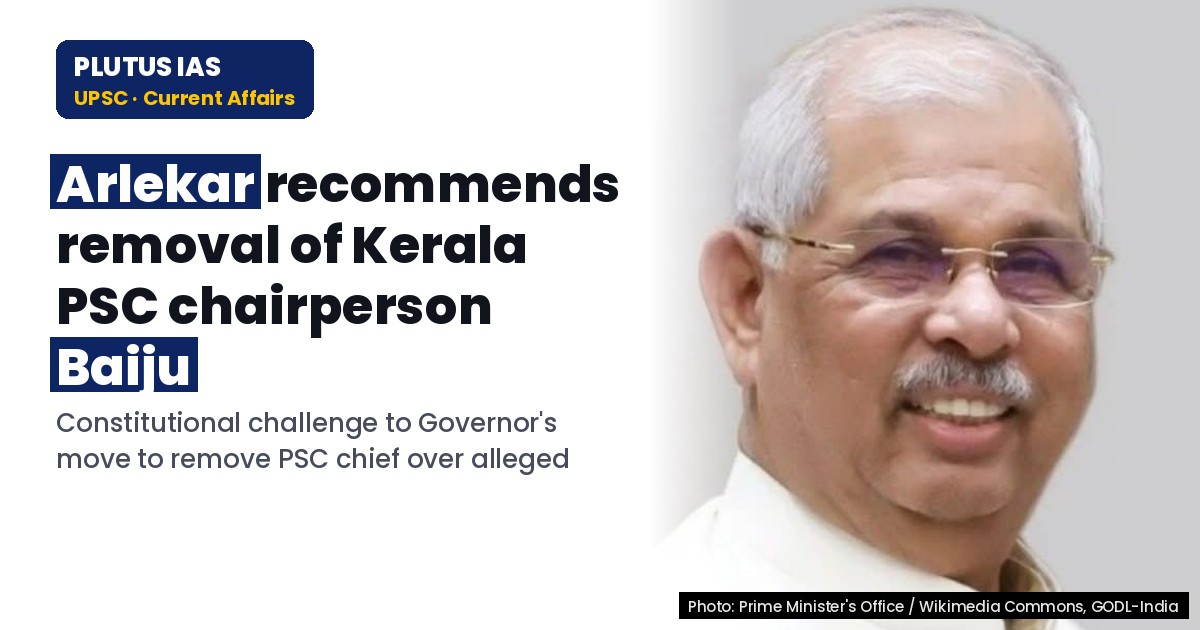
25 Oct Kerala PSC Chairperson Removal: Governor’s Recommendation Explained for UPSC
✎ The removal of a PSC chairperson or member under Article 317 requires a Supreme Court inquiry and a report to the President; the Governor cannot act independently in this matter.
Subject Relevance — Where This Topic Fits
- GS Paper II — Polity and Governance: Constitutional Provisions, Constitutional Bodies | GS Paper II — Functions and Responsibilities of the Union and the States
- Prelims: Article 317, Article 163, Governor’s discretionary powers, PSC, Supreme Court inquiry, constitutional removal of PSC members
- Essay: Institutional autonomy versus executive overreach: The delicate balance in constitutional governance
Quick Revision: The removal of a PSC chairperson or member under Article 317 requires a Supreme Court inquiry and a report to the President; the Governor cannot act independently in this matter.
Why is this in the news?
The issue has gained prominence following the recommendation by former Kerala Governor Rajendra Vishwanath Arlekar to the President for the removal of the Kerala Public Service Commission (PSC) chairperson, M.R. Baiju, amid allegations of irregularities in PSC examinations. The controversy underscores the constitutional safeguards governing the removal of PSC members and the limits of gubernatorial authority, particularly in the context of a state governed by an elected council of ministers.
Background
- The Kerala Public Service Commission (PSC) is a constitutional body established under Article 315 of the Constitution, responsible for conducting recruitment examinations for civil services in the state.
- Article 317 of the Constitution provides the procedure for the removal of a PSC chairperson or member, which includes an inquiry by the Supreme Court and a subsequent report to the President, who may then remove the individual.
- Article 163 of the Constitution mandates that the Governor shall act in accordance with the aid and advice of the Council of Ministers, except in cases where discretionary powers are explicitly granted.
- The allegation of irregularities pertains to a PSC examination for certain posts in the State Planning Board, with a Crime Branch investigation currently underway.
- The former Governor’s recommendation to the President occurred shortly before his tenure ended, raising questions about the timing and constitutional validity of the action.
- The Opposition has termed the move as unconstitutional, citing the absence of a Supreme Court inquiry and the Governor’s lack of independent authority in this matter.
What is the constitutional framework governing the removal of Public Service Commission members?
- The removal of a Public Service Commission (PSC) chairperson or member is governed by Article 317 of the Constitution, which stipulates that such removal can only occur after an inquiry by the Supreme Court and a subsequent report to the President.
- The Supreme Court conducts an inquiry into allegations of misbehaviour or incapacity and submits a report to the President, who may then remove the individual if deemed necessary.
- The Governor does not possess independent authority to recommend the removal of a PSC chairperson or member; any such recommendation must be made by the Council of Ministers in accordance with Article 163.
- The Governor’s role is largely ceremonial and executive actions must align with the advice of the Council of Ministers, except in cases where constitutional discretion is explicitly granted.
- The Kerala PSC, like other state PSCs, functions as an autonomous body to ensure impartiality and fairness in recruitment processes, safeguarding it from political interference.
- The constitutional safeguards aim to prevent arbitrary removals and protect the independence of the PSC, ensuring its credibility and autonomy in conducting examinations.
- Any attempt to bypass these constitutional procedures risks undermining institutional autonomy and the integrity of the recruitment process.
Key Features
| Feature | Significance |
|---|---|
| Constitutional role of the Governor | The Governor, as the constitutional head of the state, is bound by the aid and advice of the Council of Ministers under Article 163, limiting independent executive actions. |
| PSC chairperson removal process | Removal of a PSC chairperson or member requires a Supreme Court inquiry under Article 317, ensuring judicial oversight over allegations of misbehaviour. |
| Crime Branch investigation | An ongoing investigation into alleged irregularities in PSC examinations for State Planning Board posts underscores the need for transparent and impartial scrutiny. |
| Institutional autonomy of PSC | The PSC operates as an independent constitutional body, and any interference must adhere to constitutional safeguards to maintain its credibility. |
| Opposition’s constitutional argument | The LDF’s contention that the Governor’s recommendation violates constitutional provisions highlights the importance of procedural adherence in governance. |
Why it Matters
Constitutional Governance
- The episode underscores the principle of separation of powers, where the judiciary, executive, and legislature must function within their constitutional mandates.
- It highlights the need for adherence to Article 317, which mandates judicial scrutiny before the removal of a PSC chairperson or member.
- The role of the Governor is clarified as ceremonial and advisory, with no independent authority to recommend removals without ministerial advice.
- The incident raises questions about the balance between executive action and institutional autonomy in state governance.
Administrative Integrity
- The PSC’s credibility is central to fair recruitment practices, which are vital for efficient public service delivery.
- Allegations of irregularities in PSC examinations necessitate transparent investigations to uphold public trust in recruitment processes.
- The episode demonstrates the risks of politicisation of constitutional bodies, which can erode public confidence in governance institutions.
Judicial Oversight
- The requirement for a Supreme Court inquiry before removal ensures that allegations of misbehaviour are scrutinised impartially.
- This case exemplifies the judiciary’s role in safeguarding constitutional provisions against executive overreach.
- The ongoing Crime Branch investigation may provide evidence that could inform future judicial or administrative actions.
Challenges
1. Constitutional Overreach in Executive Actions
- The Governor’s recommendation to remove the PSC chairperson without ministerial advice or judicial scrutiny raises concerns about constitutional compliance.
- Such actions risk undermining the autonomy of constitutional bodies like the PSC, which are essential for fair governance.
- The episode highlights the need for clear delineation of powers between the executive, judiciary, and legislature to prevent institutional conflicts.
UPSC Link: GS-II (Constitution)
2. Erosion of Institutional Credibility
- Allegations of irregularities in PSC examinations, if unaddressed, can damage public trust in recruitment processes.
- Politicisation of constitutional bodies, whether real or perceived, can lead to erosion of faith in governance institutions.
- The lack of transparency in investigations and the absence of a judicial inquiry before the Governor’s recommendation exacerbate these concerns.
UPSC Link: GS-II (Governance)
3. Conflict Between Constitutional Provisions and Political Narratives
- The episode reflects a broader tension between constitutional provisions and political narratives, where actions are framed as either legitimate or unconstitutional based on partisan perspectives.
- Such conflicts can distract from the core issue of ensuring fair and transparent governance.
- It underscores the importance of adhering to established procedures to avoid perceptions of bias or misuse of power.
UPSC Link: GS-II (Polity)
4. Ensuring Impartial Investigations
- The ongoing Crime Branch investigation must be conducted impartially to determine the veracity of allegations against the PSC.
- Any findings must be subjected to judicial scrutiny to ensure fairness and transparency.
- The lack of a structured inquiry process before the Governor’s recommendation raises questions about the integrity of the process.
UPSC Link: GS-II (Governance)
5. Maintaining PSC Autonomy
- The PSC must operate independently to ensure fair and merit-based recruitment processes.
- Interference, whether real or perceived, can compromise the PSC’s ability to function effectively.
- The episode highlights the need for safeguards to protect the PSC from external pressures.
UPSC Link: GS-II (Constitution)
Challenges — UPSC Perspective
| Issue | Concern |
|---|---|
| Constitutional compliance in executive actions | Risk of executive overreach undermining institutional autonomy and judicial oversight. |
| Transparency in PSC investigations | Lack of a structured inquiry process before the Governor’s recommendation raises questions about fairness. |
| Public trust in governance institutions | Allegations of irregularities and perceived politicisation can erode confidence in the PSC and other constitutional bodies. |
| Balance of powers between executive and judiciary | The episode highlights the need for clear delineation of powers to prevent conflicts. |
| Politicisation of constitutional bodies | Perceived or real interference can compromise the independence of bodies like the PSC. |
Way Forward
- Conduct a transparent and impartial Crime Branch investigation into the alleged PSC irregularities, ensuring all stakeholders are heard.
- Subject any findings to judicial scrutiny to determine the need for further action against PSC members or officials.
- Clarify the constitutional role of the Governor in recommending removals, ensuring adherence to Article 163 and Article 317.
- Strengthen safeguards to protect the autonomy of the PSC, including clear protocols for investigations and removals.
- Ensure that any executive actions are taken in consultation with the Council of Ministers and in compliance with constitutional provisions.
- Promote public awareness about the constitutional processes governing PSC operations and removals to maintain trust.
- Establish an independent oversight mechanism to monitor the functioning of constitutional bodies like the PSC.
- Encourage dialogue between political parties to avoid politicisation of governance institutions and uphold constitutional principles.
UPSC Value Addition
Keywords for Mains Answer-Writing
Constitutional provisions governing removal of Public Service Commission members · Article 317 of the Constitution of India · Role and powers of the Governor under Article 163 · Institutional autonomy of Public Service Commissions · Constitutional scheme of checks and balances in India · Supreme Court’s role in removal of PSC members · Article 324 and independent constitutional bodies · Federalism and centre-state relations in appointment/removal processes · Constitutional morality and institutional integrity · Judicial review of executive actions in constitutional matters
Constitutional & Policy Linkages
- Article 163: Governor’s discretionary powers
- Article 317: Removal of PSC chairperson/member
- Article 324: Superintendence, direction and control of elections
- Seventh Schedule: State List (Public Service Commissions)
Concept Flow
Allegations of irregularities in PSC examinations → Crime Branch investigation initiated → Governor recommends PSC chairperson’s removal → Opposition challenges move as unconstitutional → Governor’s action scrutinised under Article 163 and Article 317 → Judicial oversight required for removal → Broader debate on institutional autonomy and constitutional compliance → Need for transparent and impartial processes to uphold governance integrity
Prelims Practice Questions
Q1. Consider the following statements regarding the removal of a chairperson or member of a State Public Service Commission (PSC) under the Constitution of India:
1. The President can remove a PSC chairperson or member only after the Supreme Court, following an inquiry, has reported that they should be removed.
2. The Governor of a State has the independent constitutional authority to recommend the removal of a PSC chairperson without the aid and advice of the Council of Ministers.
3. The provisions governing the removal of PSC members are contained in Article 317 of the Constitution.
4. The Council of Ministers of a State can decide on the removal of a PSC chairperson without reference to the Supreme Court.
How many of the above statements are correct?
- Only one
- Only two
- Only three
- All four
Answer: Only two — Only statement 1 and 3 are correct. Statement 2 is incorrect as the Governor acts on the aid and advice of the Council of Ministers under Article 163. Statement 4 is incorrect because the Council of Ministers cannot take such a decision without a Supreme Court inquiry under Article 317.
Q2. Assertion (A): The Governor of a State can recommend the removal of the Chairperson of the State Public Service Commission to the President without consulting the Council of Ministers.
Reason (R): Article 163 of the Constitution vests the Governor with independent discretionary powers in matters relating to the removal of constitutional functionaries.
In the context of the above statements, which of the following is correct?
- Both A and R are true, and R is the correct explanation of A.
- Both A and R are true, but R is not the correct explanation of A.
- A is true, but R is false.
- A is false, but R is true.
Answer: A is false, but R is true. — Assertion (A) is false because the Governor acts on the aid and advice of the Council of Ministers under Article 163. Reason (R) is also false as the Governor does not possess independent discretionary powers in this regard.
Q3. Match the following constitutional provisions with their correct descriptions:
Column I (Provisions)
A. Article 317
B. Article 163
C. Article 324
D. Article 311
Column II (Descriptions)
1. Provides for the removal of members of Public Service Commissions
2. Deals with the appointment and conditions of service of the Governor
3. Relates to the conduct of elections and superintendence, direction and control of elections
4. Protects civil servants from arbitrary dismissal
Select the correct match:
- A-1, B-2, C-3, D-4
- A-2, B-1, C-4, D-3
- A-3, B-4, C-2, D-1
- A-4, B-3, C-1, D-2
Answer: A-1, B-2, C-3, D-4 — A-1 (Article 317 governs removal of PSC members), B-2 (Article 163 defines the Governor’s role with aid and advice), C-3 (Article 324 relates to elections), D-4 (Article 311 protects civil servants).
Mains Practice Question
✍ The constitutional scheme for removal of the Chairperson of a State Public Service Commission (PSC) is governed by Article 317, which mandates a judicial inquiry by the Supreme Court before any such removal can be effected. In light of recent events in Keralam, critically examine the constitutional validity of the Governor’s recommendation for the removal of the PSC Chairperson. Also, elucidate the institutional safeguards that ensure the autonomy and independence of PSCs in India. (15 Marks)
Approach: MODEL-ANSWER SKELETON:
1. Constitutional Framework:
– Article 317(1): President may remove PSC chairperson/member only after Supreme Court inquiry and report.
– Article 317(2): Inquiry by Supreme Court on reference from President.
– Article 163: Governor acts on aid and advice of Council of Ministers; no independent authority.
– Article 324: Independent constitutional bodies and their autonomy.
2. Recent Event Analysis:
– Governor’s recommendation without Supreme Court inquiry violates Article 317.
– Governor’s action lacks constitutional legitimacy under Article 163.
– No prior judicial scrutiny; potential misuse of gubernatorial powers.
3. Institutional Safeguards:
– Constitutional independence of PSCs under Article 318.
– Judicial review as a safeguard against arbitrary executive action.
– Role of Supreme Court in ensuring constitutional morality.
– Federal balance: Centre-state relations and respect for institutional autonomy.
4. Comparative Perspective:
– Similar provisions for UPSC under Article 317(3).
– Landmark judgments: Union of India v. S. S. Dhillon (1979) on PSC autonomy.
5. Consequences of Unconstitutional Action:
– Erosion of institutional credibility.
– Undermining of constitutional checks and balances.
– Potential for political interference in recruitment processes.
6. Balanced View:
– Need for transparency in PSC functioning.
– Role of Crime Branch investigations in ensuring accountability.
– Importance of judicial oversight in constitutional matters.
Source: The Hindu
Generated by AanyaAi for educational purpose.
Related guides on our sites
- Best PSIR optional coaching for upsc
- Best PSIR optional teacher for upsc
- Best teacher of PSIR optional for upsc
- Best PSIR optional coaching in delhi for UPSC

- Kerala PSC Chairperson Removal: Governor’s Recommendation Explained for UPSC - October 25, 2026
- लोकसभा स्पीकर बिरला और रूस के ड्यूमा स्पीकर वोलोडिन ने संसदीय सहयोग बढ़ाने पर बातचीत की - October 25, 2026
- UP’s New Age Verification Rules to Curb POCSO Act Misuse - October 25, 2026

No Comments