


30 Aug Kerala to Keralam: Why High Court of Kerala Name Stays Unchanged
✎ The name of the High Court of Kerala is statutorily fixed under the Kerala High Court Act, 1958, and cannot be altered by a state name change; any modification requires a legislative amendment to the Act.
Subject Relevance — Where This Topic Fits
- GS Paper II — Constitutional and Non-Constitutional Bodies (Judiciary) | GS Paper II — Functions and Responsibilities of the Union and the States
- Prelims: High Court of Kerala Act, 1958, States Reorganisation Act, 1956, Judicial independence, Constitutional provisions related to High Courts, Judicial nomenclature, State name change procedure, Judicial hierarchy
- Essay: The principle of judicial independence and its institutional safeguards, Federalism and the balance between state and central institutions
Quick Revision: The name of the High Court of Kerala is statutorily fixed under the Kerala High Court Act, 1958, and cannot be altered by a state name change; any modification requires a legislative amendment to the Act.
Why is this in the news?
The High Court of Kerala (HCK) will retain its name despite the state’s official name change to ‘Keralam’, as the nomenclature of the court is statutorily defined under the Kerala High Court Act, 1958. This development underscores the constitutional and statutory autonomy of the judiciary from executive or legislative changes to state nomenclature, and highlights the procedural distinction between state name changes and institutional nomenclature in India’s federal structure.
Background
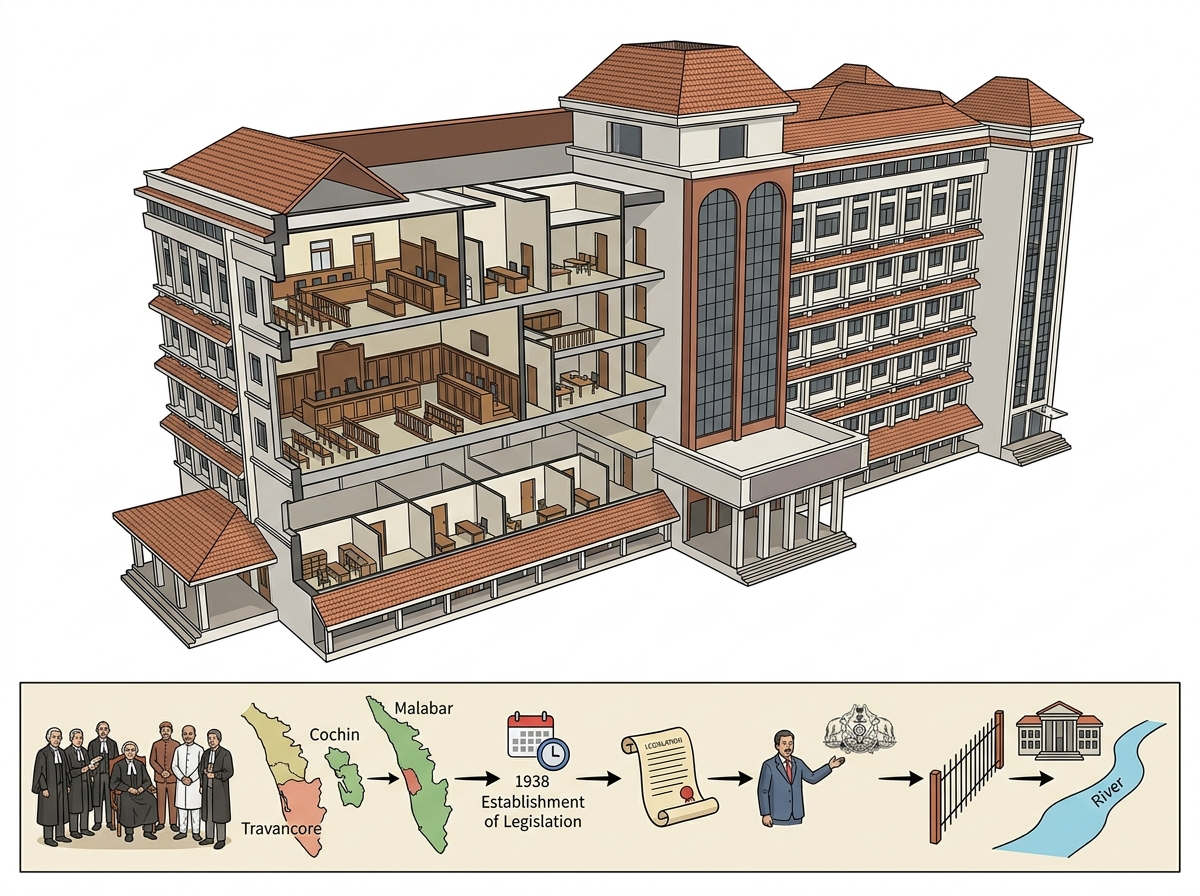
- The High Court of Kerala was established on 1 November 1956 following the formation of the State of Kerala as per the States Reorganisation Act.
- The court’s seat was established at Ernakulam, integrating the erstwhile High Courts of Travancore (at Thiruvananthapuram) and Cochin (at Ernakulam), with the Malabar District previously under the jurisdiction of the Madras High Court.
- The Kerala High Court Act, 1958, provides the statutory framework for the court’s establishment, jurisdiction, and nomenclature, including the definition of the High Court as the ‘High Court of the State of Kerala’.
- The Union government notified the name change of the State of Kerala to ‘Keralam’ before August 29, 2026, triggering administrative processes for updating official records, documents, and seals across state institutions.
- Judicial institutions in India operate under a distinct constitutional framework separate from the executive and legislative branches.
- Several High Courts across India, such as those of Bombay, Calcutta, Madras, and Orissa, have retained their original names despite changes in the names of their respective states, reflecting a consistent judicial nomenclature practice.
What is the High Court of Kerala, and how does its name remain unaffected by state name changes?
- The High Court of Kerala is a constitutional court with its jurisdiction defined by the Kerala High Court Act, 1958.
- The nomenclature of the High Court is statutorily fixed in Section 2 of the Kerala High Court Act, 1958, which defines it as the ‘High Court of the State of Kerala’. Any change to this nomenclature requires a legislative amendment to the Act.
- Judicial independence, as a core principle of the Constitution, ensures that the judiciary functions autonomously from the executive and legislative branches, including in matters of nomenclature.
- The judiciary is one of the four pillars of democracy, and its institutional identity is preserved through constitutional and statutory safeguards, preventing unilateral changes by the state government.
- State name changes, such as from ‘Kerala’ to ‘Keralam’, are administrative processes governed by the Union government and do not automatically extend to constitutional or statutory bodies like High Courts.
- The Kerala High Court Act, 1958, is the parent legislation governing the court’s establishment, and any modification to its provisions, including the name, must follow the legislative process, including parliamentary or state legislative approval as applicable.
- Historical precedents, such as the High Courts of Bombay, Calcutta, Madras, and Orissa, demonstrate that High Courts often retain their original names despite state name changes, reinforcing the principle of judicial continuity.
- In legal proceedings where the State of Kerala (now Keralam) is a party, the state must be referred to as ‘Keralam’ in all official communications, while the High Court retains its statutory name.
Key Features
| Feature | Significance |
|---|---|
| Name of High Court as per Kerala High Court Act, 1958 | The nomenclature of the High Court is statutorily fixed and cannot be altered by state administrative actions alone. |
| Judicial Independence | The judiciary operates as an independent pillar of democracy, distinct from the executive and legislative branches, ensuring its name remains unaffected by state nomenclature changes. |
| Precedents of other High Courts | High Courts of Bombay, Calcutta, Madras, and Orissa retained their original names despite state name changes, establishing a legal precedent. |
| Amendment Requirement | Any change to the High Court’s name necessitates a legislative amendment to the Kerala High Court Act, 1958, initiated by the judiciary or Parliament. |
| State vs. Court Jurisdiction | The state’s name change to Keralam applies to all government institutions, but the High Court’s name is governed by its founding legislation, not state administrative decisions. |
Why it Matters
Constitutional and Legal
- The High Court of Kerala’s name is enshrined in the Kerala High Court Act, 1958, making it immune to unilateral state administrative changes.
- Judicial independence ensures that the judiciary’s name and character remain insulated from executive or legislative actions.
- The principle of separation of powers is reinforced, as the judiciary’s nomenclature is not subject to state-level political decisions.
Administrative and Procedural
- The state’s transition to Keralam in official records does not automatically extend to judicial institutions, requiring separate statutory amendments.
- The judiciary’s administrative autonomy allows it to retain its name without coercion from state or central government directives.
- The process underscores the need for clear demarcation between state administrative functions and judicial institutional identity.
Historical and Precedential
- The High Court of Kerala was established in 1956 under the States Reorganisation Act, 1956, merging Travancore-Cochin and Malabar regions.
- Precedents from other High Courts (Bombay, Calcutta, Madras, Orissa) demonstrate that judicial nomenclature is not contingent on state name changes.
Challenges
1. Statutory Amendment Process
- Amending the Kerala High Court Act, 1958, to change the High Court’s name requires legislative approval, which may face procedural delays or political considerations.
- The judiciary must initiate or consent to such amendments, adding a layer of institutional autonomy to the process.
UPSC Link: Parliament and State Legislatures
2. Coordination Between State and Judiciary
- Ensuring consistency in nomenclature across state records and judicial proceedings may require coordinated efforts between the executive and judiciary.
- Potential discrepancies could arise if state records use ‘Keralam’ while judicial references retain ‘Kerala,’ necessitating clarity in legal documentation.
UPSC Link: Separation of Powers
3. Financial and Administrative Burden
- The state’s transition to Keralam in official records involves substantial administrative and financial costs, which could divert resources from other priorities.
- However, this burden does not extend to the judiciary, as its name remains unchanged.
UPSC Link: Public Expenditure Management
Challenges — UPSC Perspective
| Issue | Concern |
|---|---|
| Legislative Amendment | Requires parliamentary or judicial initiative, with potential delays or political complexities. |
| Nomenclature Consistency | Risk of discrepancies between state records (Keralam) and judicial references (Kerala) in legal proceedings. |
| Administrative Coordination | Need for seamless integration between state administrative changes and judicial documentation. |
| Resource Allocation | State-wide transition to Keralam may strain administrative and financial resources, though judiciary remains unaffected. |
Way Forward
- The Kerala High Court may consider initiating a legislative proposal to amend the Kerala High Court Act, 1958, if a name change is deemed necessary.
- State and judicial authorities should collaborate to ensure consistency in nomenclature across all official records and legal proceedings.
- Public awareness campaigns may be undertaken to clarify the distinction between the state’s name change and the judiciary’s nomenclature.
- The judiciary should maintain its autonomy in decision-making regarding its name, free from external political or administrative pressures.
- Parliamentary or judicial committees may review precedents from other High Courts to guide any future amendments to the High Court’s name.
- The state government should prioritize the efficient implementation of the name change in administrative records while minimizing disruptions.
- Legal practitioners and litigants should be educated on the correct usage of ‘Keralam’ in state-related cases and ‘Kerala’ in judicial references.
UPSC Value Addition
Keywords for Mains Answer-Writing
Judicial Independence · High Court of Kerala · Kerala High Court Act 1958 · State Name Change · Judicial Naming Conventions · Judicial Reforms · Constitutional Provisions on Courts · Judicial Pillar of Democracy · Judicial Naming Precedents · States Reorganisation Act 1956 · Judicial Autonomy · Judicial Naming Legislation · Judicial Identity · Judicial Governance
Concept Flow
State government initiates name change from ‘Kerala’ to ‘Keralam’ through administrative and legislative processes. → Notification of name change by the Union government triggers the state’s transition in official records. → Judiciary remains unaffected due to its statutory nomenclature under the Kerala High Court Act, 1958. → Potential need for legislative amendment to align judicial nomenclature with state name change, initiated by the judiciary or Parliament. → Precedents from other High Courts (Bombay, Calcutta, etc.) demonstrate judicial autonomy in retaining original names. → State-wide implementation of ‘Keralam’ in records, while judicial references retain ‘Kerala,’ ensuring consistency in legal proceedings.
Prelims Practice Questions
Q1. Consider the following statements regarding the High Court of Kerala:
1. The High Court of Kerala was established under the Kerala High Court Act, 1958.
2. The name of the High Court must change if the State’s name changes.
3. The judiciary is an independent pillar of democracy and not subject to State government directives.
4. The High Court of Kerala was established on November 1, 1956, following the States Reorganisation Act, 1956.
How many of the above statements are correct?
- Only one
- Only two
- Only three
- All
Answer: All — Statements 1, 3, and 4 are correct. Statement 2 is incorrect because the name of the High Court is governed by the Kerala High Court Act, 1958, and does not automatically change with the State’s name. The judiciary operates independently of the State government.
Q2. Assertion (A): The name of a High Court is determined by the legislation under which it was established, not by the name of the State.
Reason (R): The Kerala High Court Act, 1958, defines the court as the High Court of the State of Kerala, and any change to its name requires an amendment to the Act.
Options:
A. Both A and R are true, and R is the correct explanation of A.
B. Both A and R are true, but R is not the correct explanation of A.
C. A is true, but R is false.
D. A is false, but R is true.
Answer: ? — Both the Assertion (A) and Reason (R) are true, and R correctly explains A. The name of the High Court is governed by the legislation under which it was established, and any change requires amending that Act.
Q3. Match the following High Courts with their respective States:
Column I (High Court) Column II (State)
A. High Court of Kerala 1. Odisha
B. High Court of Bombay 2. Tamil Nadu
C. High Court of Madras 3. Maharashtra
D. High Court of Orissa 4. Kerala
Options:
A – 4, B – 3, C – 2, D – 1
A – 4, B – 2, C – 3, D – 1
A – 1, B – 3, C – 2, D – 4
A – 3, B – 2, C – 4, D – 1
Answer: ? — The correct matches are: A (High Court of Kerala) – 4 (Kerala), B (High Court of Bombay) – 3 (Maharashtra), C (High Court of Madras) – 2 (Tamil Nadu), D (High Court of Orissa) – 1 (Odisha).
Mains Practice Question
✍ Examine the constitutional and institutional rationale for the autonomy of the judiciary in the context of the independence of the High Court of Kerala. How does the Kerala High Court Act, 1958, safeguard this autonomy, particularly in the event of a State’s name change? Also, discuss the implications of retaining the original name of a High Court despite changes in the State’s nomenclature. (15 Marks)
Approach: MODEL-ANSWER SKELETON:
1. **Judicial Independence as a Constitutional Principle**:
– Define judicial independence (Art. 50, Basic Structure Doctrine, Supreme Court judgments like S.P. Gupta v. Union of India).
– Explain the judiciary as the ‘third pillar’ of democracy, distinct from the executive and legislature.
2. **Kerala High Court Act, 1958, and Institutional Autonomy**:
– Section 2 of the Act: Defines the High Court as the High Court of the State of Kerala.
– Emphasise that the Act is a parliamentary legislation, not a State Act, ensuring federal oversight.
– Highlight that amendments to the Act require parliamentary approval, insulating the judiciary from State-level political pressures.
3. **Name Change and Judicial Naming Conventions**:
– Explain that the name of the High Court is determined by the Act, not the State’s name.
– Cite precedents: High Courts of Bombay, Calcutta, Madras, and Orissa retained their original names despite State name changes.
– Discuss the rationale: Judicial identity and continuity are preserved to maintain public trust and institutional stability.
4. **Implications of Retaining Original Name**:
– **Positive**: Ensures continuity, avoids confusion in legal proceedings, and upholds judicial identity.
– **Challenges**: Potential mismatch between State name and High Court name in official records (e.g., litigations where the State is a party).
– **Legal Position**: The judiciary is not bound by State government directives, as affirmed by senior judges and legal experts.
5. **Balancing State Identity and Judicial Autonomy**:
– Discuss the need to balance the State’s cultural and linguistic identity (e.g., renaming to ‘Keralam’) with the judiciary’s institutional integrity.
– Highlight that the judiciary’s independence is a cornerstone of the rule of law, as recognised in landmark cases like Kesavananda Bharati v. State of Kerala.
6. **Conclusion**:
– Reiterate that the judiciary’s autonomy is safeguarded by constitutional provisions and parliamentary legislation, not State-level decisions.
– Emphasise that judicial naming conventions are a matter of institutional identity, not administrative convenience.
Source: The Hindu
Kerala PCS (Kerala PSC (KAS)) — State PCS Practice
Prelims: In the context of the recent decision by the Kerala government to adopt the name ‘Keralam’ in the Malayalam script, which of the following statements is correct regarding the High Court of Kerala?
- The name of the High Court of Kerala will be changed to ‘High Court of Keralam’ to align with the state’s new name.
- The name of the High Court of Kerala will remain unchanged despite the state adopting the name ‘Keralam’.
- The High Court of Kerala will be renamed as ‘Kerala High Court’ in English to reflect the new state name.
- The High Court of Kerala will be merged with the High Court of Tamil Nadu to form a new judicial entity.
Answer: The name of the High Court of Kerala will remain unchanged despite the state adopting the name ‘Keralam’. — The High Court of Kerala will retain its name as per the decision of the Kerala government to maintain continuity and legal clarity.
Mains: Critically examine the significance of retaining the name ‘High Court of Kerala’ despite the state adopting the name ‘Keralam’ in the Malayalam script. Discuss the legal, administrative, and symbolic implications of this decision from a Kerala State-PCS perspective.
Generated by AanyaAi for educational purpose.
Related guides on our sites
- Current affairs for upsc 2026
- Best PSIR optional coaching for upsc
- Best PSIR optional teacher for upsc
- Best teacher of PSIR optional for upsc

- Tamil Nadu Guest Lecturers Await ₹5,000 Honorarium Hike in Budget - October 21, 2026
- भारत-अमेरिका व्यापार समझौता निकट, रुबियो बोले- ऊर्जा एवं रक्षा खरीद बढ़े - October 20, 2026
- UAE FM’s India Visit: Key Outcomes for UPSC & State PCS - October 20, 2026

No Comments