


08 Aug Kerala’s Big Boost from India-UK Trade Deal: CETA Opportunities Explained
✎ CETA provides zero-duty access to 99% of India’s exports to the UK, significantly enhancing export competitiveness in sectors like fisheries, spices, IT, and textiles, with Kerala positioned to leverage these opportunities due to…
Subject Relevance — Where This Topic Fits
- GS Paper II — International Relations: Bilateral Agreements and Economic Diplomacy | GS Paper III — Economy: Trade Policies, Export Competitiveness, and Sectoral Opportunities
- Prelims: Comprehensive Economic and Trade Agreement (CETA), zero-duty access, export competitiveness, fisheries and marine products, spices and food processing, IT and digital services, textiles and handloom, engineering and advanced manufacturing, yoga and wellness, branch campuses of foreign universities, bilateral trade expansion
- Essay: The role of trade agreements in shaping India’s economic diplomacy in the 21st century, Leveraging regional strengths: How Kerala can transform trade opportunities into sustainable development
Quick Revision: CETA provides zero-duty access to 99% of India’s exports to the UK, significantly enhancing export competitiveness in sectors like fisheries, spices, IT, and textiles, with Kerala positioned to leverage these opportunities due to its existing strengths.
Why is this in the news?
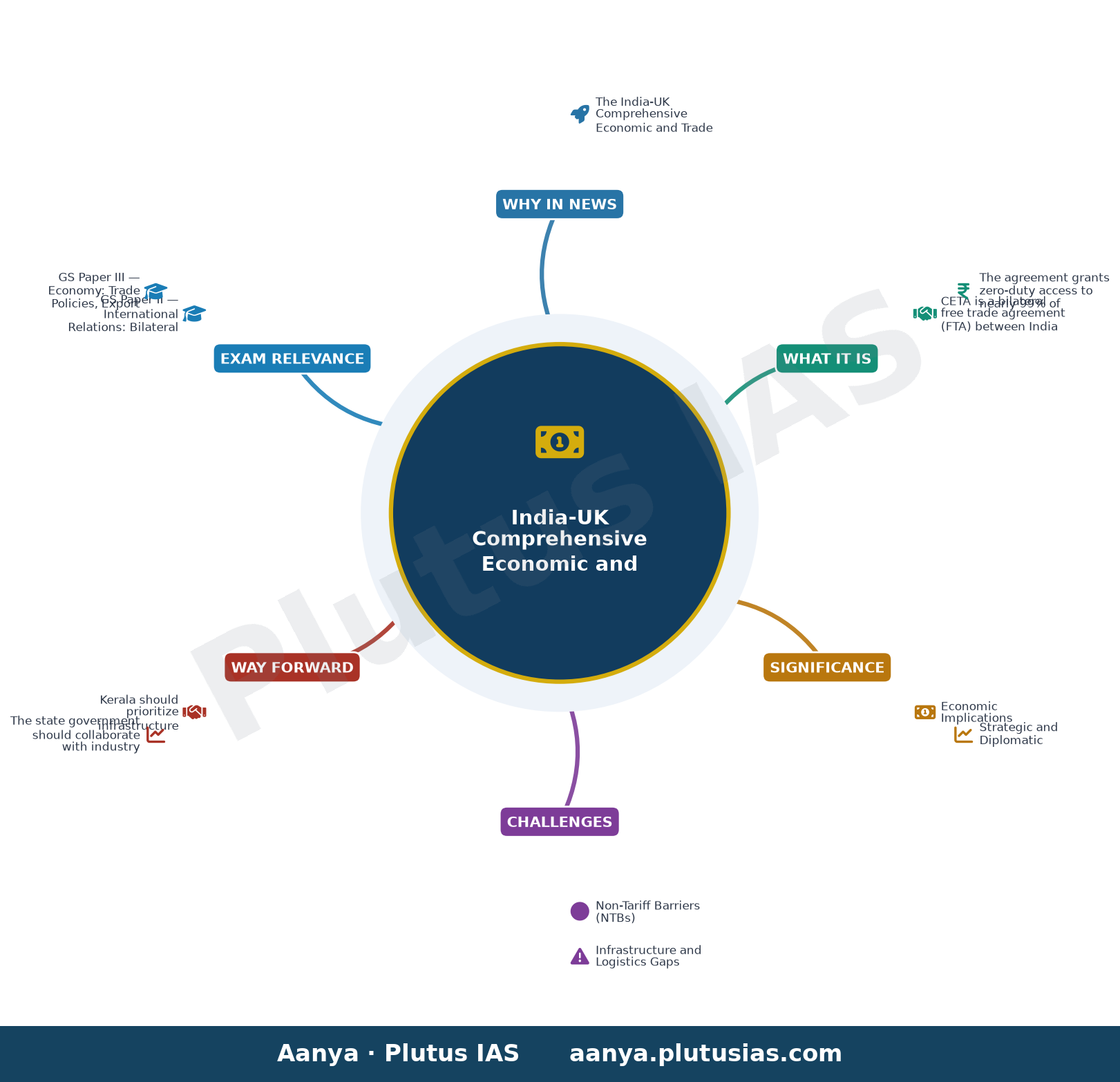
The India-UK Comprehensive Economic and Trade Agreement (CETA), which entered into force on July 15, 2026, has been highlighted by British Deputy High Commissioner Sutapa Choudhury as a transformative framework offering significant trade and investment opportunities for Kerala. The agreement, described as ‘inclusive and future-oriented’ by the Government of India, aims to reduce trade barriers, enhance export competitiveness, and attract foreign direct investment (FDI), particularly in sectors where Kerala holds comparative advantages such as fisheries, spices, IT, and wellness tourism.
Background
- The India-UK trade relationship has historically been constrained by tariff and non-tariff barriers, limiting the full potential of bilateral trade.
- The CETA negotiations culminated in a landmark agreement signed in July 2025, reflecting a broader geopolitical shift toward diversifying trade partnerships amid global trade tensions.
- Kerala, with its strategic coastal location and robust service sector, has consistently contributed to India’s export basket, particularly in marine products, spices, and IT services, making it a natural beneficiary of trade liberalisation measures.
- The UK’s post-Brexit trade strategy has prioritised securing comprehensive trade deals with key partners, including India, to mitigate economic disruptions and foster new growth avenues.
- Kerala’s focus on sustainable development, particularly in fisheries and wellness tourism, presents an opportunity to align with global demand trends under the CETA framework.
What is the Comprehensive Economic and Trade Agreement (CETA) between India and the UK?
- CETA is a bilateral free trade agreement (FTA) between India and the United Kingdom, designed to eliminate or reduce tariffs, non-tariff barriers, and other trade restrictions across goods and services.
- The agreement grants zero-duty access to nearly 99% of India’s exports to the UK, significantly enhancing the competitiveness of Indian products in the UK market, particularly in labour-intensive and high-value sectors.
- CETA includes provisions for mutual recognition of professional qualifications, streamlined customs procedures, and enhanced intellectual property rights (IPR) protection, facilitating smoother trade flows and investment.
- The agreement covers a wide range of sectors, including agriculture, fisheries, textiles, engineering, IT services, and healthcare, with specific chapters dedicated to digital trade and sustainable development.
- Under CETA, the UK has committed to reducing non-tariff barriers in sectors such as pharmaceuticals, automobiles, and food processing, while India has opened its market to UK services, particularly in education, financial services, and legal services.
- The agreement also includes a dispute resolution mechanism and provisions for periodic reviews to ensure its relevance and effectiveness over time.
- CETA is part of a broader trend of India’s engagement with developed economies to diversify trade partners and reduce reliance on traditional markets like the EU and the US.
Key Features
| Feature | Significance |
|---|---|
| Zero-duty access on 99% of India’s exports under CETA | Enhances export competitiveness by eliminating tariffs on nearly all Indian goods, particularly benefiting labour-intensive sectors like textiles and marine products. |
| Simplified customs procedures and reduced non-tariff barriers | Facilitates faster clearance of goods, lowering transaction costs and improving supply chain efficiency for Kerala’s industries. |
| Market access for spices, marine products, and IT services | Provides a structured pathway for Kerala’s traditional and emerging sectors to penetrate the UK market with reduced regulatory hurdles. |
| Provision for branch campuses of UK universities | Expands higher education opportunities in Kerala, fostering academic collaboration and skill development in emerging fields. |
| Focus on wellness, healthcare, and textiles | Leverages Kerala’s niche strengths in Ayurveda, healthcare services, and handloom textiles to attract investment and tourism. |
Why it Matters
Economic Implications
- The CETA is expected to boost bilateral trade between India and the UK by reducing tariffs and streamlining regulatory frameworks, thereby enhancing Kerala’s export potential in fisheries, spices, and IT services.
- Zero-duty access on 99% of exports will particularly benefit Kerala’s marine product industry, which faces high tariffs in the UK market, thereby increasing revenue and employment in the sector.
- The agreement’s focus on digital trade and IT services aligns with Kerala’s growing tech ecosystem, including Technopark Thiruvananthapuram, potentially attracting more foreign direct investment (FDI) in this domain.
Strategic and Diplomatic
- The CETA serves as a model for future trade agreements, reinforcing India’s commitment to an open, rules-based international trade system while strengthening ties with a key European partner.
- The UK’s interest in establishing university branch campuses in Kerala underscores the state’s potential as an educational hub, fostering long-term people-to-people and knowledge exchange ties.
- The proposal for a UK consulate or honorary consulate in Thiruvananthapuram highlights the growing economic and cultural engagement between Kerala and the UK, which could further deepen bilateral relations.
Sectoral Opportunities for Kerala
- Fisheries and marine products: Kerala, a major producer of seafood, can leverage reduced tariffs to expand exports to the UK, where demand for high-quality seafood is high.
- Spices and food processing: The agreement’s tariff reductions will make Kerala’s spices and processed foods more competitive in the UK market, where there is significant demand for organic and traditional products.
- IT and digital services: Kerala’s IT sector, particularly in Thiruvananthapuram, can benefit from easier market access and collaboration with UK firms in emerging technologies like AI and fintech.
Challenges
1. Non-Tariff Barriers (NTBs)
- Despite tariff reductions, non-tariff barriers such as sanitary and phytosanitary (SPS) measures, technical standards, and regulatory compliance may pose challenges for Kerala’s exporters, particularly in fisheries and food processing.
- The UK’s stringent food safety regulations could require Kerala’s exporters to invest in certification and compliance infrastructure, increasing operational costs.
UPSC Link: GS3: Trade Barriers and WTO
2. Infrastructure and Logistics Gaps
- Kerala’s ports and logistics infrastructure may need upgrades to fully capitalize on the trade deal, particularly for perishable goods like marine products and spices.
- Inadequate cold chain infrastructure could limit the shelf life of exported goods, reducing their competitiveness in the UK market.
UPSC Link: GS3: Infrastructure and Logistics
3. Competition from Other States
- Other Indian states with similar export profiles, such as Tamil Nadu and Gujarat, may pose competition to Kerala in sectors like textiles, IT, and marine products, necessitating targeted strategies to differentiate Kerala’s offerings.
- The state must focus on value addition and branding to enhance its competitiveness in the UK market.
UPSC Link: GS3: Export Competitiveness
4. Skill Gaps in Emerging Sectors
- The IT and digital services sector in Kerala may face challenges in meeting the UK’s demand for high-skilled professionals, particularly in emerging technologies like AI and cybersecurity.
- Collaboration with UK universities and vocational training institutions could help bridge these skill gaps.
UPSC Link: GS3: Skill Development and Employment
Challenges — UPSC Perspective
| Issue | Concern |
|---|---|
| Sanitary and Phytosanitary (SPS) Measures | UK’s stringent food safety regulations may require Kerala’s exporters to invest in certification and compliance infrastructure. |
| Port and Logistics Infrastructure | Inadequate cold chain and port infrastructure could limit the competitiveness of Kerala’s perishable exports. |
| Competition from Other States | Other Indian states with similar export profiles may pose challenges to Kerala’s market share in the UK. |
| Skill Gaps in IT Sector | Kerala’s IT sector may struggle to meet the UK’s demand for high-skilled professionals in emerging technologies. |
| Regulatory Compliance Costs | Compliance with UK’s technical standards and regulations could increase operational costs for Kerala’s exporters. |
Way Forward
- Kerala should prioritize infrastructure upgrades in ports and cold chain facilities to ensure seamless export of perishable goods like marine products and spices.
- The state government should collaborate with industry associations to identify and address non-tariff barriers, such as SPS measures, through targeted training and certification programs.
- Kerala’s IT sector should leverage the CETA to forge partnerships with UK firms in emerging technologies, including AI, fintech, and cybersecurity, to enhance skill development and employment opportunities.
- The state should promote value addition in traditional sectors like spices and textiles to differentiate its products in the UK market and command premium pricing.
- Kerala should actively pursue the establishment of branch campuses of UK universities, particularly in fields like healthcare, wellness, and digital education, to attract foreign investment and talent.
- Industry bodies like the Trivandrum Chamber of Commerce and Industry (TCCI) should engage with the UK government to explore the feasibility of opening a consulate or honorary consulate in Thiruvananthapuram to facilitate trade and cultural exchanges.
- Kerala’s exporters should be provided with capacity-building programs to navigate the UK’s regulatory landscape, including training on compliance with SPS measures and technical standards.
UPSC Value Addition
Keywords for Mains Answer-Writing
Comprehensive Economic and Trade Agreement (CETA) · India-UK bilateral trade · Kerala’s export potential · Fisheries and marine products · Spices and food processing · Information Technology (IT) and digital services · Textiles and handloom sector · Engineering and advanced manufacturing · Yoga, wellness, and healthcare · Branch campuses of foreign universities · Zero-duty market access · Export competitiveness · Trade facilitation measures · Foreign Direct Investment (FDI) attraction
Concept Flow
India-UK Comprehensive Economic and Trade Agreement (CETA) signed in July 2025 and enforced on July 15, 2026 → Zero-duty access on 99% of India’s exports reduces tariffs on Kerala’s key sectors (marine products, spices, IT) → Simplified customs procedures and reduced non-tariff barriers lower transaction costs and improve supply chain efficiency → Kerala leverages its unique strengths (fisheries, spices, IT, wellness) to expand exports and attract investment → Enhanced trade and investment opportunities create employment and stimulate economic growth in Kerala → Strengthened bilateral ties between India and the UK foster long-term strategic and diplomatic partnerships
Prelims Practice Questions
Q1. Consider the following statements regarding the Comprehensive Economic and Trade Agreement (CETA) between India and the United Kingdom:
1. CETA provides zero-duty access to nearly 99% of India’s exports to the UK.
2. CETA came into force on July 15, 2026.
3. CETA includes provisions for the establishment of branch campuses of Indian universities in the UK.
4. CETA aims to expand bilateral trade and attract investment.
How many of the above statements are correct?
- Only one
- Only two
- Only three
- All
Answer: Only three — Statements 1, 2, and 4 are correct. Statement 3 is incorrect as CETA facilitates branch campuses of UK universities in India, not the other way around.
Q2. Assertion (A): The Comprehensive Economic and Trade Agreement (CETA) between India and the UK is designed to make business ‘cheaper, quicker, and easier’ between the two countries.
Reason (R): CETA includes provisions for reducing tariffs, streamlining customs procedures, and enhancing regulatory cooperation.
Options:
A. Both A and R are true, and R is the correct explanation of A.
B. Both A and R are true, but R is not the correct explanation of A.
C. A is true, but R is false.
D. A is false, but R is true.
Answer: ? — Both A and R are true, and R correctly explains A as CETA’s provisions directly aim to reduce costs and procedural hurdles in trade.
Q3. Match the following sectors with their potential benefits under the India-UK Comprehensive Economic and Trade Agreement (CETA):
Column I (Sector)
1. Fisheries and marine products
2. Spices and food processing
3. Information Technology (IT) and digital services
4. Textiles and handloom
Column II (Benefit)
A. Zero-duty access to the UK market
B. Cost advantages in export logistics
C. Enhanced market access for processed goods
D. Ease of doing business in digital services
Options:
A. 1-A, 2-C, 3-D, 4-B
B. 1-B, 2-A, 3-D, 4-C
C. 1-C, 2-B, 3-A, 4-D
D. 1-D, 2-C, 3-B, 4-A
Answer: ? — 1-A (Fisheries and marine products benefit from zero-duty access), 2-C (Spices and food processing gain enhanced market access for processed goods), 3-D (IT and digital services benefit from ease of doing business), 4-B (Textiles and handloom gain cost advantages in export logistics).
Mains Practice Question
✍ Critically examine the potential of the India-UK Comprehensive Economic and Trade Agreement (CETA) in transforming Kerala’s export basket and industrial landscape. Also, analyse the challenges that may impede its full realisation. (15 Marks)
Approach: MODEL-ANSWER SKELETON:
1. **Introduction (2 Marks)**
– Briefly define CETA and its objectives (zero-duty access, trade facilitation, FDI attraction).
– Highlight Kerala’s identified strengths (fisheries, spices, IT, textiles, wellness, engineering) as per the agreement.
2. **Transformative Potential for Kerala (6 Marks)**
– **Fisheries and Marine Products**: Zero-duty access to the UK market; potential for export growth in shrimp, tuna, and processed seafood. Reference: Kerala’s 12% share in India’s marine exports (2024-25 data).
– **Spices and Food Processing**: Enhanced market access for cardamom, pepper, and vanilla; opportunities in value-added products (e.g., spice blends, ready-to-eat meals).
– **IT and Digital Services**: Ease of doing business in IT/ITES; potential for Kerala’s Technopark and Infopark to attract UK-based firms.
– **Textiles and Handloom**: Cost advantages in export logistics; opportunities for handloom products (e.g., Kasaragod’s coir, Kannur’s handloom textiles).
– **Wellness and Healthcare**: Leveraging Kerala’s traditional Ayurveda and yoga; potential for medical tourism and wellness retreats.
– **Engineering and Advanced Manufacturing**: Attracting UK investment in precision engineering and MSMEs.
3. **Challenges to Realisation (5 Marks)**
– **Regulatory and Non-Tariff Barriers**: Sanitary and phytosanitary (SPS) measures, technical barriers to trade (TBT), and compliance costs.
– **Infrastructure Gaps**: Port infrastructure (e.g., Vizhinjam Port’s underutilisation), logistics costs, and connectivity issues.
– **Skill Mismatch**: Need for upskilling in IT, advanced manufacturing, and food processing sectors.
– **Competition**: Other Indian states (e.g., Tamil Nadu, Maharashtra) with established export ecosystems.
– **Political and Bureaucratic Hurdles**: Delays in implementation, lack of awareness among SMEs, and coordination issues between state and central governments.
4. **Conclusion (2 Marks)**
– CETA offers a transformative opportunity for Kerala, but its success hinges on addressing structural challenges, leveraging state strengths, and proactive policy interventions (e.g., skill development, infrastructure upgrades, and export promotion).
Source: The Hindu
Generated by AanyaAi for educational purpose.

- KWML’s Feasibility Reports for Water Metro in 18 Cities: UPSC & PCS Insights - October 3, 2026
- ओडिशा में वन्यजीव अनुसंधान अनुदान कार्यक्रम शुरू, सिमिलिपाल में 300 कैमरे और बढ़ेंगे - October 3, 2026
- India Summons Pakistan High Commission Official Over Violation - October 3, 2026

No Comments