


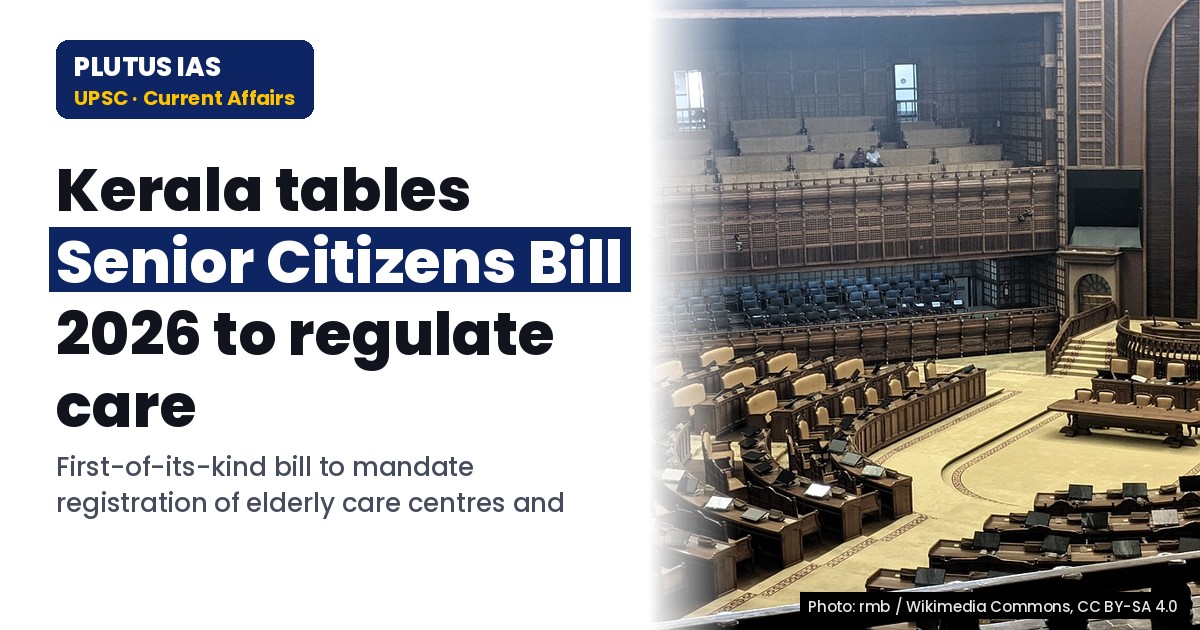
14 Oct Kerala’s Elderly Care Bill: UPSC-PCS Polity Explained
✎ The Keralam Senior Citizens (Care and Protection of Rights) Bill, 2026, proposes a pioneering regulatory framework for elderly care, emphasising ‘ageing in place’, living wills, and mandatory standards for care services, in…
Subject Relevance — Where This Topic Fits
- GS Paper I — Indian Society (Ageing Population, Social Sector Initiatives) | GS Paper II — Governance (Elderly Care Policies, Institutional Frameworks) | GS Paper III — Social Justice (Welfare Schemes for Vulnerable Groups)
- Prelims: Senior Citizens (Care and Protection of Rights) Bill, 2026, Ageing in place, Living will, District Level Senior Citizen Protection Forum, Kerala State Senior Citizens Commission Act, 2025, State Policy for Elder Persons, Hospice care, Assisted living facilities
- Essay: Ageing population: Challenges and policy responses in India, Balancing autonomy and protection: The ethics of elderly care regulation
Quick Revision: The Keralam Senior Citizens (Care and Protection of Rights) Bill, 2026, proposes a pioneering regulatory framework for elderly care, emphasising ‘ageing in place’, living wills, and mandatory standards for care services, in response to Kerala’s rapid demographic ageing.
Why is this in the news?
The Kerala government introduced the *Keralam Senior Citizens (Care and Protection of Rights) Bill, 2026* in the Legislative Assembly on 13 October 2026. The Bill proposes a first-of-its-kind regulatory framework to govern elderly-care services, including mandatory registration of care centres and caregivers, prescribed standards, and penalties for violations. This initiative is significant as Kerala faces one of India’s fastest demographic transitions, with the elderly population projected to constitute 30% of the state’s demographic by 2051.
Background
- Kerala is experiencing a rapid demographic shift, with a declining total fertility rate (TFR) and mortality rate contributing to an ageing population. The proportion of persons aged 60 and above increased from 12.7% in 2011 to 15% in 2021, with projections indicating a rise to 30% by 2051.
- The state was among the first in India to introduce an elderly care policy in 2006, subsequently updated in 2013. A new draft *State Policy for Elder Persons* was released in August 2025 to address the evolving needs of its ageing population.
- Kerala enacted the *Kerala State Senior Citizens Commission Act, 2025*, establishing a dedicated institutional mechanism for senior citizens’ welfare. The state also operates a separate department for senior citizens’ affairs.
- The Bill aligns with global best practices, including the *Madrid International Plan of Action on Ageing* (2002), which emphasises the rights of older persons, non-discrimination, and the provision of enabling environments.
- Existing legal frameworks for elderly care in India include the *Maintenance and Welfare of Parents and Senior Citizens Act, 2007*, and the *National Policy for Senior Citizens, 2011*, but Kerala’s Bill introduces a more comprehensive and enforceable regulatory regime.
- The Bill reflects a shift from institutional care to community-based and home-based care, addressing the ethical and practical challenges of ageing in a rapidly urbanising society.
What is the Keralam Senior Citizens (Care and Protection of Rights) Bill, 2026?
- The Bill seeks to establish a **first-of-its-kind regulatory framework** for elderly-care services in India, including mandatory registration of care centres, caregivers, and prescribed standards for service delivery.
- It introduces the concept of **‘ageing in place’**, enabling senior citizens to live independently in their homes or communities, with institutional care as a last resort. This approach prioritises autonomy while ensuring access to support systems.
- The Bill recognises **living wills**, allowing senior citizens to document their preferences for medical care in advance, including decisions on life-sustaining interventions. A living will is executed in the presence of the chairperson of the District Level Senior Citizen Protection Forum or Unit.
- It expands the definition of elderly care beyond basic needs (food, shelter, medical care) to include **social services, recreation, spiritual participation, and dignified living**, particularly for those with disabilities or incapacitation.
- The framework includes provisions for **affordable and accessible** home care, day care, assisted living, hospice care, and emergency medical assistance, ensuring equitable access to services.
- Mandatory registration of care centres and caregivers, along with prescribed standards, aims to **prevent exploitation, neglect, and abuse** of senior citizens, with penalties for violations.
- The Bill establishes **District Level Senior Citizen Protection Forums** to oversee implementation and address grievances, ensuring decentralised governance of elderly care.
- It aligns with constitutional provisions such as **Article 41 (Right to Public Assistance)**, reinforcing the state’s duty to protect vulnerable groups.
Key Features
| Feature | Significance |
|---|---|
| Mandatory registration of elderly-care facilities and caregivers | Ensures accountability and standardisation in care quality, reducing exploitation and neglect risks. |
| Prescribed standards for elderly-care services | Guarantees minimum quality benchmarks for institutional and home-based care, aligning with global best practices. |
| Penalties for violations of standards | Deters negligence and abuse in care centres, providing legal recourse for senior citizens and their families. |
| Ageing in place policy | Promotes independent living for senior citizens, reducing institutional dependency and aligning with the United Nations Principles for Older Persons. |
| Recognition and execution of living wills | Empowers senior citizens to document medical preferences, ensuring dignity and autonomy in end-of-life care decisions. |
| Senior-friendly environment provisions | Mandates accessible infrastructure and services, addressing the needs of elderly persons with disabilities or limited mobility. |
Why it Matters
Demographic Transition
- Keralam’s elderly population (60+) grew from 12.7% in 2011 to 15% in 2021, with projections reaching 30% by 2051, necessitating a robust policy framework.
- The state’s demographic shift, marked by falling birth and mortality rates, underscores the urgency of structured elderly care policies.
- The elderly population is projected to outnumber children by 2030, highlighting the need for long-term planning in healthcare, housing, and social security.
Social Welfare
- The Bill expands the scope of elderly care beyond basic needs to include social, recreational, and spiritual participation, addressing holistic well-being.
- Institutional care is framed as a last resort, prioritising family and community-based support systems in line with global ageing policies.
- The inclusion of living wills recognises the right to self-determination in medical decisions, aligning with ethical frameworks in geriatric care.
Governance and Institutional Capacity
- The establishment of a dedicated Department for Senior Citizens’ Welfare and the Kerala State Senior Citizens Commission Act, 2025, reflects institutional preparedness.
- Mandatory registration and standards enforcement require robust administrative and monitoring mechanisms, testing the state’s governance capabilities.
- The Bill’s provisions necessitate inter-departmental coordination between health, social justice, and local governance authorities.
Legal and Ethical Dimensions
- The Bill introduces legal recognition of living wills, addressing gaps in end-of-life care decision-making for incapacitated senior citizens.
- Penalties for violations create a deterrent against abuse, neglect, and exploitation in elderly-care facilities, reinforcing legal protections.
- The emphasis on dignity and autonomy aligns with constitutional principles of equality and non-discrimination under Articles 14 and 21.
Challenges
1. Implementation and Enforcement
- Ensuring uniform compliance across rural and urban care centres may prove challenging due to resource disparities and varying levels of awareness.
- Monitoring mechanisms for mandatory registration and standards enforcement will require significant administrative capacity and periodic audits.
- Penalties for violations must be balanced with corrective measures to avoid punitive overreach and ensure proportionality.
UPSC Link: GS-II: Governance, Challenges in Policy Implementation
2. Financial Sustainability
- Affordability of elderly-care services, including home care and assisted living, remains a concern for low-income senior citizens.
- The state may need to explore public-private partnerships or subsidies to make institutional care accessible without compromising quality.
- Long-term funding for the Department of Senior Citizens’ Welfare and related programmes must be ensured amidst competing fiscal priorities.
UPSC Link: GS-III: Economic Development, Inclusive Growth
3. Cultural and Social Barriers
- Traditional family-based care systems may resist formalisation, leading to underreporting of elderly-care needs or reluctance to utilise institutional services.
- Stigma associated with ageing and dependency could discourage senior citizens from seeking formal care or executing living wills.
- Urbanisation and migration of younger populations may weaken family support systems, necessitating alternative care models.
UPSC Link: GS-I: Social Issues, Changing Family Structures
4. Technological and Infrastructure Gaps
- Limited digital literacy among elderly persons may hinder access to telemedicine, online registration, or awareness campaigns.
- Inadequate infrastructure for accessible housing, transportation, and healthcare in rural areas could undermine the ‘ageing in place’ policy.
- The state must invest in geriatric-friendly urban planning and assistive technologies to support independent living.
UPSC Link: GS-III: Science and Technology, Infrastructure Development
5. Legal and Ethical Complexities
- Defining the legal validity and scope of living wills may face challenges, particularly in cases of family disputes or unclear medical prognoses.
- Balancing the autonomy of senior citizens with the duty of care for incapacitated individuals requires nuanced legal frameworks.
- Ensuring that penalties for violations are proportionate and do not discourage legitimate care providers is critical.
UPSC Link: GS-II: Fundamental Rights, Legal Framework
Challenges — UPSC Perspective
| Issue | Concern |
|---|---|
| Resource allocation for monitoring | Limited administrative capacity may hinder effective enforcement of standards and penalties. |
| Affordability of elderly-care services | Low-income senior citizens may struggle to access quality care despite policy provisions. |
| Cultural resistance to formal care | Traditional family support systems may undermine the adoption of institutional or home-based care models. |
| Digital divide among elderly persons | Limited access to technology could exclude senior citizens from awareness campaigns or digital services. |
| Inter-departmental coordination | Fragmented governance may delay implementation of the Bill’s provisions across sectors. |
| Legal ambiguities in living wills | Unclear definitions or disputes over execution may limit the policy’s effectiveness. |
Government Initiatives — Must-Memorise for Prelims
- Kerala State Senior Citizens Commission Act, 2025
- Kerala Senior Citizens Policy (2006, 2013, Draft 2025)
Way Forward
- Establish a state-level task force to draft detailed operational guidelines for the Bill’s provisions, including registration processes and standards.
- Launch public awareness campaigns to educate senior citizens, families, and caregivers about rights, services, and legal provisions like living wills.
- Develop a digital portal for mandatory registration of care centres and caregivers, with real-time monitoring and grievance redressal mechanisms.
- Collaborate with academic institutions and NGOs to conduct training programmes for caregivers, focusing on geriatric care, ethics, and legal compliance.
- Pilot ‘ageing in place’ initiatives in select districts, integrating healthcare, social services, and community support systems.
- Allocate dedicated funds in the state budget for elderly welfare programmes, ensuring sustainability and scalability.
- Strengthen inter-departmental coordination between health, social justice, and local governance authorities to streamline implementation.
- Conduct periodic audits and third-party evaluations of care centres to assess compliance with standards and identify areas for improvement.
UPSC Value Addition
Keywords for Mains Answer-Writing
Kerala Senior Citizens (Care and Protection of Rights) Bill, 2026 · ageing in place · living wills for senior citizens · elderly care policy framework · demographic transition in Kerala · Senior Citizens Commission Act, 2025 · institutional care for elderly · rights of senior citizens · elderly population projections · social security for elderly in India · constitutional provisions for senior citizens · geriatric healthcare policy
Constitutional & Policy Linkages
- Article 41: Directive Principle of State Policy on public assistance for aged citizens (GS-II: Governance, DPSP)
- Article 21: Right to life and personal liberty, interpreted to include dignity and autonomy in elderly care (GS-II: Fundamental Rights)
Concept Flow
Falling birth and mortality rates → Rapid demographic transition → Rising elderly population share (12.7% in 2011 to projected 30% by 2051) → Increased demand for elderly-care services. → Demographic shift → Need for structured policy response → Enactment of Kerala State Senior Citizens Commission Act, 2025 → Formulation of Keralam Senior Citizens (Care and Protection of Rights) Bill, 2026. → Bill provisions → Mandatory registration and standards for care centres → Accountability and quality assurance in elderly-care services. → Ageing in place policy → Promotion of independent living → Reduced institutional dependency → Alignment with global ageing principles. → Living wills recognition → Legal empowerment of senior citizens → Dignified end-of-life care decisions → Ethical and legal safeguards. → Senior-friendly environment provisions → Accessible infrastructure and services → Addressing needs of elderly persons with disabilities → Inclusive welfare framework.
Prelims Practice Questions
Q1. Consider the following statements regarding the Kerala Senior Citizens (Care and Protection of Rights) Bill, 2026:
1. The Bill mandates the registration of all elderly care facilities and caregivers.
2. It recognises ‘ageing in place’ as a primary model of elderly care.
3. The Bill allows the execution of living wills only in the presence of a judicial magistrate.
4. Institutional care is envisaged as the first resort for elderly care under the Bill.
How many of the above statements are correct?
- Only one
- Only two
- Only three
- All
Answer: Only two — Statements 1 and 2 are correct as the Bill mandates registration of care centres and caregivers while promoting ‘ageing in place’. Statement 3 is incorrect because living wills can be executed in the presence of the chairperson of the District Level Senior Citizen Protection Forum. Statement 4 is incorrect as institutional care is envisaged as a last resort.
Q2. Assertion (A): Kerala has one of the fastest demographic transitions in India, with a rapidly ageing population.
Reason (R): Falling birth rates and mortality rates contribute to a growing elderly population in Kerala.
Options:
A. Both A and R are true, and R is the correct explanation of A.
B. Both A and R are true, but R is not the correct explanation of A.
C. A is true, but R is false.
D. A is false, but R is true.
Answer: ? — Both Assertion (A) and Reason (R) are true, and Reason (R) correctly explains Assertion (A) as demographic transition in Kerala is driven by declining birth and mortality rates.
Q3. Match the following provisions of the Kerala Senior Citizens (Care and Protection of Rights) Bill, 2026 with their descriptions:
Column I (Provision) | Column II (Description)
1. Ageing in place | A. Mandatory registration of elderly care facilities and caregivers
2. Living will | B. Senior citizens’ ability to live safely and independently at home or in their community
3. Mandatory registration | C. Document specifying medical care preferences if the senior citizen becomes incapacitated
4. Institutional care | D. Care provided in a residential facility as a last resort
Options:
A. 1-B, 2-C, 3-A, 4-D
B. 1-A, 2-B, 3-C, 4-D
C. 1-D, 2-A, 3-B, 4-C
D. 1-C, 2-D, 3-A, 4-B
Answer: ? — The correct match is: 1-B (Ageing in place), 2-C (Living will), 3-A (Mandatory registration), and 4-D (Institutional care).
Mains Practice Question
✍ The Kerala Senior Citizens (Care and Protection of Rights) Bill, 2026, represents a pioneering legislative effort to address the challenges posed by rapid demographic ageing in India. Critically examine the key provisions of the Bill, including ‘ageing in place’, living wills, and mandatory registration of care facilities. Also, discuss the constitutional and policy framework governing the rights of senior citizens in India. (15 Marks)
Approach: MODEL-ANSWER SKELETON:
1. **Introduction (2 marks)**
– Context: Kerala’s demographic transition (12.7% elderly in 2011 → 15% in 2021 → projected 30% by 2051).
– Objective of the Bill: Framework for regulating elderly care, balancing autonomy and protection.
2. **Key Provisions of the Bill (6 marks)**
– **Ageing in place**: Define as enabling senior citizens to live independently at home/community; contrast with institutional care as last resort.
– **Living wills**: Explain as advance medical directives; role of District Level Senior Citizen Protection Forum; safe custody and legal recognition.
– **Mandatory registration**: Requirements for care centres and caregivers; prescribed standards and penalties for violations.
– **Rights and services**: Beyond food/clothing/shelter to include social, recreational, and spiritual participation; focus on dignity and accessibility.
3. **Constitutional and Policy Framework (4 marks)**
– **Constitutional provisions**: Article 41 (Directive Principle) and Article 46 (promotion of educational and economic interests of weaker sections).
– **National Policy on Older Persons (1999)**: Framework for state-level policies.
– **Maintenance and Welfare of Parents and Senior Citizens Act, 2007**: Legal obligations of children/heirs; state-level mechanisms.
– **Kerala’s institutional framework**: Senior Citizens Commission Act, 2025; dedicated department for senior citizens’ welfare.
4. **Critical Appraisal (3 marks)**
– Strengths: Progressive recognition of autonomy (living wills), emphasis on home-based care, and regulatory oversight.
– Challenges: Implementation gaps (e.g., enforcement of living wills), rural-urban disparities in care access, and financial sustainability.
– Comparative perspective: Reference to global models (e.g., Japan’s Long-Term Care Insurance, Scandinavian elder care policies).
Source: The Indian Express
Generated by AanyaAi for educational purpose.
Related guides on our sites
- Best PSIR optional coaching for upsc
- Best PSIR optional teacher for upsc
- Best teacher of PSIR optional for upsc
- Best PSIR optional coaching in delhi for UPSC

- Treasury Bills Auction: RBI Releases Full Results for UPSC Exam - October 21, 2026
- यूपीएससी के लिए महत्वपूर्ण: 91, 182 और 364 दिन के टी-बिल नीलामी परिणाम - October 21, 2026
- Army Commanders’ Conference 2024: Key Security Discussions & Outcomes - October 21, 2026

No Comments