


09 Sep Kiren Rijiju to lead 27th National Youth Parliament Awards 2025-26
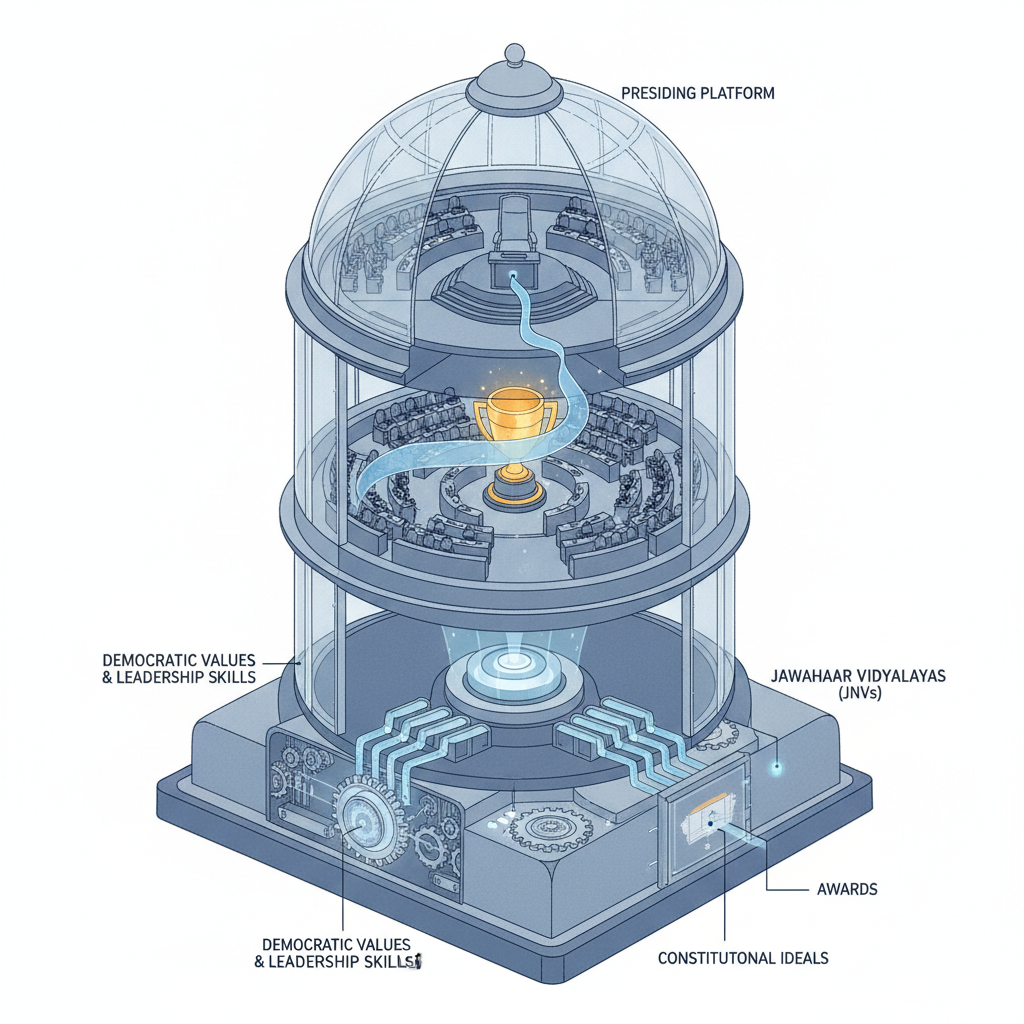
✎ The National Youth Parliament Scheme is a Ministry of Parliamentary Affairs initiative to inculcate democratic values and parliamentary skills among Jawahar Navodaya Vidyalaya students through annual competitions and simulated…
Subject Relevance — Where This Topic Fits
- GS Paper II — Governance, Constitution and Polity (Parliamentary Processes, Institutions and Initiatives) | GS Paper IV — Ethics, Integrity and Aptitude (Value-based Education and Leadership)
- Prelims: Jawahar Navodaya Vidyalayas (JNVs), National Youth Parliament Scheme, Parliamentary Affairs Ministry, GMC Balayogi Auditorium, Youth Parliament, Democratic Values, Leadership Development
- Essay: Role of educational institutions in fostering democratic values and civic consciousness, Youth engagement in parliamentary democracy: Challenges and opportunities
Quick Revision: The National Youth Parliament Scheme is a Ministry of Parliamentary Affairs initiative to inculcate democratic values and parliamentary skills among Jawahar Navodaya Vidyalaya students through annual competitions and simulated parliamentary sessions.
Why is this in the news?
The 27th National Youth Parliament Competition for Jawahar Navodaya Vidyalayas (2025-26) is scheduled to culminate in an award distribution ceremony on 10 September 2026, presided over by the Union Minister for Parliamentary Affairs. The event underscores the Ministry’s three-decade-long initiative to inculcate democratic values, parliamentary procedures, and leadership skills among school students, aligning with constitutional ideals of participatory governance and civic education.
Background
- The National Youth Parliament Scheme is administered by the Ministry of Parliamentary Affairs, Government of India, as part of its mandate to promote democratic awareness among youth.
- Jawahar Navodaya Vidyalayas (JNVs) are co-educational residential schools established under the Navodaya Vidyalaya Scheme, 1986, to provide quality education to meritorious students from rural areas.
- The scheme aims to identify and nurture young talent by exposing students to parliamentary processes, thereby fostering critical thinking, tolerance, and ethical leadership.
- The competition is conducted annually across eight regional zones of the Navodaya Vidyalaya Samiti, involving approximately 100 JNVs nationwide.
- The event serves as a platform for students to simulate parliamentary debates, thereby enhancing their public speaking, negotiation, and democratic decision-making skills.
- The scheme has been operational for over three decades, reflecting its institutionalisation as a key component of India’s civic education framework.
What is the National Youth Parliament Scheme?
- The National Youth Parliament Scheme is a flagship initiative of the Ministry of Parliamentary Affairs, launched to familiarise school students with the functioning of Parliament, parliamentary procedures, and democratic governance.
- The scheme is implemented through the Navodaya Vidyalaya Samiti for Jawahar Navodaya Vidyalayas, covering students across eight regional zones in India.
- The competition involves structured parliamentary debates on pre-determined topics, where students assume roles of Members of Parliament, ministers, and opposition leaders, adhering to parliamentary etiquette and decorum.
- The primary objectives include developing self-discipline, tolerance towards diverse viewpoints, ethical expression of ideas, and fostering democratic values such as transparency, accountability, and civic responsibility.
- The scheme enhances students’ confidence, leadership skills, and oratory abilities by providing a simulated environment for democratic deliberation and policy formulation.
- The competition is evaluated on parameters such as content relevance, logical argumentation, adherence to parliamentary rules, and effective communication.
- The award distribution ceremony recognises outstanding performances at the individual and institutional levels, with trophies and shields presented to deserving students and schools.
- The scheme aligns with constitutional provisions promoting democratic values and citizen participation, as enshrined in the Preamble and Directive Principles of State Policy.
Key Features
| Feature | Significance |
|---|---|
| National Youth Parliament Competition | A flagship initiative by the Ministry of Parliamentary Affairs to inculcate democratic values, parliamentary procedures, and civic engagement among school students. |
| Annual Event (2025-26, 27th Edition) | Demonstrates continuity and institutionalisation of the programme, fostering long-term democratic culture among youth. |
| Participation Across 8 Regions | Ensures geographical inclusivity, covering 100 Jawahar Navodaya Vidyalayas, promoting national integration. |
| Awards and Recognitions | Encourages competitive excellence, leadership, and public speaking skills among students and schools. |
| Re-enactment of Parliamentary Session | Provides practical exposure to legislative processes, debate, and consensus-building in a simulated environment. |
Why it Matters
Democratic Governance
- Reinforces the constitutional principle of participatory democracy by engaging youth in structured parliamentary deliberations.
- Develops critical democratic traits such as tolerance, reasoned argumentation, and respect for diverse viewpoints.
- Serves as a pedagogical tool to familiarise students with the functioning of Parliament, including procedural norms and ethical conduct.
Educational Impact
- Complements formal education by integrating civic literacy, constitutional awareness, and parliamentary etiquette into the school curriculum.
- Fosters soft skills such as confidence, articulation, and leadership among participants, aligning with NEP 2020’s emphasis on experiential learning.
- Encourages a culture of debate and constructive dialogue, countering misinformation and fostering informed citizenship.
Institutional Strengthening
- Strengthens the institutional framework of Jawahar Navodaya Vidyalayas by providing a platform for inter-school competition and collaboration.
- Enhances the role of the Ministry of Parliamentary Affairs in promoting democratic values beyond formal institutions.
- Demonstrates the government’s commitment to youth engagement in governance processes.
Challenges
1. Geographical Disparities in Participation
- Ensuring equitable representation from all regions, particularly remote and tribal areas, remains a challenge.
- Logistical constraints in organising events across diverse terrains may limit participation from certain zones.
UPSC Link: GS-II: Governance, GS-II: Social Justice
2. Sustainability of Impact
- Translating competition-based exposure into long-term civic engagement and leadership among participants.
- Ensuring follow-up mechanisms to nurture the skills developed during the programme.
UPSC Link: GS-II: Governance, GS-IV: Ethics
3. Resource Allocation
- Balancing the financial and administrative resources required for national-scale competitions with other educational priorities.
- Ensuring adequate funding for training, infrastructure, and dissemination of best practices.
UPSC Link: GS-II: Governance, GS-III: Economic Development
4. Assessment of Learning Outcomes
- Developing robust evaluation frameworks to measure the programme’s impact on democratic values, leadership, and civic awareness.
- Addressing the challenge of quantifying qualitative outcomes such as tolerance and ethical reasoning.
UPSC Link: GS-II: Governance, GS-IV: Ethics
5. Integration with School Curriculum
- Ensuring alignment with school curricula to reinforce learning outcomes and avoid superficial participation.
- Providing teacher training and resource materials to support sustained engagement beyond the competition.
UPSC Link: GS-II: Governance, GS-I: Society
Challenges — UPSC Perspective
| Issue | Concern |
|---|---|
| Regional Representation | Risk of underrepresentation from remote or socio-economically disadvantaged areas. |
| Skill Retention | Ensuring participants retain and apply democratic values and skills post-competition. |
| Resource Constraints | Limited budget allocation for training, infrastructure, and programme expansion. |
| Curriculum Alignment | Lack of integration with formal school education leading to transient engagement. |
| Evaluation Metrics | Difficulty in measuring intangible outcomes such as tolerance and ethical reasoning. |
| Sustainability | Maintaining momentum and institutional support beyond the annual event. |
Way Forward
- Expand the programme to include more schools and regions, particularly tribal and remote areas, to ensure inclusivity.
- Develop a post-competition mentorship framework to nurture leadership and civic engagement among participants.
- Integrate the competition with school curricula through teacher training and resource kits aligned with NEP 2020.
- Establish a robust evaluation system to assess long-term impact on democratic values and leadership skills.
- Enhance collaboration with state governments and local bodies to institutionalise youth engagement in governance.
- Leverage digital platforms to facilitate virtual debates, training sessions, and resource sharing.
- Promote alumni networks to sustain engagement and provide platforms for continued civic participation.
- Allocate dedicated budgetary provisions for programme expansion, training, and infrastructure development.
UPSC Value Addition
Keywords for Mains Answer-Writing
National Youth Parliament Competition · Jawahar Navodaya Vidyalayas · Parliamentary Affairs Ministry · Democratic values in education · Youth participation in democracy · Civic engagement among students · Parliamentary procedures for youth · Inclusive governance education · School-level democratic institutions · Youth leadership development
Constitutional & Policy Linkages
- Article 51A (Fundamental Duties): Emphasises the duty of citizens to promote harmony and the spirit of common brotherhood.
- Article 350A (Facilities for instruction in mother-tongue): Supports linguistic inclusivity in educational programmes.
- Directive Principles of State Policy (Part IV): Advocates for the diffusion of democratic values and civic education.
Concept Flow
Inception of National Youth Parliament Competition → Institutionalisation by Ministry of Parliamentary Affairs → Selection of participants from Jawahar Navodaya Vidyalayas → Conduct of regional and national rounds → Evaluation and recognition of top performers → Re-enactment of parliamentary session → Development of democratic values and leadership skills → Long-term civic engagement and societal impact.
Prelims Practice Questions
Q1. Consider the following statements regarding the National Youth Parliament Competition organised by the Parliamentary Affairs Ministry:
1. The competition is exclusively conducted for students of Jawahar Navodaya Vidyalayas.
2. The competition aims to develop tolerance towards diverse opinions and self-discipline among students.
3. The competition includes a mock parliamentary session where students simulate the proceedings of the Parliament.
How many of the above statements are correct?
- Only one
- Only two
- All three
- None
Answer: All three — Statement 1 is correct as the competition is specifically for Jawahar Navodaya Vidyalayas. Statement 2 is correct as the programme aims to inculcate democratic values such as tolerance and self-discipline. Statement 3 is correct as the competition includes a mock parliamentary session.
Q2. Assertion (A): The National Youth Parliament Competition is organised annually by the Parliamentary Affairs Ministry.
Reason (R): The competition aims to familiarise students with the functioning and procedures of the Parliament.
In the context of the above two statements, which one of the following is correct?
- Both A and R are true, and R is the correct explanation of A
- Both A and R are true, but R is NOT the correct explanation of A
- A is true, but R is false
- A is false, but R is true
Answer: Both A and R are true, but R is NOT the correct explanation of A — The competition has been organised for the past 30 years, indicating it is an annual event (A is true). The Reason (R) correctly explains the purpose of the competition, which is to familiarise students with parliamentary procedures.
Q3. Match the following columns related to the National Youth Parliament Competition:
Column I (Aspect) | Column II (Description)
— | —
A. Organising Body | 1. Ministry of Education
B. Target Audience | 2. Jawahar Navodaya Vidyalaya students
C. Objective | 3. Develop democratic values and parliamentary skills
D. Mock Session | 4. Simulation of Parliament proceedings
Select the correct match:
- A-1, B-2, C-3, D-4
- A-2, B-1, C-3, D-4
- A-3, B-2, C-1, D-4
- A-4, B-1, C-2, D-3
Answer: A-1, B-2, C-3, D-4 — The competition is organised by the Parliamentary Affairs Ministry (A-1 is incorrect; correct is A-4). The target audience is students of Jawahar Navodaya Vidyalayas (B-2). The objective is to develop democratic values and parliamentary skills (C-3). The mock session involves simulation of Parliament proceedings (D-4).
Mains Practice Question
✍ The National Youth Parliament Competition, organised under the aegis of the Parliamentary Affairs Ministry, serves as a pedagogical tool to inculcate democratic values among students. Critically examine its significance in fostering civic engagement and leadership qualities in the youth of India. (15 Marks)
Approach: MODEL-ANSWER SKELETON:
1. **Introduction (2 Marks)**: Define the National Youth Parliament Competition and its institutional framework (Parliamentary Affairs Ministry, Jawahar Navodaya Vidyalayas).
2. **Objectives and Pedagogical Design (4 Marks)**:
– Develop democratic values: tolerance, self-discipline, and respect for diverse opinions.
– Familiarise students with parliamentary procedures, debate techniques, and the legislative process.
– Enhance leadership, public speaking, and critical thinking skills.
– Reference: Press Information Bureau release on the 27th edition (2025-26).
3. **Institutional and Constitutional Context (4 Marks)**:
– Link to constitutional provisions: Preamble (democratic republic), Fundamental Duties (Art. 51A), and Directive Principles (Art. 45, 46).
– Role of Parliament in democratic education: Article 79 (constitution of Parliament), Article 80 (composition of Rajya Sabha), and Article 81 (composition of Lok Sabha).
– Reference to the National Education Policy 2020, which emphasises value-based education and constitutional literacy.
4. **Impact and Critique (3 Marks)**:
– **Strengths**: Reach across 8 regions and 100 schools; long-standing tradition (30 years); integration of theory and practice.
– **Limitations**: Limited to a specific student demographic (Jawahar Navodaya Vidyalayas); scalability challenges; need for broader participation across all school systems.
– **Comparative Perspective**: Contrast with other youth engagement programmes (e.g., National Service Scheme, UNICEF’s civic education initiatives).
5. **Conclusion (2 Marks)**: Summarise the role of such competitions in nurturing informed, participative, and responsible citizens. Highlight the need for scaling up and integrating such programmes into mainstream education systems.
Source: PIB (Press Information Bureau)
Generated by AanyaAi for educational purpose.
Related guides on our sites
- Anthropology VS PSIR
- Best PSIR optional coaching
- Best PSIR optional coaching online
- Current affairs for upsc 2026

- मेटा ने स्वीकारा: बाल यौन शोषण मामलों की रिपोर्ट पुलिस को करेगी - September 15, 2026
- Meta to Report Child Abuse Cases to Law Enforcement: Govt’s New Stance on Online Safety - September 15, 2026
- उत्तराखंड राज्यपाल के 5 वर्ष: पांच मिशन और AI क्रांति का लेखा-जोखा - September 15, 2026

No Comments