


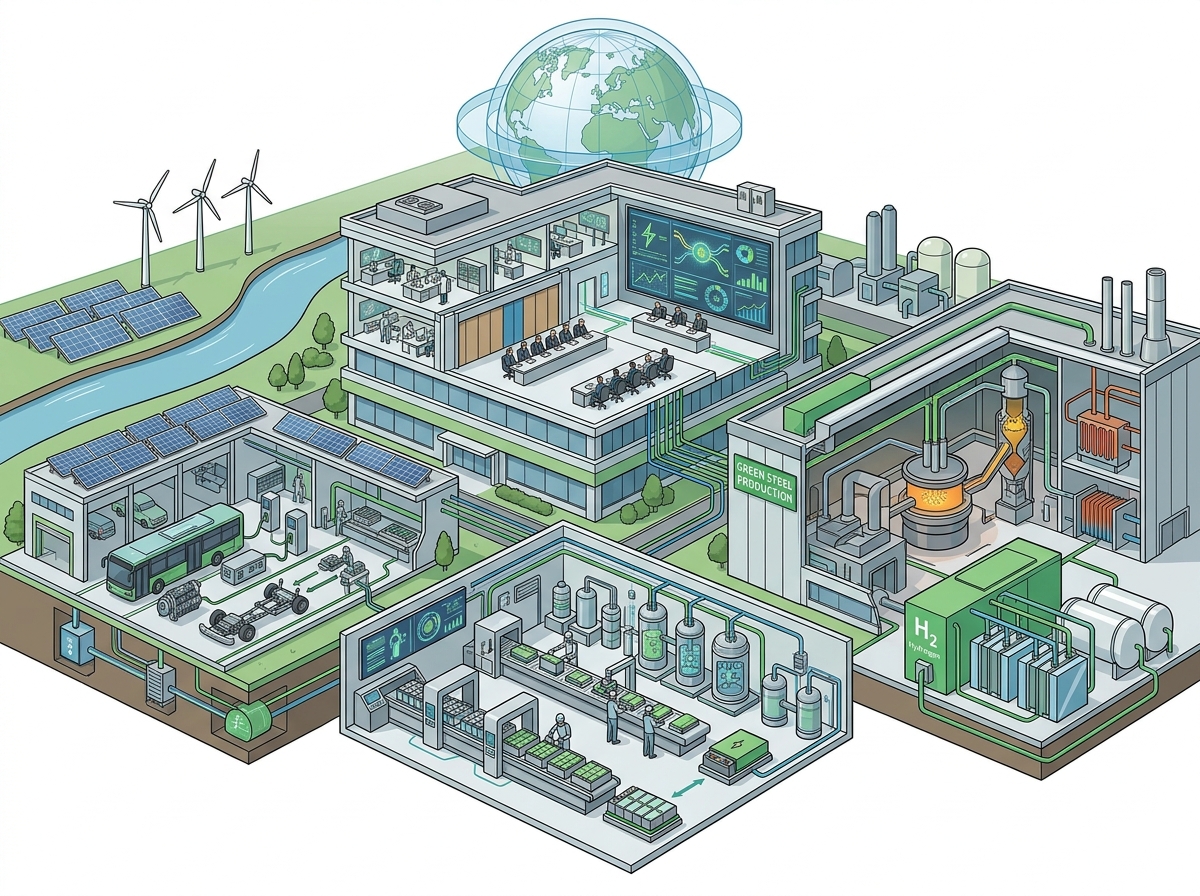
22 Sep Kumar Swamy Meets EU Delegation: India-EU EV & Green Steel Collaboration Boost
✎ India and the EU are leveraging their complementary strengths—India’s domestic manufacturing push and the EU’s technological leadership—to forge a strategic partnership on clean energy, industrial decarbonisation, and sustainable…
Subject Relevance — Where This Topic Fits
- GS Paper II — International Relations: Bilateral, Regional and Global Groupings and Agreements involving India and/or affecting India’s interests | GS Paper III — Environment and Ecology: Conservation, Environmental Pollution and Degradation, Environmental Impact Assessment | GS Paper III — Economy: Infrastructure: Energy, Ports, Roads, Airports, Railways etc. | GS Paper III — Economy: Major Crops-Cropping Patterns in various parts of the country, Different Types of Irrigation and Irrigation Systems; Storage, Transport and Marketing of Agricultural Produce and Issues and Related Constraints | GS Paper III — Science and Technology: Developments and their Applications and Effects in Everyday Life
- Prelims: India-EU FTA, PLI Scheme for Automobiles and Auto Components, PLI Scheme for Advanced Chemistry Cell (ACC) Battery Storage, PM e-DRIVE, Industrial Decarbonisation, Green Steel, Electric Vehicle (EV) Ecosystem, Circular Economy in Steel Sector, BHEL’s Indigenous Gasification Technology, 16th India-EU Summit 2026, EU Parliament’s ITRE Committee, Global Supply Chains, Clean Energy Transition, Sustainable Mobility
- Essay: The Imperative of Global Climate Action: Bridging North-South Divides in Energy Transitions, Industrial Modernisation and Sustainability: Charting a Path for Developing Economies
Quick Revision: India and the EU are leveraging their complementary strengths—India’s domestic manufacturing push and the EU’s technological leadership—to forge a strategic partnership on clean energy, industrial decarbonisation, and sustainable mobility, anchored in the 16th India-EU Summit’s Comprehensive Strategic Agenda.
Why is this in the news?
On 22 September 2026, the Union Minister for Heavy Industries and Steel, Shri H.D. Kumaraswamy, engaged in high-level deliberations with a delegation from the European Parliament’s Industry, Research and Energy (ITRE) Committee in New Delhi. The meeting, held in the aftermath of the 16th India-EU Summit (January 2026), underscored the strategic importance of deepening cooperation in electric mobility, battery manufacturing, industrial decarbonisation, and green steel production. This interaction reflects the institutionalisation of India-EU engagement on clean energy transitions and sustainable industrialisation, aligning with global commitments under the Paris Agreement and the EU Green Deal.
Background
- The 16th India-EU Summit (January 2026) concluded negotiations on a Free Trade Agreement (FTA) and adopted a Joint India-EU Comprehensive Strategic Agenda, marking a pivotal moment in bilateral relations.
- The EU’s Green Deal (2019) and India’s Mission LiFE (Lifestyle for Environment) (2022) share convergent objectives of achieving net-zero emissions, promoting circular economy principles, and fostering sustainable industrial practices.
- India’s domestic policy frameworks—such as the Production-Linked Incentive (PLI) Scheme for Advanced Chemistry Cells (ACC) and the PM e-DRIVE initiative—aim to catalyse domestic manufacturing in electric mobility and energy storage, aligning with global supply chain diversification efforts.
- The EU Parliament’s ITRE Committee plays a critical role in shaping EU policies on industrial competitiveness, energy transition, and research and innovation, making its engagement with Indian counterparts strategically significant.
- Industrial decarbonisation in India is being pursued through technological innovations in gasification (e.g., BHEL’s indigenous technologies), steel sector circularity (e.g., scrap recycling, slag utilisation), and integration of renewable energy in industrial processes.
- Global supply chains for critical minerals (e.g., lithium, cobalt, nickel) and clean energy technologies are increasingly becoming focal points of India-EU economic diplomacy, given their implications for energy security and climate resilience.
Key Dimensions of India-EU Cooperation on Clean Energy and Industrial Decarbonisation
- Electric Mobility and EV Ecosystem: The EU, a leader in automotive innovation, offers opportunities for technology transfer, joint R&D, and market access.
- Battery Manufacturing and Energy Storage: The PLI Scheme for Advanced Chemistry Cells (ACC) involves a global bidding process for 10 GWh of ACC manufacturing, which is open until October 13, 2026. This aligns with the EU’s Battery Regulation (2023), which mandates sustainability and recycling standards.
- Industrial Decarbonisation: Both India and the EU are prioritising decarbonisation of hard-to-abate sectors (e.g., steel, cement, fertilizers) through hydrogen-based technologies, carbon capture utilisation and storage (CCUS), and energy efficiency measures. India’s National Green Hydrogen Mission (2023) and the EU’s Hydrogen Strategy (2020) provide complementary policy frameworks.
- Green Steel Production: India’s steel sector, the world’s second-largest, is transitioning towards low-carbon pathways via scrap-based steelmaking, utilisation of steel slag in construction, and adoption of hydrogen direct reduction (H-DR) technologies. The EU’s Carbon Border Adjustment Mechanism (CBAM) (effective 2026) incentivises Indian exporters to align with global carbon pricing regimes.
- Circular Economy in Industry: India’s Steel Scrap Recycling Policy (2019) and the draft National Resource Efficiency Policy (2022) promote resource efficiency, while the EU’s Circular Economy Action Plan (2020) sets benchmarks for waste reduction and material recovery. Collaboration in this domain can enhance resource security and reduce environmental footprints.
- Clean Energy Transition and Global Supply Chains: The India-EU partnership seeks to diversify supply chains for critical minerals (e.g., lithium, rare earths) and clean energy technologies, reducing dependency on single-source suppliers and mitigating geopolitical risks.
- Institutional Mechanisms for Cooperation: The India-EU Clean Energy and Climate Partnership (CECP), established in 2016 and renewed in 2021, provides a structured framework for joint initiatives in renewable energy, energy efficiency, and industrial decarbonisation. The ITRE Committee’s engagement with Indian ministries further institutionalises high-level dialogue.
- Technology Transfer and R&D Collaboration: Joint ventures in battery recycling, hydrogen electrolyser manufacturing, and smart grid technologies can accelerate innovation. India’s National Mission on Interdisciplinary Cyber-Physical Systems (NM-ICPS) and the EU’s Horizon Europe programme offer avenues for collaborative research.
Key Features
| Feature | Significance |
|---|---|
| 16th India-EU Summit (January 2026) | Concluded negotiations on Free Trade Agreement (FTA) and adopted a Joint India-EU Comprehensive Strategic Agenda, establishing a framework for future cooperation in trade, technology, and sustainability. |
| PLI Scheme for Advanced Chemistry Cells (ACC) | Aims to boost domestic battery manufacturing capacity, reduce import dependence, and accelerate India’s transition to electric mobility and stationary energy storage systems. |
| PM E-DRIVE Initiative | Focuses on accelerating electric vehicle (EV) adoption, strengthening EV ecosystem, and promoting indigenous manufacturing of EV components and charging infrastructure. |
| BHEL’s Indigenous Gasification Technology | Supports India’s industrial decarbonization by enabling efficient conversion of biomass and waste into syngas for energy and chemical applications, reducing reliance on fossil fuels. |
| Steel Sector Decarbonization Roadmap | Envisions circular economy practices, including scrap recycling, steel slag utilization, and adoption of green steel technologies to reduce carbon intensity in the steel industry. |
Why it Matters
Economic Integration and Trade
- Facilitates deeper economic ties between India and the EU through joint investments in clean energy, EV manufacturing, and industrial decarbonization, potentially enhancing bilateral trade flows.
- The concluded FTA negotiations signal a commitment to reducing trade barriers, which could benefit sectors like automotive components, renewable energy equipment, and advanced materials.
- Collaboration in global supply chains for batteries, EVs, and green steel can position India as a key node in the transition to a low-carbon industrial ecosystem.
Technological Collaboration and Innovation
- Promotes knowledge exchange and joint R&D in clean energy technologies, including battery storage systems, hydrogen-based industrial processes, and carbon capture utilization and storage (CCUS).
- Enables Indian industries to access EU’s advanced manufacturing capabilities in EVs, batteries, and green steel, while EU firms benefit from India’s cost-competitive production ecosystem and large domestic market.
- Supports the development of indigenous technologies such as BHEL’s gasification systems, which align with global decarbonization goals and reduce import dependence on critical inputs.
Environmental and Climate Governance
- Strengthens India’s commitment to the Paris Agreement by accelerating industrial decarbonization through adoption of circular economy principles, renewable energy integration, and green steel production.
- Aligns with the EU’s Green Deal objectives, fostering a shared pathway for reducing carbon emissions in hard-to-abate sectors like steel and heavy industry.
- Enhances India’s role in global climate negotiations by demonstrating scalable solutions for sustainable industrial growth, particularly in the Global South context.
Strategic Autonomy and Supply Chain Resilience
- Reduces vulnerability in critical supply chains by diversifying sources for batteries, rare earth materials, and green steel, thereby enhancing India’s strategic autonomy.
- Encourages domestic manufacturing of EVs and battery components, reducing reliance on imports and fostering self-sufficiency in key green technology sectors.
- Promotes regional cooperation in South Asia and beyond by positioning India as a hub for clean energy manufacturing and technology transfer.
Challenges
1. Regulatory and Standards Harmonization
- Divergent regulatory frameworks between India and the EU on EV safety, battery standards, and industrial emissions may create non-tariff barriers to trade and investment.
- Need for mutual recognition of certification and testing protocols to streamline market access for Indian and European firms in each other’s jurisdictions.
UPSC Link: GS3: Industrial Policy and Standards
2. Technology Transfer and IPR Constraints
- Limited access to proprietary green technologies due to stringent intellectual property rights (IPR) regimes in the EU may hinder India’s ability to rapidly scale up manufacturing.
- Bilateral agreements on technology sharing and joint ventures must balance IPR protection with the need for affordable, scalable solutions in India.
UPSC Link: GS3: IPR and Technology Transfer
3. Infrastructure and Logistics Bottlenecks
- Inadequate charging infrastructure for EVs, especially in tier-2 and tier-3 cities, may impede the growth of electric mobility despite policy incentives.
- High logistics costs and inefficient supply chains for raw materials (e.g., lithium, nickel) and finished goods (e.g., batteries, steel) could undermine cost competitiveness.
UPSC Link: GS3: Infrastructure and Logistics
4. Financing and Investment Risks
- High capital expenditure (CapEx) requirements for green steel and battery manufacturing may deter private investment without robust risk-sharing mechanisms.
- Need for blended finance models, including sovereign guarantees, green bonds, and multilateral development bank (MDB) support, to de-risk projects.
UPSC Link: GS3: Investment Models and Financing
5. Skilling and Human Capital Development
- Shortage of skilled workforce in advanced manufacturing, EV technology, and green steel sectors may constrain India’s ability to capitalize on bilateral collaborations.
- Vocational training programs and industry-academia partnerships must be scaled up to align with the evolving demands of the green industrial ecosystem.
UPSC Link: GS2: Skill Development and Education
Challenges — UPSC Perspective
| Issue | Concern |
|---|---|
| Divergent Regulatory Standards | Potential non-tariff barriers to trade in EVs, batteries, and green steel due to differing certification and emission norms. |
| Intellectual Property Rights (IPR) | Limited technology transfer from the EU to India due to strict IPR regimes, affecting scalability of green technologies. |
| Charging Infrastructure Gaps | Inadequate EV charging network in India, particularly outside major metropolitan areas, hindering mass adoption. |
| Supply Chain Inefficiencies | High logistics costs and dependency on imported raw materials for batteries and green steel, impacting cost competitiveness. |
| Financing Constraints | High upfront costs for green steel and battery manufacturing deter private investment without risk-sharing mechanisms. |
| Skilled Labour Shortage | Lack of trained workforce in advanced manufacturing and green technology sectors limits India’s ability to scale up production. |
Government Initiatives — Must-Memorise for Prelims
- Production-Linked Incentive (PLI) Scheme for Advanced Chemistry Cells (ACC)
- Production-Linked Incentive (PLI) Scheme for Automobile and Auto Components
Way Forward
- Establish a joint India-EU task force to harmonize regulatory standards for EVs, batteries, and industrial decarbonization, ensuring seamless market access.
- Expand bilateral R&D collaborations in green steel, battery storage, and hydrogen technologies through joint funding mechanisms and innovation hubs.
- Accelerate the deployment of EV charging infrastructure by leveraging public-private partnerships and integrating it with India’s renewable energy grid.
- Develop a comprehensive financing framework for green industrial projects, including sovereign guarantees, green bonds, and concessional loans from multilateral institutions.
- Scale up vocational training programs in collaboration with EU institutions to address the skilled labour gap in advanced manufacturing and green technology sectors.
- Strengthen supply chain resilience by diversifying sources of critical minerals (e.g., lithium, cobalt) and promoting domestic recycling of battery materials.
- Enhance data sharing and transparency in industrial emissions and energy efficiency metrics to align with global decarbonization benchmarks.
- Promote pilot projects in circular economy practices, such as steel slag utilization and scrap recycling, to demonstrate scalable solutions for industrial decarbonization.
UPSC Value Addition
Keywords for Mains Answer-Writing
India-EU Strategic Partnership · Industrial Decarbonisation · Electric Mobility (E-Mobility) · Green Steel · Production-Linked Incentive (PLI) Schemes · Advanced Chemistry Cell (ACC) Manufacturing · Circular Economy in Steel Sector · India-EU Free Trade Agreement (FTA) · Battery Energy Storage Systems · Indigenous Gasification Technology · Energy Transition · Sustainable Mobility · Global Supply Chains · Decarbonisation of Heavy Industries
Concept Flow
India-EU Summit (Jan 2026) → Concludes FTA negotiations and adopts Joint Strategic Agenda → Sets framework for bilateral cooperation in trade, technology, and sustainability. → Joint Strategic Agenda → Identifies focus areas: EVs, batteries, industrial decarbonization, and green steel → Drives policy alignment and investment priorities. → Policy Alignment → PLI Scheme for ACC and PM E-DRIVE Initiative → Accelerates domestic manufacturing and EV adoption, reducing import dependence. → Domestic Manufacturing Expansion → Increased demand for critical minerals and green technologies → Spurs supply chain diversification and circular economy practices. → Supply Chain Diversification → Integration with global markets → Enhances India’s strategic autonomy and resilience in green industrial sectors. → Circular Economy Integration → Adoption of scrap recycling and steel slag utilization → Reduces carbon intensity in steel production and aligns with EU Green Deal objectives. → Industrial Decarbonization → Deployment of indigenous technologies (e.g., BHEL’s gasification) and green steel production → Contributes to Paris Agreement commitments and climate governance.
Prelims Practice Questions
Q1. Consider the following statements regarding the Production-Linked Incentive (PLI) Scheme for Advanced Chemistry Cells (ACC):
1. The PLI scheme for ACC aims to reduce import dependence in battery manufacturing.
2. The scheme provides financial incentives linked to incremental sales of ACC batteries.
3. The scheme is implemented by the Ministry of Heavy Industries.
How many of the above statements are correct?
- Only one
- Only two
- All three
- None
Answer: All three — Statements 1 and 3 are correct. The PLI scheme for ACC is designed to boost domestic manufacturing of advanced battery cells, thereby reducing import dependence. The scheme is indeed implemented by the Ministry of Heavy Industries. Statement 2 is incorrect because the incentives are linked to sales of domestically manufactured ACC batteries, not merely incremental sales.
Q2. Assertion (A): The India-EU Free Trade Agreement (FTA) negotiations concluded in January 2026.
Reason (R): The FTA aims to deepen trade and investment ties between India and the European Union, including in sectors like electric mobility and green steel.
In the context of the above two statements, which one of the following is correct?
- Both A and R are true, and R is the correct explanation of A
- Both A and R are true, but R is not the correct explanation of A
- A is true, but R is false
- A is false, but R is true
Answer: A is true, but R is false — Assertion (A) is true as the India-EU FTA negotiations concluded in January 2026. Reason (R) is also true as the FTA aims to deepen trade and investment ties, including in sectors like electric mobility and green steel. However, the conclusion of the FTA negotiations is not directly explained by the objectives of the FTA itself; it is a separate event.
Q3. Match the following initiatives with their respective ministries/departments:
Initiative:
1. PLI Scheme for Automobiles and Auto Components
2. PLI Scheme for Advanced Chemistry Cells
3. PM e-DRIVE
4. Indigenous Gasification Technology
Ministry/Department:
A. Ministry of Heavy Industries
B. Ministry of Steel
C. NITI Aayog
D. Ministry of Power
Select the correct match:
- 1-A, 2-B, 3-C, 4-D
- 1-A, 2-A, 3-C, 4-B
- 1-B, 2-A, 3-D, 4-C
- 1-C, 2-A, 3-D, 4-B
Answer: 1-A, 2-A, 3-C, 4-B — 1. PLI Scheme for Automobiles and Auto Components is implemented by the Ministry of Heavy Industries (A).
2. PLI Scheme for Advanced Chemistry Cells is also implemented by the Ministry of Heavy Industries (A).
3. PM e-DRIVE is a scheme under NITI Aayog (C).
4. Indigenous Gasification Technology is associated with the Ministry of Steel (B).
Mains Practice Question
✍ The India-EU Strategic Partnership is increasingly focusing on industrial decarbonisation, electric mobility, and green steel as key pillars of cooperation. In this context, critically analyse the significance of these sectors for India’s sustainable development and global supply chain resilience. (15 Marks)
Approach: MODEL-ANSWER SKELETON:
1. **Introduction (2 Marks)**
– Briefly define the India-EU Strategic Partnership and its evolving focus areas post-16th India-EU Summit (January 2026).
– Highlight the three key sectors: industrial decarbonisation, electric mobility, and green steel.
2. **Industrial Decarbonisation (3 Marks)**
– Discuss India’s commitments under international agreements (e.g., Paris Agreement, Glasgow Climate Pact).
– Explain the role of indigenous technologies (e.g., BHEL’s gasification technology) and circular economy practices (e.g., scrap recycling, steel slag utilisation) in reducing carbon intensity.
– Mention the importance of India-EU collaboration in sharing best practices and technologies.
3. **Electric Mobility (3 Marks)**
– Analyse the significance of electric mobility for India’s energy security and climate goals (e.g., reduction in crude oil imports, lower emissions).
– Discuss the role of PLI schemes (Automobiles & Auto Components, ACC) and PM e-DRIVE in accelerating the EV ecosystem.
– Highlight the potential for India-EU cooperation in battery manufacturing, charging infrastructure, and technology transfer.
4. **Green Steel (3 Marks)**
– Define green steel and its role in decarbonising the steel sector, which is a major contributor to industrial emissions.
– Discuss India’s roadmap for green steel, including the use of hydrogen-based reduction, carbon capture, and circular economy principles.
– Explain how India-EU collaboration can facilitate the adoption of green steel technologies and standards.
5. **Global Supply Chain Resilience (2 Marks)**
– Argue how collaboration in these sectors can enhance India’s resilience in global supply chains (e.g., reduced dependence on imported technologies, diversification of supply sources).
– Discuss the potential for India to emerge as a hub for clean energy technologies and components.
6. **Challenges and Way Forward (2 Marks)**
– Briefly mention challenges such as high capital costs, technological gaps, and regulatory hurdles.
– Suggest measures like continued policy support, R&D collaboration, and skill development to overcome these challenges.
**Balanced View Required:**
– Acknowledge the benefits of India-EU cooperation while also noting the need for domestic capacity-building and policy coherence.
Source: PIB (Press Information Bureau)
Generated by AanyaAi for educational purpose.
Related guides on our sites
- Anthropology VS PSIR
- Best PSIR optional coaching
- Best PSIR optional coaching online
- Best PSIR optional teacher

- Kumar Swamy Meets EU Delegation: India-EU EV & Green Steel Collaboration Boost - September 22, 2026
- तेलंगाना में बच्चों की अवैध गोद लेने और तस्करी: उच्च न्यायालय ने लिया स्वतः संज्ञान - September 22, 2026
- Telangana HC takes suo motu PIL on illegal baby adoption & trafficking - September 22, 2026

No Comments