


08 Aug Last-Minute Rush for Crop Insurance Before July 31 Deadline: Key Facts for UPSC & PCS
✎ PMFBY and RWBCIS are India’s flagship crop insurance schemes designed to mitigate financial risks for farmers from climate variability, with PMFBY focusing on yield losses and RWBCIS on weather parameter deviations, both…
Subject Relevance — Where This Topic Fits
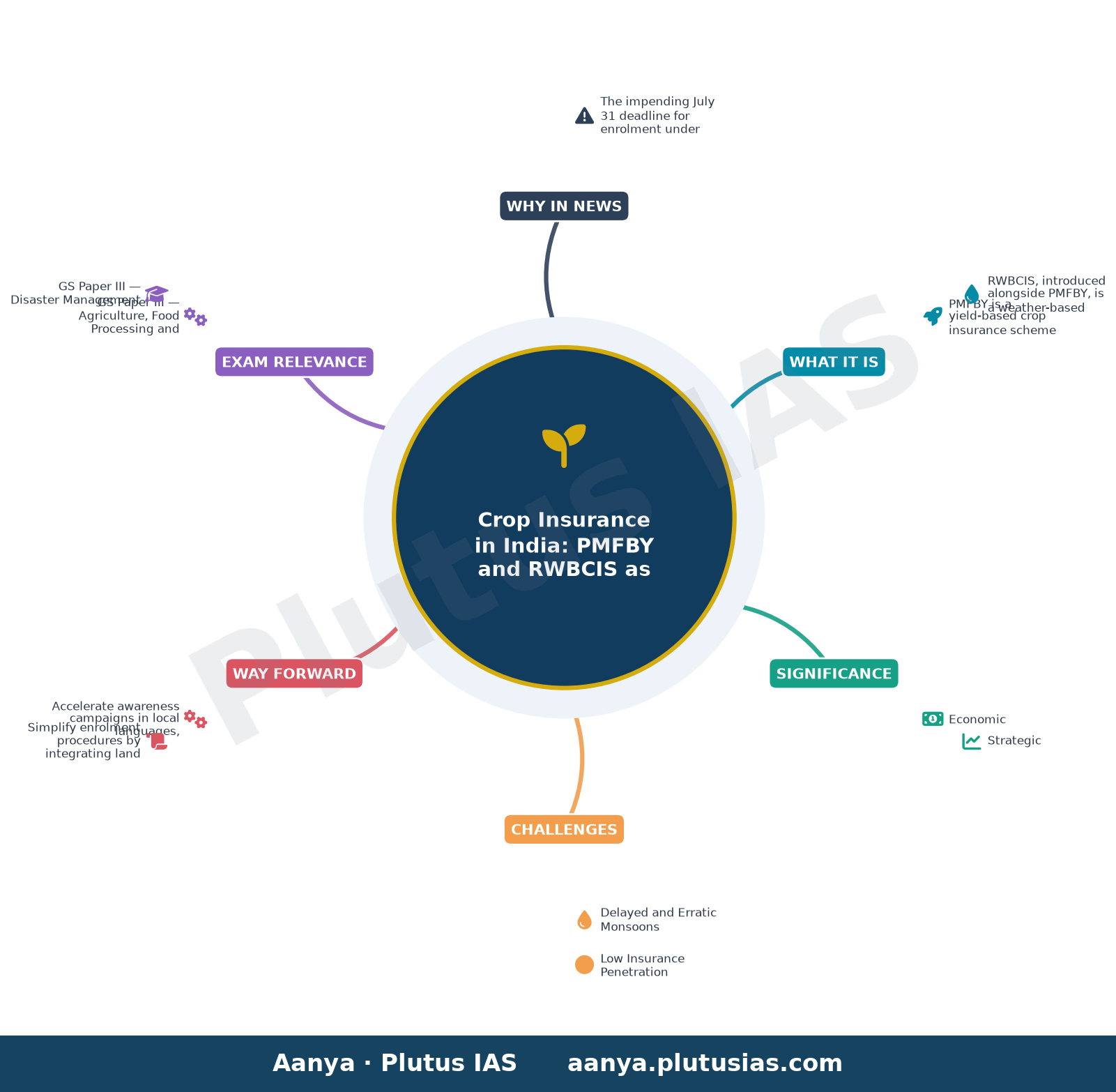
- GS Paper III — Agriculture, Food Processing and Related Issues | GS Paper III — Disaster Management | GS Paper III — Government Budgeting and Financial Inclusion
- Prelims: Pradhan Mantri Fasal Bima Yojana (PMFBY), Restructured Weather-Based Crop Insurance Scheme (RWBCIS), Rayalaseema region, El Niño impact on agriculture, climate-resilient agriculture, farm distress, monsoon variability, small and marginal farmers, horticulture crops, agricultural insurance penetration
- Essay: Climate change and its socio-economic impacts on vulnerable communities: Lessons from India’s crop insurance mechanisms, The role of state-led financial instruments in mitigating agrarian distress: A case study of Andhra Pradesh’s crop insurance initiatives
Quick Revision: PMFBY and RWBCIS are India’s flagship crop insurance schemes designed to mitigate financial risks for farmers from climate variability, with PMFBY focusing on yield losses and RWBCIS on weather parameter deviations, both utilising technology for efficient claim settlement.
Why is this in the news?
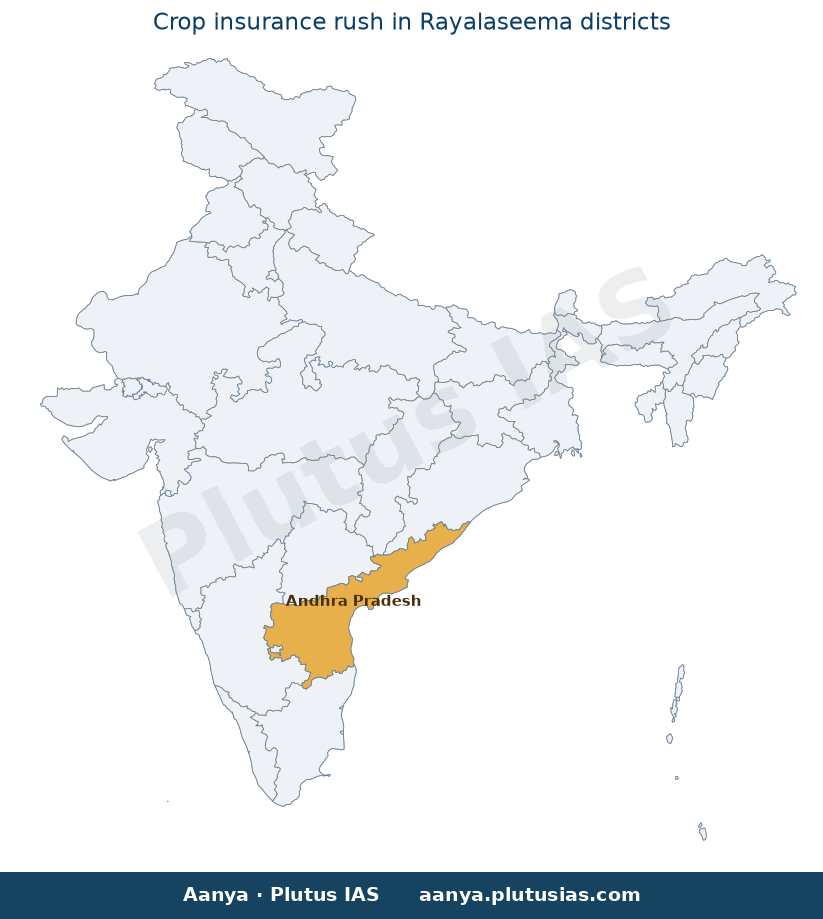
The impending July 31 deadline for enrolment under India’s flagship crop insurance schemes—Pradhan Mantri Fasal Bima Yojana (PMFBY) and Restructured Weather-Based Crop Insurance Scheme (RWBCIS)—has triggered a last-minute surge in farmer registrations across Andhra Pradesh’s Rayalaseema region, particularly in Sri Sathya Sai, Chittoor, and Annamayya districts. This rush underscores the critical role of crop insurance as a climate-resilient financial safety net amid escalating climate variability, delayed monsoons, and the projected El Niño impact, which threaten the livelihoods of small and marginal farmers dependent on rainfed agriculture.
Background
- The Rayalaseema region of Andhra Pradesh is historically characterised by high dependence on monsoon rainfall for agriculture, with over 80% of cultivated area being rainfed, making it highly vulnerable to climatic aberrations such as delayed monsoons, dry spells, and unseasonal rainfall.
- The region has experienced recurring agricultural distress due to climatic variability, with studies indicating a 15–20% reduction in crop yields during El Niño years, exacerbating farm incomes and food security risks.
- India’s crop insurance ecosystem has evolved significantly post-2016 with the launch of PMFBY and RWBCIS, replacing earlier schemes like the National Agricultural Insurance Scheme (NAIS) and Modified National Agricultural Insurance Scheme (MNAIS), to enhance coverage, reduce premiums, and improve claim settlements.
- PMFBY, a yield-based insurance scheme, compensates farmers for losses due to non-preventable risks such as drought, flood, hailstorm, and pest attacks, while RWBCIS, a weather-based scheme, provides payouts based on deviations in key weather parameters like rainfall, temperature, and humidity from normal thresholds.
- The Rayalaseema region’s agrarian economy is dominated by small and marginal farmers, with horticulture crops such as mango, tomato, banana, and vegetables contributing significantly to rural livelihoods and regional GDP.
- The July 31 deadline for enrolment under these schemes is a statutory requirement, and delays in registration can result in exclusion from insurance coverage for the current agricultural season, leaving farmers exposed to financial risks from adverse weather events.
What are the Pradhan Mantri Fasal Bima Yojana (PMFBY) and Restructured Weather-Based Crop Insurance Scheme (RWBCIS)?
- PMFBY is a yield-based crop insurance scheme launched in 2016 to provide comprehensive insurance coverage against non-preventable risks such as drought, flood, hailstorm, and pest attacks, replacing earlier schemes like NAIS and MNAIS to improve efficiency and farmer participation.
- RWBCIS, introduced alongside PMFBY, is a weather-based insurance scheme that compensates farmers based on deviations in key weather parameters (rainfall, temperature, humidity) from normal thresholds, making it particularly suitable for regions with high climatic variability like Rayalaseema.
- Both schemes are voluntary for farmers but mandatory for loanee farmers availing crop loans from financial institutions, ensuring broad-based coverage across India’s agricultural landscape.
- Premium rates under PMFBY are capped at 2% for kharif crops, 1.5% for rabi crops, and 5% for horticulture crops, while RWBCIS charges a uniform premium of 7% for all crops, with the central and state governments subsidising the remaining premium amount to make insurance affordable for farmers.
- The schemes utilise technology extensively, including remote sensing, drones, and smartphone-based crop cutting experiments (CCEs), to assess crop losses accurately and expedite claim settlements, reducing the time lag between loss occurrence and compensation disbursal.
- PMFBY and RWBCIS are implemented through a public-private partnership model, with insurance companies selected through a transparent bidding process, and claims are settled within a stipulated timeline to ensure timely financial relief to farmers.
- The schemes aim to reduce the financial burden on farmers by providing a safety net against crop losses, thereby encouraging investment in agriculture, enhancing food security, and stabilising rural incomes in climate-vulnerable regions like Rayalaseema.
- Data from the Ministry of Agriculture and Farmers’ Welfare indicates that over 5 crore farmers have been enrolled under PMFBY since its inception, with cumulative claims exceeding ₹1.5 lakh crore, demonstrating the scheme’s scale and impact in mitigating agrarian distress.
Key Features
| Feature | Significance |
|---|---|
| Pradhan Mantri Fasal Bima Yojana (PMFBY) | Provides financial protection to farmers against crop losses due to natural calamities, pests, and diseases, ensuring income stability. |
| Restructured Weather-Based Crop Insurance Scheme (RWBCIS) | Covers risks associated with adverse weather conditions, including delayed monsoons, dry spells, and unseasonal rainfall, tailored for rainfed regions. |
| Last-minute enrolment drives | Accelerated registration efforts by Agriculture and Horticulture departments to maximize coverage before the July 31 deadline, addressing time constraints. |
| El Niño impact | Exacerbates monsoon variability, increasing the vulnerability of rain-dependent agriculture in Rayalaseema, necessitating timely insurance coverage. |
| Small and marginal farmers | Predominant beneficiary category in Chittoor and Annamayya districts, highlighting the scheme’s role in safeguarding livelihoods of economically weaker sections. |
Why it Matters
Economic
- Crop insurance mitigates financial losses for farmers in Rayalaseema, where agriculture is the primary livelihood source, reducing rural distress.
- Ensures continuity of agricultural operations by providing liquidity during crop failures, preventing debt traps and farmer suicides.
- Protects horticulture crops (mango, tomato, banana) that contribute significantly to the regional agrarian economy and export earnings.
Strategic
- Supports food security by stabilizing farm incomes in drought-prone regions, ensuring consistent agricultural output.
- Reduces dependency on ad-hoc relief measures by institutionalizing risk management through insurance mechanisms.
- Aligns with the government’s goal of doubling farmer incomes by 2022 (extended targets), ensuring sustainable agricultural growth.
Social
- Provides a safety net for small and marginal farmers, who constitute the majority in Chittoor and Annamayya districts, enhancing social equity.
- Reduces migration pressures from rural areas by improving economic resilience in agriculture-dependent communities.
- Encourages adoption of modern agricultural practices by reducing perceived risks associated with innovation.
Challenges
1. Delayed and Erratic Monsoons
- Rayalaseema’s historical dependence on monsoons makes agriculture highly vulnerable to delayed onset, dry spells, and unseasonal rainfall.
- El Niño events intensify monsoon variability, increasing the frequency and severity of crop losses.
- Limited access to irrigation infrastructure exacerbates the impact of erratic rainfall on crop yields.
UPSC Link: Geography: Climate and Weather Patterns
2. Low Insurance Penetration
- Despite the PMFBY and RWBCIS, enrolment remains suboptimal due to awareness gaps, procedural complexities, and last-minute rushes.
- Small and marginal farmers often lack the documentation or financial literacy to navigate insurance schemes effectively.
- Distrust in insurance payout mechanisms and delayed claim settlements deter participation.
UPSC Link: Economy: Agricultural Marketing and Insurance
3. Administrative Bottlenecks
- Last-minute enrolment drives strain departmental resources, leading to inefficiencies in verification and processing.
- Inadequate coordination between Agriculture, Horticulture, and Revenue departments hampers seamless implementation.
- Digital divide and limited internet access in rural areas impede online enrolment under PMFBY.
UPSC Link: Governance: E-Governance and Service Delivery
4. Climate Change Adaptation
- Increasing frequency of extreme weather events (droughts, floods) necessitates adaptive agricultural practices and insurance models.
- Traditional crop varieties and farming techniques are ill-equipped to withstand rapid climate shifts, increasing insurance claims.
- Lack of climate-resilient infrastructure (e.g., drought-resistant seeds, micro-irrigation) limits the efficacy of insurance schemes.
UPSC Link: Environment: Climate Change and Agriculture
Challenges — UPSC Perspective
| Issue | Concern |
|---|---|
| Awareness and Outreach | Limited understanding of insurance benefits and procedural requirements among small farmers. |
| Documentation Gaps | Incomplete land records, Aadhaar linkage issues, and lack of bank accounts hinder enrolment. |
| Claim Settlement Delays | Bureaucratic hurdles and inadequate assessment mechanisms lead to delayed or denied claims. |
| Climate Variability | Increasing unpredictability of monsoons and extreme weather events undermines risk assessment models. |
| Financial Constraints | Premium affordability for small farmers and inadequate government subsidies for high-risk crops. |
Government Initiatives — Must-Memorise for Prelims
- Pradhan Mantri Fasal Bima Yojana (PMFBY)
- Restructured Weather-Based Crop Insurance Scheme (RWBCIS)
Way Forward
- Accelerate awareness campaigns in local languages, leveraging community leaders, agricultural extension services, and digital platforms to educate farmers on insurance benefits and enrolment processes.
- Simplify enrolment procedures by integrating land records with Aadhaar and bank accounts, reducing documentation burdens and streamlining verification.
- Strengthen last-mile delivery of insurance services by deploying mobile units and facilitating offline enrolment in remote areas.
- Enhance claim settlement mechanisms by digitizing assessment processes, reducing turnaround time, and ensuring transparency in payouts.
- Promote climate-resilient agriculture through subsidies for drought-resistant seeds, micro-irrigation, and weather advisory services to reduce insurance claims.
- Increase government subsidies for high-risk crops and marginal farmers to improve affordability and participation in insurance schemes.
- Establish a grievance redressal system with dedicated helplines and local grievance cells to address farmer concerns and build trust in the system.
UPSC Value Addition
Keywords for Mains Answer-Writing
Pradhan Mantri Fasal Bima Yojana (PMFBY) · Restructured Weather-Based Crop Insurance Scheme (RWBCIS) · Rayalaseema region vulnerability · monsoon dependence in agriculture · small and marginal farmers · climate change and agriculture · crop insurance as financial safety net · El Niño impact on Indian agriculture · Agricultural Insurance in India · financial security for farmers · dry spells and unseasonal rainfall · agricultural productivity and risk mitigation
Concept Flow
Monsoon variability and El Niño impact → Increased crop losses in rainfed regions (Rayalaseema) → Higher demand for crop insurance coverage. → Last-minute enrolment rush → Administrative challenges in processing applications → Potential exclusion of eligible farmers. → Enrolment under PMFBY/RWBCIS → Financial protection for farmers → Reduced rural distress and debt traps. → Delayed claim settlements → Distrust in insurance schemes → Lower future participation. → Climate change exacerbates weather risks → Need for adaptive agricultural practices and resilient infrastructure → Long-term sustainability of insurance models.
Prelims Practice Questions
Q1. Consider the following statements regarding the Pradhan Mantri Fasal Bima Yojana (PMFBY):
1. It is a voluntary scheme for all farmers.
2. It covers all food and oilseed crops and annual commercial/horticultural crops.
3. The premium rates are uniform across all states and crops.
4. It is implemented through the Agriculture Insurance Company of India Limited (AICIL).
How many of the above statements are correct?
- Only one
- Only two
- Only three
- All
Answer: Only three — Statements 1 and 2 are correct. Statement 3 is incorrect as premium rates vary by crop and state. Statement 4 is incorrect as PMFBY is implemented through multiple insurance companies, not solely AICIL.
Q2. Assertion (A): The Restructured Weather-Based Crop Insurance Scheme (RWBCIS) provides compensation based on the extent of deviation in weather parameters from the normal range.
Reason (R): RWBCIS is designed to mitigate risks associated with weather variability, such as rainfall deficit or excess, temperature anomalies, and humidity fluctuations.
Options:
A. Both A and R are true, and R is the correct explanation of A.
B. Both A and R are true, but R is not the correct explanation of A.
C. A is true, but R is false.
D. A is false, but R is true.
Answer: ? — Both the assertion and reason are correct. RWBCIS indeed compensates farmers based on deviations in weather parameters from normal ranges, which directly addresses weather-related risks in agriculture.
Q3. Match the following pairs related to agricultural insurance schemes in India:
Column I (Scheme) | Column II (Key Feature)
— | —
A. Pradhan Mantri Fasal Bima Yojana (PMFBY) | 1. Covers only horticultural crops
B. Restructured Weather-Based Crop Insurance Scheme (RWBCIS) | 2. Compensation based on yield loss
C. National Agricultural Insurance Scheme (NAIS) | 3. Compensation based on weather parameter deviations
D. Coconut Palm Insurance Scheme | 4. Covers all food and oilseed crops
Options:
A-4, B-3, C-2, D-1
A-2, B-4, C-3, D-1
A-1, B-3, C-2, D-4
A-3, B-2, C-4, D-1
- A-4, B-3, C-2, D-1
- A-2, B-4, C-3, D-1
- A-1, B-3, C-2, D-4
- A-3, B-2, C-4, D-1
Answer: A-4, B-3, C-2, D-1 — PMFBY (A) covers all food and oilseed crops (4). RWBCIS (B) compensates based on weather parameter deviations (3). NAIS (C) compensates based on yield loss (2). The Coconut Palm Insurance Scheme (D) covers only horticultural crops (1).
Mains Practice Question
✍ Critically examine the role of crop insurance schemes, particularly the Pradhan Mantri Fasal Bima Yojana (PMFBY) and the Restructured Weather-Based Crop Insurance Scheme (RWBCIS), in mitigating agricultural risks in climatically vulnerable regions like Rayalaseema. Also, assess their effectiveness in providing financial security to small and marginal farmers in the context of climate change. (15 Marks)
Approach: MODEL-ANSWER SKELETON:
1. **Introduction (2 marks)**: Define agricultural risk and the vulnerability of Rayalaseema to monsoon dependence, dry spells, and unseasonal rainfall. Highlight the importance of crop insurance as a risk mitigation tool.
2. **PMFBY: Features and Coverage (3 marks)**:
– Voluntary participation with low premium rates (2% for kharif, 1.5% for rabi, 5% for horticulture crops).
– Comprehensive coverage of food and oilseed crops, annual commercial/horticultural crops.
– Implementation through multiple insurance companies with government subsidy.
– Data from the article: 10,279 farmers and 15,950 hectares covered in Sri Sathya Sai district under PMFBY.
3. **RWBCIS: Features and Coverage (3 marks)**:
– Compensation based on weather parameter deviations (rainfall, temperature, humidity).
– Suitable for regions with high weather variability like Rayalaseema.
– Data from the article: 78,798 farmers and 1,00,320 hectares covered under RWBCIS in Sri Sathya Sai district.
4. **Effectiveness in Rayalaseema (4 marks)**:
– **Strengths**: Provides financial security against weather anomalies; reduces distress migration; supports livelihoods of 3.5 lakh farmers in Chittoor and Annamayya districts.
– **Limitations**: Low awareness among farmers; last-minute enrolment indicates systemic gaps; El Niño exacerbates risks, testing scheme robustness.
– **Climate Change Context**: Increased frequency of extreme weather events necessitates adaptive insurance models.
5. **Challenges and Way Forward (3 marks)**:
– **Challenges**: High administrative costs, delayed claim settlements, exclusion of tenant farmers.
– **Suggestions**: Strengthen grievance redressal mechanisms; leverage technology (remote sensing, AI) for accurate weather data; expand coverage to tenant farmers and sharecroppers.
Balance of views: Acknowledge the schemes’ role in risk mitigation while critiquing their implementation gaps and the need for reforms to address climate change impacts.
Source: The Hindu
Generated by AanyaAi for educational purpose.

- बिहार सरकार का बड़ा फैसला: कारोबार शुरू करने में होगी आसानी, जानिए कैसे मिलेगा फायदा - September 23, 2026
- Bihar Launches Single Window Portal for 62 Business Services: UPSC & PCS Guide - September 23, 2026
- ग्रीनलैंड समझौता: अमेरिका को मिले अतिरिक्त रक्षा क्षेत्र, जानिए पूरा मामला - September 23, 2026

No Comments