


19 Apr Is Law a Good Optional for UPSC CSE Mains Exam?
Is Law a Good Optional for UPSC CSE Mains Exam?
Why Consider Law as an Optional Subject?
Law is a rational, conceptual, and relatively scoring optional subject that requires clarity in legal interpretation and strong answer-writing skills. Here are several reasons why many aspirants pick Law:
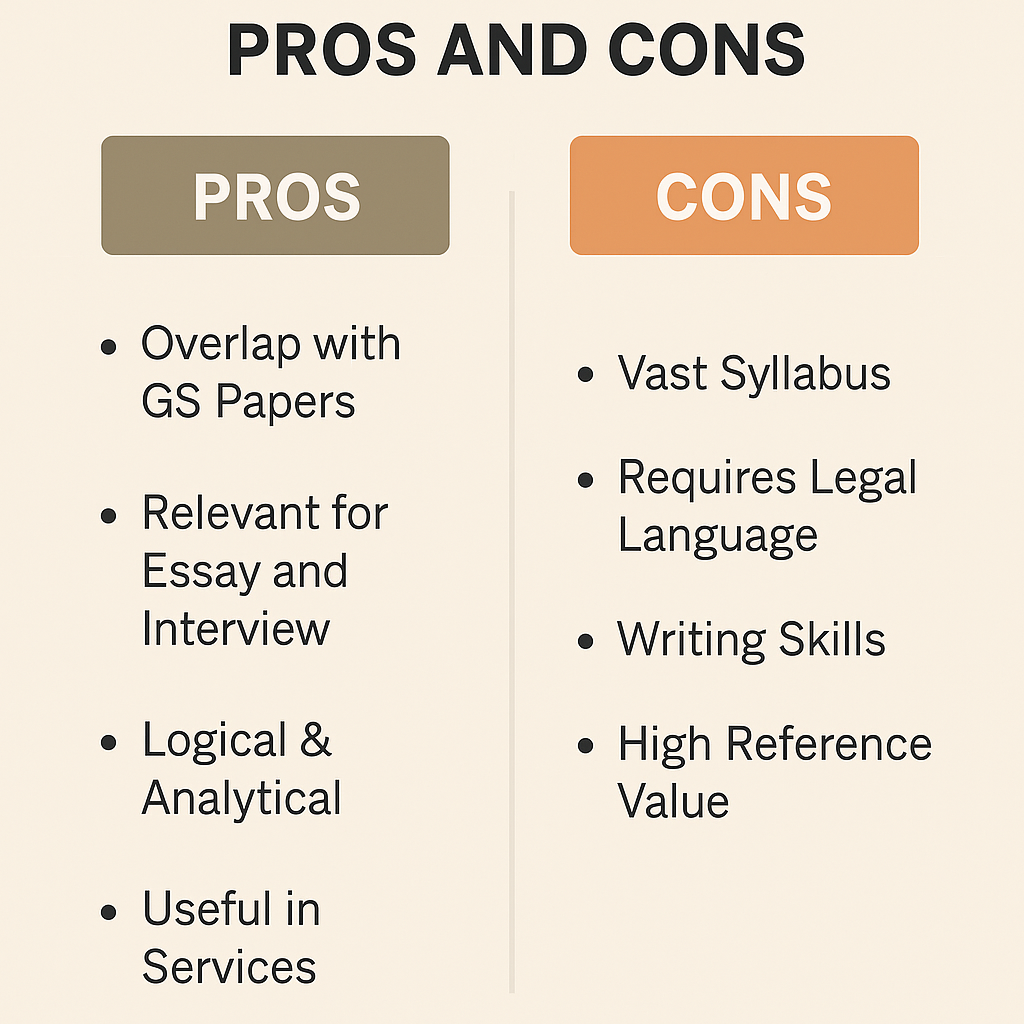
- Overlap with GS Papers: Constitutional Law, Administrative Law, and International Relations overlap with GS Paper 2.
- Relevant for Essay and Interview: Law helps in presenting structured arguments in the essay and discussing governance-related issues in the interview.
- Logical & Analytical: The subject is analytical rather than theoretical, making it ideal for candidates with rational reasoning skills.
- Useful in Services: Knowledge of law is helpful not just in exams but also while working in administrative services, especially IAS, IPS, or IRS.
- Scoring Trend: Candidates with Law optional have consistently scored 270+ marks with the right preparation and writing style.
Who Should Choose Law Optional?
Law optional is best suited for:
- Law graduates or students from legal backgrounds.
- Aspirants with good comprehension and analytical skills.
- Candidates who are comfortable with technical language and case laws.
Even non-law graduates can opt for Law if they are ready to put in the initial effort to understand legal concepts and case-based learning.
Challenges of Choosing Law as Optional
- Vast Syllabus: Although structured, the syllabus is vast and includes Constitution, IPC, CrPC, International Law, Torts, and more.
- Requires Legal Language: Legal jargon and referencing of case laws can be difficult for beginners.
- Writing Skills: Presentation, clarity, and referencing appropriate judgments are crucial to fetch good marks.
Paper Pattern and Approach
UPSC Law optional consists of two papers:
- Paper I: Constitutional and Administrative Law, International Law
- Paper II: Law of Crimes, Law of Torts, Contract and Mercantile Law, Contemporary Legal Developments
To better understand the question structure and focus areas, you can review the
past year question papers of Law Paper 1 and Paper 2 on the official UPSC website — many analytical approaches overlap in subjects like Law and Philosophy.
Best Teachers for Law Optional
One of the key success factors is learning from an experienced mentor who understands how to decode the UPSC pattern. You can explore
best teacher for law optional — many of these expert educators also offer modules or guidance for Law optional.
Top Coaching Institutes for Law Optional
If you are looking for a structured learning program, test series, and personalized mentorship, go through
best coaching for Law optional. While primarily for Philosophy, some coaching centers on this list also offer Law optional with similar quality standards.
Tips to Maximize Marks in Law Optional
- Focus on clarity and concise presentation of legal principles.
- Practice answer writing with regular mock tests and previous year papers.
- Use case law references smartly – not too many, not too few.
- Read from standard texts like V.N. Shukla for Constitution, and Avtar Singh for Contract Law.
Conclusion
Is Law a good optional for UPSC? Definitely yes — if you enjoy structured, logical subjects with real-world application and have the discipline to master its wide syllabus. With regular writing practice, proper guidance, and legal insight, Law can be a high-scoring and professionally enriching optional subject in the UPSC mains exam.

- मिशन कर्मयोगी: पहली क्षेत्रीय कार्यशाला विजयवाड़ा में संपन्न, जानें मुख्य बिंदु - October 2, 2026
- UPSC Focus: Arjun Ram Meghwal Leads Tree Plantation at IIAC - October 2, 2026
- गोबरधन योजना: सीबीजी क्षेत्र को बढ़ावा देने के लिए केंद्र सरकार की पहल - October 2, 2026

No Comments