


31 Dec Lighthouse Tourism in India: Illuminating Maritime Heritage and Driving Economic Growth
This article covers “Daily Current Affairs,” and the topic details related to Lighthouse Tourism in India: Illuminating Maritime Heritage and Driving Economic Growth
Syllabus mapping:
GS-3: Indian Economy and sectors of Indian Economy: Tourism sector.
For Prelims:
What is Lighthouse Tourism, Government initiatives in this regard.
For Mains:
What is the Significance of lighthouse tourism its potential, hurdles limiting the potential, and ways to reduce these hurdles?
Why in the News?
India, with a coastline spanning over 7,500 kilometers and home to 204 lighthouses, is now witnessing a transformative initiative by the Government of India. Traditionally serving as navigational aids for seafarers, these iconic structures are being reimagined as tourism destinations under the government’s developmental vision. This initiative seeks to preserve the historical and architectural significance of lighthouses while unlocking their potential for economic growth and community empowerment.

What is Lighthouse Tourism?
Lighthouse tourism involves transforming lighthouses and their surrounding areas into vibrant tourist attractions. Often situated in scenic coastal or island settings, these structures uniquely blend natural beauty, maritime history, and recreational activities. The Central Government is promoting lighthouse tourism as part of its Maritime India Vision (MIV) 2030 and Amrit Kaal Vision 2047 to preserve India’s cultural heritage and maritime legacy. This initiative seeks to boost India’s tourism potential, create employment opportunities, and foster local economic growth.

Significance of Lighthouse Tourism:
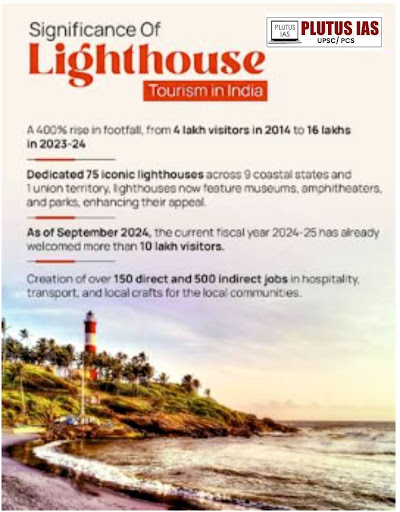
Job Creation: The initiative has led to the creation of 150 direct and 500 indirect employment opportunities in sectors like hospitality, transportation, tour operations, and local crafts, boosting livelihoods in surrounding areas.
Economic Boost: Increased tourist footfall has directly benefited local businesses such as hotels, restaurants, shops, and artisans, fostering economic activity in coastal regions.
Preservation of Heritage: With a ₹60 crore investment, 75 iconic lighthouses have been developed with modern amenities like museums, amphitheaters, and children’s parks, ensuring the conservation of India’s maritime history while making it accessible to the public.
Tourist Attraction: In 2023-24, these lighthouses attracted 16 lakh visitors, a significant rise from just 4 lakh visitors in 2014, marking a 400% increase in footfall. In 2024-25, over 10 lakh tourists visited by September, including more than 5 lakh between April and June 2024, showcasing their growing popularity.
Community Empowerment: Tourism has empowered local communities by creating opportunities for skill development and enhancing participation in tourism-related activities, uplifting livelihoods.
Global Appeal: The initiative under Maritime India Vision 2030 and Amrit Kaal Vision 2047 aligns with India’s vision to showcase its maritime and cultural legacy, drawing attention from both domestic and international tourists.
Sustainable Tourism: By integrating eco-friendly practices and promoting heritage conservation, the initiative ensures tourism development aligns with environmental and cultural preservation.
Enhanced Infrastructure: The development of tourist-friendly facilities has transformed lighthouses into hubs for history, adventure, and leisure, making them unique travel destinations that appeal to diverse demographics.
Government Initiatives and Schemes to Promote Lighthouse Tourism in India
| Initiative/Scheme | Details |
|---|---|
| Indian Lighthouse Festival | – The 1st Bharatiya Prakash Stambh Utsav was inaugurated on 23rd September 2023 at Fort Aguada, Goa by Union Minister Shri Sarbananda Sonowal and Goa CM Shri Pramod Sawant. |
| – The 2nd Festival was held in Odisha, where two lighthouses at Chaumuck (Balasore) and Dhamra (Bhadrak) were dedicated, promoting maritime heritage and tourism. | |
| Stakeholders Meeting | – A stakeholders’ meet chaired by Shri Sarbananda Sonowal in Kerala (July 2024) strategized the promotion of lighthouse tourism and revitalization of these structures as vibrant tourist destinations. |
| Sagarmala Programme | – A national program leveraging India’s coastline and waterways to promote economic development through projects like coastal circuits, cruise tourism infrastructure, and lighthouse development. |
| Swadesh Darshan Scheme | – Provides financial assistance for developing tourism infrastructure in state and UT-administered areas. Includes the Coastal Circuit as a thematic focus and a Challenge-Based Destination Development sub-scheme. |
| Incredible India Campaign | – A flagship initiative under the Ministry of Tourism to promote India as a global tourist destination, highlighting its diverse heritage, including coastal and maritime attractions like lighthouses. |
| National Heritage Complex Development | – Focuses on preserving and promoting heritage sites, integrating lighthouses into broader national efforts to conserve cultural landmarks. |
| National Strategy for Sustainable Tourism | – Aims at sustainable tourism by emphasizing environmental sustainability, resource efficiency, and long-term management practices for tourism destinations, including lighthouses. |
| 75 Lighthouses Development | – 75 iconic lighthouses were developed with amenities such as museums, amphitheaters, and parks in February 2024 with a ₹60 crore investment, underlining their cultural and recreational significance. |
| Future National Framework | – Plans are underway to establish a national framework aimed at empowering coastal communities and promoting sustainable development around lighthouses. |
The Potential of Lighthouse Tourism in India
Scenic Locations: Positioned along India’s vast coastline and remote islands, many lighthouses provide stunning panoramic sea views, making them ideal for nature enthusiasts and photographers.
Historical Significance: Some lighthouses date back centuries and are situated near UNESCO World Heritage Sites such as Mahabalipuram in Tamil Nadu, enhancing their cultural and architectural appeal.
Adventure and Recreation: These sites can host activities such as trekking, boating, and water sports, catering to adventure seekers and families alike.
Economic Growth: Developing lighthouse tourism creates employment opportunities in hospitality, transportation, and local handicrafts, fostering regional economic development.
Government Initiative: Recognizing their potential, the government has identified lighthouse tourism as a priority area under its Maritime India Vision (MIV) 2030 and Amrit Kaal Vision 2047.
Modern Facilities: In February 2024, PM Narendra Modi inaugurated 75 lighthouses equipped with tourist facilities, including museums, amphitheaters, children’s parks, and more, with a ₹60 crore investment.
Tourist Footfall: The dedicated lighthouses attracted 16 lakh visitors in 2023-24, a significant rise from 4 lakh visitors in 2014, reflecting a 400% increase. By September 2024, over 10 lakh tourists had already visited in the current fiscal year.
Sustainable Tourism: The initiative promotes sustainable tourism practices by preserving the historical and ecological integrity of lighthouses while enhancing their appeal as global travel destinations.
Hurdles Limiting the Realization of Lighthouse Tourism Potential in India
Infrastructure Limitations: Many lighthouses are in remote areas with poor connectivity, like Kochi and Sundarbans, limiting access and footfall. This reduces tourism potential and revenue generation.
Environmental Concerns: Tourism development can negatively impact fragile ecosystems, as seen at Alappuzha Lighthouse in Kerala. The surrounding backwaters face ecological threats from infrastructure.
Lack of Awareness: Lighthouse tourism gained momentum after the 2023 Indian Lighthouse Festival, showing prior low awareness. This limits tourist interest and growth potential.
Regulatory Issues: Strict security measures at sites like Mangalore Lighthouse restrict public access. These regulations hinder tourist engagement and development.
Coastal Community Involvement: In places like Goa, local communities weren’t initially involved in tourism planning, limiting their benefits. Tourism revenue wasn’t reinvested into community development.
Seasonal Tourism Impact: Lighthouse tourism in coastal regions faces seasonal fluctuations, as seen in Odisha. Off-season declines affect profitability and operational sustainability.
Insufficient Skill Development: Limited skill-building programs in Tamil Nadu prevent locals from benefiting from tourism growth. Lack of hospitality and guiding skills restricts job opportunities.
Private Sector Challenges: High investment costs and risks deter private players, as in the Sundarbans. Developing tourism infrastructure in ecologically sensitive areas faces slow progress.
Heritage Conservation: Balancing preservation with modern tourism at Kanyakumari Lighthouse is challenging. The need for new facilities conflicts with maintaining the structure’s historical integrity.
Ways to Tap the Potential of Lighthouse Tourism in India
| Strategy | Details |
|---|---|
| Sustainable Development | – Emphasis on eco-friendly practices to protect fragile coastal ecosystems and ensure the long-term viability of lighthouse tourism. |
| Integration with Coastal Circuits | – Lighthouses are integrated into broader coastal tourism circuits to enhance their appeal and connect them with other cultural and natural landmarks. |
| Awareness Campaigns | – Launching digital initiatives and campaigns to showcase lighthouse destinations, targeting both domestic and international audiences. |
| Skill Development | – Introducing training programs to equip local communities with skills for employment in hospitality and tourism-related sectors, fostering local economic growth. |
| Alignment with “Atmanirbhar Bharat” | – Aligning lighthouse tourism development with Prime Minister Modi’s “Atmanirbhar Bharat” vision to foster self-reliant India, integrating maritime heritage into the nation’s economic growth strategy. |
| Preservation of Maritime Biodiversity | – Focus on preserving the environment surrounding lighthouses, protecting India’s rich maritime biodiversity while promoting tourism. |
| Experiential and Off-the-Beaten-Path Travel | – Catering to the growing demand for experiential tourism by offering tourists the opportunity to engage with local cultures, enjoy scenic landscapes, and participate in activities around lighthouses. |
| Lighthouse Festivals and Community Engagement | – Organizing Indian Lighthouse Festivals and Stakeholders Meetings to bring together local communities, tourism operators, and government bodies, fostering a sense of ownership and pride while benefiting local economies. |
| MIV 2030 Integration | – Incorporating lighthouse tourism into the Maritime India Vision 2030 (MIV 2030) initiative, linking lighthouses with larger coastal tourism circuits to boost global appeal. |
Conclusion:
The government’s ongoing efforts to develop lighthouse tourism are already yielding significant results, with millions of tourists visiting these iconic sites. By combining history, adventure, and natural beauty, lighthouses are becoming an integral part of India’s tourism landscape. The focus on sustainable development, community engagement, and environmental preservation ensures that lighthouse tourism will continue to drive economic growth in India’s coastal regions.
Download Plutus IAS Current Affairs (Eng) 31st Dec 2024
Prelims Question:
Q. Which of the following are the advantages of the Lighthouse tourism?
1. Employment generation
2. Sustainable coastal tourism
3. Elimination of involvement of local communities.
Select the correct answer using the code given below:
A. 1 and 2 only
B. 2 and 3 only
C. 1 and 3 only
D. 1, 2 and 3
ANSWER: A
Mains question:
Q. Discuss the potential and significance of lighthouse tourism in India. What measures have been taken by the government to tap into the potential of lighthouse tourism and enhance its contribution to the economy and sustainable development?
(Answer in 250 words)

- United Nations in the 21st Century: Relevance, Crisis, and Way Forward - September 22, 2025
- Election Commission of India: Strengthening the Democratic Backbone - September 20, 2025
- India’s Renewable Energy Journey: Towards Energy Self-Reliance and Climate Leadership - September 19, 2025

No Comments