


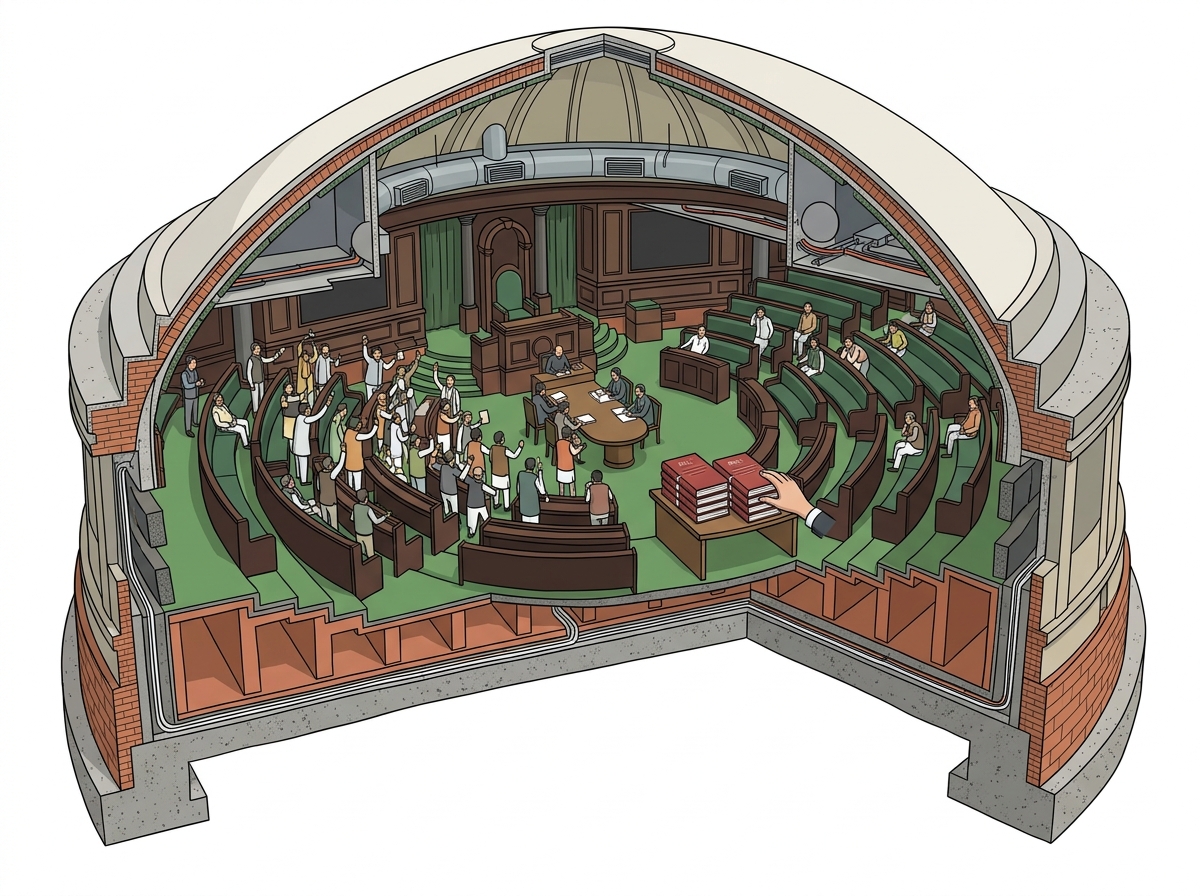
11 Aug Lok Sabha Deadlock: Two Bills Passed Without Discussion Amid Opposition Protests
Lok SabhaBillsOppositionHome MinisterParliamentary procedures✎ Parliamentary procedures allow the passage of Bills without discussion under specific circumstances, such as disruptions, but structured debates are essential for legislative scrutiny and accountability.
Subject Relevance — Where This Topic Fits
- GS Paper II — Polity and Governance — Parliament and State Legislatures — Structure, Functioning, Conduct of Business, Powers and Privileges | GS Paper II — Polity and Governance — Constitutional Framework — Federalism and State Reorganisation
- Prelims: Lok Sabha, Rajya Sabha, Parliamentary procedures, Bill passage, voice vote, adjournment, Speaker’s powers, federalism, cooperative federalism, state name alteration, constitutional amendment
- Essay: Parliamentary democracy: Challenges and reforms, Federalism in India: Balancing unity and diversity
Quick Revision: Parliamentary procedures allow the passage of Bills without discussion under specific circumstances, such as disruptions, but structured debates are essential for legislative scrutiny and accountability.
Why is this in the news?
The Lok Sabha witnessed prolonged disruptions on August 11, 2026, leading to the passage of two Bills without discussion. The Opposition’s demand for a statement by the Home Minister on alleged use of force against student protesters and concerns regarding donations to the Ram Temple stalled proceedings, highlighting procedural challenges in legislative functioning. This incident underscores the importance of structured parliamentary debates and the role of institutional mechanisms in resolving deadlocks.
Background
- The Monsoon Session of Parliament is a critical phase for legislative business, where key Bills are introduced, discussed, and passed.
- Parliamentary procedures are governed by the Rules of Procedure and Conduct of Business in the Lok Sabha, which outline the methods for introducing, discussing, and passing Bills.
- Disruptions in Parliament are not uncommon and often stem from differences in political opinions, demands for accountability, or procedural disputes.
- The Kerala (Alteration of Name) Bill, 2026, seeks to rename the state from ‘Kerala’ to ‘Keralam’, reflecting linguistic and cultural considerations.
- The National Co-operative Development Corporation (Amendment) Bill, 2026, aims to amend the NCDC Act, 1962, to enhance the cooperative sector’s role in national development.
- The Speaker of the Lok Sabha holds the authority to maintain order and adjourn the House in case of unruly behavior, as seen in the adjournment on August 11, 2026.
What are the key aspects of the Bills passed and the procedural context?
- The **Kerala (Alteration of Name) Bill, 2026** proposes to rename the state from ‘Kerala’ to ‘Keralam’. This aligns with the linguistic and cultural identity of the state, as ‘Keralam’ is the Malayalam name for the region.
- The **National Co-operative Development Corporation (Amendment) Bill, 2026** seeks to amend the National Co-operative Development Corporation Act, 1962. The NCDC is a statutory body under the Ministry of Cooperation, established to promote and develop cooperative societies in India.
- Disruptions in Parliament often lead to the suspension of normal legislative procedures, including discussions and debates, which can impact the scrutiny and accountability of Bills.
- The role of the Opposition in demanding accountability and raising concerns is a fundamental aspect of parliamentary democracy, as enshrined in the **Constitution of India** under Article 105 (freedom of speech in Parliament).
- The incident highlights the importance of **structured debates** and the need for institutional mechanisms to address procedural disputes without compromising legislative productivity.
UPSC Value Addition
Keywords for Mains Answer-Writing
Parliamentary procedures and conventions · Legislative process in Lok Sabha · Role of the Speaker in Parliament · Opposition’s role in legislative debates · Name change of a State (Kerala to Keralam) · Co-operative sector reforms · Constitutional provisions for State name alteration · Parliamentary deadlock and adjournments · Parliamentary Affairs and Government accountability · Procedural irregularities in legislative business · Parliamentary etiquette and decorum · Legislative scrutiny and debate · Institutional checks on executive power
Prelims Practice Questions
Q1. Consider the following statements regarding the procedure for altering the name of a State in India:
1. The Constitution of India empowers Parliament to alter the name of a State by a simple majority.
2. The consent of the State Legislature is mandatory before Parliament can consider such a proposal.
3. The Bill for altering the name of a State must be introduced in the Rajya Sabha first.
How many of the above statements are correct?
- Only one
- Only two
- All three
- None
Answer: Only two — Statement 1 is correct as Article 3 of the Constitution empowers Parliament to alter the name of a State by a simple majority. Statement 2 is incorrect because the consent of the State Legislature is not mandatory; the Bill can be introduced in either House of Parliament. Statement 3 is incorrect as the Bill can be introduced in either House of Parliament.
Q2. Assertion (A): The Speaker of the Lok Sabha has the power to adjourn the House sine die in case of persistent disorder.
Reason (R): The Constitution of India explicitly vests the Speaker with the authority to adjourn the House without the concurrence of the House.
Options:
A. Both A and R are true, and R is the correct explanation of A.
B. Both A and R are true, but R is not the correct explanation of A.
C. A is true, but R is false.
D. A is false, but R is true.
Answer: ? — Assertion (A) is true as the Speaker has the power to adjourn the House sine die in case of persistent disorder. Reason (R) is false because the Constitution does not explicitly vest this power; it is derived from the Rules of Procedure and Conduct of Business in Lok Sabha.
Q3. Match the following Bills with their respective subjects:
Column I (Bill) | Column II (Subject)
—————-|——————-
A. Kerala (Alteration of Name) Bill, 2026 | 1. Co-operative sector reforms
B. National Co-operative Development Corporation (Amendment) Bill, 2026 | 2. Renaming of a State
C. The Constitution (One Hundred and Twenty-Eighth Amendment) Bill, 2026 | 3. Reservation for women in local bodies
D. The Constitution (Scheduled Castes) Order (Amendment) Bill, 2026 | 4. Inclusion of new communities in Scheduled Castes
Options:
A. A-2, B-1, C-3, D-4
B. A-1, B-2, C-3, D-4
C. A-4, B-3, C-2, D-1
D. A-3, B-4, C-1, D-2
Answer: ? — A. Kerala (Alteration of Name) Bill, 2026 pertains to the renaming of the State of Kerala to Keralam (2). B. National Co-operative Development Corporation (Amendment) Bill, 2026 pertains to co-operative sector reforms (1). C. The Constitution (One Hundred and Twenty-Eighth Amendment) Bill, 2026 pertains to reservation for women in local bodies (3). D. The Constitution (Scheduled Castes) Order (Amendment) Bill, 2026 pertains to inclusion of new communities in Scheduled Castes (4).
Mains Practice Question
✍ The legislative process in Parliament is designed to ensure thorough scrutiny and debate. However, recent incidents in the Lok Sabha indicate a departure from these norms. Critically examine the procedural and institutional mechanisms that govern the passage of Bills in Parliament, with particular reference to the Kerala (Alteration of Name) Bill, 2026 and the National Co-operative Development Corporation (Amendment) Bill, 2026. Also assess the implications of such procedural irregularities for the democratic functioning of Parliament. (15 Marks)
Approach: MODEL-ANSWER SKELETON:
1. **Introduction (2 Marks)**
– Briefly define the legislative process in Parliament, highlighting the role of debate and scrutiny.
– Mention the recent incidents in the Lok Sabha where Bills were passed without discussion.
2. **Procedural Mechanisms for Passing Bills (4 Marks)**
– Outline the stages of a Bill in Parliament: introduction, discussion, committee stage, report stage, and passing.
– Highlight the constitutional provisions governing these stages (Articles 107–109 for ordinary Bills, Article 3 for State name alteration).
– Explain the role of the Speaker in maintaining decorum and ensuring orderly conduct (Rules of Procedure and Conduct of Business in Lok Sabha).
3. **Analysis of the Kerala (Alteration of Name) Bill, 2026 (4 Marks)**
– Discuss the constitutional basis for altering a State’s name (Article 3).
– Examine whether the Bill underwent adequate scrutiny or debate.
– Assess the implications of passing such a Bill without discussion for federalism and State identity.
4. **Analysis of the National Co-operative Development Corporation (Amendment) Bill, 2026 (4 Marks)**
– Explain the significance of co-operative sector reforms in India (Constitution, 97th Amendment Act, 2011).
– Evaluate whether the Bill addressed key issues in the co-operative sector or merely procedural amendments.
– Discuss the impact of passing the Bill without debate on policy coherence and stakeholder engagement.
5. **Implications for Democratic Functioning (3 Marks)**
– Critically assess how procedural irregularities undermine parliamentary democracy.
– Discuss the role of the Opposition in holding the executive accountable.
– Highlight the long-term consequences for public trust in Parliament and legislative institutions.
6. **Conclusion (2 Marks)**
– Summarise the key points and reiterate the importance of adhering to parliamentary norms for democratic governance.
Source: The Hindu
Generated by AanyaAi for educational purpose.

- KWML’s Feasibility Reports for Water Metro in 18 Cities: UPSC & PCS Insights - October 3, 2026
- ओडिशा में वन्यजीव अनुसंधान अनुदान कार्यक्रम शुरू, सिमिलिपाल में 300 कैमरे और बढ़ेंगे - October 3, 2026
- India Summons Pakistan High Commission Official Over Violation - October 3, 2026

No Comments