


27 Jul Lok Sabha Introduces Public Exams (Malpractices Prevention) Amendment Bill 2026
Subject Relevance — Where This Topic Fits
- GS Paper II — Governance, Transparency and Accountability | GS Paper III — Issues Relating to Employment and Skill Development | GS Paper IV — Ethics in Governance
- Prelims: Public Examination Act, 2024, Fast-track courts for criminal cases, Organised crime in examination systems, Section 12A and 12B of the Bill, Union Public Service Commission (UPSC), SSC, NTA
- Essay: Integrity in public institutions: A cornerstone of democratic governance, Technology and ethics: Balancing innovation with accountability in examinations
Quick Revision: The Lok Pariksha (Prevention of Unfair Means) Amendment Bill, 2026 introduces stricter penalties, fast-track courts, and expedited investigations to combat organised malpractices in public examinations, ensuring timely justice and enhanced deterrence.
Why is this in the news?
The Lok Sabha on 27 July 2026 witnessed the introduction of the Lok Pariksha (Prevention of Unfair Means) Amendment Bill, 2026 by the Union Minister of State (Independent Charge) for Science and Technology, Dr. Jitendra Singh. The Bill seeks to amend the Lok Pariksha (Prevention of Unfair Means) Act, 2024, introducing stringent punitive measures, expedited investigations, and fast-track judicial mechanisms to address organised malpractices in public examinations, including paper leaks and impersonation. This legislative intervention follows recurring incidents of examination-related fraud, necessitating a robust legal framework to preserve the sanctity and credibility of competitive examinations in India.
Background
- The Lok Pariksha (Prevention of Unfair Means) Act, 2024 received Presidential assent on 12 February 2024 and came into force on 21 June 2024, establishing a comprehensive national legal framework to deter malpractices in public examinations.
- The Act applies to examinations conducted by constitutional bodies such as the Union Public Service Commission (UPSC), Staff Selection Commission (SSC), Railway Recruitment Boards (RRBs), Institute of Banking Personnel Selection (IBPS), National Testing Agency (NTA), and other notified authorities for recruitment to central government posts.
- Recent years have witnessed a surge in organised malpractices, including question paper leaks, impersonation, and collusion between examination authorities and service providers, undermining public trust in merit-based selection processes.
- Despite these measures, the persistence of organised examination fraud necessitated further legislative strengthening to ensure timely justice and enhanced deterrence.
- The amendment aligns with the government’s broader agenda of transparency, accountability, and ethical governance in public institutions.
What is the Lok Pariksha (Prevention of Unfair Means) Amendment Bill, 2026?
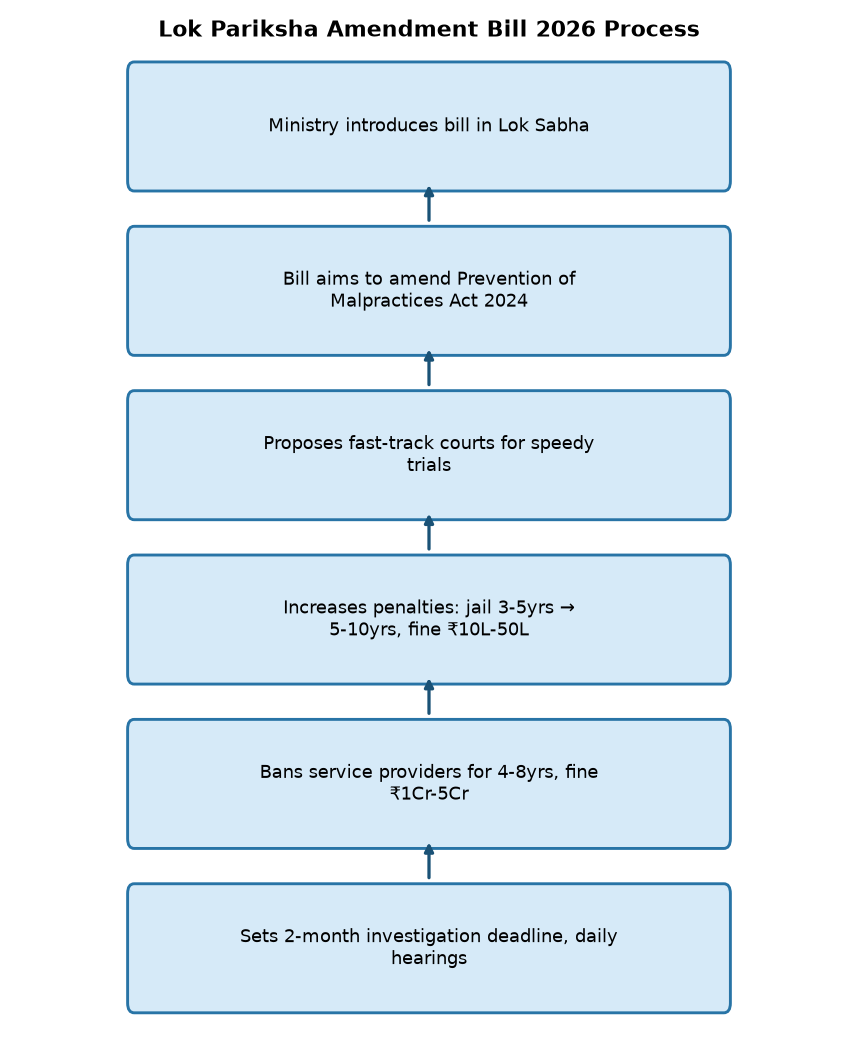
- The Bill seeks to amend the Lok Pariksha (Prevention of Unfair Means) Act, 2024, to introduce stricter punitive measures, expedited investigations, and fast-track judicial mechanisms for offences related to public examinations.
- It proposes to increase the minimum imprisonment for unfair means from three years to five years, extendable up to ten years, and raise the fine from ₹10 lakh to ₹50 lakh for individuals.
- For service providers involved in malpractices, the Bill proposes to increase the maximum fine from ₹1 crore to ₹5 crore and extend the ban on conducting examinations from four years to eight years.
- The Bill introduces stringent penalties for managerial personnel of service providers, including imprisonment ranging from five to ten years and fines up to ₹5 crore.
- Organised examination-related crimes are addressed with a minimum imprisonment of seven years, extendable to ten years, and a fine increase from ₹1 crore to ₹10 crore.
- The Bill empowers the central government to assign investigation of offences to a dedicated task force, ensuring focused and expedited action against malpractices.
- A new Section 12A is proposed to mandate completion of investigations within two months, daily hearings in fast-track courts, and disposal of cases within three months of filing the charge sheet, with the appointment of special public prosecutors for each fast-track court.
- A new Section 12B is proposed to limit appeals against decisions of fast-track courts to 30 days, with a mandatory disposal timeline of three months by the High Court, ensuring swift judicial redressal.
- The Bill underscores the government’s commitment to preserving the integrity, fairness, and credibility of public examinations, which are critical for recruitment to government posts and competitive examinations.
Key Features
| Feature | Significance |
|---|---|
| Enhanced minimum imprisonment (5–10 years) | Deters organised malpractice by imposing severe penalties for offenders, raising the cost of violation of examination integrity. |
| Increased pecuniary penalties (₹50 lakh–₹10 crore) | Ensures proportionate financial disincentives, especially for service providers and organised crime syndicates involved in exam fraud. |
| Special fast-track courts with dedicated prosecutors | Guarantees time-bound adjudication (2-month investigation, 3-month trial) to prevent delays and ensure swift justice. |
| Ban on service providers (4–8 years) | Prohibits errant agencies from conducting any public examination, reinforcing accountability in the examination ecosystem. |
| Appeal timeline (30 days, 3-month disposal) | Reduces appellate delays by mandating high-court-level resolution within a strict window, preventing prolonged litigation. |
Why it Matters
Examination Integrity
- Strengthens the legal framework to combat organised exam fraud, including paper leaks and malpractices, ensuring fair competition for candidates.
- Enhances public trust in the recruitment processes conducted by UPSC, SSC, RRB, IBPS, NTA, and other notified authorities.
- Deters collusion between candidates, coaching centres, and exam-conducting agencies through stringent penalties and bans.
Judicial Efficiency
- Establishes a robust mechanism for expedited trials via special fast-track courts, reducing pendency and ensuring timely justice.
- Mandates daily hearings and strict timelines for investigations and appeals, addressing systemic delays in prosecution.
- Institutes dedicated prosecutors to handle exam-related crimes, improving the quality and speed of legal proceedings.
Governance and Accountability
- Empowers the central government to deploy a special task force for investigating exam-related crimes, enhancing inter-agency coordination.
- Imposes cumulative penalties on service providers, including fines and bans, to enforce strict compliance with examination protocols.
- Ensures accountability of managerial personnel in service-providing agencies through enhanced penalties and imprisonment.
Public Policy Impact
- Aligns with the constitutional mandate for equality of opportunity (Article 14) by safeguarding the fairness of competitive examinations.
- Supports the Right to Education (Article 21A) by ensuring that merit-based selection processes remain untainted by malpractices.
- Contributes to the broader goal of transparent governance by curbing corruption in recruitment processes.
Challenges
1. Implementation Bottlenecks
- Coordination challenges between central agencies (e.g., NTA, UPSC) and state authorities in executing fast-track trials and investigations.
- Potential delays in appointing special prosecutors and constituting fast-track courts, given resource constraints and procedural requirements.
- Risk of over-criminalisation if penalties are disproportionately severe, leading to unintended consequences in the examination ecosystem.
UPSC Link: GS-II: Governance, Challenges in Policy Implementation
2. Technological Vulnerabilities
- Examination fraud may evolve to exploit digital platforms, necessitating continuous upgrades in anti-cheating technologies and monitoring systems.
- Cyber threats, such as hacking of question papers or manipulation of online exams, require robust cybersecurity measures and real-time audits.
- Ensuring the integrity of remote proctoring systems and AI-based monitoring tools to prevent impersonation and malpractices.
UPSC Link: GS-III: Science & Technology, Cyber Security
3. Legal and Procedural Hurdles
- Balancing the need for swift justice with the constitutional rights of accused individuals, including the presumption of innocence until proven guilty.
- Ensuring that the enhanced penalties do not violate the principle of proportionality, particularly for first-time offenders or minor infractions.
- Addressing cross-jurisdictional challenges in cases involving multi-state organised crime networks.
UPSC Link: GS-II: Judiciary, Fundamental Rights
4. Resource Allocation
- Significant financial and human resource requirements for setting up special fast-track courts, dedicated prosecutors, and investigative task forces.
- Training and capacity-building for judicial officers, prosecutors, and law enforcement agencies to handle complex exam-related crimes.
- Sustained funding for technological upgrades in examination infrastructure to prevent fraud and ensure transparency.
UPSC Link: GS-II: Governance, Resource Mobilisation
5. Stakeholder Resistance
- Resistance from coaching centres, service providers, or even sections of the public who may perceive the stringent measures as excessive.
- Potential backlash from candidates or families affected by strict penalties, necessitating awareness campaigns to explain the rationale behind the amendments.
- Lobbying by vested interests to dilute the provisions or delay their implementation.
UPSC Link: GS-II: Pressure Groups, Governance
Challenges — UPSC Perspective
| Issue | Concern |
|---|---|
| Resource constraints in fast-track courts | Insufficient judges, prosecutors, and infrastructure may lead to delays despite statutory timelines. |
| Cross-border organised crime networks | Difficulty in tracking and prosecuting syndicates operating across states or internationally. |
| Proportionality of penalties | Risk of penalties being deemed excessive, leading to legal challenges or reduced deterrence. |
| Technological lag in examination systems | Inadequate cybersecurity measures may render new laws ineffective against digital fraud. |
| Public perception and trust deficits | Perceived harshness of penalties may erode faith in the examination system despite its intent. |
Way Forward
- Establish a dedicated nodal agency under the Ministry of Personnel to oversee the implementation of the amended Act and monitor fast-track courts.
- Conduct regular audits of examination processes by third-party agencies to identify vulnerabilities and recommend technological upgrades.
- Launch nationwide awareness campaigns to educate stakeholders—candidates, coaching centres, and service providers—about the new penalties and their implications.
- Develop a real-time monitoring system for examinations, integrating AI-based proctoring, blockchain for question paper management, and encrypted communication channels.
- Strengthen inter-state and inter-agency coordination through the establishment of a centralised task force for investigating exam-related crimes.
- Introduce mandatory certification for examination service providers, with periodic re-evaluation to ensure compliance with integrity standards.
- Enhance the capacity of judicial and prosecutorial institutions through specialised training programmes focused on cyber fraud and organised crime.
- Formulate a grievance redressal mechanism for candidates affected by malpractices, ensuring transparency and timely resolution.
UPSC Value Addition
Keywords for Mains Answer-Writing
Public Examinations (Prevention of Unfair Means) Amendment Bill 2026 · examination malpractices · fast-track courts for exam frauds · UPSC Civil Services Examination integrity · organised crime in recruitment exams · penal provisions under Public Examinations Act 2024 · specialised investigating agencies for exam frauds · time-bound judicial process for exam-related offences · financial penalties for service providers in exam malpractices · accountability in public examinations
Constitutional & Policy Linkages
- Article 14: Equality before law and equal protection of laws (examination integrity as a facet of fair competition).
- Article 21: Protection of life and personal liberty (right to fair examination processes).
- Article 19(1)(g): Freedom to practise any profession or occupation (balanced with regulatory measures to prevent malpractice).
Concept Flow
Organised examination malpractice (e.g., paper leaks, impersonation) → Public outrage and erosion of trust → Enactment of the Public Examinations (Prevention of Unfair Means) Act, 2024 → Inadequacy of penalties and delays in justice → Proposal of 2026 Amendment Bill → Enhancement of minimum imprisonment and penalties → Establishment of special fast-track courts and dedicated prosecutors → Time-bound investigations and trials → Deterrence and restoration of examination integrity → Strengthening of governance and public trust.
Prelims Practice Questions
Q1. Which of the following is NOT a provision of the Public Examinations (Prevention of Unfair Means) Amendment Bill, 2026?
- A. Mandatory minimum imprisonment of five years for organised exam frauds
- B. Establishment of special fast-track courts for expeditious trial of exam-related offences
- C. Empowerment of the Union Government to constitute a special task force for investigation
- D. Abolition of the Public Examinations Act, 2024 and replacement with a new Act
Answer: D. Abolition of the Public Examinations Act, 2024 and replacement with a new Act — The Amendment Bill, 2026 seeks to strengthen the existing Public Examinations Act, 2024 and does not propose its abolition. Provisions such as minimum imprisonment, fast-track courts, and special task forces are explicitly included in the Amendment Bill.
Q2. Under the proposed amendments, what is the maximum fine that can be imposed on service providers involved in organised exam frauds?
- A. ₹1 crore
- B. ₹5 crore
- C. ₹10 crore
- D. ₹50 crore
Answer: C. ₹10 crore — The Amendment Bill proposes to increase the maximum fine for service providers involved in organised exam frauds from ₹1 crore to ₹10 crore, as part of stricter penal provisions.
Q3. Which of the following examinations is NOT explicitly covered under the Public Examinations (Prevention of Unfair Means) Act, 2024?
- A. UPSC Civil Services Examination
- B. SSC Combined Graduate Level Examination
- C. State Public Service Commission Examinations
- D. IBPS Banking Examinations
Answer: C. State Public Service Commission Examinations — The Act applies to examinations conducted by UPSC, SSC, RRB, IBPS, NTA, and other notified authorities under the Central Government. State Public Service Commission examinations fall under state jurisdiction and are not covered.
Mains Practice Question
✍ Examine the significance of the Public Examinations (Prevention of Unfair Means) Amendment Bill, 2026 in ensuring the integrity of public examinations in India. Critically analyse the proposed institutional mechanisms and penal provisions, and suggest measures to further strengthen the legal framework against examination malpractices.
Approach: The answer should begin by contextualising the rise of organised exam frauds in India, citing recent instances of question paper leaks and malpractices. Next, analyse the key provisions of the Amendment Bill, such as the introduction of special fast-track courts, time-bound investigations, enhanced penalties, and the role of a special task force. Critically evaluate these measures in terms of their deterrent effect, feasibility, and potential challenges in implementation. Conclude by suggesting supplementary measures, such as leveraging technology for secure examinations, enhancing transparency in exam processes, and fostering multi-stakeholder collaboration to uphold examination integrity.
Source: PIB (Press Information Bureau)
Generated by AanyaAi for educational purpose.

- उत्तराखंड राज्यपाल के 5 वर्ष: पांच मिशन और AI क्रांति का लेखा-जोखा - September 15, 2026
- UPSC Focus: Uttarakhand Governor’s 5-Year Journey & 5 Key Missions Explained - September 15, 2026
- AI का वादा और खतरा: क्या मानवता के लिए खतरा है कृत्रिम बुद्धिमत्ता? - September 15, 2026

No Comments