


05 Aug Lok Sabha Passes Bankers’ Books Evidence Bill 2026: Digital Records Now Admissible in Courts
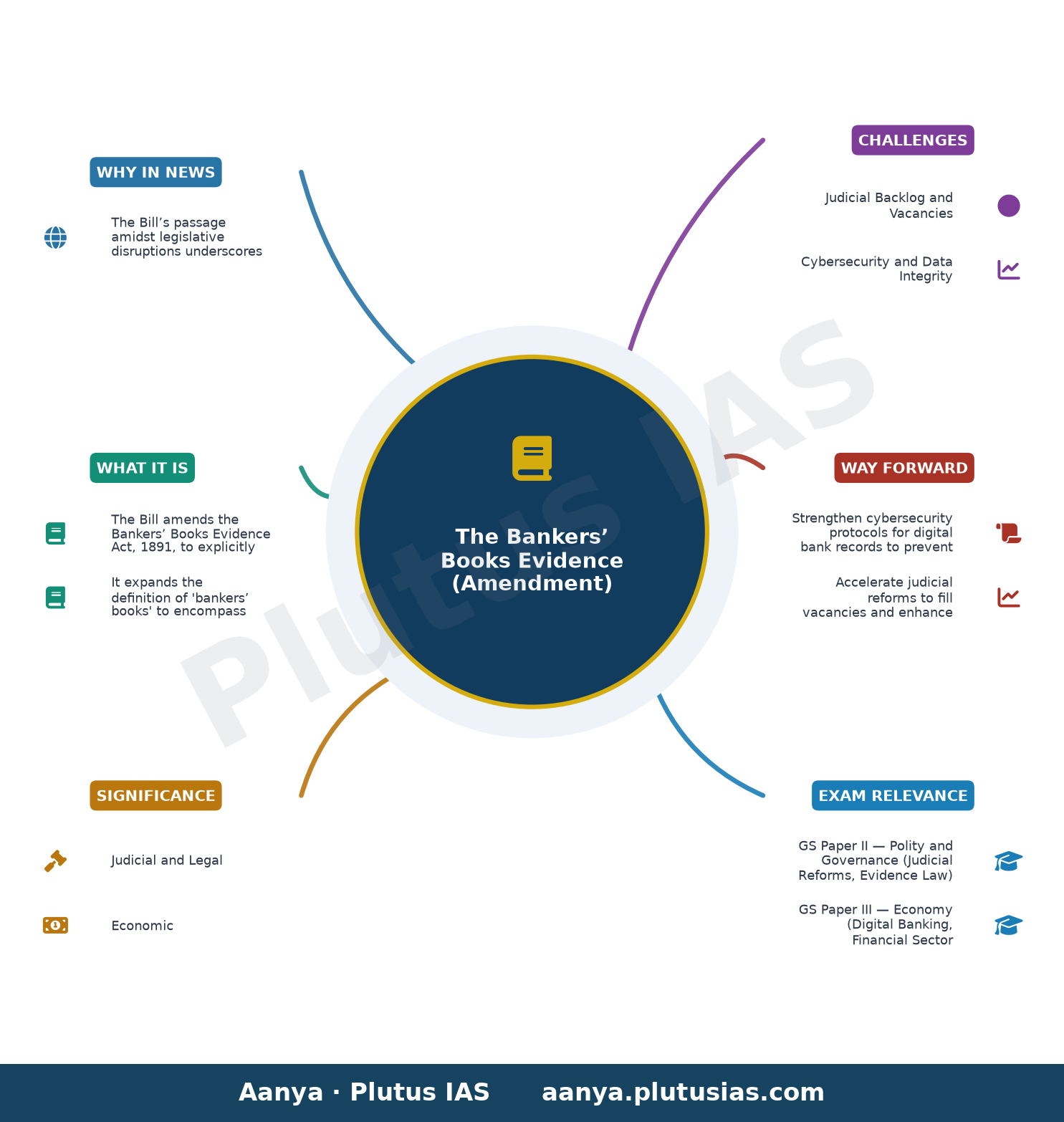
✎ The Bill’s passage amidst legislative disruptions underscores its significance in aligning India’s financial sector with global digital standards while addressing judicial bottlenecks in financial litigation.
Subject Relevance — Where This Topic Fits
- GS Paper II — Polity and Governance (Judicial Reforms, Evidence Law) | GS Paper III — Economy (Digital Banking, Financial Sector Reforms)
- Prelims: Bankers’ Books Evidence Act, 1891, Admissibility of Digital Evidence, Section 34 of the Evidence Act, 1872, Judicial Reforms in India, Digital Banking Records, Supreme Court (Number of Judges) Act, 1956
- Essay: The interplay between technological advancement and legal frameworks in modern governance, Judicial efficiency and the necessity of digital evidence in contemporary legal proceedings
Why is this in the news?
The Bill’s passage amidst legislative disruptions underscores its significance in aligning India’s financial sector with global digital standards while addressing judicial bottlenecks in financial litigation.
Background
- The Bankers’ Books Evidence Act, 1891, originally framed in the colonial era, governs the admissibility of bank records as evidence in legal proceedings, primarily in physical form.
- With the exponential growth of digital banking, fintech innovations, and electronic financial transactions, the existing legal framework has become inadequate to address modern evidentiary requirements.
- The Act’s archaic provisions did not explicitly recognise digital records, leading to legal ambiguities in cases involving cyber fraud, digital loans, or electronic banking transactions.
- The Supreme Court of India, in *Anvar P.V. v. P.K. Basheer* (2014), emphasised strict adherence to the Indian Evidence Act, 1872, for digital evidence, creating a need for legislative clarity.
- The Bill aligns with global trends, such as the UK’s Electronic Communications Act, 2000, and the EU’s eIDAS Regulation, which recognise digital signatures and records as legally valid.
- The amendment is part of broader judicial reforms aimed at reducing pendency in financial disputes, particularly in cases involving banks, NBFCs, and digital lenders.
What is the Bankers’ Books Evidence (Amendment) Bill, 2026?
- The Bill amends the Bankers’ Books Evidence Act, 1891, to explicitly include digital and electronic bank records—such as transaction logs, e-statements, and digital signatures—as admissible evidence in courts.
- It expands the definition of ‘bankers’ books’ to encompass records maintained in electronic, optical, or magnetic form, ensuring parity with physical records under the Act.
- The amendment empowers courts to admit digital evidence without requiring physical production of ledgers or books, subject to authentication under the Indian Evidence Act, 1872.
- It introduces safeguards to prevent misuse, such as mandatory certification of digital records by authorised bank officials and adherence to the Information Technology Act, 2000.
- The Bill addresses challenges in financial litigation, including loan recovery cases, fraud detection, and disputes involving digital payment platforms and neo-banks.
- It harmonises India’s banking laws with the Reserve Bank of India’s (RBI) push for a cashless, digital economy and the government’s Digital India initiative.
- The amendment is expected to expedite judicial proceedings by reducing reliance on cumbersome physical record production and enabling faster dispute resolution in financial matters.
- Critics argue that the Bill lacks robust data protection provisions, potentially exposing sensitive financial data to misuse, despite the IT Act’s safeguards.
Key Features
| Feature | Significance |
|---|---|
| Recognition of digital bank records as admissible evidence | Facilitates modernisation of legal processes by incorporating electronic records, reducing reliance on physical documents. |
| Amendment to the Bankers’ Books Evidence Act, 1891 | Expands the scope of the Act to include digital and virtual records, aligning with contemporary banking practices. |
| Voice vote passage in Lok Sabha | Demonstrates procedural efficiency despite disruptions, though it underscores the need for structured debate. |
| Exclusion of debate due to protests | Highlights parliamentary disruption, raising concerns about the quality of legislative scrutiny. |
Why it Matters
Judicial and Legal
- Enhances the evidentiary value of digital bank records, reducing litigation delays in financial disputes.
- Strengthens the legal framework for cyber-enabled financial crimes and digital frauds.
- Aligns Indian evidence law with global standards, such as the UNCITRAL Model Law on Electronic Commerce.
Economic
- Supports the growth of digital banking and fintech ecosystems by providing legal certainty to electronic records.
- Reduces transaction costs and operational inefficiencies in financial institutions by eliminating the need for physical documentation.
Parliamentary and Procedural
- Expedites legislative processes but risks undermining democratic deliberation when debates are bypassed.
- Illustrates the impact of political disruptions on legislative functioning and policy implementation.
Challenges
1. Judicial Backlog and Vacancies
- High vacancy rates in higher judiciary (e.g., 30% in High Courts) impede timely disposal of cases involving digital evidence.
- Limited representation of women in the judiciary (14%) may affect sensitivity to digital financial crimes.
UPSC Link: Judicial reforms and pendency
2. Cybersecurity and Data Integrity
- Risk of tampering or manipulation of digital bank records necessitates robust authentication mechanisms.
- Dependence on third-party digital platforms (e.g., cloud storage) introduces vulnerabilities to cyber threats.
UPSC Link: Cybersecurity and financial crimes
3. Parliamentary Disruptions
- Frequent disruptions obstruct structured legislative scrutiny, compromising the quality of enacted laws.
- Normalisation of protests risks eroding institutional decorum and procedural integrity.
UPSC Link: Parliamentary functioning and ethics
Challenges — UPSC Perspective
| Issue | Concern |
|---|---|
| Digital Evidence Authenticity | Ensuring unaltered and tamper-proof digital records for court admissibility. |
| Judicial Capacity | Inadequate infrastructure and manpower to handle complex digital financial litigation. |
| Regulatory Gaps | Lack of standardised protocols for digital record-keeping across banks and financial institutions. |
| Public Trust | Perception of judicial bias or inefficiency in handling digital evidence cases. |
Way Forward
- Strengthen cybersecurity protocols for digital bank records to prevent tampering and ensure evidentiary integrity.
- Accelerate judicial reforms to fill vacancies and enhance capacity for digital evidence adjudication.
- Establish specialised benches in High Courts to expedite cases involving digital financial crimes.
- Conduct capacity-building programmes for judges and legal professionals on digital evidence handling.
- Promote inter-ministerial coordination to develop a unified framework for digital record-keeping standards.
- Encourage public-private partnerships to enhance digital forensic capabilities in financial institutions.
- Review parliamentary procedures to minimise disruptions and ensure structured legislative debates.
UPSC Value Addition
Keywords for Mains Answer-Writing
Bankers’ Books Evidence Bill, 2026 · admissibility of digital evidence · Electronic Evidence Act, 2023 · Section 65B of the Indian Evidence Act, 1872 · judicial reforms · Supreme Court judge strength · Parliamentary disruption · judicial vacancies · High Court judges’ representation · right to fair trial · procedural fairness in evidence · digital transformation of banking · evidentiary standards in courts
Constitutional & Policy Linkages
- [‘Article 21 (Right to Life and Personal Liberty)’, ‘Protection against arbitrary denial of digital financial rights.’]
- [‘Article 14 (Equality before Law)’, ‘Ensuring non-discriminatory access to justice for digital evidence cases.’]
Concept Flow
Digital transformation in banking -> Need for legal recognition of digital records -> Amendment to Bankers’ Books Evidence Act, 1891 -> Admissibility of digital bank records in courts -> Enhanced judicial scrutiny of financial disputes -> Requirement for cybersecurity and judicial reforms.
Prelims Practice Questions
Q1. Consider the following statements regarding the Bankers’ Books Evidence Bill, 2026:
1. The Bill seeks to amend the Indian Evidence Act, 1872 to include digital bank records as admissible evidence.
2. Section 65B of the Indian Evidence Act, 1872 already provides for the admissibility of electronic records.
3. The Bill is aimed at reducing the burden on courts by eliminating the need for physical bank records.
4. The Bill proposes to replace the Indian Evidence Act, 1872 entirely with a new statute governing electronic evidence.
How many of the above statements are correct?
- Only one
- Only two
- Only three
- All
Answer: Only three — Statements 1 and 2 are correct. The Bill amends the Indian Evidence Act to include digital bank records, and Section 65B already addresses electronic records. Statements 3 and 4 are incorrect as the Bill does not aim to reduce the burden by eliminating physical records nor does it propose to replace the Act entirely.
Q2. Assertion (A): The Bankers’ Books Evidence Bill, 2026, recognises digital bank records as admissible evidence in courts.
Reason (R): The Bill is necessitated by the increasing digitalisation of banking operations and the need to align with modern evidentiary standards.
In the context of the above two statements, which one of the following is correct?
- Both A and R are true, and R is the correct explanation of A.
- Both A and R are true, but R is not the correct explanation of A.
- A is true, but R is false.
- A is false, but R is true.
Answer: Both A and R are true, but R is not the correct explanation of A. — Both the Assertion (A) and Reason (R) are true. The Bill indeed recognises digital bank records as admissible evidence, and the Reason correctly explains the necessity for such recognition due to digitalisation in banking.
Q3. Match the following provisions with their corresponding legal frameworks:
Column I (Provision)
1. Admissibility of electronic records
2. Number of Supreme Court judges
3. Vacancies in High Courts
4. Parliamentary disruption during Monsoon Session
Column II (Legal Framework/Context)
A. Indian Evidence Act, 1872
B. Constitution of India (Article 124)
C. Judiciary-related data
D. Parliamentary proceedings
- {‘1-A, 2-B, 3-C, 4-D’: ‘Correct’}
- {‘1-B, 2-A, 3-D, 4-C’: ‘Incorrect’}
- {‘1-C, 2-D, 3-A, 4-B’: ‘Incorrect’}
- {‘1-D, 2-C, 3-B, 4-A’: ‘Incorrect’}
Answer: {‘1-A, 2-B, 3-C, 4-D’: ‘Correct’} — The correct match is: 1-A (Section 65B of the Indian Evidence Act, 1872 governs admissibility of electronic records), 2-B (Article 124 of the Constitution specifies the number of Supreme Court judges), 3-C (Judiciary-related data includes vacancies in High Courts), and 4-D (Parliamentary disruption relates to proceedings in Parliament).
Mains Practice Question
✍ The Bankers’ Books Evidence Bill, 2026, seeks to recognise digital bank records as admissible evidence in courts. Critically examine the implications of this legislative measure on the Indian judicial system and the principles of procedural fairness. Also, analyse how this Bill aligns with the existing legal framework governing electronic evidence under the Indian Evidence Act, 1872. (15 Marks)
Approach: MODEL-ANSWER SKELETON:
1. **Introduction**: Briefly state the objective of the Bankers’ Books Evidence Bill, 2026, and its significance in the context of digital transformation in banking.
2. **Admissibility of Digital Evidence**:
– Explain the current legal position under Section 65B of the Indian Evidence Act, 1872, which already provides for the admissibility of electronic records.
– Highlight the specific provisions of the Bill that expand the scope to include digital bank records.
3. **Implications for the Judicial System**:
– **Efficiency**: Discuss how digital evidence can expedite judicial proceedings by reducing reliance on physical records.
– **Challenges**: Address concerns such as authenticity, tampering, and the need for robust authentication mechanisms.
– **Procedural Fairness**: Examine whether the Bill ensures procedural fairness, including the right to cross-examine evidence and the burden of proof.
4. **Alignment with Existing Legal Framework**:
– Compare the Bill with Section 65B and other relevant provisions (e.g., Information Technology Act, 2000).
– Discuss whether the Bill introduces any conflicts or redundancies with existing laws.
5. **Judicial Precedents and Comparative Analysis**:
– Cite recent Supreme Court judgments (e.g., Arjun Panditrao Khotkar v. Kailash Kushanrao Gorantyal, 2020) that have interpreted Section 65B.
– Briefly compare India’s approach with global standards (e.g., UK’s Civil Evidence Act, 1995 or US Federal Rules of Evidence).
6. **Conclusion**:
– Summarise the potential benefits and challenges of the Bill.
– Provide a balanced view on whether the Bill strikes the right balance between technological advancement and legal safeguards.
Source: The Indian Express
Generated by AanyaAi for educational purpose.

- सुप्रीम कोर्ट ने चुनाव आयोग को दिल्ली में ‘यांत्रिक’ SIR नोटिस पर सावधानियां बरतने को कहा - September 22, 2026
- ‘स्वच्छता ही सेवा-2026’ अभियान: सरकारी विभागों में स्वच्छता क्रांति, जानिए मुख्य बिंदु - September 22, 2026
- DFPD Launches ‘Swachhata Hi Seva-2026’ Campaign for Clean India Mission - September 22, 2026

No Comments