


11 Aug Lok Sabha Passes Bill to Rename Kerala as Keralam Amid Opposition Protests
✎ The renaming of a State in India requires a resolution from the State Legislature, a bill passed by Parliament, and the President’s assent.
Subject Relevance — Where This Topic Fits
- GS Paper II — Polity and Governance | GS Paper II — Constitutional Framework
- Prelims: Article 3 of the Constitution, First Schedule of the Constitution, State Reorganisation Act, 1956, Parliamentary procedures for constitutional amendments, Malayalam language and linguistic identity, Keralam vs Kerala nomenclature, Voice vote in Parliament, Role of State Legislatures in name changes
- Essay: The interplay between linguistic identity and constitutional governance in India, Federalism and cooperative federalism: Centre-State relations in constitutional amendments
Quick Revision: The renaming of a State in India requires a resolution from the State Legislature, a bill passed by Parliament, and the President’s assent.
Why is this in the news?
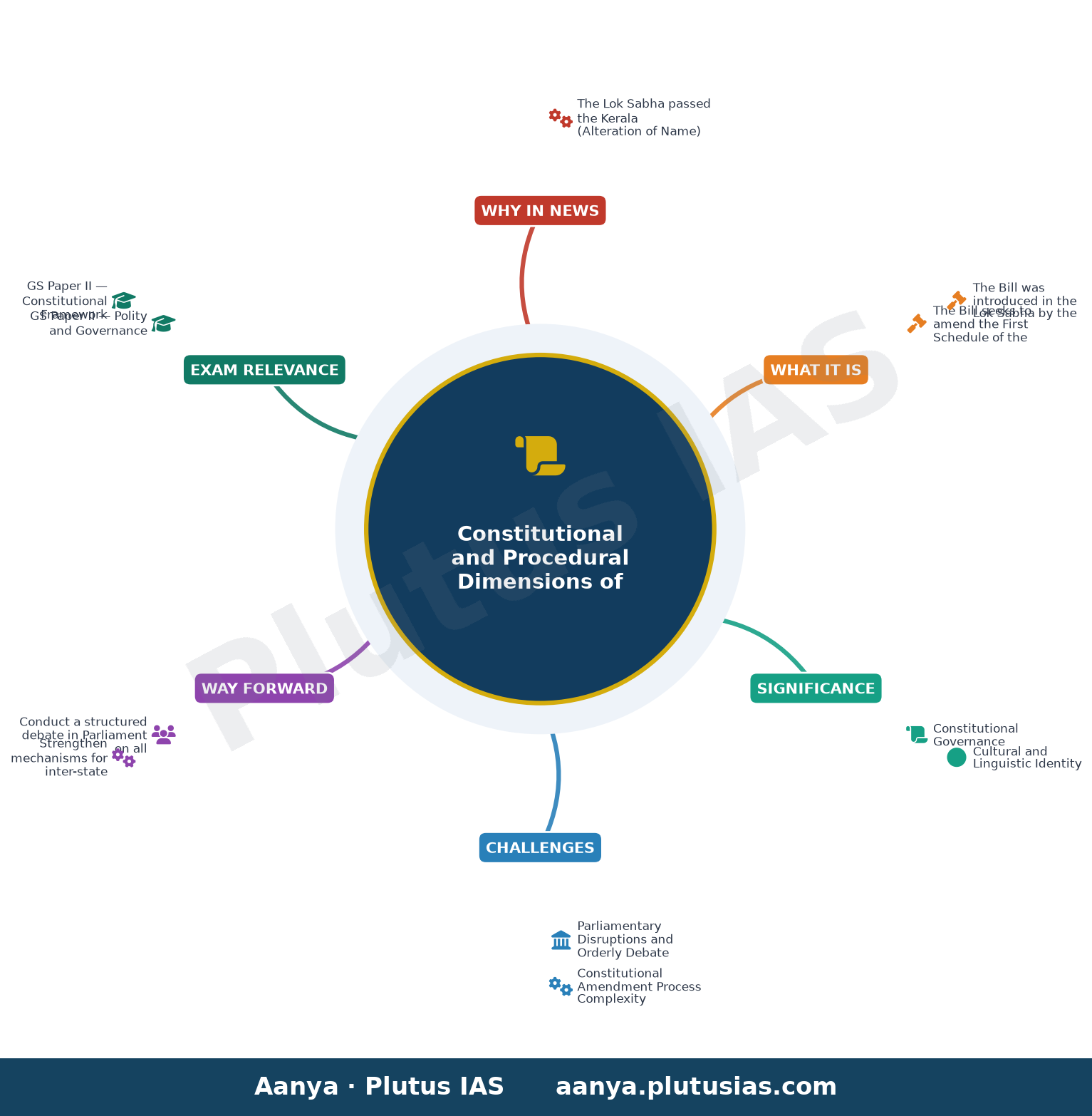
The Lok Sabha passed the Kerala (Alteration of Name) Bill, 2026, renaming the state from ‘Kerala’ to ‘Keralam’ by voice vote amid Opposition protests. This development underscores the procedural and constitutional mechanisms governing state name changes in India, as well as the broader implications for federalism and parliamentary functioning. The Bill’s passage, without debate, also highlights the procedural norms and disruptions in parliamentary proceedings, warranting analysis of constitutional provisions and institutional practices.
Background
- The State of Kerala was formed on 1 November 1956, under the States Reorganisation Act, 1956, based on linguistic identity (Malayalam-speaking regions).
- The name ‘Kerala’ was adopted in the First Schedule of the Constitution, which lists the names and territories of States.
- The Kerala Legislative Assembly adopted a unanimous resolution on 24 June 2024, requesting the central government to initiate the procedure to rename the state to ‘Keralam’, reflecting its Malayalam nomenclature.
- Article 3 of the Constitution empowers Parliament to form new States, alter boundaries, or change the name of any State, subject to the President’s prior recommendation.
- The procedure requires the State Legislature to pass a resolution requesting the change, followed by a bill introduced in Parliament.
- The Bill’s passage by voice vote, without debate, reflects procedural norms but also raises questions about the quality of legislative scrutiny in Parliament.
What is the Kerala (Alteration of Name) Bill, 2026?
- The Bill seeks to amend the First Schedule of the Constitution to replace ‘Kerala’ with ‘Keralam’, aligning the state’s official nomenclature with its Malayalam linguistic identity.
- The Bill was introduced in the Lok Sabha by the Minister of State for Home Affairs, Nityanand Rai, following a resolution passed by the Kerala Legislative Assembly.
- The Bill’s Statement of Objects and Reasons notes that ‘Keralam’ is the correct Malayalam rendering of the state’s name, and the change is intended to reflect linguistic and cultural identity.
- The Bill, once passed by both Houses of Parliament and ratified by the President, will come into force as per the constitutional process.
- The Bill does not alter the territorial boundaries of the state; it only changes its name in the constitutional records.
- The passage of the Bill by voice vote, without debate, is procedurally valid but raises questions about the depth of parliamentary scrutiny.
- The Bill is part of a broader trend of linguistic and cultural reassertion in Indian federalism, where states seek to align their official nomenclature with local linguistic identities.
Key Features
| Feature | Significance |
|---|---|
| Constitutional Amendment Process | The Bill seeks to amend the First Schedule of the Constitution (Article 3), necessitating parliamentary approval for renaming a state, which is a constitutional procedure governed by Article 3 of the Indian Constitution. |
| State Legislative Assembly Resolution | The Kerala Legislative Assembly passed a unanimous resolution on 24 June 2024, formally requesting the central government to initiate the name change process, demonstrating democratic consensus at the state level. |
| Voice Vote Passage | The Bill was passed by voice vote in the Lok Sabha without debate, indicating procedural efficiency but raising questions about the absence of deliberative discussion on the matter. |
| Consequential Amendments | The Bill includes provisions for consequential amendments to the Constitution, ensuring legal consistency across all references to the state’s name in constitutional and statutory documents. |
| Procedural Disruptions | The passage of the Bill occurred amid Opposition sloganeering and disruptions, highlighting challenges in maintaining orderly parliamentary proceedings and constructive debate. |
Why it Matters
Constitutional Governance
- The renaming of a state is a rare constitutional exercise, governed by Article 3 of the Constitution, which empowers Parliament to alter the name of a state by law.
- The process underscores the federal structure of India, where state governments initiate such requests, and the central government facilitates the constitutional amendment.
- The absence of debate in the Lok Sabha, despite the procedural correctness, raises questions about the quality of parliamentary discussions on matters of state identity and governance.
Cultural and Linguistic Identity
- The name ‘Keralam’ is the Malayalam-language denomination of the state, reflecting its linguistic and cultural heritage, as acknowledged in the Kerala Legislative Assembly resolution.
- The renaming aligns with the historical and linguistic identity of the Malayalam-speaking people, who have long advocated for a united Kerala (Keralam).
- Such name changes often serve as symbolic affirmations of regional identity, particularly in states with strong linguistic or cultural movements.
Parliamentary Procedure
- The passage of the Bill by voice vote without debate contrasts with the Speaker’s earlier concern over disruptions, highlighting the tension between procedural efficiency and the need for substantive discussion.
- The absence of the Union Home Minister during the introduction of the Bill, despite being scheduled to move it, raises questions about executive accountability in parliamentary proceedings.
- The repeated passage of Bills without debate in the current session reflects broader challenges in maintaining orderly and deliberative legislative processes.
Federalism and Centre-State Relations
- The initiative demonstrates the collaborative nature of centre-state relations, where a state-led demand for a constitutional amendment is processed through parliamentary approval.
- The process exemplifies how federalism in India accommodates regional aspirations while maintaining constitutional uniformity.
Challenges
1. Parliamentary Disruptions and Orderly Debate
- Frequent disruptions in the Lok Sabha impede the passage of Bills through meaningful debate, undermining the legislature’s role in scrutinising legislation.
- The lack of discussion on the Kerala (Alteration of Name) Bill, despite its constitutional significance, raises concerns about the erosion of deliberative democracy.
- Speaker’s interventions, while necessary, highlight the need for sustained efforts to restore order and constructive engagement in parliamentary proceedings.
UPSC Link: GS-II: Parliament and State Legislatures
2. Constitutional Amendment Process Complexity
- Amending the First Schedule of the Constitution requires a multi-step process, including state legislative approval, central government initiation, and parliamentary passage, which can be time-consuming.
- The absence of debate in the Lok Sabha, despite the procedural correctness, may lead to perceptions of procedural formalism over substantive governance.
- Ensuring that all stakeholders—state governments, Parliament, and citizens—are adequately informed and consulted remains a challenge in such amendments.
UPSC Link: GS-II: Constitutional Amendments
3. Linguistic and Cultural Symbolism
- Balancing linguistic identity with national unity is a delicate task, as name changes can sometimes be perceived as divisive or exclusionary by non-Malayalam-speaking populations.
- Ensuring that the renaming does not lead to unintended political or social consequences requires careful communication and consensus-building at all levels.
UPSC Link: GS-I: Social Empowerment
4. Executive Accountability in Parliamentary Proceedings
- The absence of the Union Home Minister during the introduction of the Bill, despite being scheduled to move it, raises questions about executive accountability and adherence to parliamentary norms.
- Ministers of State moving Bills in the absence of senior ministers may lead to perceptions of reduced executive engagement in legislative processes.
UPSC Link: GS-II: Role of the Executive
Challenges — UPSC Perspective
| Issue | Concern |
|---|---|
| Lack of Debate on Constitutional Amendments | Undermines the legislature’s role in scrutinising significant constitutional changes, potentially leading to procedural formalism. |
| Frequent Disruptions in Parliament | Impedes the passage of Bills through meaningful discussion, eroding the quality of legislative deliberations. |
| State-Centre Coordination | Ensuring seamless collaboration between state governments and the central government in processing constitutional amendments remains a challenge. |
| Public Perception and Symbolism | Balancing linguistic identity with national unity, particularly in diverse linguistic states, requires careful handling to avoid unintended social or political consequences. |
| Executive Engagement in Parliament | The absence of senior ministers during critical legislative proceedings may raise questions about executive accountability and adherence to parliamentary norms. |
| Procedural Efficiency vs. Deliberative Democracy | Striking a balance between passing legislation efficiently and ensuring thorough debate remains a persistent challenge in parliamentary democracy. |
Way Forward
- Conduct a structured debate in Parliament on all constitutional amendment Bills to ensure thorough scrutiny and public accountability.
- Strengthen mechanisms for inter-state consultations to facilitate smoother processing of state-led demands for constitutional amendments.
- Enhance parliamentary discipline by implementing stricter norms for maintaining order during sessions, including time-bound discussions on significant Bills.
- Develop a public information campaign to explain the rationale and implications of constitutional amendments, particularly those involving state identity.
- Encourage the presence of senior ministers in Parliament during the introduction and passage of critical Bills to uphold executive accountability.
- Establish a dedicated committee to review and streamline the process of constitutional amendments, ensuring timely and transparent execution.
- Promote awareness among citizens about the federal structure of India and the role of state governments in initiating such amendments.
UPSC Value Addition
Keywords for Mains Answer-Writing
Article 3 of the Constitution · First Schedule of the Constitution · Procedure for renaming a State · Constitutional amendment for State name change · Role of Parliament in State name alteration · State Legislative Assembly resolution · Keralam (Malayalam nomenclature) · Constitutional provisions for State reorganisation · Parliamentary procedure for legislative business · Voice vote in Lok Sabha · Disruption of legislative proceedings · Constitutional amendments and consequential provisions
Constitutional & Policy Linkages
- Article 3: Alteration of name of a State
- First Schedule: List of States and Union Territories
Concept Flow
State Legislative Assembly passes resolution requesting name change (Kerala Legislative Assembly, 24 June 2024) → State government approaches central government to initiate constitutional amendment → Central government introduces Bill in Parliament (Kerala (Alteration of Name) Bill, 2026) → Lok Sabha passes Bill by voice vote → Rajya Sabha to consider and pass the Bill → President of India gives assent → Constitutional amendment notified in the Gazette of India → Name change officially recorded in the First Schedule of the Constitution
Prelims Practice Questions
Q1. Consider the following statements regarding the procedure for altering the name of a State in India:
1. The State Legislative Assembly must adopt a resolution for the name change.
2. The Parliament must amend the First Schedule of the Constitution under Article 3.
3. The President of India must give prior consent before the Parliament can consider the amendment.
4. The name change requires a special majority in both Houses of Parliament.
How many of the above statements are correct?
- Only one
- Only two
- Only three
- All
Answer: Only three — Statements 1 and 2 are correct as they align with the constitutional process. Statement 3 is incorrect because the President’s role is limited to giving assent after Parliament’s approval, not prior consent. Statement 4 is incorrect as a simple majority in Parliament suffices for such amendments under Article 3.
Q2. Assertion (A): The Kerala (Alteration of Name) Bill, 2026, was passed by voice vote in the Lok Sabha without any discussion.
Reason (R): The Bill sought to amend the First Schedule of the Constitution, which requires a special majority in Parliament.
Options:
A. Both A and R are true, and R is the correct explanation of A.
B. Both A and R are true, but R is not the correct explanation of A.
C. A is true, but R is false.
D. A is false, but R is true.
Answer: ? — Assertion (A) is true as the Bill was passed by voice vote without discussion. Reason (R) is false because amendments to the First Schedule under Article 3 require only a simple majority, not a special majority.
Q3. Match the following pairs with their correct constitutional provisions:
Column I (Provision) | Column II (Article/Schedule)
1. Alteration of name of a State | A. Article 3
2. Special provisions for certain States | B. Fifth Schedule
3. Administration of Union Territories | C. Article 239
4. Emergency provisions | D. Article 356
Options:
A. 1-A, 2-B, 3-C, 4-D
B. 1-B, 2-A, 3-D, 4-C
C. 1-C, 2-D, 3-A, 4-B
D. 1-D, 2-C, 3-B, 4-A
- A
- B
- C
- D
Answer: A — 1-A (Article 3 empowers Parliament to alter the name of a State), 2-B (Fifth Schedule deals with special provisions for certain States), 3-C (Article 239 governs the administration of Union Territories), 4-D (Article 356 deals with emergency provisions).
Mains Practice Question
✍ The Parliament of India, through a voice vote, passed the Kerala (Alteration of Name) Bill, 2026, to rename the State of Kerala as ‘Keralam’. Examine the constitutional and procedural dimensions of such State name alterations in India. Also, analyse the implications of frequent disruptions in legislative proceedings on the functioning of Parliament. (15 Marks)
Approach: MODEL-ANSWER SKELETON:
1. Constitutional Basis for State Name Alteration:
– Article 3 of the Constitution: Power of Parliament to form new States, alter areas, boundaries, or names of existing States.
– First Schedule of the Constitution: Lists the names of States; any alteration requires a constitutional amendment.
– Role of the State Legislative Assembly: Resolution adopted by the Kerala Assembly on 24 June 2024, requesting the name change.
– Parliamentary Procedure: Bill introduced in Lok Sabha, passed by voice vote (simple majority required under Article 3).
2. Steps Involved in the Process:
– State Assembly resolution (unanimous in this case).
– Central Government initiates the Bill in Parliament.
– Constitutional amendment to the First Schedule.
– President’s assent (mandatory under Article 368 for amendments).
3. Implications of Legislative Disruptions:
– Erosion of deliberative democracy: Disruptions hinder constructive debate and scrutiny of Bills.
– Impact on legislative productivity: 11 Bills passed without debate in the current session.
– Constitutional safeguards: Article 105 (freedom of speech in Parliament) balanced with Article 118 (rules of procedure).
– Speaker’s role: Om Birla’s concern over repeated disruptions and call for common ground.
4. Broader Governance Perspective:
– Importance of parliamentary decorum in maintaining institutional credibility.
– Need for structured Opposition participation to ensure accountability.
– Consequences of unchecked disruptions: Delay in legislative agenda, erosion of public trust in Parliament.
5. Comparative Insight (Optional for higher marks):
– Contrast with other federal systems (e.g., USA, Canada) where State name changes require legislative approval but not necessarily a constitutional amendment.
Balance of Views:
– Proponents argue for efficiency in passing Bills without disruptions.
– Critics highlight the need for robust debate to ensure Bills are well-scrutinised.
Conclusion:
– State name alterations are a procedural matter under Article 3, but their execution must uphold parliamentary norms. Frequent disruptions risk undermining the legislature’s role as a deliberative body.
Source: Mint
Generated by AanyaAi for educational purpose.

- KWML’s Feasibility Reports for Water Metro in 18 Cities: UPSC & PCS Insights - October 3, 2026
- ओडिशा में वन्यजीव अनुसंधान अनुदान कार्यक्रम शुरू, सिमिलिपाल में 300 कैमरे और बढ़ेंगे - October 3, 2026
- India Summons Pakistan High Commission Official Over Violation - October 3, 2026

No Comments