


29 Jul Lok Sabha Passes Coal Mines Bill: Key Provisions & Opposition Concerns
Subject Relevance — Where This Topic Fits
- GS Paper III — Economy: Resource Mobilisation, Coal Sector Reforms, Auction Mechanisms, and Energy Security | GS Paper II — Polity and Governance: Legislative Processes, Parliamentary Scrutiny, and Federalism in Resource Allocation
- Prelims: Coal Mines (Special Provisions) Act, 2015, Supreme Court’s 2014 coal block allocation cancellation verdict, Auction of coal blocks, Coal India Limited (CIL), Singareni Collieries Company Limited (SCCL), End-use criteria in coal block allocation, Departmental Standing Committee, Ordinance route for legislative action, Federalism and state ownership of minerals, Power sector and coal deficit
- Essay: India’s energy security: Balancing coal dependence with environmental sustainability, Federalism in resource governance: Centre-State relations in mineral allocation
Quick Revision: The Coal Mines (Special Provisions) Act, 2015, replaced the Ordinance and provides the legal framework for re-auctioning 204 coal blocks de-allocated by the Supreme Court, with proceeds accruing to state governments and end-use criteria subject to central government specifications.
Why is this in the news?
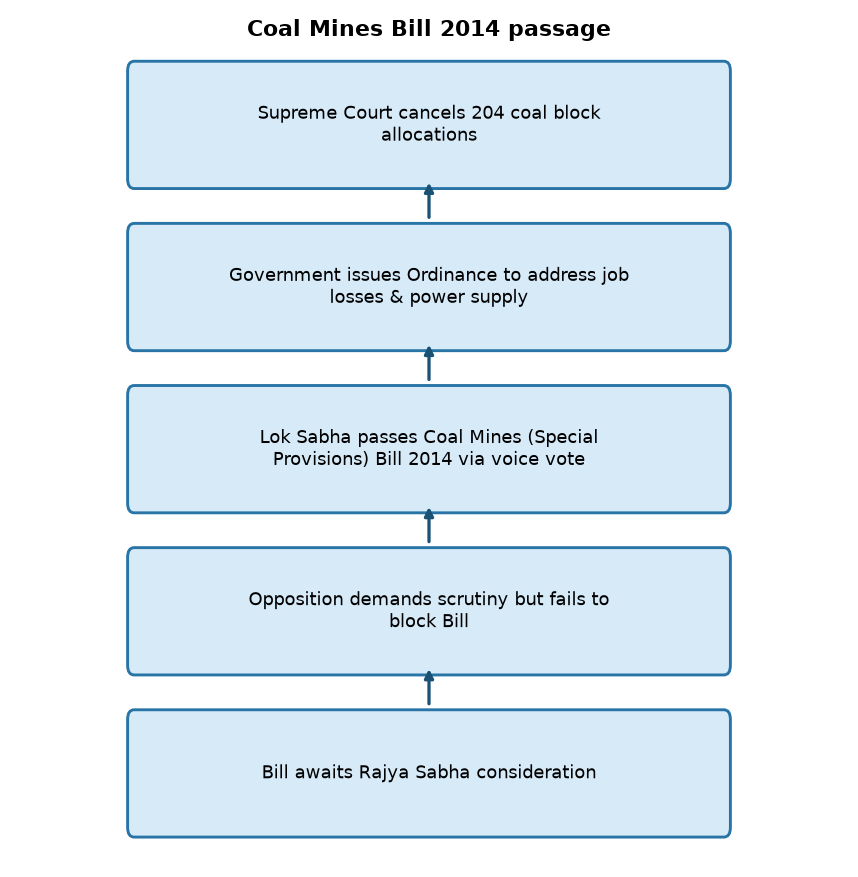
The Lok Sabha’s passage of the Coal Mines (Special Provisions) Bill, 2014, marks a critical legislative response to the Supreme Court’s 2014 verdict cancelling the allocation of 204 coal blocks. The Bill seeks to facilitate the re-auction of these de-allocated blocks, addressing concerns of job losses, power supply disruptions, and revenue generation for state governments. The debate surrounding the Bill highlights tensions between legislative expediency, parliamentary scrutiny, and the need for transparent, equitable resource governance in India’s coal sector.
Background
- In 2014, the Supreme Court of India, in its landmark judgment in *Manohar Lal Sharma v. The Principal Secretary & Ors.*, cancelled the allocation of 204 coal blocks allocated since 1993 on the grounds of arbitrariness and lack of transparency, citing violations of Article 14 (Right to Equality) of the Constitution.
- The cancellation led to a significant disruption in coal supply, exacerbating the coal deficit in India’s power sector, which relies heavily on coal for over 70% of its electricity generation.
- To address the resultant crisis, the government promulgated the Coal Mines (Special Provisions) Ordinance, 2014, to enable the re-auction of these blocks while ensuring continuity of coal supply and minimising economic disruptions.
- The Ordinance was subsequently replaced by the Coal Mines (Special Provisions) Bill, 2014, which was introduced in the Lok Sabha on December 10, 2014, and has since undergone multiple iterations to address parliamentary concerns.
- The Bill assumes significance in the context of India’s energy transition, where coal remains a dominant fuel despite growing emphasis on renewable energy sources.
- The debate on the Bill reflects broader tensions between the Centre and states over the ownership and control of mineral resources, as coal-bearing states stand to gain significant revenue from the auction proceeds.
What is the Coal Mines (Special Provisions) Bill, 2014?
- The Coal Mines (Special Provisions) Bill, 2014, is a legislative measure designed to facilitate the re-auction of 204 coal blocks de-allocated by the Supreme Court in 2014, ensuring legal continuity and operational feasibility for coal mining activities.
- The Bill seeks to replace the Coal Mines (Special Provisions) Ordinance, 2014, which was promulgated to address the immediate crisis arising from the Supreme Court’s cancellation of coal block allocations, thereby preventing disruptions in coal supply to the power sector.
- Key provisions of the Bill include mechanisms for the grant of mining leases, composite licences, and end-use criteria for coal block allocation, with a focus on transparency and competitive bidding to maximise revenue for state governments.
- The Bill empowers the Central Government to specify end-use criteria for coal blocks, including ‘any other use as may be specified,’ which has been criticised for potentially introducing discretionary practices and undermining transparency.
- The legislation mandates that proceeds from the auction of coal blocks shall accrue to the state governments where the blocks are located, reflecting the constitutional principle of federalism and the state’s ownership of minerals under the Seventh Schedule of the Constitution.
- The legislative process has been marked by debates on the need for parliamentary scrutiny, with Opposition parties initially demanding a referral to the Departmental Standing Committee, though this demand was not sustained in the Lok Sabha.
- The Bill is part of a broader framework of coal sector reforms aimed at improving efficiency, reducing the coal deficit, and ensuring scientific and cost-effective mining practices.
UPSC Value Addition
Keywords for Mains Answer-Writing
Coal Mines (Special Provisions) Bill, 2014 · Supreme Court order on coal block allocations · Commercial mining of coal · Coal India Limited (CIL) · Auction mechanism for coal blocks · End-use clause in coal policy · Departmental Standing Committee · Power sector reforms · Resource nationalism in natural resources · Federalism and mineral resource ownership
Prelims Practice Questions
Q1. Consider the following statements regarding the Coal Mines (Special Provisions) Bill, 2014:
1. The Bill seeks to provide for the fresh auction of 204 coal blocks de-allocated by the Supreme Court.
2. The Bill mandates that all coal blocks must be allocated to Coal India Limited (CIL) only.
3. The Bill includes provisions to improve the working conditions of coal miners.
4. The Bill allows for the auction of coal blocks for both regulated and unregulated entities.
How many of the above statements are correct?
- Only one
- Only two
- Only three
- All
Answer: Only three — Statements 1 and 4 are correct. Statement 2 is incorrect as the Bill does not mandate allocation to CIL only; it allows auction to other entities. Statement 3 is incorrect as the Bill does not include provisions to improve working conditions of coal miners.
Q2. Assertion (A): The Coal Mines (Special Provisions) Bill, 2014, was necessitated due to the Supreme Court’s order cancelling the allocation of 204 coal blocks.
Reason (R): The Supreme Court held that the coal block allocations made through the Screening Committee process were arbitrary and illegal.
Options:
A. Both A and R are true, and R is the correct explanation of A.
B. Both A and R are true, but R is not the correct explanation of A.
C. A is true, but R is false.
D. A is false, but R is true.
Answer: ? — Both A and R are true, and R correctly explains A. The Supreme Court’s 2014 order in the Coal Block Allocation case (2014) declared the allocations illegal, necessitating the Bill.
Q3. Match the following coal-related entities with their correct descriptions:
Column I
1. Coal India Limited (CIL)
2. Singareni Collieries Company Limited (SCCL)
3. Departmental Standing Committee
4. Commercial mining
Column II
A. A state-owned coal mining company in Telangana.
B. A parliamentary committee that examines bills referred to it.
C. A mining practice where coal is mined for sale in the open market rather than captive use.
D. A Maharatna public sector undertaking engaged in coal mining and production in India.
Answer: ? — 1-D, 2-A, 3-B, 4-C. CIL is India’s largest coal producer, SCCL is a state PSU in Telangana, the Departmental Standing Committee reviews bills, and commercial mining involves open-market sale.
Mains Practice Question
✍ Critically examine the constitutional and economic implications of the Coal Mines (Special Provisions) Bill, 2014, in the context of resource nationalism and federalism. Also, analyse the concerns raised by Opposition parties regarding the ‘end-use’ clause and its potential for discretionary practices. (15 Marks)
Approach: MODEL-ANSWER SKELETON:
1. **Introduction (2 Marks)**
– Briefly state the background: Supreme Court’s 2014 order cancelling 204 coal block allocations and the subsequent need for the Bill.
– Define key terms: resource nationalism, federalism, end-use clause.
2. **Constitutional Implications (5 Marks)**
– **Federalism**: Discuss the constitutional framework under Article 246 and the Seventh Schedule, which places minerals in the Concurrent List. Highlight the tension between central and state governments over ownership and revenue sharing.
– **End-use clause**: Explain the ambiguity in the clause (‘any other use as specified by the Central government’) and its potential to dilute transparency, citing critiques by Opposition leaders like Tatagatha Satpathy (BJD).
– **Parliamentary scrutiny**: Discuss the Opposition’s demand for referring the Bill to a Departmental Standing Committee and the government’s justification for urgency.
3. **Economic Implications (5 Marks)**
– **Resource nationalism**: Evaluate the Bill’s role in asserting state control over a critical natural resource (coal) while promoting commercial mining. Compare with previous policies (e.g., captive mining vs. commercial mining).
– **Revenue generation**: Analyse how auction mechanisms aim to maximise revenue for state governments, addressing the deficit in coal supply.
– **Job security and power sector**: Discuss the government’s assurance on job security and uninterrupted power supply, linking it to economic stability.
4. **Concerns and Criticisms (3 Marks)**
– **Discretionary practices**: Address the Opposition’s concerns about the end-use clause enabling discretionary allocations, citing examples of past controversies (e.g., coal scam).
– **Exclusion of labour welfare**: Highlight the lack of provisions for improving working conditions in coal mines, as pointed out by Jyotiraditya Scindia (Congress).
– **Balancing views**: Present the government’s counter-argument on strengthening Coal India Limited (CIL) and its role in the sector.
5. **Conclusion (2 Marks)**
– Summarise the Bill’s dual objectives: addressing the Supreme Court’s order while balancing economic growth and federal concerns.
– Offer a balanced view on whether the Bill achieves its goals without compromising transparency and accountability.
Source: The Hindu
Generated by AanyaAi for educational purpose.

- F-35 Stealth Fighter to Feature in India’s Tarang Shakti 2026 Exercise - September 22, 2026
- UPSC Civil Services (Main) Examination 2026 — Sindhi Devanagari Literature Paper II: Question Paper | Plutus IAS - September 22, 2026
- गूगल भी करेगा बाल यौन शोषण सामग्री की सीधे भारतीय अधिकारियों को रिपोर्टिंग - September 22, 2026

No Comments