


11 Aug Lok Sabha passes Kerala name change, co-op bills without debate amid stalemate
Lok SabhaBillsOppositionSpeaker✎ The Kerala (Alteration of Name) Bill, 2026 requires a simple majority in Parliament and the President's assent under Article 3, while the National Co-operative Development Corporation (Amendment) Bill, 2026 aims to strengthen the…
Subject Relevance — Where This Topic Fits
- GS Paper II — Parliament and State Legislatures — Structure, Functioning, Conduct of Business, Powers & Privileges and Issues Arising out of these | GS Paper II — Constitutional Framework, Amendment Process and Federalism
- Prelims: Lok Sabha, Rajya Sabha, Speaker of Lok Sabha, voice vote, adjournment sine die, Bill passage without debate, Article 3 of the Constitution, cooperative societies, cooperative federalism
- Essay: Parliamentary democracy: The balance between legislative efficiency and deliberative accountability, Federalism in India: State identity, nomenclature, and cooperative governance
Quick Revision: The Kerala (Alteration of Name) Bill, 2026 requires a simple majority in Parliament and the President’s assent under Article 3, while the National Co-operative Development Corporation (Amendment) Bill, 2026 aims to strengthen the cooperative sector’s regulatory and developmental framework.
Why is this in the news?
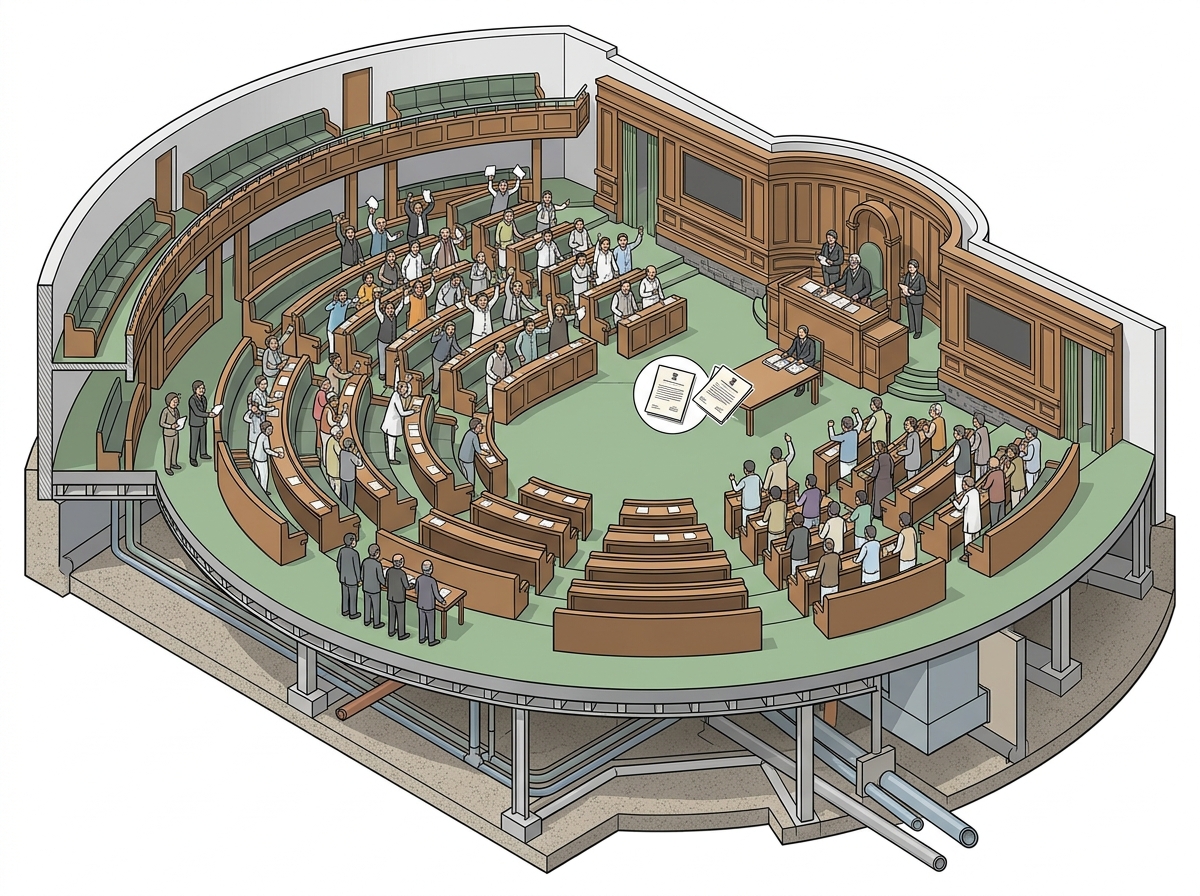
On 11 August 2026, during the Monsoon Session of Parliament, the Lok Sabha passed two Bills—the Kerala (Alteration of Name) Bill, 2026 and the National Co-operative Development Corporation (Amendment) Bill, 2026—without debate amid sustained disruptions by the Opposition. The procedural irregularity, marked by the use of voice votes and adjournments, underscores the tension between legislative productivity and the constitutional mandate for informed deliberation in parliamentary democracy.
Background
- The Monsoon Session of Parliament in 2026 has been marked by persistent disruptions, with the Opposition demanding statements from the Home Minister on alleged use of force against student protesters and financial irregularities related to the Ram Temple trust.
- The Speaker of the Lok Sabha adjourned the House twice on 11 August 2026 due to unruly protests, reflecting the procedural challenges in maintaining legislative order.
- The Kerala (Alteration of Name) Bill, 2026 seeks to rename the state from ‘Kerala’ to ‘Keralam’, invoking Article 3 of the Constitution, which empowers Parliament to alter the name of a state.
- The National Co-operative Development Corporation (Amendment) Bill, 2026 proposes amendments to the National Co-operative Development Corporation Act, 1962, aimed at enhancing the regulatory and developmental framework for cooperative societies in India.
- The passage of Bills without debate raises questions about the efficacy of parliamentary scrutiny and the balance between legislative efficiency and democratic accountability.
Key Aspects of the Bills and Parliamentary Procedure
- The Kerala (Alteration of Name) Bill, 2026: This Bill seeks to rename the state of Kerala to ‘Keralam’. The process involves a simple majority in Parliament, followed by the President’s assent. The Bill does not require ratification by state legislatures as it pertains to nomenclature rather than territorial reorganisation.
- Constitutional Provisions for State Name Change: Article 3 of the Constitution empowers Parliament to form a new state, alter the name, boundaries, or area of any state, or unite two or more states. The process requires a simple majority in Parliament and the President’s assent but does not mandate state legislative approval for name changes alone.
- The National Co-operative Development Corporation (Amendment) Bill, 2026: This Bill proposes amendments to the National Co-operative Development Corporation Act, 1962, which was established to promote and develop cooperative societies in India. The amendments likely aim to address governance gaps, enhance financial autonomy, or expand the scope of cooperative activities.
- Cooperative Sector in India: Cooperatives are recognised as a critical component of India’s socio-economic fabric, particularly in agriculture, credit, and rural development. The 97th Constitutional Amendment Act, 2011, introduced Part IXB to the Constitution, providing a legal framework for the regulation of cooperative societies.
- Parliamentary Procedure for Bill Passage: Under the Rules of Procedure and Conduct of Business in Lok Sabha, a Bill may be passed by voice vote, division, or unanimous consent. Voice votes are typically used for non-controversial Bills, but their use amid disruptions raises concerns about the absence of deliberative scrutiny.
- Role of the Speaker: The Speaker of the Lok Sabha is responsible for maintaining order and ensuring adherence to parliamentary rules. In cases of unruly conduct, the Speaker may adjourn the House or name members for suspension, as per Rule 374 of the Rules of Procedure.
- Cooperative Federalism: The passage of the cooperative sector Bill reflects the Centre’s role in fostering cooperative governance, a key feature of India’s federal structure where the Union and states collaborate on developmental initiatives.
Key Features
| Feature | Significance |
|---|---|
| Lok Sabha deadlock | Demonstrates the procedural breakdown in parliamentary functioning, impeding legislative deliberation and consensus-building. |
| Voice vote passage of Bills | Highlights the circumvention of substantive debate, raising concerns about the quality of legislative scrutiny and democratic accountability. |
| Kerala (Alteration of Name) Bill, 2026 | Represents a procedural mechanism for altering a state’s name under Article 3 of the Constitution, with implications for federalism and administrative nomenclature. |
| National Co-operative Development Corporation (Amendment) Bill, 2026 | Seeks to amend a central legislation governing co-operative societies, reflecting the Centre’s role in regulating a sector critical to rural and agricultural economies. |
| Speaker’s adjournment power | Illustrates the constitutional authority of the Speaker under Article 118 to maintain order, though its exercise amid disruptions raises questions about procedural fairness. |
Why it Matters
Constitutional and Procedural
- The passage of Bills without debate underscores the erosion of parliamentary norms, particularly the principle of informed deliberation enshrined in Article 105 and Article 118 of the Constitution.
- Article 3 of the Constitution empowers Parliament to alter the name of a state, but the process typically involves consultation with the state legislature and central government, raising questions about the adequacy of prior consultation in this instance.
- The use of a voice vote in a contentious environment bypasses individual accountability, deviating from the standard practice of recorded voting in matters of significance.
Legislative and Governance
- The passage of the Kerala name-change Bill without debate sets a precedent for future name changes, potentially normalising procedural shortcuts in legislative processes.
- The amendment to the National Co-operative Development Corporation Act reflects the Centre’s expanding role in co-operative governance, which may impact federal principles and state autonomy in economic regulation.
- The deadlock highlights the challenges of maintaining legislative productivity in a polarised political environment, with implications for the passage of critical reforms.
Federalism and Administrative
- The Kerala name-change Bill, while procedural, raises questions about the Centre’s role in state nomenclature, a domain traditionally governed by federal consensus.
- The co-operative sector amendments may centralise regulatory oversight, potentially affecting the autonomy of state-level co-operative institutions and their federations.
Challenges
1. Parliamentary Disruptions and Legislative Productivity
- Chronic disruptions in Parliament impede the passage of essential legislation, delaying reforms in critical sectors such as economy, education, and social welfare.
- The absence of structured debate reduces the quality of legislative scrutiny, leading to poorly drafted or inadequately deliberated laws.
- Frequent adjournments and walkouts erode public trust in parliamentary institutions and their ability to function as deliberative bodies.
UPSC Link: Parliamentary functioning and legislative process
2. Erosion of Procedural Norms
- The use of voice votes in contentious circumstances bypasses individual accountability and undermines the principle of informed consent in legislative processes.
- The circumvention of debate on significant Bills sets a precedent that may normalise procedural shortcuts, undermining the integrity of parliamentary democracy.
- The Speaker’s exercise of adjournment power amid disruptions raises questions about the balance between maintaining order and ensuring fair representation of all voices.
UPSC Link: Parliamentary procedures and conventions
3. Federalism and State Autonomy
- The Centre’s unilateral action in altering a state’s name without adequate consultation or debate may be perceived as an encroachment on state autonomy, raising federalism concerns.
- Amendments to central legislation governing co-operative societies may centralise regulatory powers, potentially diluting the autonomy of state-level institutions.
UPSC Link: Federalism and Centre-State relations
4. Accountability and Transparency
- The lack of debate on Bills passed without discussion reduces transparency, as key amendments or provisions are not subjected to public or parliamentary scrutiny.
- The absence of recorded voting in contentious circumstances undermines transparency and individual accountability, making it difficult to assess the positions of different political parties.
UPSC Link: Accountability in governance and transparency
5. Legislative Scrutiny and Quality of Lawmaking
- The passage of Bills without debate compromises the quality of legislative scrutiny, increasing the risk of poorly drafted or inadequately deliberated laws.
- The lack of structured debate reduces the opportunity for expert input, stakeholder consultations, and public feedback, leading to suboptimal policy outcomes.
UPSC Link: Legislative scrutiny and policy formulation
Challenges — UPSC Perspective
| Issue | Concern |
|---|---|
| Chronic parliamentary disruptions | Systemic impediment to legislative productivity and reform agenda |
| Circumvention of debate | Undermines democratic accountability and informed consent |
| Centralisation of regulatory powers | Potential erosion of state autonomy in co-operative sector |
| Lack of transparency in legislative process | Reduces public trust in parliamentary institutions |
| Precedent for procedural shortcuts | Normalises bypassing of substantive debate in future Bills |
| Erosion of federal principles | Raises concerns about Centre’s role in state-level administrative matters |
Way Forward
- Constitute a bipartisan parliamentary committee to review and recommend reforms for managing disruptions and enhancing legislative productivity.
- Enforce strict adherence to the ‘Rule of Law’ in parliamentary proceedings, including mandatory recorded voting for Bills of significant public interest.
- Establish a pre-legislative consultation process for Bills involving federal matters, ensuring adequate state government input before introduction.
- Strengthen the role of the Department-related Standing Committees in scrutinising Bills, particularly those with federal or sectoral implications.
- Introduce time-bound debate schedules for Bills, with mandatory breaks for structured discussions to prevent procedural circumventions.
- Enhance transparency by publishing draft Bills and committee reports in the public domain for wider stakeholder consultation.
- Promote cross-party consensus on key legislative reforms to reduce polarisation and improve parliamentary functioning.
- Conduct periodic reviews of parliamentary rules and conventions to adapt to evolving political and social dynamics.
UPSC Value Addition
Keywords for Mains Answer-Writing
Parliamentary procedures · Legislative deadlock · State name change process · Constitutional amendment · Co-operative sector reforms · Lok Sabha functioning · Article 3 of the Constitution · National Co-operative Development Corporation (NCDC) · Parliamentary sovereignty · Opposition role in Parliament · Voice vote in Parliament · Legislative business · Constitutional provisions for state name change · Parliamentary deadlock resolution · Role of Speaker in Parliament
Constitutional & Policy Linkages
- Article 3: Alteration of state boundaries or name
- Article 105: Powers and privileges of Parliament
- Article 118: Rules of procedure in Parliament
Concept Flow
Parliamentary deadlock due to Opposition protests → Speaker adjourns House → Bills moved without debate → Voice vote passage → Circumvention of substantive scrutiny → Erosion of legislative norms → Implications for federalism and governance → Calls for procedural reforms
Prelims Practice Questions
Q1. Consider the following statements regarding the process of changing the name of a State in India:
1. The proposal must be initiated by the State Legislature and approved by the Parliament.
2. The Constitution of India does not explicitly mention the procedure for changing the name of a State.
3. The President of India must give his/her assent to the Bill passed by Parliament for the name change to take effect.
4. The name change does not require a constitutional amendment.
How many of the above statements are correct?
- Only one
- Only two
- Only three
- All four
Answer: Only three — Statements 1, 3, and 4 are correct. Statement 2 is incorrect as the procedure is outlined in Article 3 of the Constitution.
Q2. Assertion (A): The National Co-operative Development Corporation (Amendment) Bill, 2026, seeks to amend the National Co-operative Development Corporation Act, 1962.
Reason (R): The amendment aims to enhance the regulatory and developmental role of NCDC in the co-operative sector.
Options:
A. Both A and R are true, and R is the correct explanation of A.
B. Both A and R are true, but R is NOT the correct explanation of A.
C. A is true, but R is false.
D. A is false, but R is true.
- A
- B
- C
- D
Answer: B — Both the assertion and reason are true, and the reason correctly explains the assertion as the amendment bill targets the NCDC Act, 1962, to strengthen its role.
Q3. Match the following parliamentary procedures with their descriptions:
Column I
1. Voice Vote
2. Division of Votes
3. Guillotine
4. Adjournment Motion
Column II
A. A method of voting where the Speaker announces the result based on the volume of voices.
B. A procedure to end a debate and put the matter to vote immediately.
C. A formal proposal to suspend the normal business of the House for a specified period.
D. A method of voting where members physically divide into groups to record their vote.
Options:
1-A, 2-D, 3-B, 4-C
1-B, 2-A, 3-D, 4-C
1-C, 2-D, 3-A, 4-B
1-D, 2-A, 3-C, 4-B
- 1-A, 2-D, 3-B, 4-C
- 1-B, 2-A, 3-D, 4-C
- 1-C, 2-D, 3-A, 4-B
- 1-D, 2-A, 3-C, 4-B
Answer: 1-A, 2-D, 3-B, 4-C — 1-A (Voice Vote), 2-D (Division of Votes), 3-B (Guillotine), 4-C (Adjournment Motion).
Mains Practice Question
✍ Examine the constitutional and procedural dimensions of the passage of Bills in the Lok Sabha during periods of legislative deadlock. Critically analyse the implications of such procedural bypasses on the principles of parliamentary democracy and legislative accountability. (15 Marks)
Approach: MODEL-ANSWER SKELETON:
1. **Constitutional Framework**:
– Article 107 and 108 of the Constitution: Modes of passing Bills (ordinary, money, financial, constitutional amendment).
– Article 118: Rules of Procedure in Parliament.
– Role of Article 3 (Alteration of name of a State) and Article 244A (Constitutional provisions for State formation).
2. **Procedural Mechanisms in Deadlock**:
– Voice vote vs. Division (Rule 361 of Lok Sabha Rules).
– Guillotine (Rule 363): Circumstances and implications.
– Adjournment and prorogation (Article 85).
3. **Case Analysis**:
– Kerala (Alteration of Name) Bill, 2026: Process under Article 3; role of State Legislature and Parliament.
– National Co-operative Development Corporation (Amendment) Bill, 2026: Legislative competence under Entry 43, List I (Union List) of the Seventh Schedule.
4. **Implications on Parliamentary Democracy**:
– Erosion of deliberative democracy: Lack of debate and scrutiny.
– Executive dominance: Circumvention of Opposition role.
– Accountability concerns: Absence of Ministerial responsibility for lack of discussion.
5. **Judicial and Constitutional Safeguards**:
– Judicial review of procedural irregularities (e.g., In re: Special Reference No. 1 of 2020).
– Role of Speaker under Article 122 (Parliamentary privileges and immunities).
6. **Comparative Perspective**:
– Contrast with other parliamentary democracies (e.g., UK, Canada) on procedural bypasses.
7. **Conclusion**:
– Balance between legislative efficiency and democratic accountability.
– Need for reforms in Rules of Procedure to ensure transparency and inclusivity.
Source: The Hindu
Generated by AanyaAi for educational purpose.

- KWML’s Feasibility Reports for Water Metro in 18 Cities: UPSC & PCS Insights - October 3, 2026
- ओडिशा में वन्यजीव अनुसंधान अनुदान कार्यक्रम शुरू, सिमिलिपाल में 300 कैमरे और बढ़ेंगे - October 3, 2026
- India Summons Pakistan High Commission Official Over Violation - October 3, 2026

No Comments