


11 Aug Lok Sabha Passes Kerala Renaming Bill to Keralam: Key Updates for UPSC 2026
✎ The alteration of a state’s name in India is governed by **Article 3 of the Constitution**, requiring a Bill passed by Parliament with the President’s prior recommendation, while the NCDC Amendment Bill aims to modernise…
Subject Relevance — Where This Topic Fits
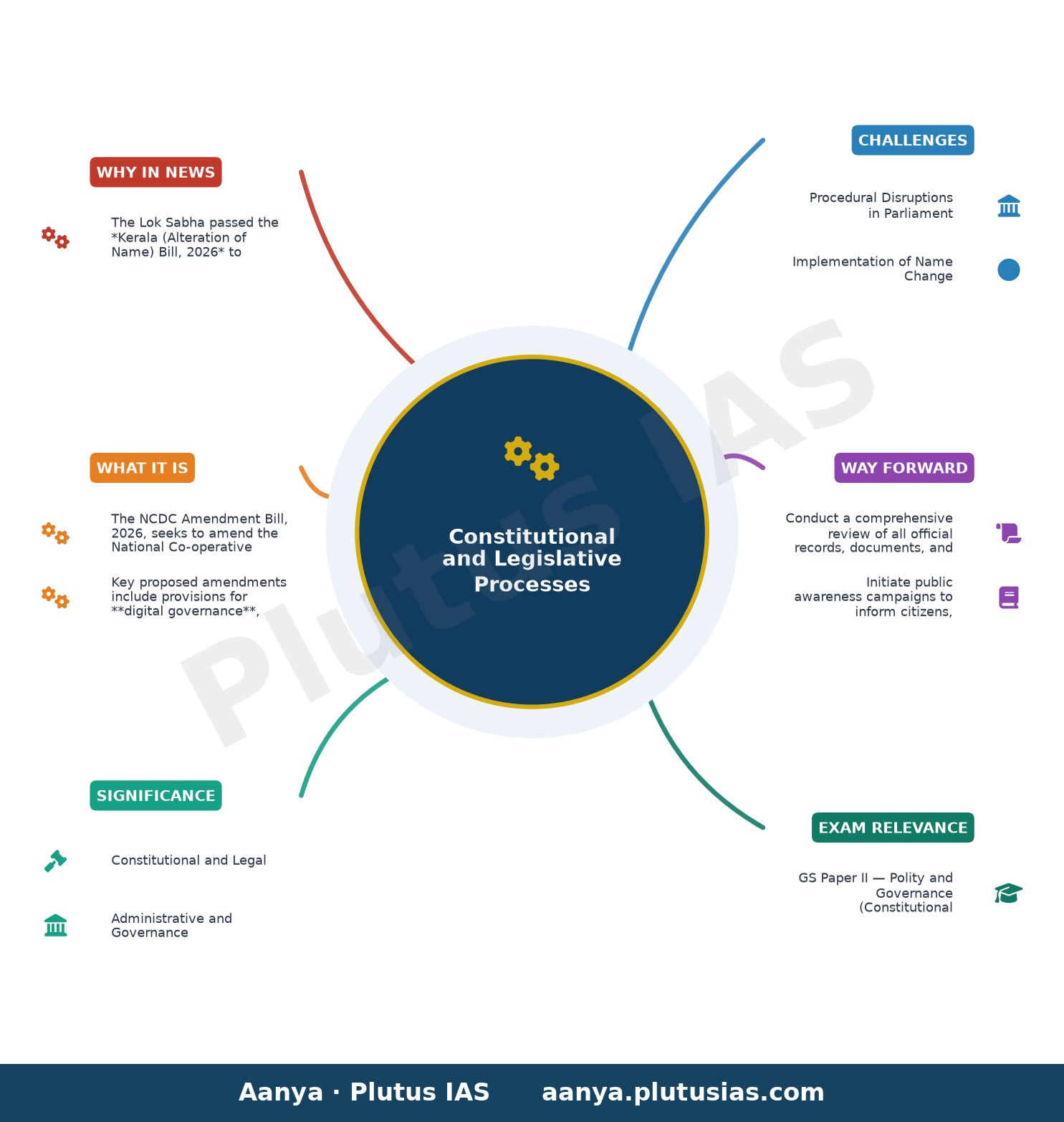
- GS Paper II — Polity and Governance (Constitutional Provisions, Federalism)
- Prelims: State Reorganisation Act, 1956, Article 3 of the Constitution, National Co-operative Development Corporation (NCDC), Cooperative Societies (Amendment) Bills, Parliamentary Procedures (Bill Passing), Federalism in India
- Essay: Federalism and cooperative federalism in India, Role of Parliament in state-building and governance reforms
Quick Revision: The alteration of a state’s name in India is governed by **Article 3 of the Constitution**, requiring a Bill passed by Parliament with the President’s prior recommendation, while the NCDC Amendment Bill aims to modernise cooperative sector governance through digital reforms and enhanced financial autonomy.
Why is this in the news?
The Lok Sabha passed the *Kerala (Alteration of Name) Bill, 2026* to rename the state of Kerala as *Keralam* and the *National Co-operative Development Corporation (Amendment) Bill, 2026* during the Monsoon Session of Parliament on August 11, 2026. These legislative actions highlight the constitutional mechanism for altering state names and the evolving regulatory framework for India’s cooperative sector, both of which are critical governance topics for UPSC Civil Services aspirants.
Background
- The Constitution of India, under Article 3, empowers Parliament to alter the name of any state by law, provided the Bill is introduced with the prior recommendation of the President.
- Kerala was originally formed as the state of *Travancore-Cochin* in 1956 under the States Reorganisation Act, 1956, and renamed *Kerala* in 1956 itself. The proposed alteration to *Keralam* reflects a linguistic shift to the Malayalam script form.
- The National Co-operative Development Corporation (NCDC) was established in 1963 under the NCDC Act, 1962, to promote and develop cooperative societies in India, particularly in agriculture and allied sectors.
- The NCDC Amendment Bill, 2026, seeks to modernise the governance and operational framework of NCDC to align with contemporary cooperative principles and digital governance needs.
- Parliamentary procedures for passing such Bills involve introduction, debate (if any), and voting, followed by the President’s assent for enactment into law.
- The Monsoon Session of Parliament is a critical legislative period where multiple Bills are introduced and passed, reflecting the government’s policy priorities.
National Co-operative Development Corporation (Amendment) Bill, 2026: Objectives and Implications
- The NCDC Amendment Bill, 2026, seeks to amend the National Co-operative Development Corporation Act, 1962, to enhance the governance, financial autonomy, and operational efficiency of NCDC.
- Key proposed amendments include provisions for **digital governance**, streamlining **credit delivery mechanisms**, and strengthening **audit and accountability frameworks** for cooperative societies funded by NCDC.
- The Bill aims to align NCDC’s functioning with the **Cooperative Societies (Amendment) Act, 2023**, which introduced reforms to modernise cooperative societies in India, including provisions for **ease of doing business** and **transparency in governance**.
- NCDC plays a pivotal role in financing and promoting cooperative societies, particularly in **agriculture, dairy, and rural development sectors**, which are critical for inclusive growth and employment generation.
- The amendments may include provisions for **greater participation of women and marginalised groups** in cooperative governance, reflecting the government’s emphasis on **gender inclusivity** and **social justice** in cooperative sector reforms.
- The Bill also proposes to enhance NCDC’s **financial autonomy**, enabling it to raise funds independently and collaborate with international agencies for cooperative development projects.
- The NCDC Amendment Bill is part of a broader legislative push to revitalise India’s cooperative sector, which contributes significantly to the rural economy and employment, particularly in states like Gujarat, Maharashtra, and Kerala.
- The Bill must be passed by both Houses of Parliament and receive the President’s assent to become law, following which NCDC will implement the amended provisions in consultation with state governments.
Key Features
| Feature | Significance |
|---|---|
| Kerala (Alteration of Name) Bill, 2026 | Proposes a formal change in the State’s name from ‘Kerala’ to ‘Keralam’ in the First Schedule of the Constitution, reflecting linguistic and cultural identity. |
| Procedure for alteration of State names | Demonstrates the constitutional process under Article 3 of the Constitution, requiring parliamentary approval and presidential assent. |
| National Co-operative Development Corporation (Amendment) Bill, 2026 | Aims to amend the NCDC Act, 1962, to enhance the regulatory and developmental framework for co-operative societies in India. |
| Parliamentary procedure in Monsoon Session | Highlights the legislative functioning of Parliament, including introduction, debate, and passage of Bills amid procedural disruptions. |
| Role of the Speaker/Chairperson | Illustrates the authority of the Lok Sabha Speaker or Rajya Sabha Chairman in maintaining order and ensuring legislative business. |
Why it Matters
Constitutional and Legal
- The alteration of a State’s name is a constitutional exercise under Article 3, which empowers Parliament to form new States or alter boundaries, names, or areas of existing States.
- The First Schedule of the Constitution lists the names and territories of States; any change requires parliamentary approval and presidential assent.
- The process underscores the federal nature of India, where State identity is constitutionally recognised and can be modified through legislative action.
Administrative and Governance
- A change in the State’s name necessitates updates in all official records, documents, and communications to reflect the new nomenclature.
- The alteration may have implications for inter-State and international correspondence, requiring coordination with the Union Government, judiciary, and other States.
- The NCDC Amendment Bill reflects the government’s focus on strengthening the co-operative sector, which is a key pillar of India’s rural and agricultural economy.
Political and Procedural
- The passage of Bills without discussion highlights the procedural flexibility in Parliament, though it may raise questions about the depth of legislative scrutiny.
- Disruptions in Parliament underscore the challenges in maintaining orderly legislative proceedings, particularly during contentious debates.
- The introduction of multiple Bills in a single session reflects the government’s legislative agenda and the need for efficient parliamentary functioning.
Challenges
1. Procedural Disruptions in Parliament
- Frequent interruptions and sloganeering during legislative proceedings can impede the passage of Bills and reduce the quality of debate.
- Maintaining decorum and ensuring the smooth functioning of Parliament is essential for effective governance and legislative output.
- The role of the Chair in managing disruptions is critical to uphold the dignity and authority of the House.
UPSC Link: Parliamentary procedures and conduct of business
2. Implementation of Name Change
- Updating all official records, including the Constitution, government documents, and international correspondence, requires meticulous planning and coordination.
- Ensuring uniformity in the use of the new name across all government agencies, educational institutions, and public platforms is a logistical challenge.
- The process may face resistance or confusion among citizens, necessitating awareness campaigns and public communication.
UPSC Link: Federalism and State identity
3. Amendment of NCDC Act
- The NCDC Amendment Bill must balance the need for regulatory reforms with the autonomy of co-operative societies to ensure effective implementation.
- Ensuring that the amendments do not impose undue financial or administrative burdens on co-operative societies is a key challenge.
- The amendment process requires consultations with stakeholders, including co-operative societies, to address their concerns and ensure inclusivity.
UPSC Link: Co-operative societies and rural development
4. Legislative Scrutiny and Debate
- The passage of Bills without discussion raises questions about the depth of legislative scrutiny and the quality of parliamentary debate.
- Ensuring that Bills are thoroughly examined, especially those with significant implications, is essential for robust governance.
- The lack of debate may limit the opportunity for stakeholders to provide input or raise concerns about the Bills.
UPSC Link: Parliamentary scrutiny and legislative process
Challenges — UPSC Perspective
| Issue | Concern |
|---|---|
| Parliamentary disruptions | Impedes the passage of Bills and reduces the quality of legislative debate. |
| Implementation of name change | Requires updating all official records and ensuring uniformity in the use of the new name. |
| NCDC Amendment Bill | Must balance regulatory reforms with the autonomy of co-operative societies. |
| Legislative scrutiny | Passage without discussion may limit the depth of examination and stakeholder input. |
| Co-ordination with States | Ensuring all government agencies and institutions adopt the new name uniformly. |
| Public awareness | Necessitating campaigns to inform citizens about the name change and its implications. |
Way Forward
- Conduct a comprehensive review of all official records, documents, and communications to ensure uniformity in the use of the new name ‘Keralam’.
- Initiate public awareness campaigns to inform citizens, educational institutions, and government agencies about the name change and its implications.
- Establish a dedicated task force to oversee the implementation of the name change and address any logistical or administrative challenges.
- Ensure that the NCDC Amendment Bill is accompanied by clear guidelines and consultations with co-operative societies to facilitate smooth implementation.
- Strengthen parliamentary procedures to minimise disruptions and ensure that Bills are debated thoroughly before passage.
- Encourage constructive debate and stakeholder consultations during the legislative process to enhance the quality of governance.
- Monitor the implementation of the Bills to assess their impact and address any unintended consequences.
- Promote inter-State and inter-departmental co-ordination to ensure seamless adoption of the new name and regulatory amendments.
UPSC Value Addition
Keywords for Mains Answer-Writing
Constitutional provisions for alteration of state names · Article 3 of the Constitution of India · Procedure for renaming a state · Role of Parliament in state name changes · Governor’s role in state name alteration · Federalism and state identity · Constitutional amendments and federal structure · State legislature’s role in name change · Provisions of the States Reorganisation Act, 1956 · Parliamentary sovereignty in federal matters · Kerala (Alteration of Name) Bill, 2026 · Keralam as the new name for Kerala
Concept Flow
State identity and linguistic representation → Constitutional provision under Article 3 → Parliamentary approval and presidential assent → Amendment of the First Schedule of the Constitution → Implementation and public communication → Uniform adoption across all government records and platforms.
Prelims Practice Questions
Q1. Consider the following statements regarding the procedure for altering the name of a State in India:
1. The Parliament can alter the name of a State by a simple majority.
2. The State Legislature must pass a resolution before the Parliament can consider the alteration.
3. The Governor of the State must give prior consent before the Parliament can alter the name.
4. The alteration of the name of a State does not require a constitutional amendment.
How many of the above statements are correct?
- Only one
- Only two
- Only three
- All
Answer: Only three — Statements 1 and 4 are correct. Altering the name of a State is done under Article 3 of the Constitution, which requires a simple majority in Parliament and does not mandate a constitutional amendment. Statement 2 is incorrect because the State Legislature’s resolution is not mandatory; the Parliament can initiate the process independently. Statement 3 is incorrect as the Governor’s consent is not required for the Parliament to alter a State’s name.
Q2. Assertion (A): The Kerala (Alteration of Name) Bill, 2026 seeks to change the name of the State from ‘Kerala’ to ‘Keralam’.
Reason (R): The Constitution of India empowers the Parliament to alter the name of a State through a simple majority, without requiring a constitutional amendment.
Options:
A. Both A and R are true, and R is the correct explanation of A.
B. Both A and R are true, but R is not the correct explanation of A.
C. A is true, but R is false.
D. A is false, but R is true.
Answer: ? — Both the Assertion (A) and Reason (R) are true. The Kerala (Alteration of Name) Bill, 2026 indeed seeks to rename the State to ‘Keralam’. The Reason (R) correctly explains the constitutional basis for altering a State’s name under Article 3, which requires only a simple majority in Parliament and does not necessitate a constitutional amendment.
Q3. Match the following provisions with their respective constitutional articles:
Column I (Provision)
1. Alteration of the name of a State
2. Formation of new States and alteration of areas, boundaries, or names of States
3. Special provisions with respect to the State of Jammu and Kashmir (prior to abrogation)
4. Appointment of the Governor
Column II (Article)
A. Article 3
B. Article 153
C. Article 370 (prior to abrogation)
D. Article 4
Options:
A. 1-A, 2-D, 3-C, 4-B
B. 1-D, 2-A, 3-B, 4-C
C. 1-B, 2-C, 3-D, 4-A
D. 1-C, 2-B, 3-A, 4-D
Answer: ? — The correct matches are: 1-A (Alteration of the name of a State is covered under Article 3), 2-D (Formation of new States and alteration of areas, boundaries, or names of States is covered under Article 4), 3-C (Special provisions with respect to the State of Jammu and Kashmir were covered under Article 370 prior to its abrogation), and 4-B (Appointment of the Governor is covered under Article 153).
Mains Practice Question
✍ The Parliament has passed the Kerala (Alteration of Name) Bill, 2026, seeking to rename the State from ‘Kerala’ to ‘Keralam’. Critically examine the constitutional and federal implications of such name changes in India. Also, analyse the role of the Parliament and the State Legislature in this process, with reference to relevant constitutional provisions. (15 Marks)
Approach: MODEL-ANSWER SKELETON:
1. **Constitutional Basis (Article 3)**: Explain that altering the name of a State is governed by Article 3 of the Constitution, which empowers Parliament to form new States or alter the name, boundaries, or areas of existing States by law. Emphasise that this does not require a constitutional amendment but only a simple majority in Parliament.
2. **Federal Implications**: Discuss the federal structure of India and how name changes reflect the dynamic nature of federalism. Highlight that such changes do not alter the federal balance but may impact state identity, cultural heritage, and administrative convenience. Mention the States Reorganisation Act, 1956, as a precedent for altering state names.
3. **Role of Parliament and State Legislature**: Clarify that while the Parliament has the ultimate authority to alter a State’s name, the State Legislature’s role is not mandatory. However, the State Legislature may pass a resolution expressing its views, which the Parliament may consider. Cite examples like the renaming of Madras to Tamil Nadu (1969) and Mysore to Karnataka (1973), where the State Legislature’s consent was not legally required but politically significant.
4. **Governor’s Role**: Explain that the Governor, as the constitutional head of the State, does not have a formal role in the process of altering the State’s name. The process is initiated by the Parliament.
5. **Contemporary Relevance**: Discuss the significance of the Kerala (Alteration of Name) Bill, 2026, in the context of linguistic and cultural identity. Highlight how such changes are often driven by regional aspirations and political symbolism.
6. **Critique and Challenges**: Critically examine potential challenges, such as administrative confusion, cost of rebranding, and the need for consensus among stakeholders. Discuss whether such changes should be subject to broader consultations or referendums.
7. **Conclusion**: Summarise the constitutional and federal dimensions, and offer a balanced view on the necessity and impact of such name changes in a federal polity.
Source: The Hindu
Generated by AanyaAi for educational purpose.

- KWML’s Feasibility Reports for Water Metro in 18 Cities: UPSC & PCS Insights - October 3, 2026
- ओडिशा में वन्यजीव अनुसंधान अनुदान कार्यक्रम शुरू, सिमिलिपाल में 300 कैमरे और बढ़ेंगे - October 3, 2026
- India Summons Pakistan High Commission Official Over Violation - October 3, 2026

No Comments