


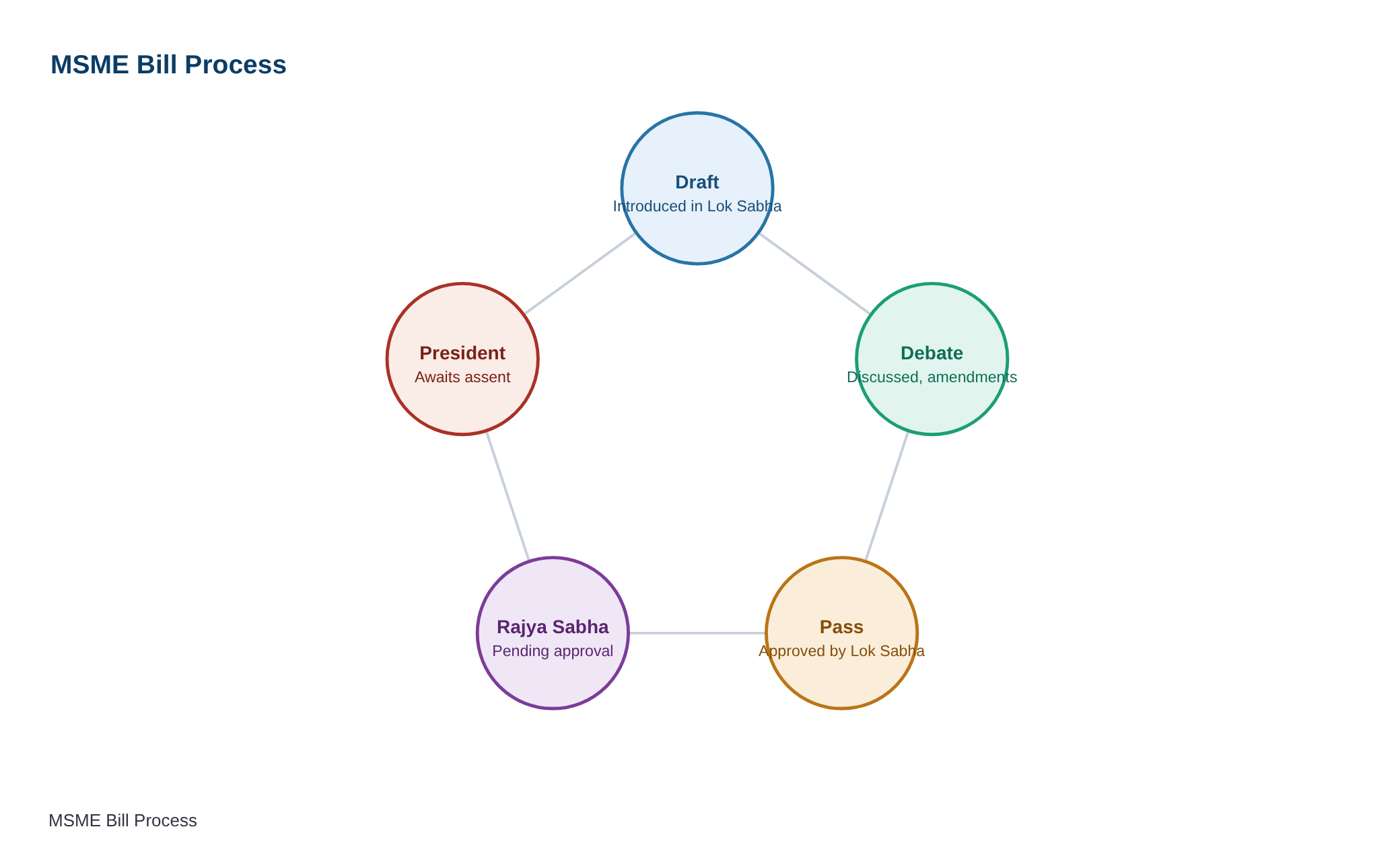
07 Aug Lok Sabha Passes MSME Bill 2024: Key Provisions for UPSC & State PCS
✎ MSME Bill 2024 aims to curb payment delays and disputes, ensuring faster resolution and better cash flow for small businesses.
Relevance for UPSC & State PCS: Polity
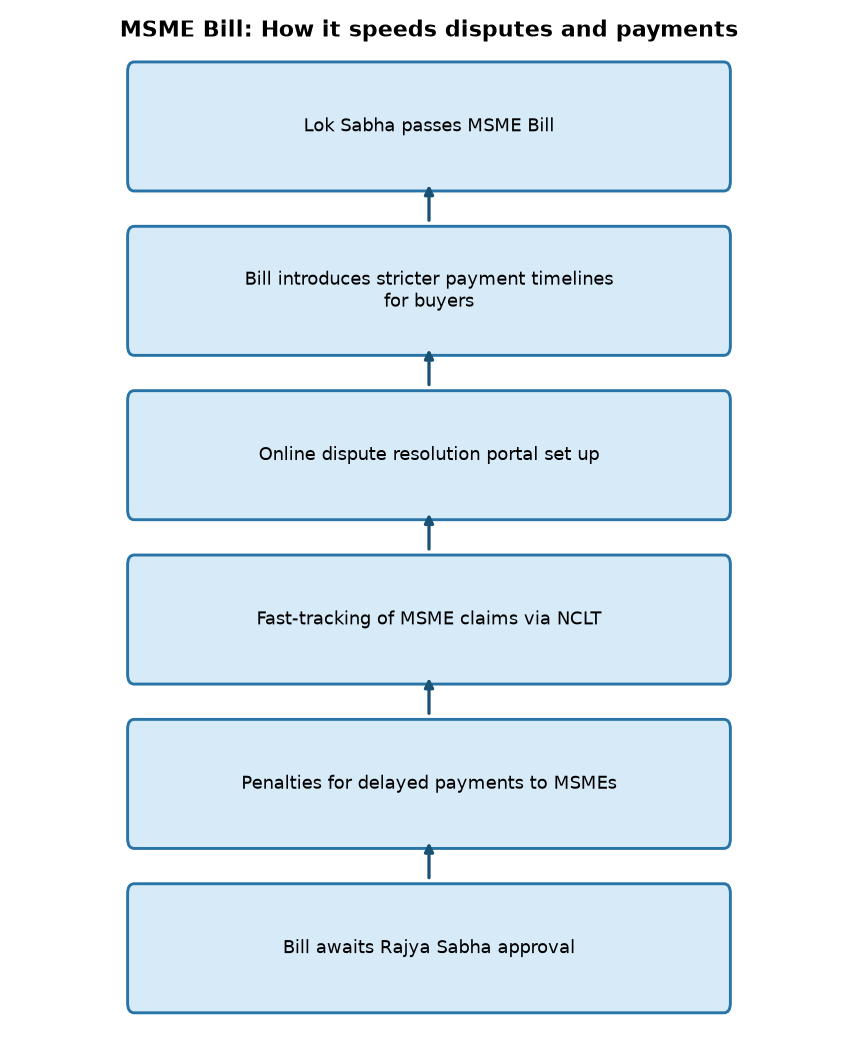
The Lok Sabha recently passed the Micro, Small and Medium Enterprises (MSME) Development (Amendment) Bill, 2024, aimed at addressing persistent challenges such as delayed payments and prolonged dispute resolution mechanisms that have long plagued India’s MSME sector. The bill introduces provisions to expedite settlement of dues owed to MSMEs by larger corporate buyers, a critical issue that has stifled cash flows and operational continuity for small businesses. By mandating stricter timelines for payments and empowering the Micro and Small Enterprises Facilitation Council (MSEFC) to resolve disputes more efficiently, the legislation seeks to enhance the financial resilience of MSMEs, which contribute nearly 30% to India’s GDP and employ over 110 million people. The move aligns with the government’s broader ‘Make in India’ and ‘Atmanirbhar Bharat’ initiatives, reinforcing the need for a robust ecosystem that supports small enterprises in a competitive market landscape.
For UPSC and State PCS aspirants, this bill holds significant relevance as it intersects with constitutional provisions, economic governance, and the role of statutory bodies. The amendments touch upon Article 19(1)(g) of the Constitution, which guarantees the right to practice any profession or trade, while also reflecting the government’s commitment under the Directive Principles of State Policy (Article 43) to promote cottage and small-scale industries. The bill’s emphasis on dispute resolution through specialized councils also highlights the administrative mechanisms under the MSME Development Act, 2006, making it a pertinent case study for questions on policy implementation and judicial reforms. Additionally, the issue of delayed payments ties into broader themes of financial inclusion and the informal economy, often tested in mains examinations under topics like ‘Inclusive Growth’ or ‘Ease of Doing Business.’
From a State PCS perspective, the bill underscores the importance of inter-state coordination in implementing MSME policies, especially for states with a high concentration of small-scale industries such as Tamil Nadu, Gujarat, and Maharashtra. Aspirants should note how the amendments could influence state-level policies on credit access, skill development, and infrastructure support for MSMEs, which are frequently examined in state-specific papers. The bill also raises questions about the role of state governments in monitoring compliance with payment timelines, a topic that could be explored in essays or interviews on ‘Cooperative Federalism’ or ‘Economic Reforms.’ Understanding the interplay between central legislation and state-level execution is crucial for aspirants targeting roles in state administration or public policy.
The passage of the MSME Bill also reflects the evolving nature of India’s economic policies, particularly in the context of global supply chain disruptions and the push for self-reliance. For UPSC mains, this could be linked to questions on ‘Globalization vs. Protectionism’ or ‘Post-COVID Economic Recovery.’ The bill’s focus on reducing bureaucratic hurdles and ensuring timely payments
Source: ndtv.com
Practice Questions
Q1. What is the primary objective of the MSME Bill recently passed by the Lok Sabha?
- To provide financial subsidies directly to MSMEs for expansion
- To tackle payment delays and speed up dispute resolution for MSMEs
- To increase the tax burden on large corporations to support MSMEs
- To mandate a minimum wage for all MSME employees
Answer
To tackle payment delays and speed up dispute resolution for MSMEs — The MSME Bill passed by the Lok Sabha aims to address payment delays faced by Micro, Small, and Medium Enterprises (MSMEs) and expedite the resolution of disputes related to these delays.
Q2. Which of the following issues is the MSME Bill primarily designed to resolve?
- Tax evasion by MSMEs
- Delayed payments to MSMEs by larger entities
- Lack of skilled labor in MSMEs
- Insufficient government funding for MSMEs
Answer
Delayed payments to MSMEs by larger entities — The bill is specifically aimed at resolving the issue of delayed payments to MSMEs by larger corporations and other entities, which often hampers their cash flow and operations.
Generated by AanyaAi for educational purpose.

- कर्नाटक उच्च न्यायालय ने ठेकेदारों की न्यूनतम मजदूरी रोकने के सरकारी आदेश पर रोक लगाई - September 19, 2026
- Karnataka HC Stays Circulars on Withholding Salaries for Contract Employees - September 19, 2026
- भारतीय रेलवे ने लखनऊ मंडल में ‘कवच 4.0’ लगाने के लिए ₹252 करोड़ मंजूर किए - September 19, 2026

No Comments