


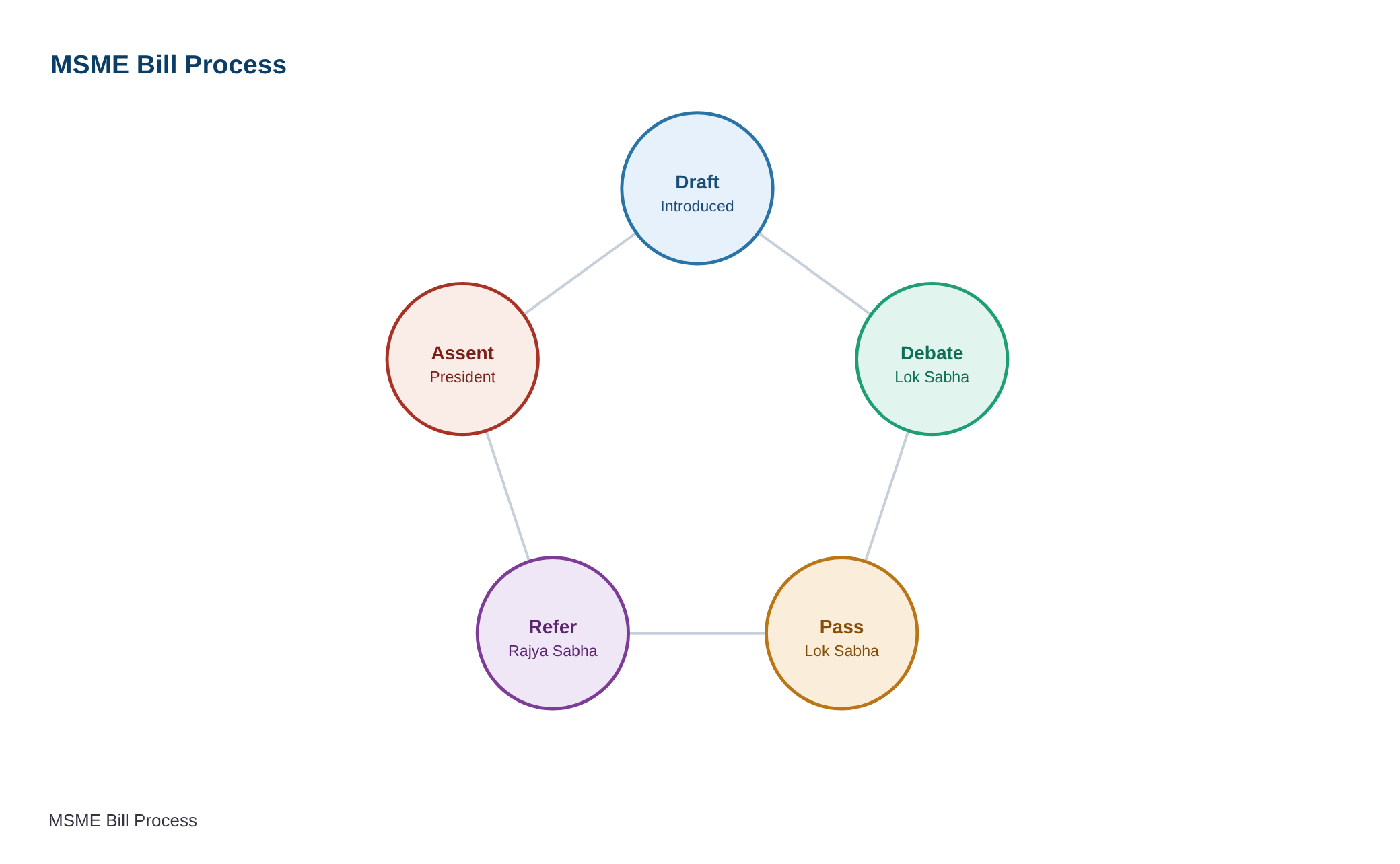
07 Aug Lok Sabha Passes MSME Bill: Key Provisions for UPSC & State PCS
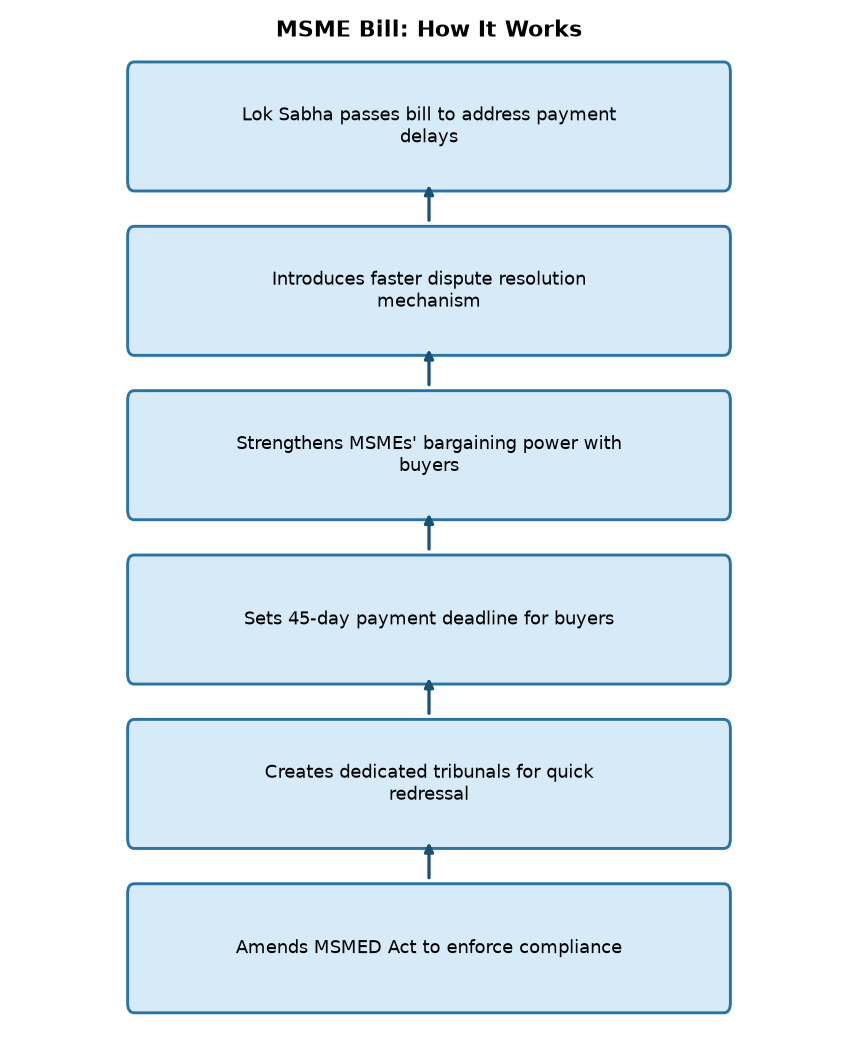
✎ MSME Bill 2024 aims to curb payment delays and expedite dispute resolution for small businesses.
Relevance for UPSC & State PCS: Polity
The Lok Sabha’s recent passage of the Micro, Small and Medium Enterprises (MSME) Development (Amendment) Bill, 2024, marks a significant legislative step aimed at addressing systemic challenges faced by India’s MSME sector, particularly the chronic issue of delayed payments and prolonged dispute resolution. The Bill introduces amendments to the MSMED Act, 2006, by mandating stricter timelines for payments to MSMEs from buyers, including government entities, and establishing dedicated dispute resolution mechanisms to expedite settlements. This move is part of the government’s broader push to enhance the ease of doing business for small enterprises, which form the backbone of India’s industrial ecosystem but often grapple with liquidity constraints due to unpaid invoices. The amendments also propose higher penalties for non-compliance, signaling a shift toward stricter enforcement to deter delays.
For UPSC and State PCS aspirants, this development holds relevance in the context of India’s economic governance, federalism, and the role of statutory bodies in regulating industrial sectors. The Bill’s emphasis on timely payments and dispute resolution reflects the Centre’s evolving approach to balancing business interests with the welfare of small enterprises, a theme that intersects with topics like cooperative federalism, financial inclusion, and the implementation of flagship schemes such as the Atmanirbhar Bharat initiative. Aspirants should analyze how such legislative measures align with the government’s broader economic policies, including the Production-Linked Incentive (PLI) schemes, which also target MSMEs as key stakeholders in supply chain diversification.
The Bill’s provisions also underscore the challenges of inter-state coordination, as payment delays often involve transactions between entities across different states, necessitating uniform enforcement mechanisms. This raises questions about the role of state governments in implementing the amended Act, particularly in sectors where MSMEs are concentrated, such as textiles, food processing, or handicrafts. For State PCS aspirants, understanding the devolution of powers under the Constitution—especially in the concurrent list—becomes crucial, as the Centre’s legislative intervention may require state-level adaptations or supplementary rules. Additionally, the Bill’s focus on dispute resolution mechanisms ties into judicial reforms and the efficiency of quasi-judicial bodies like the MSME Facilitation Councils, which aspirants should link to broader discussions on judicial pendency and alternative dispute resolution (ADR) in India.
Politically, the passage of this Bill also reflects the government’s responsiveness to long-standing demands from MSME associations, which have consistently highlighted the sector’s vulnerabilities to payment defaults, especially from large corporations and public sector undertakings. For UPSC mains, this could be framed as a case study in policy responsiveness and stakeholder engagement, where legislative action is driven by grassroots economic pressures. Aspirants should also consider the Bill’s potential impact on India’s export competitiveness, given that MSMEs contribute significantly to the country’s manufacturing exports. By addressing payment delays
Source: ndtv.com
Practice Questions
Q1. Which of the following is the primary objective of the MSME Bill recently passed by the Lok Sabha?
- To provide financial subsidies to MSMEs for expansion
- To tackle payment delays and expedite dispute resolution for MSMEs
- To increase the export quota for MSME products
- To mandate a minimum wage for all MSME employees
Answer
To tackle payment delays and expedite dispute resolution for MSMEs — The MSME Bill passed by the Lok Sabha aims to address payment delays faced by Micro, Small, and Medium Enterprises (MSMEs) and speed up the resolution of disputes related to delayed payments.
Q2. What is the significance of the MSME Bill in the context of business disputes?
- It introduces a mandatory arbitration process for all business disputes
- It expedites the resolution of disputes related to delayed payments for MSMEs
- It allows MSMEs to bypass legal recourse in disputes
- It imposes heavy penalties on MSMEs for delayed payments
Answer
It expedites the resolution of disputes related to delayed payments for MSMEs — The bill focuses on expediting the resolution of disputes, particularly those arising from delayed payments to MSMEs, by streamlining processes to ensure timely settlements.
Generated by AanyaAi for educational purpose.

- बॉम्बे हाईकोर्ट ने गणेशोत्सव में ध्वनि एवं वायु प्रदूषण पर उठाई चिंता - September 22, 2026
- Bombay HC Raps Noise, Air Pollution During Ganeshotsav: Key UPSC Perspective - September 22, 2026
- जल जीवन मिशन 2.0: कुशल कार्यबल निर्माण के लिए पहली वर्चुअल सम्मेलन आयोजित - September 22, 2026

No Comments