


07 Aug Lok Sabha Passes Tax Amendment Bill: Key Changes for UPI & Offshore Funds Explained
✎ The Taxation and Other Laws (Amendment) Bill, 2026, removes the zero-MDR framework for UPI transactions and extends tax exemptions for FPIs investing in G-Secs, aiming to enhance fiscal predictability and the financial viability…
Subject Relevance — Where This Topic Fits
- GS Paper III — Indian Economy: Issues Relating to Planning, Mobilisation of Resources, Growth, Development and Employment | GS Paper III — Money and Banking: Digital Payments and Financial Inclusion | GS Paper II — Government Policies and Interventions for Development in various sectors
- Prelims: Payment and Settlement Systems Act, 2007, Merchant Discount Rate (MDR), Unified Payments Interface (UPI), Foreign Portfolio Investors (FPIs), Government Securities (G-Secs), Income Tax Act, 2025, Taxation and Other Laws (Amendment) Bill, 2026
- Essay: The evolving role of digital public infrastructure in India’s economic transformation, Balancing fiscal sustainability with inclusive growth: Lessons from recent legislative amendments
Quick Revision: The Taxation and Other Laws (Amendment) Bill, 2026, removes the zero-MDR framework for UPI transactions and extends tax exemptions for FPIs investing in G-Secs, aiming to enhance fiscal predictability and the financial viability of digital payments.
Why is this in the news?
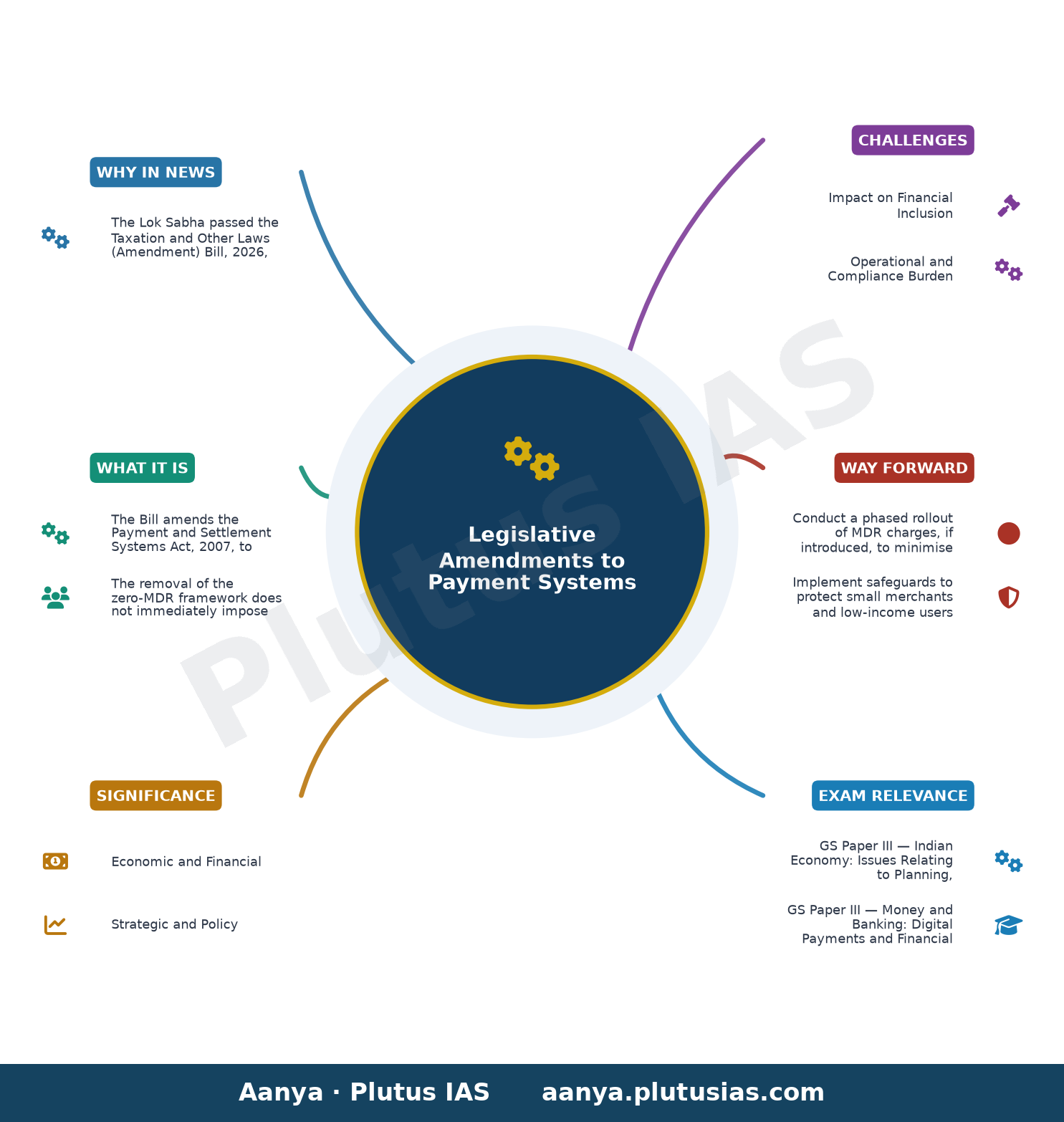
The Lok Sabha passed the Taxation and Other Laws (Amendment) Bill, 2026, which introduces significant amendments to the Payment and Settlement Systems Act, 2007, and the Income Tax Act, 2025. The Bill removes the legal prohibition on levying Merchant Discount Rate (MDR) on UPI transactions, potentially altering the cost structure of digital payments, while also extending tax exemptions for offshore investments in government securities. These amendments reflect the government’s dual objectives of enhancing fiscal predictability for global investors and ensuring the financial viability of the digital payments ecosystem.
Background
- The Payment and Settlement Systems Act, 2007, was enacted to regulate payment systems in India and provide a legal framework for the Reserve Bank of India (RBI) to oversee digital payment mechanisms, including UPI.
- Since its inception, UPI transactions in India have operated under a zero-MDR framework, exempting merchants and consumers from charges to promote digital adoption and financial inclusion.
- The zero-MDR policy was introduced to incentivise the adoption of digital payments, particularly in sectors with thin margins, such as retail and micro-enterprises, by reducing transaction costs.
- The Income Tax Act, 2025, introduced in the Union Budget 2025-26, aimed to rationalise tax provisions and align them with contemporary economic realities, including those concerning foreign portfolio investments (FPIs).
- The Taxation and Other Laws (Amendment) Bill, 2026, replaces an earlier ordinance issued on June 5, 2026, which provided tax exemptions for interest income and capital gains earned by FPIs from investments in government securities (G-Secs).
- The Bill was passed without discussion in the Lok Sabha amid Opposition protests, indicating a lack of consensus on its broader economic implications.
Key Provisions and Implications of the Taxation and Other Laws (Amendment) Bill, 2026
- The Bill amends the Payment and Settlement Systems Act, 2007, to empower the government to permit banks and payment service providers to levy Merchant Discount Rate (MDR) on UPI transactions and other notified electronic payment modes, thereby removing the existing legal prohibition on such charges.
- The removal of the zero-MDR framework does not immediately impose charges on UPI transactions but grants the government the authority to introduce them in the future, subject to policy considerations and stakeholder consultations.
- The Bill also amends the Income Tax Act, 2025, to extend tax exemptions for interest income and capital gains earned by Foreign Portfolio Investors (FPIs) from investments in Government Securities (G-Secs), aiming to enhance India’s attractiveness as an investment destination for global capital.
- The amendments to the Finance Act, 2026, are procedural and ensure the legal alignment of the Finance Act with the revised provisions of the Income Tax Act and the Payment and Settlement Systems Act.
- The Bill seeks to unlink the Payment and Settlement Systems Act from the Income Tax Act, providing the government with greater flexibility to modify the regulatory framework for digital payments without requiring concurrent amendments to tax laws.
- The proposed changes are part of a broader strategy to create a sustainable revenue model for banks and payment service providers, ensuring the long-term viability of the digital payments ecosystem in India.
- The amendments reflect a shift towards balancing fiscal sustainability with the promotion of digital public infrastructure, a critical component of India’s economic growth strategy.
Key Features
| Feature | Significance |
|---|---|
| Removal of zero-MDR provision for UPI transactions | Enables banks and payment service providers to levy Merchant Discount Rate (MDR) on UPI transactions, potentially introducing charges for merchants. |
| Amendment to Payment and Settlement Systems Act, 2007 | Provides legal authority to the government to modify or reintroduce charges on electronic payment modes, including UPI. |
| Unlinking from Income Tax Act, 2025 | Decouples the regulatory framework for digital payments from income tax provisions, allowing independent policy adjustments. |
| Exemption for RTGS/NEFT transactions | Real-time payments via RTGS and NEFT continue to attract service charges, maintaining their existing fee structure. |
| Revenue model sustainability for banks | Aims to create a sustainable revenue stream for banks and payment service providers to support digital payment infrastructure. |
Why it Matters
Economic and Financial
- Enhances fiscal sustainability of digital payment systems by enabling revenue generation through MDR on UPI transactions.
- Aligns with global practices where electronic payment systems often incur merchant charges, fostering a level playing field.
- Supports the monetisation of digital payment infrastructure, which has been largely subsidised or free for users till now.
- May reduce the burden on government exchequer by shifting part of the cost of digital payment infrastructure to end-users or merchants.
Strategic and Policy
- Strengthens the regulatory framework for digital payments by granting the government flexibility to adjust charges based on market dynamics.
- Promotes predictability and long-term planning for businesses and investors by clarifying the legal environment for digital transactions.
- Facilitates the integration of digital payment systems with broader economic policies, including taxation and financial inclusion.
Technological and Infrastructure
- Encourages investment in digital payment infrastructure by ensuring a viable revenue model for service providers.
- Supports the scalability of UPI and other electronic payment systems by addressing funding gaps in maintenance and upgrades.
- May incentivise innovation in payment technologies to offset potential cost increases for users.
Challenges
1. Impact on Financial Inclusion
- Risk of reduced adoption of digital payments among low-income and marginalised groups if charges are introduced.
- Potential widening of the digital divide if UPI transactions become costly for small merchants and consumers.
- May undermine the government’s goal of achieving a cashless economy by discouraging digital payment usage.
UPSC Link: GS3: Financial Inclusion
2. Operational and Compliance Burden
- Increased complexity for merchants in managing multiple payment systems with varying fee structures.
- Potential for regulatory arbitrage if banks and payment service providers impose disproportionate charges.
- Need for robust grievance redressal mechanisms to address disputes over transaction charges.
UPSC Link: GS3: Digital Payments
3. Macroeconomic Stability
- Risk of inflationary pressures if merchants pass on UPI charges to consumers, affecting price levels.
- Possible dampening effect on consumer spending if digital transactions become less attractive due to costs.
- Impact on the growth of the digital economy if transaction costs deter small businesses from adopting digital payments.
UPSC Link: GS3: Inflation and Growth
4. Global Competitiveness
- Need to balance domestic revenue generation with maintaining India’s attractiveness for global investors and businesses.
- Risk of losing the competitive edge of UPI as a low-cost, high-efficiency payment system in international comparisons.
- Potential for foreign investors to perceive the new charges as an additional cost of doing business in India.
UPSC Link: GS3: Ease of Doing Business
Challenges — UPSC Perspective
| Issue | Concern |
|---|---|
| Financial inclusion | Risk of reduced digital payment adoption among low-income groups |
| Merchant compliance | Increased operational complexity and cost for small businesses |
| Inflationary pressures | Potential pass-through of charges to consumers, affecting price levels |
| Global investor perception | Possible negative impact on India’s attractiveness for foreign investment |
| Regulatory arbitrage | Disproportionate or unfair charges by banks and payment service providers |
Way Forward
- Conduct a phased rollout of MDR charges, if introduced, to minimise disruption to digital payment adoption.
- Implement safeguards to protect small merchants and low-income users from excessive charges.
- Strengthen consumer awareness campaigns to educate users on the potential impact of new charges.
- Develop a transparent pricing framework for UPI transactions to ensure fairness and predictability.
- Enhance digital payment infrastructure in rural and semi-urban areas to maintain financial inclusion.
- Monitor inflationary pressures and adjust policy to mitigate any adverse macroeconomic effects.
- Encourage innovation in low-cost digital payment solutions to offset potential cost increases.
- Establish a robust grievance redressal mechanism for disputes related to transaction charges.
UPSC Value Addition
Keywords for Mains Answer-Writing
Payment and Settlement Systems Act, 2007 · Merchant Discount Rate (MDR) · Unified Payments Interface (UPI) · Taxation and Other Laws (Amendment) Bill, 2026 · digital payments ecosystem · offshore funds and global capital · Income Tax Act, 2025 · Financial sector regulatory framework · sustainable revenue model for banks · electronic payment modes · Monsoon Session of Parliament 2026 · sovereign guarantee and predictability for investors
Concept Flow
Government introduces Taxation and Other Laws (Amendment) Bill, 2026 to amend Payment and Settlement Systems Act, 2007. → Bill removes zero-MDR provision, enabling banks to charge Merchant Discount Rate on UPI transactions. → Potential introduction of charges may impact merchant costs and consumer behaviour. → Risk of reduced digital payment adoption, particularly among low-income groups. → Government may introduce safeguards to mitigate adverse effects on financial inclusion. → Policy adjustments may be required to balance revenue generation with inclusivity and economic stability.
Prelims Practice Questions
Q1. Consider the following statements regarding the Payment and Settlement Systems Act, 2007:
1. The Act currently prohibits banks and payment service providers from charging Merchant Discount Rate (MDR) on UPI transactions.
2. The Taxation and Other Laws (Amendment) Bill, 2026 seeks to remove this prohibition and allow charging of MDR on UPI transactions.
3. The Act does not apply to real-time gross settlement (RTGS) and national electronic funds transfer (NEFT) transactions.
How many of the above statements are correct?
- Only one
- Only two
- All three
- None
Answer: Only two — Statement 1 and 2 are correct as the Bill seeks to remove the prohibition on MDR for UPI. Statement 3 is incorrect because RTGS and NEFT transactions are subject to service charges under the Act.
Q2. Assertion (A): The Taxation and Other Laws (Amendment) Bill, 2026 aims to make India a more attractive destination for global capital by providing tax exemptions to offshore funds.
Reason (R): The Bill replaces an earlier ordinance that exempted interest income and capital gains made by Foreign Portfolio Investors (FPIs) from investments in Government Securities (G-Secs).
- Both A and R are true, and R is the correct explanation of A.
- Both A and R are true, but R is not the correct explanation of A.
- A is true, but R is false.
- A is false, but R is true.
Answer: Both A and R are true, and R is the correct explanation of A. — Both the assertion and reason are true. The Bill’s aim to attract global capital is supported by the tax exemption provisions for FPIs investing in G-Secs, as stated in the reason.
Q3. Match the following columns with reference to the Payment and Settlement Systems Act, 2007 and the Taxation and Other Laws (Amendment) Bill, 2026:
Column I | Column II
1. Payment and Settlement Systems Act, 2007 | A. Exempts UPI transactions from MDR charges
2. Taxation and Other Laws (Amendment) Bill, 2026 | B. Amends the Income Tax Act, 2025
3. Merchant Discount Rate (MDR) | C. Allows charging of MDR on UPI transactions
4. RTGS and NEFT transactions | D. Subject to service charges
Select the correct match:
- 1-A, 2-B, 3-C, 4-D
- 1-B, 2-A, 3-D, 4-C
- 1-C, 2-D, 3-A, 4-B
- 1-D, 2-C, 3-B, 4-A
Answer: 1-A, 2-B, 3-C, 4-D — 1-A: The Act currently exempts UPI from MDR. 2-B: The Bill amends the Income Tax Act, 2025. 3-C: The Bill allows charging MDR on UPI. 4-D: RTGS and NEFT are subject to service charges.
Mains Practice Question
✍ The Taxation and Other Laws (Amendment) Bill, 2026 seeks to amend the Payment and Settlement Systems Act, 2007 to permit charging of Merchant Discount Rate (MDR) on UPI transactions. Critically analyse the implications of this amendment for the digital payments ecosystem, the banking sector, and the broader macroeconomic objectives of financial inclusion and global capital attraction. (15 Marks)
Approach: MODEL-ANSWER SKELETON:
1. **Context and Provisions**:
– Briefly outline the Payment and Settlement Systems Act, 2007, and the zero-MDR framework for UPI transactions.
– Highlight the key amendment proposed in the Bill: removal of the prohibition on MDR for UPI transactions.
– Mention the stated objective: creating a sustainable revenue model for banks and payment service providers.
2. **Implications for the Digital Payments Ecosystem**:
– **Merchant Perspective**: Potential increase in costs for merchants, leading to higher prices for consumers or reduced adoption of UPI.
– **Consumer Perspective**: UPI transactions may no longer remain free, impacting user behavior and digital adoption rates.
– **Payment Service Providers**: Need for transparent pricing models and potential competition among providers.
– **RBI’s Role**: Regulatory oversight to balance innovation, affordability, and sustainability.
3. **Impact on the Banking Sector**:
– **Revenue Streams**: Banks and payment aggregators may gain new revenue streams, addressing the issue of cost recovery for infrastructure.
– **Financial Inclusion**: Risk of reduced financial inclusion if UPI becomes less attractive to low-income users.
– **Competition**: Potential for oligopolistic pricing if MDR is not regulated, favoring large players over smaller fintech firms.
4. **Macroeconomic Objectives**:
– **Financial Inclusion**: Critically examine whether the amendment aligns with India’s goal of achieving 100% financial inclusion by 2026.
– **Global Capital Attraction**: Assess how the amendment supports the government’s objective of making India an attractive destination for global capital, particularly in the context of tax exemptions for offshore funds.
– **Predictability and Stability**: Evaluate the amendment’s role in providing a predictable and stable regulatory environment for investors.
5. **Balancing Views and Way Forward**:
– Present arguments for and against the amendment (e.g., sustainability vs. affordability).
– Suggest measures such as capping MDR rates, phased implementation, or subsidies for small merchants to mitigate negative impacts.
– Reference global examples (e.g., Brazil, Singapore) where MDR frameworks have been implemented.
6. **Conclusion**:
– Summarize the key findings and take a reasoned position on the amendment’s net impact.
Source: Mint
Generated by AanyaAi for educational purpose.

- स्वच्छ सागर सुरक्षित सागर 5.0: 15 लाख लोगों ने ली महासागर संरक्षण की शपथ, जानें पूरा विवरण - September 21, 2026
- 15 लाख लोगों ने ली महासागर संरक्षण की शपथ: स्वच्छ सागर सुरक्षित सागर 5.0 अभियान की सफलता - September 21, 2026
- आईसीआई अगस्त 2026: आधार वर्ष 2022-23 के साथ प्रमुख उद्योगों का प्रदर्शन एवं वृद्धि दर - September 21, 2026

No Comments