


10 Aug Lok Sabha Passes Tribunals Reforms Bill 2026: Key Features & Implications for UPSC
✎ The Tribunals Reforms Bill, 2026, establishes the National Tribunals Commission to centralise and professionalise the appointment of tribunal members, ensuring judicial independence and transparency in compliance with Supreme…
Subject Relevance — Where This Topic Fits
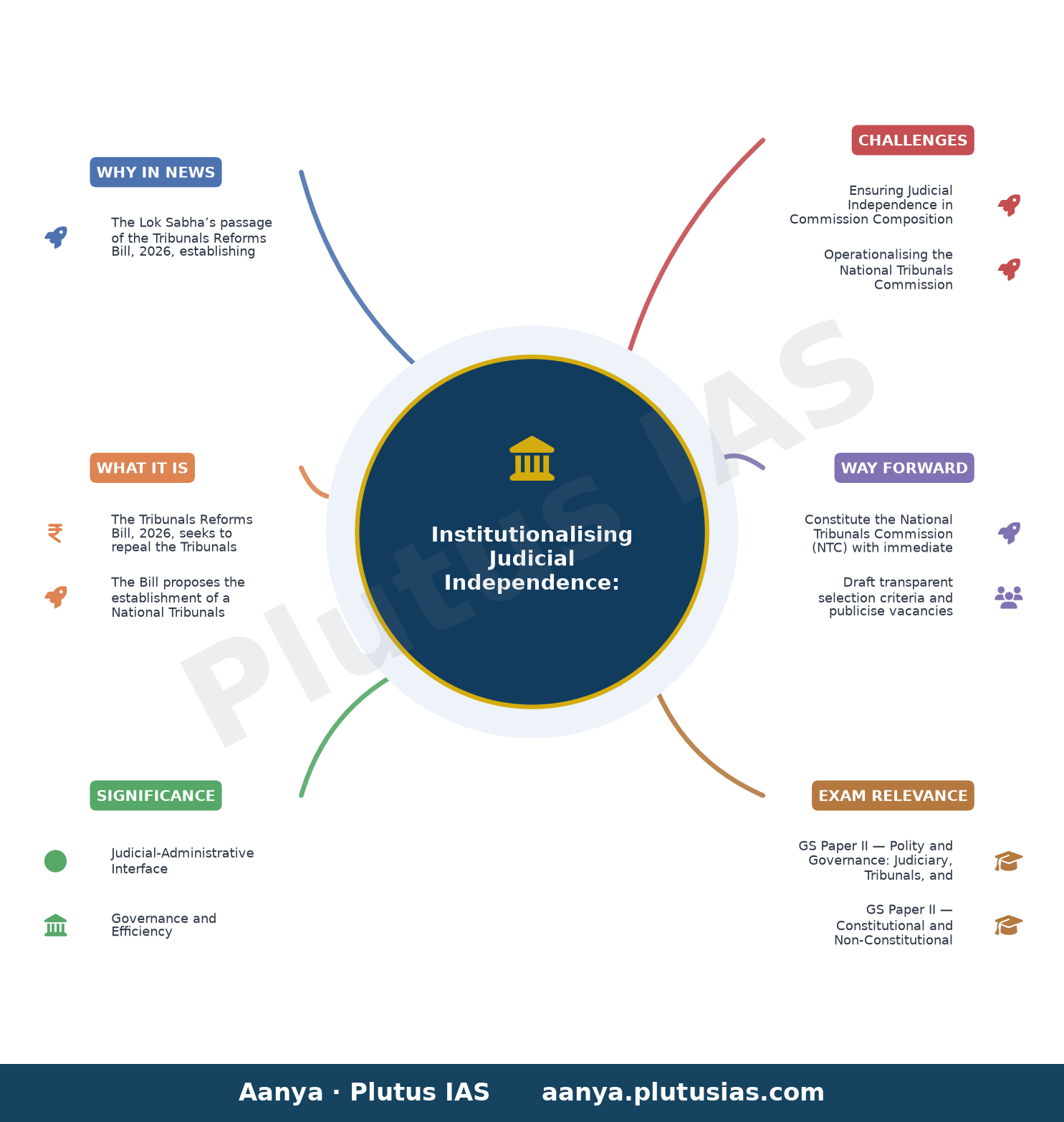
- GS Paper II — Polity and Governance: Judiciary, Tribunals, and Constitutional Bodies | GS Paper II — Constitutional and Non-Constitutional Bodies | GS Paper III — Administrative Reforms and Governance
- Prelims: Tribunals Reforms Act, 2021, National Tribunals Commission (NTC), Supreme Court’s judicial review of tribunals, Qualifications for tribunal members, Separation of powers doctrine, Judicial independence, Constitutional validity of tribunals
- Essay: Judicial independence and the balance of power in India’s constitutional democracy, Administrative reforms and the quest for efficiency in governance
Quick Revision: The Tribunals Reforms Bill, 2026, establishes the National Tribunals Commission to centralise and professionalise the appointment of tribunal members, ensuring judicial independence and transparency in compliance with Supreme Court directives.
Why is this in the news?
The Lok Sabha’s passage of the Tribunals Reforms Bill, 2026, establishing a National Tribunals Commission to oversee the appointment of tribunal chairpersons and members, is significant as it responds to the Supreme Court’s directives to rectify deficiencies in the Tribunals Reforms Act, 2021. The Bill aims to enhance transparency, uniformity, and independence in tribunal appointments, addressing concerns raised by judicial pronouncements on the separation of powers and the need for an independent oversight mechanism.
Background
- The Tribunals Reforms Act, 2021, was enacted to streamline the functioning of tribunals by prescribing qualifications, appointment processes, tenure, and service conditions for tribunal members.
- The Supreme Court, in *Rojer Mathew v. South Indian Bank Ltd.* (2020) and subsequent judgments, struck down key provisions of the 2021 Act, citing violations of the doctrine of separation of powers and judicial independence.
- The Court directed the Union Government to establish an independent National Tribunals Commission to ensure professional expertise, transparency, and fairness in the appointment of tribunal members.
- The proposed National Tribunals Commission is envisaged as a statutory body to centralise the appointment process, replacing the ad hoc and potentially opaque methods previously employed.
- The Bill reflects a broader trend of administrative reforms aimed at improving efficiency and accountability in quasi-judicial institutions.
- Parliamentary debates and judicial scrutiny have highlighted the need for a robust institutional framework to safeguard the autonomy of tribunals, which adjudicate matters ranging from service disputes to environmental and tax issues.
What is the Tribunals Reforms Bill, 2026, and the National Tribunals Commission?
- The Tribunals Reforms Bill, 2026, seeks to repeal the Tribunals Reforms Act, 2021, and replace it with a new legislative framework for the appointment and functioning of tribunal members.
- The Bill proposes the establishment of a National Tribunals Commission (NTC), a statutory body headquartered in New Delhi, to oversee the appointment of chairpersons and members of various tribunals.
- The NTC will consist of a chairperson and four members—two judicial members and two technical members with domain expertise.
- The Commission will prescribe uniform qualifications, selection criteria, and service conditions for tribunal members, ensuring consistency across different tribunals.
- The Bill does not alter the jurisdiction or adjudicatory powers of existing tribunals, thereby preserving their functional autonomy in dispute resolution.
- The NTC will have the authority to recommend appointments, prescribe salaries, allowances, tenure, and conditions of service, and oversee the removal of tribunal members in accordance with statutory provisions.
- The legislation aims to address the Supreme Court’s concerns regarding the lack of independence and transparency in the appointment process under the 2021 Act.
- The Bill is part of a broader governance reform agenda to enhance efficiency, reduce delays, and strengthen the institutional capacity of tribunals.
Key Features
| Feature | Significance |
|---|---|
| Establishment of National Tribunals Commission (NTC) | Centralises appointment authority for tribunal chairpersons and members, replacing ad-hoc processes under the Tribunals Reforms Act, 2021. |
| Composition: Chairperson + 4 Members (2 judicial, 2 technical) | Ensures judicial oversight while incorporating domain expertise for informed appointments. |
| Eligibility: Retired SC judge or HC Chief Justice as Chairperson | Upholds judicial independence by vesting leadership in senior judicial figures. |
| Prescribed qualifications, tenure, and service conditions | Standardises selection criteria, reduces arbitrariness, and enhances predictability in tribunal governance. |
| Repeal of Tribunals Reforms Act, 2021 | Addresses judicial concerns over separation of powers and judicial independence raised in prior Supreme Court rulings. |
Why it Matters
Judicial-Administrative Interface
- Reinforces the constitutional principle of judicial independence by insulating tribunal appointments from executive discretion.
- Aligns with the Supreme Court’s directive in the case of *Rojer Mathew v. South Indian Bank Ltd.* (2020), which struck down provisions of the 2021 Act for violating separation of powers.
- Ensures uniformity in appointment processes across 27 tribunals, including the National Company Law Tribunal (NCLT) and Income Tax Appellate Tribunal (ITAT).
Governance and Efficiency
- Centralised commission model reduces delays in filling vacancies, a chronic issue in tribunals with over 1,000 pending cases in some benches.
- Professionalises tribunal administration by separating selection criteria from political considerations, enhancing credibility.
- Mandates transparent selection procedures, including public advertisements and interviews, to curb nepotism.
Legal and Constitutional Implications
- Restores balance between executive and judiciary in tribunal governance, following judicial pushback against executive overreach in the 2021 Act.
- Clarifies the role of tribunals as quasi-judicial bodies distinct from civil courts, reinforcing their specialised function.
- Potential to reduce litigation over tribunal appointments, as the NTC’s decisions would be subject to judicial review under Article 226/227.
Impact on Stakeholders
- For litigants: Faster dispute resolution due to reduced vacancies and improved tribunal efficiency.
- For tribunal members: Clearer career progression and service conditions, reducing uncertainty.
- For the executive: Streamlined process for tribunal appointments, though oversight remains judicial.
Challenges
1. Ensuring Judicial Independence in Commission Composition
- Risk of executive influence if the government retains significant control over the selection of the Chairperson or technical members.
- Need for safeguards to prevent the NTC from becoming a tool for political appointments under the guise of reform.
UPSC Link: Judicial Activism vs. Separation of Powers
2. Operationalising the National Tribunals Commission
- High initial costs for setting up infrastructure, staffing, and digital systems for transparent selection processes.
- Delays in recruitment due to bureaucratic hurdles or resistance from existing tribunal members accustomed to the old system.
UPSC Link: Institutional Capacity Building
3. Balancing Efficiency with Due Process
- Pressure to expedite appointments may lead to compromises in meritocracy, undermining the NTC’s credibility.
- Risk of over-centralisation, where the NTC’s decisions may not account for regional or sector-specific tribunal needs.
UPSC Link: Administrative Efficiency vs. Procedural Justice
4. Judicial Review and Overreach Concerns
- Potential for courts to overstep by reviewing NTC’s appointments on grounds of merit, conflicting with the principle of judicial restraint.
- Litigation over the NTC’s decisions could delay tribunal functioning, defeating the purpose of reform.
UPSC Link: Judicial Review of Executive Actions
5. Coordination with Existing Tribunals
- Resistance from existing tribunal members or bar associations over perceived dilution of their autonomy.
- Need for seamless transition from the 2021 Act to the NTC framework to avoid disruption in tribunal operations.
UPSC Link: Inter-Institutional Coordination
Challenges — UPSC Perspective
| Issue | Concern |
|---|---|
| Executive Influence in NTC Composition | Risk of appointments being influenced by political considerations rather than merit. |
| High Implementation Costs | Financial and administrative burden of setting up a new commission with professional staff. |
| Delays in Appointment Process | Bureaucratic or legal hurdles may slow down tribunal functioning initially. |
| Judicial Overreach in Review | Courts may substitute their judgment for the NTC’s selections, leading to delays. |
| Resistance from Stakeholders | Existing tribunal members or legal fraternity may oppose the reform, citing loss of autonomy. |
Way Forward
- Constitute the National Tribunals Commission (NTC) with immediate effect to avoid further delays in tribunal appointments.
- Draft transparent selection criteria and publicise vacancies widely to ensure merit-based appointments.
- Establish a grievance redressal mechanism within the NTC to address concerns of tribunal members or litigants.
- Conduct capacity-building programmes for NTC staff to ensure efficient and impartial functioning.
- Monitor the NTC’s performance through quarterly reports to Parliament, ensuring accountability.
- Engage with the Supreme Court to clarify the scope of judicial review over NTC decisions to prevent overreach.
- Phase out the Tribunals Reforms Act, 2021, and ensure all pending appointments are transitioned to the NTC framework.
- Sensitise stakeholders, including the legal fraternity and tribunal members, about the benefits of the reform to garner support.
UPSC Value Addition
Keywords for Mains Answer-Writing
Tribunals Reforms Bill 2026 · National Tribunals Commission · appointment of tribunal members · judicial independence · separation of powers · Supreme Court directives on tribunals · Tribunals Reforms Act 2021 · qualifications for tribunal chairpersons · appointment process for tribunals · judicial reforms in India · constitutional provisions on tribunals · Parliamentary oversight of tribunals
Constitutional & Policy Linkages
- Article 50: Separation of Judiciary from Executive (Directive Principle of State Policy).
- Article 226: Writs jurisdiction of High Courts (judicial review of tribunal appointments).
- Article 227: Superintendence of High Courts over subordinate courts and tribunals.
Concept Flow
Supreme Court strikes down provisions of Tribunals Reforms Act, 2021 → Cites violation of separation of powers and judicial independence. → Government introduces Tribunals Reforms Bill, 2026 → Proposes National Tribunals Commission (NTC) to centralise appointments. → Lok Sabha passes Bill without debate → Opposition protests over unrelated issues, but Bill proceeds. → NTC established → Replaces ad-hoc appointment processes with a standardised, transparent framework. → NTC selects tribunal members → Ensures judicial and technical expertise, reducing vacancies and delays. → Tribunals function efficiently → Faster dispute resolution, reduced litigation, and improved governance.
Prelims Practice Questions
Q1. Consider the following statements regarding the Tribunals Reforms Bill, 2026:
1. The Bill seeks to establish a National Tribunals Commission for the appointment of tribunal members.
2. The proposed commission will comprise a chairperson and four members, with two judicial and two technical members.
3. The Bill alters the jurisdiction of existing tribunals.
4. The Bill was passed by the Lok Sabha without a debate amid Opposition protests.
How many of the above statements are correct?
- Only one
- Only two
- Only three
- All
Answer: Only three — Statements 1, 2, and 4 are correct. Statement 3 is incorrect as the Bill does not alter the jurisdiction of any tribunal.
Q2. Assertion (A): The Tribunals Reforms Bill, 2026, aims to improve transparency and independence in the appointment of tribunal members.
Reason (R): The Bill was introduced following the Supreme Court’s observation that some provisions of the Tribunals Reforms Act, 2021, were contrary to the principles of separation of powers.
In the context of the above two statements, which one of the following is correct?
- Both A and R are true, and R is the correct explanation of A.
- Both A and R are true, but R is not the correct explanation of A.
- A is true, but R is false.
- A is false, but R is true.
Answer: Both A and R are true, and R is the correct explanation of A. — Both A and R are true, and R correctly explains A as the Bill was introduced to address the Supreme Court’s concerns regarding judicial independence and separation of powers.
Q3. Match the following provisions of the Tribunals Reforms Bill, 2026, with their descriptions:
Column I (Provision)
A. Establishment of National Tribunals Commission
B. Qualifications for tribunal members
C. Repeal of Tribunals Reforms Act, 2021
D. Salaries and allowances of tribunal members
Column II (Description)
1. Prescribes the remuneration and other service conditions
2. Repeals the previous Act to bring uniformity
3. Sets standards for the selection and appointment of members
4. Creates an independent body to oversee appointments
Select the correct match:
- A-4, B-3, C-2, D-1
- A-3, B-4, C-1, D-2
- A-2, B-1, C-4, D-3
- A-1, B-2, C-3, D-4
Answer: A-4, B-3, C-2, D-1 — A-4 (Establishment of National Tribunals Commission to oversee appointments), B-3 (Sets standards for selection and appointment), C-2 (Repeals the Tribunals Reforms Act, 2021), D-1 (Prescribes salaries and allowances).
Mains Practice Question
✍ The Supreme Court has repeatedly underscored the necessity for an independent mechanism to oversee the appointment of tribunal members in India. In this context, critically examine the provisions of the Tribunals Reforms Bill, 2026, and evaluate whether the proposed National Tribunals Commission adequately addresses the concerns of judicial independence and separation of powers. (15 Marks)
Approach: MODEL-ANSWER SKELETON:
1. Context: Brief on the Supreme Court’s observations in recent judgments (e.g., Rojer Mathew v. South Indian Bank Ltd., 2020) regarding the deficiencies in the Tribunals Reforms Act, 2021, particularly on judicial independence and separation of powers.
2. Provisions of the Bill:
– Establishment of the National Tribunals Commission (NTC) with a chairperson (retired SC judge or HC CJ) and four members (two judicial, two technical).
– Prescription of qualifications, selection process, tenure, salaries, allowances, and service conditions for tribunal members.
– Repeal of the Tribunals Reforms Act, 2021, to ensure uniformity and transparency.
3. Addressing Concerns:
– Judicial independence: Examine whether the NTC’s composition and functioning insulate appointments from executive interference (e.g., through transparent selection criteria and professional expertise).
– Separation of powers: Assess whether the NTC’s role encroaches upon the judiciary’s domain or enhances judicial autonomy (cite Art. 50 of the Constitution and judicial precedents).
4. Comparison with International Models: Briefly compare India’s proposed model with the UK’s Tribunals, Courts and Enforcement Act, 2007, or Australia’s Administrative Appeals Tribunal.
5. Critique and Gaps:
– Potential executive influence in the selection of NTC members.
– Lack of explicit provisions for judicial review of NTC decisions.
– Need for statutory safeguards to prevent arbitrary removals.
6. Conclusion: Weigh the Bill’s strengths in addressing judicial independence against its potential weaknesses, and suggest reforms (e.g., greater judicial representation in the NTC, statutory appeal mechanisms).
Source: The Hindu
Generated by AanyaAi for educational purpose.

- KWML’s Feasibility Reports for Water Metro in 18 Cities: UPSC & PCS Insights - October 3, 2026
- ओडिशा में वन्यजीव अनुसंधान अनुदान कार्यक्रम शुरू, सिमिलिपाल में 300 कैमरे और बढ़ेंगे - October 3, 2026
- India Summons Pakistan High Commission Official Over Violation - October 3, 2026

No Comments