


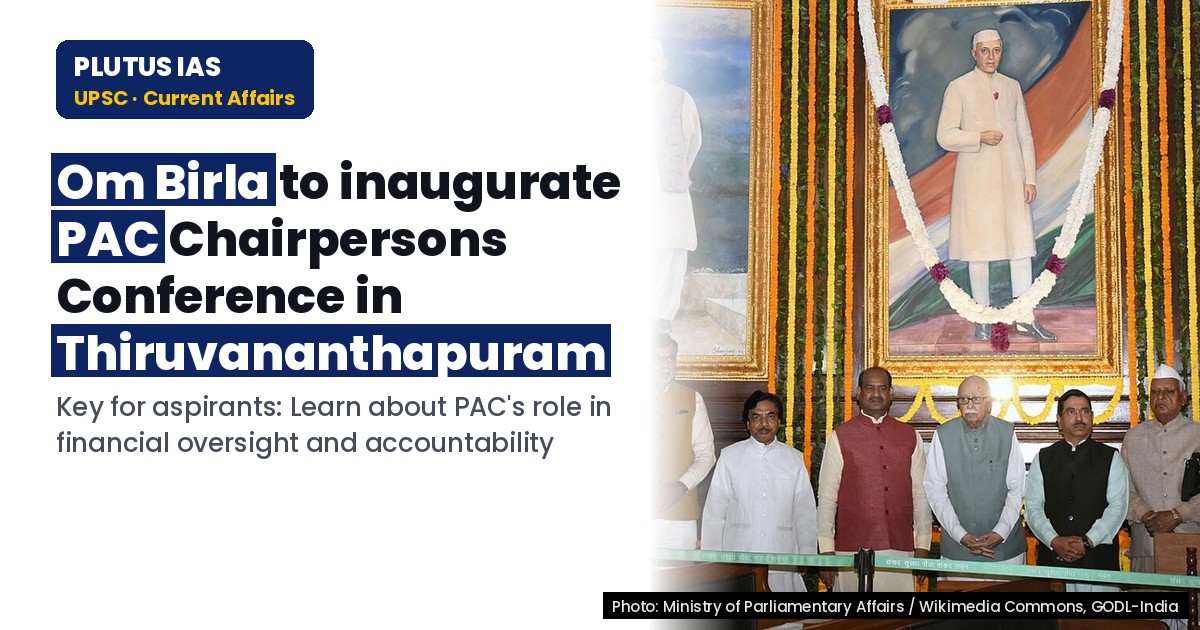
01 Nov Lok Sabha Speaker to Inaugurate PAC Chairpersons Conference in Thiruvananthapuram
✎ The Public Accounts Committee (PAC) is a parliamentary committee tasked with examining the audit reports of the CAG to ensure financial accountability and efficient utilisation of public funds by the government.
Subject Relevance — Where This Topic Fits
- GS Paper II — Parliament and State Legislatures — Structure, Functioning, Conduct of Business, Powers & Privileges and Issues Arising Out of these | GS Paper III — Government Budgeting and Fiscal Policy
- Prelims: Public Accounts Committee (PAC), Constitutional provisions under Article 149, Role of Comptroller and Auditor General (CAG), Financial accountability mechanisms, Parliamentary oversight of executive
- Essay: The efficacy of parliamentary oversight in a parliamentary democracy: A case study of Public Accounts Committees, Fiscal federalism and cooperative federalism in India: The role of State PACs
Quick Revision: The Public Accounts Committee (PAC) is a parliamentary committee tasked with examining the audit reports of the CAG to ensure financial accountability and efficient utilisation of public funds by the government.
Why is this in the news?
The Lok Sabha Speaker is scheduled to inaugurate the Conference of Chairpersons of Public Accounts Committees (PACs) of Parliament and State/UT Legislatures in Thiruvananthapuram. This conference assumes significance as it provides a platform for Chairpersons of PACs across India to deliberate on best practices, challenges, and reforms in parliamentary financial oversight, thereby enhancing the effectiveness of fiscal accountability mechanisms in the federal governance structure.
Background
- The Public Accounts Committee (PAC) is a parliamentary committee tasked with examining the audit reports of the Comptroller and Auditor General (CAG) of India.
- PACs exist at both the Union and State levels, functioning as parliamentary committees to scrutinise the expenditure of the government, ensuring that public funds are utilised efficiently and in accordance with legislative intent.
- The PAC operates on the principle of financial accountability, with its recommendations carrying significant weight in shaping fiscal policies and administrative reforms.
- The conference of Chairpersons of PACs is a biennial event, providing an opportunity for cross-learning and coordination among PACs across different legislative bodies.
- The Thiruvananthapuram conference is being held in Kerala, a state known for its robust fiscal management and emphasis on transparency in governance.
- The event underscores the importance of inter-governmental cooperation in strengthening fiscal oversight, particularly in the context of India’s cooperative federalism framework.
What is the Public Accounts Committee (PAC)?
- Composition: The PAC consists of not more than 15 members from the Lok Sabha and not more than 7 members from the Rajya Sabha. Members are elected by the respective Houses through a system of proportional representation.
- Term: Members serve for a period of one year, ensuring continuity and periodic renewal of membership.
- Functions: The primary function of the PAC is to examine the annual audit reports of the CAG, which include reports on the accounts of the Union Government, State Governments, and Union Territories.
- Scope of Examination: The PAC examines whether the money granted by Parliament has been spent by the government within the scope of the demand, and whether the expenditure conforms to the financial rules and procedures.
- Recommendations: The PAC submits its reports to Parliament, which may include recommendations for corrective actions, reforms, or further investigations. These reports are tabled in Parliament and are a critical input for legislative oversight.
- Role of CAG: The CAG acts as the ‘friend, philosopher, and guide’ to the PAC, providing technical expertise and audit findings that form the basis of the PAC’s scrutiny.
- State-Level PACs: Similar committees exist in State Legislatures, with the same mandate of examining the audit reports of the State CAGs. These committees play a crucial role in ensuring fiscal accountability at the sub-national level.
- Challenges: The PAC faces challenges such as delays in the submission of audit reports, limited technical expertise among members, and the need for stronger follow-up mechanisms to implement its recommendations.
Key Features
| Feature | Significance |
|---|---|
| Conference of Chairpersons of Public Accounts Committees (PACs) | Provides a platform for coordination between Parliament and State/UT legislatures on financial oversight mechanisms. |
| Inauguration by Lok Sabha Speaker | Highlights the constitutional role of the Speaker in ensuring accountability in public finance through PACs. |
| Thiruvananthapuram as host | Emphasizes Kerala’s role in fostering discussions on fiscal federalism and cooperative governance. |
| Focus on Public Accounts Committees | Reinforces the importance of legislative scrutiny in preventing financial irregularities and ensuring transparency. |
Why it Matters
Constitutional and Institutional Significance
- The Public Accounts Committee (PAC) is a constitutional body under Article 149, tasked with examining the audit reports of the Comptroller and Auditor General (CAG) to ensure legislative oversight over executive expenditure.
- The conference facilitates inter-institutional dialogue between the Union and State PACs, promoting uniformity in financial scrutiny and best practices.
- The Speaker of the Lok Sabha, as the presiding officer of the PAC in the Parliament, plays a pivotal role in setting the agenda for financial accountability.
- The event underscores the principle of cooperative federalism by involving State/UT legislatures in a national-level discussion on fiscal governance.
Governance and Accountability
- PACs act as a bridge between the executive and the legislature, ensuring that public funds are utilised efficiently and in accordance with parliamentary approvals.
- The conference provides an opportunity to review the implementation of recommendations from previous PAC reports and identify systemic gaps in financial governance.
- It reinforces the role of the CAG as the supreme audit authority, whose reports form the basis of PAC scrutiny.
- The event highlights the need for timely submission of audit reports and their subsequent examination by PACs to prevent financial mismanagement.
Policy and Reform Implications
- Discussions at the conference may lead to recommendations for strengthening the institutional capacity of PACs, including training for members and access to technical expertise.
- It can serve as a platform to address challenges such as delayed audits, lack of follow-up on PAC recommendations, and coordination gaps between Union and State PACs.
- The conference may propose measures to enhance the transparency of government financial statements and ensure their alignment with legislative scrutiny requirements.
Challenges
1. Institutional Capacity and Expertise
- Many PACs, particularly at the State level, face challenges due to limited technical expertise in financial auditing and accounting.
- Inadequate staff support and resources hinder the effective functioning of PACs, leading to delays in report examination.
- Lack of standardised training for PAC members may result in inconsistent scrutiny of financial reports.
UPSC Link: Parliamentary Committees (Lok Sabha/Rajya Sabha)
2. Coordination Gaps Between Union and State PACs
- Differences in procedural norms and reporting formats between Union and State PACs can impede seamless coordination.
- Inconsistent follow-up on PAC recommendations across States may lead to fragmented accountability mechanisms.
- Absence of a unified digital platform for sharing audit reports and PAC recommendations can create information asymmetries.
UPSC Link: Cooperative Federalism
3. Timeliness and Quality of Audit Reports
- Delays in the submission of audit reports by the CAG to legislatures can undermine the PAC’s ability to conduct timely scrutiny.
- Poor quality or lack of detail in audit reports may limit the PAC’s capacity to identify financial irregularities.
- Overburdened audit institutions may struggle to meet the demand for comprehensive and timely financial audits.
UPSC Link: Role of CAG (Article 148-151)
4. Implementation of PAC Recommendations
- Weak enforcement mechanisms for PAC recommendations often result in limited follow-up by the executive branch.
- Lack of statutory backing for PAC recommendations may reduce their binding impact on government actions.
- Political and administrative resistance to recommendations can hinder their implementation.
UPSC Link: Parliamentary Control over Executive
Challenges — UPSC Perspective
| Issue | Concern |
|---|---|
| Delayed submission of audit reports | Undermines the PAC’s ability to conduct timely scrutiny of public expenditure. |
| Limited technical expertise in PACs | Leads to inconsistent and superficial examination of financial reports. |
| Inconsistent follow-up on recommendations | Results in fragmented accountability across Union and State levels. |
| Lack of standardised training for PAC members | Contributes to variations in scrutiny quality and effectiveness. |
| Absence of a unified digital platform | Creates information asymmetries and coordination challenges. |
Way Forward
- Strengthen the institutional capacity of PACs by providing specialised training for members on financial auditing and accounting standards.
- Develop a unified digital platform for sharing audit reports, PAC recommendations, and follow-up actions between Union and State PACs.
- Enhance coordination mechanisms between the Union and State PACs to ensure uniformity in financial scrutiny and accountability.
- Establish a statutory framework to ensure the binding nature of PAC recommendations and improve their implementation by the executive.
- Encourage the CAG to expedite the submission of audit reports and improve their quality to facilitate effective PAC scrutiny.
- Promote the use of technology, such as AI and data analytics, to identify financial irregularities and streamline audit processes.
- Foster inter-institutional dialogue through regular conferences and workshops to share best practices and address common challenges.
UPSC Value Addition
Keywords for Mains Answer-Writing
Public Accounts Committee (PAC) · Parliamentary oversight · Financial accountability · Legislative institutions · Constitutional bodies · Fiscal federalism · Legislative procedures · Parliamentary democracy · Comptroller and Auditor General of India (CAG) · Legislative committees · State legislatures · Union Territories · Speaker of Lok Sabha · Parliamentary committees · Financial scrutiny
Constitutional & Policy Linkages
- Article 151: Reports of the Comptroller and Auditor-General
- Article 266: Consolidated Funds of India and States
Concept Flow
Constitutional mandate for financial oversight (Article 149) → Establishment of PACs in Parliament and State legislatures → Examination of CAG audit reports → Identification of financial irregularities → Formulation of PAC recommendations → Executive implementation of recommendations → Legislative follow-up and accountability.
Prelims Practice Questions
Q1. Consider the following statements regarding the Public Accounts Committee (PAC) of Parliament in India:
1. The PAC is a standing committee of Parliament.
2. It examines the audit reports of the Comptroller and Auditor General of India (CAG).
3. The PAC can summon officials and ministers to appear before it.
4. The PAC is chaired by the Speaker of the Lok Sabha.
How many of the above statements are correct?
- Only one
- Only two
- Only three
- All four
Answer: All four — Statements 1, 2, and 3 are correct. The PAC is indeed a standing committee of Parliament, examines CAG audit reports, and can summon officials. Statement 4 is incorrect as the PAC is chaired by the Chairman of the Rajya Sabha or a member of the Lok Sabha, not the Speaker.
Q2. Assertion (A): The Public Accounts Committee (PAC) in India is a financial committee of Parliament.
Reason (R): The PAC examines the appropriation accounts and the finance accounts of the Union Government.
Options:
A. Both A and R are true, and R is the correct explanation of A.
B. Both A and R are true, but R is not the correct explanation of A.
C. A is true, but R is false.
D. A is false, but R is true.
Answer: ? — Both Assertion (A) and Reason (R) are true. The PAC is a financial committee of Parliament, and it examines the appropriation accounts and finance accounts of the Union Government. R correctly explains A.
Mains Practice Question
✍ The Public Accounts Committee (PAC) serves as a critical instrument for legislative oversight of executive financial accountability. Critically examine the role and significance of the PAC in India’s parliamentary democracy, with reference to its composition, functions, and limitations. (15 Marks)
Approach: MODEL-ANSWER SKELETON:
1. Introduction (2 marks):
– Define the PAC as a constitutional/parliamentary committee under Article 149 of the Constitution and Rule 308 of the Rules of Procedure and Conduct of Business in Lok Sabha.
– State its primary role: ensuring financial accountability of the executive through post-facto scrutiny of government expenditure.
2. Composition and Structure (3 marks):
– Membership: 15 members from Lok Sabha and 7 from Rajya Sabha; elected by proportional representation.
– Chairmanship: Traditionally chaired by a member of the Opposition (convention, not constitutional mandate).
– Term: One year.
3. Functions and Powers (4 marks):
– Examines CAG reports on appropriation accounts, finance accounts, and audit reports.
– Can summon officials, ministers, and experts; examines witnesses under oath.
– Reports to Parliament with recommendations for corrective action.
– Examines reports of autonomous bodies receiving government funds.
4. Significance in Parliamentary Democracy (3 marks):
– Acts as a check on executive excesses and financial impropriety.
– Enhances transparency and accountability in public spending.
– Strengthens fiscal federalism by scrutinizing state-level expenditures via State PACs.
– Upholds the principle of ‘no taxation without representation.’
5. Limitations and Challenges (3 marks):
– Post-facto scrutiny limits preventive action.
– Recommendations are advisory; no binding authority on the executive.
– Political considerations may influence proceedings (e.g., opposition-led chairmanship).
– Limited resources and expertise compared to executive agencies like CAG.
– Delayed reports due to procedural bottlenecks.
6. Recent Initiatives and Contemporary Relevance (2 marks):
– Inclusion of State/UT PAC chairpersons in national conferences (e.g., Thiruvananthapuram event) to harmonize fiscal oversight.
– Digitalization of reports and evidence for wider accessibility.
– Need for proactive recommendations to prevent financial lapses.
Balance of Views:
– Supporters argue PAC is the ‘watchdog of the public purse’ (e.g., N. Gopalaswami Ayyangar).
– Critics highlight its reactive nature and lack of punitive powers (e.g., D.D. Basu).
Source: PIB (Press Information Bureau)
Kerala PCS (Kerala PSC (KAS)) — State PCS Practice
Prelims: Who inaugurated the Conference of Chairpersons of Public Accounts Committees (PACs) of Parliament of India and State/UT Legislatures held in Thiruvananthapuram in 2024?
- A. The President of India
- B. The Vice-President of India
- C. The Speaker of the Lok Sabha
- D. The Chief Justice of India
Answer: C. The Speaker of the Lok Sabha — The Lok Sabha Speaker inaugurated the conference, highlighting the role of PACs in legislative oversight.
Mains: Discuss the significance of the Conference of Chairpersons of Public Accounts Committees (PACs) in strengthening fiscal accountability and governance in India. Examine the role of Kerala’s PAC in this context.
Generated by AanyaAi for educational purpose.
Related guides on our sites
- Anthropology VS PSIR
- Best PSIR optional coaching
- Best PSIR optional coaching online
- Best PSIR optional teacher

- Lok Sabha Speaker to Inaugurate PAC Chairpersons Conference in Thiruvananthapuram - November 1, 2026
- छत्तीसगढ़ सरकार ने मीडिया कर्मियों के लिए बीमा योजना का प्रारूप जारी किया, सुझाव आमंत्रित - November 1, 2026
- Lok Sabha Speaker Urges Youth to Uphold National Unity for Developed India - November 1, 2026

No Comments