


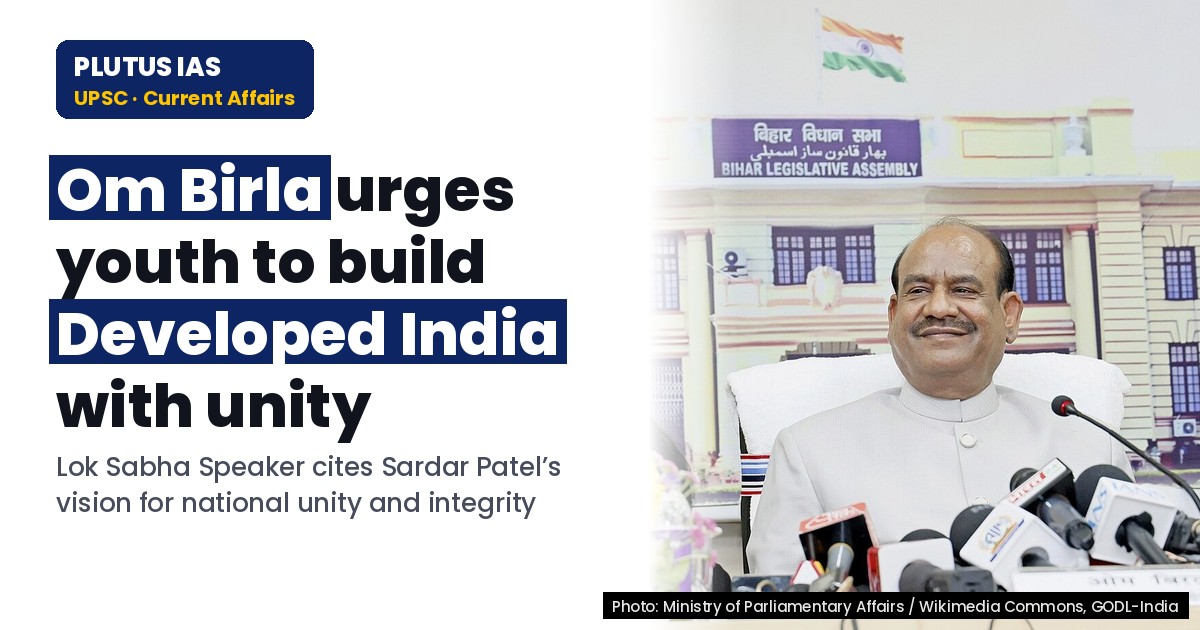
01 Nov Lok Sabha Speaker Urges Youth to Uphold National Unity for Developed India
✎ Sardar Patel’s integration of princely states and his governance principles remain foundational to India’s territorial integrity and administrative resilience, serving as a timeless reference for national unity and developmental…
Subject Relevance — Where This Topic Fits
- GS Paper II — Polity and Governance (Role of Constitutional Institutions) | GS Paper IV — Ethics and Integrity (Leadership and National Integration)
- Prelims: Lok Sabha Speaker, National Integration Council, Sardar Patel’s role in integration of princely states, Constitution Hall (Central Hall of Parliament), Article 1 of the Constitution (Union and its territory)
- Essay: National Integration: The Bedrock of a Strong and Inclusive India, Youth as Catalysts for India’s Transformation into a Developed Nation
Quick Revision: Sardar Patel’s integration of princely states and his governance principles remain foundational to India’s territorial integrity and administrative resilience, serving as a timeless reference for national unity and developmental governance.
Why is this in the news?
The Lok Sabha Speaker, Shri Om Birla, paid floral tributes to Sardar Vallabhbhai Patel on his birth anniversary at the Central Hall of Parliament, emphasizing his legacy of national integration and calling upon the youth to contribute to the construction of a developed India. The event, attended by political leaders, parliamentarians, and students, underscored the enduring relevance of Patel’s vision in the context of contemporary governance challenges and the imperative of fostering unity amidst diversity.
Background
- Sardar Vallabhbhai Patel, popularly known as the ‘Iron Man of India,’ played a pivotal role in the integration of over 560 princely states into the Indian Union post-Independence, thereby ensuring the territorial integrity of the nation.
- The Central Hall of Parliament, also referred to as the Constitution Hall, is a symbol of India’s democratic journey, having witnessed key moments such as the adoption of the Constitution and debates on national policies.
- National integration remains a constitutional and governance priority, as enshrined in the Preamble of the Constitution, which aims to secure justice, liberty, equality, and fraternity for all citizens.
- Parliamentary institutions, including the Lok Sabha and Rajya Sabha, serve as forums for deliberation on national unity, policy formulation, and the implementation of developmental schemes.
Sardar Vallabhbhai Patel: Architect of National Integration and Governance
- Sardar Patel was a key leader in the Indian independence movement and a close associate of Mahatma Gandhi, advocating for non-violent resistance and civil disobedience.
- Post-Independence, he served as the first Deputy Prime Minister and Minister of Home Affairs, leading the integration of princely states into the Indian Union through diplomatic negotiations and decisive action.
- His leadership exemplified the principles of federalism, administrative efficiency, and the primacy of national interest over regional or personal ambitions.
- Patel’s vision extended to the establishment of a strong administrative framework, including the creation of the Indian Administrative Service (IAS) and the Indian Police Service (IPS), to ensure governance continuity and institutional strength.
- His emphasis on unity and diversity was rooted in the constitutional principle of ‘Unity in Diversity,’ which remains a cornerstone of India’s pluralistic democracy.
- Patel’s administrative acumen was instrumental in resolving disputes such as the integration of Hyderabad and Junagadh, demonstrating his ability to balance firmness with inclusivity.
- The ‘Sardar Patel National Unity Award,’ instituted in his honour, recognizes contributions to national integration and social harmony.
Key Features
| Feature | Significance |
|---|---|
| National Integration under Sardar Patel | Demonstrated the critical role of decisive leadership and administrative acumen in unifying a diverse polity post-independence, ensuring territorial integrity despite centrifugal tendencies. |
| Role of Lok Sabha Speaker | Serves as the constitutional authority to uphold parliamentary traditions, symbolising continuity of democratic governance and national unity through symbolic gestures like floral tributes. |
| Youth Engagement in Nation-Building | Highlights the constitutional mandate for participatory democracy, where youth represent the demographic dividend essential for sustainable development and innovation. |
| Parliament as Constitutional Hall | Functions as the seat of legislative sovereignty, embodying the spirit of constitutionalism and serving as a living repository of India’s democratic heritage. |
| Symbolic Homage to Historical Figures | Reinforces the pedagogical value of constitutional morality, linking past sacrifices to present civic duties and fostering a culture of remembrance and responsibility. |
Why it Matters
Constitutional and Democratic
- Reaffirms the constitutional principle of unity in diversity, as enshrined in the Preamble, by invoking the legacy of Sardar Patel, whose actions exemplified the integration of princely states into the Indian Union.
- Demonstrates the institutional continuity of parliamentary democracy, where symbolic acts like floral tributes reinforce the legitimacy and sanctity of constitutional institutions.
- Emphasises the role of elected representatives in maintaining national cohesion, aligning with the constitutional duty of legislators to promote the welfare of all citizens.
Historical and Pedagogical
- Serves as a reminder of the historical challenges faced during nation-building, particularly the integration of over 560 princely states, which required exceptional negotiation and administrative skills.
- Provides a pedagogical tool for inculcating constitutional values among youth, linking the sacrifices of freedom fighters to contemporary civic responsibilities.
- Highlights the importance of leadership in crisis management, as evidenced by Sardar Patel’s role in integrating Hyderabad, Junagadh, and Jammu & Kashmir into the Indian Union.
Youth and Developmental
- Positions the youth as the vanguard of India’s developmental journey, aligning with the constitutional vision of a progressive and inclusive society.
- Encourages the harnessing of demographic dividend through innovation, scientific temper, and collective effort, as envisaged in the Directive Principles of State Policy (Article 51A).
- Promotes the idea of a ‘developed India’ by 2047, integrating youth aspirations with national goals of economic growth, social justice, and technological advancement.
Institutional and Symbolic
- Reinforces the sanctity of the Parliament as a constitutional institution, where symbolic acts like floral tributes to national figures underscore the continuity of democratic traditions.
- Demonstrates the role of parliamentary leadership in fostering national unity, aligning with the constitutional duty of the Speaker to maintain decorum and order in the House.
- Serves as a reminder of the Parliament’s role in shaping India’s socio-economic policies, as it remains the primary forum for debate and decision-making on national priorities.
Challenges
1. Maintaining National Unity in Diversity
- Preserving national cohesion amid linguistic, cultural, and regional diversities, which requires continuous efforts to foster a shared national identity.
- Addressing the challenges posed by separatist movements, communal tensions, and regional imbalances that threaten the integrity of the Indian Union.
- Ensuring equitable development across states to prevent alienation and discontent among marginalised sections of society.
UPSC Link: GS2: Indian Constitution—Historical Underpinnings, Evolution
2. Youth Participation and Civic Responsibility
- Encouraging meaningful youth engagement in governance and nation-building, beyond symbolic gestures, to ensure their active contribution to policy formulation.
- Addressing the gap between youth aspirations and ground realities, particularly in employment, education, and skill development.
- Promoting constitutional literacy among youth to foster a culture of responsible citizenship and democratic participation.
UPSC Link: GS4: Ethics and Human Interface—Role of Youth
3. Administrative and Institutional Challenges
- Ensuring the effective functioning of parliamentary institutions, including the Lok Sabha and Rajya Sabha, to maintain their credibility and relevance in a dynamic political landscape.
- Addressing the challenges of bureaucratic inertia and red tape that impede efficient governance and service delivery.
- Strengthening the capacity of constitutional bodies like the Election Commission and the Judiciary to uphold democratic values and electoral integrity.
UPSC Link: GS2: Parliament and State Legislatures—Structure, Functioning
4. Economic and Social Inequality
- Bridging the socio-economic divide to ensure inclusive growth, particularly in rural and tribal areas, where disparities remain pronounced.
- Addressing the challenges of unemployment, underemployment, and skill gaps among youth, which pose a threat to social stability and national progress.
- Ensuring equitable access to education, healthcare, and basic amenities to prevent the marginalisation of vulnerable sections of society.
UPSC Link: GS3: Inclusive Growth and Issues Arising from it
5. Technological and Ethical Challenges
- Balancing the benefits of technological advancement with ethical considerations, particularly in the realms of artificial intelligence, data privacy, and digital governance.
- Addressing the digital divide to ensure that technological progress does not exacerbate existing inequalities, particularly in rural and remote areas.
- Promoting a culture of innovation and entrepreneurship among youth to harness their potential for national development.
UPSC Link: GS3: Science and Technology—Developments and their Applications
Challenges — UPSC Perspective
| Issue | Concern |
|---|---|
| Linguistic and Cultural Fragmentation | Risk of regional identities overshadowing national unity, necessitating inclusive policies and inter-state cooperation. |
| Regional Imbalances | Economic and developmental disparities between states may lead to alienation and demands for greater autonomy or secession. |
| Youth Unemployment and Underemployment | High rates of unemployment among educated youth can fuel discontent and undermine social stability. |
| Technological Divide | Unequal access to digital infrastructure may widen socio-economic gaps, particularly in rural areas. |
| Administrative Inefficiency | Bureaucratic delays and red tape can impede policy implementation and service delivery, eroding public trust in institutions. |
| Ethical Dilemmas in Governance | Balancing rapid technological progress with ethical considerations, such as data privacy and AI governance, poses significant challenges. |
Way Forward
- Institutionalise youth engagement through structured programmes like the National Youth Parliament Scheme to foster constitutional literacy and democratic participation.
- Strengthen parliamentary oversight mechanisms to ensure transparency, accountability, and efficiency in governance, aligning with the constitutional vision of a welfare state.
- Promote inter-state cooperation and cultural exchange programmes to foster national unity and mitigate regional imbalances.
- Expand access to quality education, skill development, and employment opportunities for youth, particularly in rural and tribal areas, to harness their demographic dividend.
- Enhance the capacity of constitutional bodies like the Election Commission and the Judiciary to uphold democratic values and electoral integrity.
- Encourage innovation and entrepreneurship among youth through policy incentives, incubation centres, and mentorship programmes to drive economic growth.
- Address the digital divide by expanding broadband connectivity, digital literacy programmes, and affordable access to technology in underserved regions.
- Promote a culture of constitutional morality and civic responsibility among youth through educational curricula, public campaigns, and community engagement initiatives.
UPSC Value Addition
Keywords for Mains Answer-Writing
National Integration · Integrated Approach to Development · Role of Youth in Nation Building · Sardar Vallabhbhai Patel’s Vision · Lok Sabha Speaker’s Address · Constitutional Assembly · Administrative Acumen · Decisive Leadership · Unity in Diversity · Socio-Political Cohesion · Institutional Contributions to Governance · Ethical Governance · National Symbols and Values
Constitutional & Policy Linkages
- [‘Article 1 – Union of States’, ‘Defines the territorial integrity and federal structure of India.’]
- [‘Article 51A – Fundamental Duties’, ‘Outlines the civic responsibilities of citizens, including promoting harmony and safeguarding public property.’]
- [‘Seventh Schedule – State List’, ‘Highlights the division of powers between the Union and States, crucial for maintaining federal balance.’]
- [‘Preamble – Unity and Integrity of the Nation’, ‘Emphasises the constitutional commitment to national unity and integrity.’]
- [‘Article 370 (Repealed) – Historical Context’, “Illustrates the challenges of integrating diverse regions into the Indian Union, as exemplified by Sardar Patel’s efforts.”]
Concept Flow
Historical Context of National Integration → Sardar Patel’s Role in Unifying Princely States → Constitutional Vision of Unity in Diversity → Parliamentary Symbolism and Youth Engagement → Future Challenges and Way Forward for Nation-Building → Colonial Legacy of Fragmented Territories → Post-Independence Challenges of Integration → Constitutional Framework for Federalism → Symbolic Acts in Parliament to Reinforce National Unity → Youth as Agents of Change in Developing India → Sardar Patel’s Administrative and Negotiation Skills → Integration of 560+ Princely States → Constitutional Principles of Sovereignty and Integrity → Lok Sabha Speaker’s Call for Youth Participation → Developmental Goals and Inclusive Growth → Parliament as the Seat of Constitutional Democracy → Symbolic Homage to National Figures → Pedagogical Value for Youth → Civic Responsibility and Constitutional Literacy → Harnessing Demographic Dividend for National Progress → Challenges of Regional Imbalances and Linguistic Fragmentation → Role of Constitutional Institutions in Maintaining Unity → Youth Engagement in Governance → Technological and Ethical Challenges in Governance → Way Forward for Inclusive and Sustainable Development
Prelims Practice Questions
Q1. Consider the following statements regarding Sardar Vallabhbhai Patel’s contributions to India’s integration:
1. He played a pivotal role in the integration of approximately 560 princely states into the Indian Union.
2. His leadership was instrumental in resolving the integration of Hyderabad through military action.
3. Patel’s approach to integration was purely coercive, with no emphasis on diplomacy or negotiation.
How many of the above statements are correct?
- Only one
- Only two
- All three
- None
Answer: Only two — Statement 1 is correct as Patel successfully integrated around 560 princely states. Statement 2 is correct as the integration of Hyderabad (Operation Polo) involved military action. Statement 3 is incorrect as Patel’s approach combined diplomacy, negotiation, and coercion as necessary.
Q2. Assertion (A): The role of the Speaker of the Lok Sabha extends beyond procedural duties to include fostering national unity and integrity.
Reason (R): The Speaker, as the head of the Lok Sabha, is constitutionally mandated to ensure the smooth functioning of the House and represent the collective will of the people.
In the context of the above two statements, which one of the following is correct?
- Both A and R are true, and R is the correct explanation of A.
- Both A and R are true, but R is NOT the correct explanation of A.
- A is true, but R is false.
- A is false, but R is true.
Answer: A is true, but R is false. — While the Speaker’s constitutional role includes ensuring the smooth functioning of the House (R), the assertion (A) about fostering national unity and integrity is a broader responsibility derived from the Speaker’s institutional position and public role, not a direct constitutional mandate.
Q3. Match the following pairs related to Sardar Vallabhbhai Patel’s contributions:
Column I (Contribution) Column II (Description)
A. Integration of Princely States 1. Operation Polo
B. Economic Integration 2. Abolition of Zamindari System
C. Administrative Integration 3. Creation of unified civil services
D. Military Integration 4. Merger of Junagadh and Hyderabad
Choose the correct match:
- A-4, B-2, C-3, D-1
- A-1, B-3, C-2, D-4
- A-2, B-1, C-4, D-3
- A-3, B-4, C-1, D-2
Answer: A-4, B-2, C-3, D-1 — A-4: Patel played a key role in the integration of Junagadh and Hyderabad. B-2: He was instrumental in the abolition of the Zamindari system. C-3: Patel established a unified civil service to strengthen administrative integration. D-1: Operation Polo was the military action to integrate Hyderabad.
Mains Practice Question
✍ Discuss the significance of Sardar Vallabhbhai Patel’s administrative and political contributions in shaping India’s post-independence nation-building process. How do his principles of unity, integrity, and decisive leadership remain relevant in contemporary India? (15 Marks)
Approach: MODEL-ANSWER SKELETON:
1. **Introduction**: Briefly introduce Sardar Patel’s role as the ‘Iron Man of India’ and his contributions during the integration of princely states and post-independence governance.
2. **Administrative Contributions**:
– **Integration of Princely States**: Highlight the integration of approximately 560 princely states, including Hyderabad (Operation Polo), Junagadh, and Kashmir, through a combination of diplomacy, negotiation, and coercion.
– **Unified Civil Services**: Emphasise his role in establishing the Indian Administrative Service (IAS) and Indian Police Service (IPS) to ensure administrative cohesion.
– **Abolition of Zamindari System**: Discuss his efforts to reform land revenue systems and abolish intermediaries like the Zamindars to promote social justice.
3. **Political Contributions**:
– **Role in the Constituent Assembly**: Mention his contributions to the drafting of the Indian Constitution, particularly his advocacy for a strong Centre.
– **Ministerial Role**: Highlight his tenure as the first Deputy Prime Minister and Home Minister, where he laid the foundation for India’s federal structure.
4. **Principles of Unity and Integrity**:
– **Synthesis of Diversity**: Explain Patel’s vision of a united India that respected diversity while maintaining national cohesion.
– **Decisive Leadership**: Discuss his ability to take bold decisions, such as the integration of Hyderabad, and his emphasis on collective national goals over parochial interests.
5. **Relevance in Contemporary India**:
– **Challenges of Federalism**: Discuss how Patel’s principles of unity and integrity remain relevant in addressing contemporary challenges like regionalism, separatism, and communal tensions.
– **Administrative Reforms**: Highlight the continued relevance of his administrative reforms, such as the IAS, in maintaining governance coherence.
– **Youth and Nation-Building**: Connect his vision to the role of youth in nation-building, as emphasised by the Lok Sabha Speaker in the given context.
6. **Conclusion**: Summarise Patel’s enduring legacy and his contributions to India’s socio-political and administrative fabric, underscoring the need to uphold his principles in modern governance.
Source: PIB (Press Information Bureau)
Generated by AanyaAi for educational purpose.
Related guides on our sites
- Anthropology VS PSIR
- Best PSIR optional coaching
- Best PSIR optional coaching online
- Best PSIR optional teacher

- Lok Sabha Speaker Urges Youth to Uphold National Unity for Developed India - November 1, 2026
- कर्नाटक में आधिकारिक मान्यता मिल सकती है कन्नड़ ध्वज, सीएम शिवाकुमार का बड़ा ऐलान - November 1, 2026
- Odisha’s Wetland Conservation: Key Steps for UPSC & State PCS - November 1, 2026

No Comments