


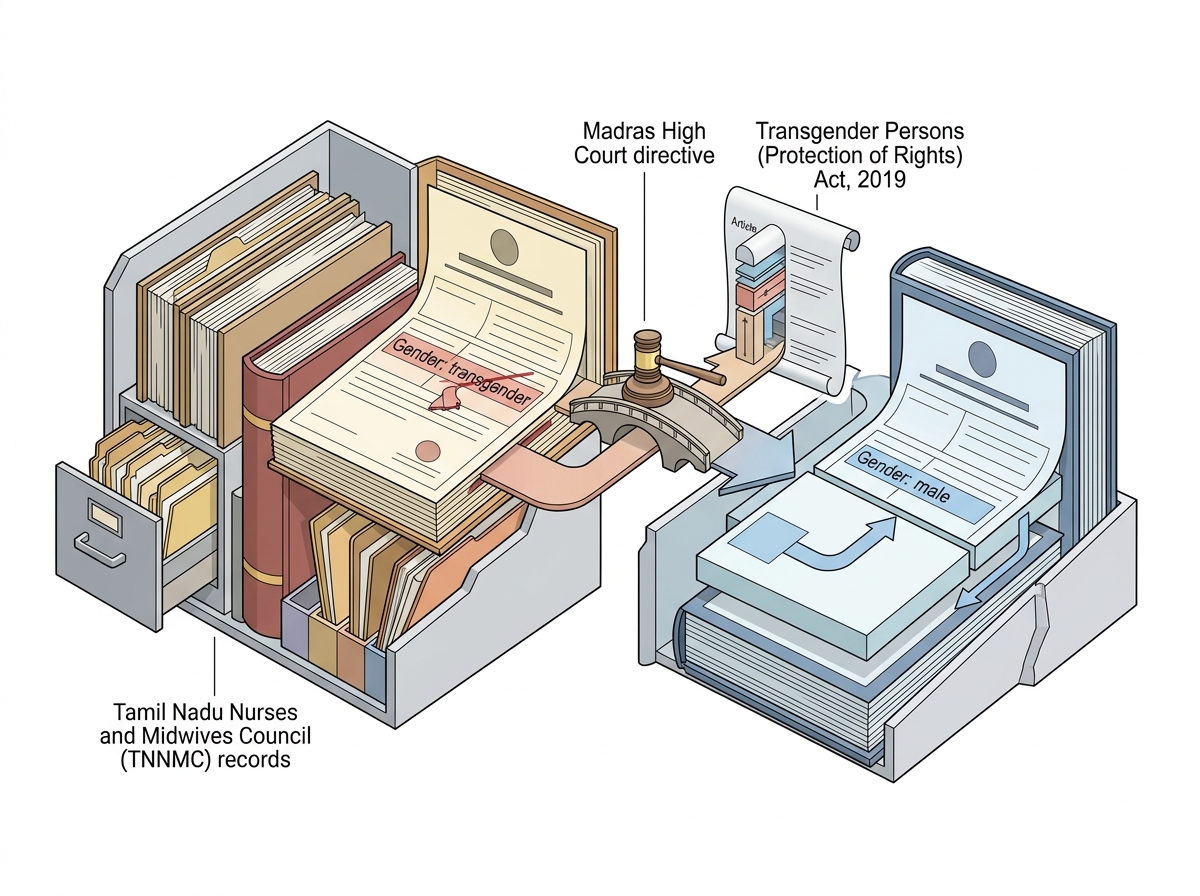
01 Sep Madras HC Orders TN Nursing Council to Correct Gender Records
✎ The Transgender Persons (Protection of Rights) Act, 2019, read with the NALSA judgment (2014), provides the legal framework for gender identity recognition in India, mandating that professional councils must reflect the gender…
Subject Relevance — Where This Topic Fits
- GS Paper II — Fundamental Rights, Constitutional Law | GS Paper III — Social Justice, Inclusive Growth
- Prelims: Transgender Persons (Protection of Rights) Act, 2019, Article 21 of the Constitution, Madras High Court, Gender Affirmation Surgery, Nursing Council Registration, Gender Identity Certificate
- Essay: The Interface of Constitutional Rights and Social Identity: A Case for Inclusive Legal Recognition, Technology, Identity, and the Law: Balancing Autonomy with Administrative Precision
Quick Revision: The Transgender Persons (Protection of Rights) Act, 2019, read with the NALSA judgment (2014), provides the legal framework for gender identity recognition in India, mandating that professional councils must reflect the gender identity of registrants as per their gender identity certificates.
Why is this in the news?
The Madras High Court has issued a directive to the Tamil Nadu Nurses and Midwives Council (TNNMC) to correct the gender marker of a registrant from ‘transgender’ to ‘male’ in official records, underscoring the legal and administrative dimensions of gender identity recognition. The order raises critical questions about the interplay between personal autonomy in gender identity, statutory frameworks, and the procedural obligations of professional councils in maintaining accurate and stigma-free records.
Background
- The Transgender Persons (Protection of Rights) Act, 2019 (2019 Act) was enacted to protect the rights of transgender persons and provide for their welfare, including legal recognition of gender identity.
- Section 6 of the 2019 Act empowers transgender persons to register with a designated authority, such as the Tamil Nadu Transgender Welfare Board, for issuance of a transgender identity card.
- Section 7 of the 2019 Act enables transgender persons to obtain a gender identity certificate from a district magistrate following gender affirmation surgery or other prescribed procedures, facilitating legal recognition of their gender identity.
- Professional councils, such as the TNNMC, are statutory bodies responsible for maintaining registers of professionals, including nurses and midwives, and ensuring compliance with registration norms.
- The petitioner underwent gender affirmation surgery in 2024, changed their name in the official gazette, and obtained a gender identity certificate under Section 7 of the 2019 Act, reflecting a transition in gender identity.
- The petitioner sought to migrate to Karnataka and requested the removal of any reference to their previous gender identity in professional records to avoid potential stigma in the new jurisdiction.
What is the Legal Framework Governing Gender Identity Recognition in India?
- The Transgender Persons (Protection of Rights) Act, 2019 is the primary legislation governing the rights of transgender persons in India, including legal recognition of gender identity.
- Section 6 of the Act provides for the issuance of a transgender identity card by a designated authority, such as a State Transgender Welfare Board, to transgender persons who self-identify as such.
- Section 7 of the Act enables transgender persons to obtain a gender identity certificate from a district magistrate after undergoing a prescribed procedure, such as gender affirmation surgery, to legally change their gender marker.
- The Act mandates that all relevant government and private entities must recognize the gender identity of transgender persons as reflected in their gender identity certificate, ensuring non-discrimination and inclusion.
- The Supreme Court’s landmark judgment in *National Legal Services Authority v. Union of India* (2014) recognized the rights of transgender persons under Articles 14, 15, 19, and 21 of the Constitution, affirming their right to self-identify and access legal recognition of their gender identity.
- The NALSA judgment directed the Union and State Governments to take steps for the welfare of transgender persons, including the creation of welfare boards and the issuance of identity cards.
- The 2019 Act was enacted to give effect to the NALSA judgment, though it has been criticized for certain provisions, such as the requirement of a district magistrate’s certificate for gender recognition, which some argue imposes unnecessary procedural burdens.
- Professional councils, such as the TNNMC, are bound by the legal framework governing gender identity recognition and must ensure that their records reflect the gender identity of registrants as per their gender identity certificates.
Key Features
| Feature | Significance |
|---|---|
| Judicial directive on gender marker correction | Reinforces the principle that gender identity is subject to individual choice and legal recognition, while also highlighting the role of courts in safeguarding personal autonomy in administrative records. |
| Striking out prior gender descriptors | Ensures that historical gender markers do not perpetuate stigma or prejudice in official communications, particularly during inter-state professional registrations. |
| Exclusion of transitional notes in transferred records | Prevents the dissemination of sensitive personal history across jurisdictions, thereby protecting the registrant’s right to privacy and dignity. |
| Time-bound compliance (eight weeks) | Demonstrates the judiciary’s emphasis on expeditious resolution of identity-related disputes to avoid prolonged administrative uncertainty. |
| Digital and physical record correction | Underscores the need for comprehensive updating of all official records to reflect the most current legal identity, including both electronic and hard-copy formats. |
Why it Matters
Legal and Judicial
- The judgment reaffirms the judiciary’s role in interpreting and enforcing the rights of transgender individuals under the Transgender Persons (Protection of Rights) Act, 2019, particularly concerning self-identified gender markers.
- It clarifies that courts may intervene to correct administrative records to align with an individual’s post-transition legal identity, ensuring consistency between legal recognition and official documentation.
- The directive serves as a precedent for future cases involving gender marker corrections in professional registrations, particularly in inter-state migration scenarios.
Administrative and Governance
- Highlights the procedural gaps in updating gender markers across multiple administrative bodies, especially in cases of inter-state professional registrations.
- Emphasises the need for standardised protocols in handling gender identity changes in official records to prevent discrimination or stigmatisation.
- Demonstrates the importance of inter-departmental coordination to ensure seamless transitions in identity-related administrative processes.
Social and Human Rights
- Reinforces the right to privacy and dignity by preventing the disclosure of an individual’s gender history in official communications, thereby reducing the risk of social stigma.
- Underscores the principle that gender identity is a matter of personal autonomy and legal recognition, not subject to institutional bias or historical records.
- Serves as a reminder of the ongoing challenges faced by transgender individuals in achieving full social and professional acceptance despite legal recognition.
Professional and Institutional
- Illustrates the complexities faced by transgender individuals in professional mobility, particularly in regulated sectors like nursing where state-level registrations are mandatory.
- Raises questions about the preparedness of professional councils and boards to handle gender identity transitions in their administrative processes.
- May prompt professional councils to review and update their policies on gender marker corrections to align with judicial precedents and legal frameworks.
Challenges
1. Administrative inertia in updating gender markers
- Lack of standardised protocols across state-level professional councils for handling gender identity transitions in registrations.
- Potential delays in updating records due to bureaucratic hurdles or resistance to change in institutional practices.
- Risk of incomplete or inconsistent corrections across digital and physical records, leading to residual discrepancies.
UPSC Link: GS-II: Role of Civil Services in Policy Implementation
2. Inter-state coordination in identity management
- Challenge of ensuring that corrections in one state’s records are accurately reflected in another state’s records during professional migration.
- Risk of miscommunication or omission of corrected gender markers in inter-state record transfers, leading to administrative inconsistencies.
- Need for a centralised or standardised system to track and update gender identity changes across state-level registrations.
UPSC Link: GS-II: Cooperative Federalism and Inter-State Relations
3. Social stigma and workplace discrimination
- Despite legal recognition, transgender individuals may continue to face social stigma or discrimination in professional environments.
- Potential for residual bias in institutions or workplaces, even after gender marker corrections are made in official records.
- Need for awareness campaigns and sensitisation programmes to foster inclusive professional environments.
UPSC Link: GS-I: Social Empowerment and Inclusive Growth
4. Legal ambiguity in gender recognition processes
- Variations in the interpretation and implementation of the Transgender Persons (Protection of Rights) Act, 2019, across different states and institutions.
- Lack of clarity on the process for updating gender markers in professional registrations, particularly for individuals who have undergone gender affirmation surgery.
- Need for judicial and administrative clarity on the rights of transgender individuals in professional and institutional settings.
UPSC Link: GS-II: Judiciary and its Functions
5. Privacy concerns in official communications
- Risk of unintentional disclosure of an individual’s gender history in official communications or records, despite judicial directives.
- Need for robust data protection measures to ensure that sensitive personal information is not inadvertently shared across institutions.
- Challenge of balancing transparency in administrative processes with the right to privacy and dignity of individuals.
UPSC Link: GS-II: Right to Privacy and Data Protection
Challenges — UPSC Perspective
| Issue | Concern |
|---|---|
| Lack of standardised protocols | Inconsistent handling of gender identity transitions across state-level professional councils. |
| Bureaucratic delays | Potential resistance or inertia in updating records, leading to prolonged administrative uncertainty. |
| Inter-state record transfer | Risk of miscommunication or omission of corrected gender markers during professional migration. |
| Social stigma | Continued discrimination or bias in professional environments despite legal recognition. |
| Legal ambiguity | Variations in the interpretation and implementation of gender recognition laws across institutions. |
| Privacy risks | Unintentional disclosure of gender history in official communications or records. |
Way Forward
- Professional councils (e.g., nursing councils) should formulate standardised protocols for updating gender markers in registrations, aligned with judicial precedents and the Transgender Persons (Protection of Rights) Act, 2019.
- State governments and professional bodies should conduct sensitisation programmes to educate officials on the rights of transgender individuals and the importance of accurate gender marker updates.
- A centralised or standardised system should be explored to track and update gender identity changes across state-level registrations, ensuring consistency and reducing administrative errors.
- Judicial training programmes should emphasise the need for expeditious resolution of identity-related disputes to avoid prolonged uncertainty for individuals.
- Awareness campaigns should be launched to foster inclusive professional environments and reduce social stigma faced by transgender individuals.
- Professional councils should review and update their policies on gender identity transitions to ensure compliance with legal frameworks and judicial directives.
- Data protection measures should be strengthened to prevent the unintentional disclosure of sensitive personal information in official communications or records.
UPSC Value Addition
Keywords for Mains Answer-Writing
Transgender Persons (Protection of Rights) Act, 2019 · gender affirmation surgery · gender identity certificate · Madras High Court judgment · Tamil Nadu Nurses and Midwives Council · Karnataka State Nursing Council · self-identified gender · right to privacy · stigma and discrimination · institutional processes and records · gender recognition · legal recognition of gender identity · medical transition · socio-legal implications
Constitutional & Policy Linkages
- Article 14: Equality before law and equal protection of laws
- Article 15: Prohibition of discrimination on grounds of religion, race, caste, sex, or place of birth
- Article 19(1)(a): Freedom of speech and expression
- Article 21: Protection of life and personal liberty
Concept Flow
Individual identifies as transgender and registers with Transgender Welfare Board under Transgender Persons (Protection of Rights) Act, 2019 → Individual undergoes gender affirmation surgery and obtains updated legal identity documents (e.g., gazette notification, gender identification certificate) → Individual seeks to migrate professionally and requests gender marker correction in official records to align with post-transition identity → Professional council (e.g., Tamil Nadu Nurses and Midwives Council) fails to update records, leading to administrative discrepancy → Individual files writ petition in Madras High Court seeking correction of gender marker in records → Court directs council to update records, striking out prior gender descriptors and ensuring no transitional notes are included in transferred records → Council complies with judicial directive, updating records both digitally and physically, and transfers corrected records to Karnataka State Nursing Council → Individual achieves seamless professional migration with updated legal identity, free from stigma or discrimination in official communications
Prelims Practice Questions
Q1. Consider the following statements regarding the Transgender Persons (Protection of Rights) Act, 2019:
1. Section 6 of the Act provides for the issuance of a transgender identity card by the appropriate government.
2. Section 7 empowers a District Magistrate to issue a gender identity certificate to a transgender person.
3. The Act mandates that all educational institutions must reserve 1% of seats for transgender persons.
How many of the above statements are correct?
- Only one
- Only two
- All three
- None
Answer: Only two — Statements 1 and 2 are correct as per Sections 6 and 7 of the Act. Statement 3 is incorrect as the Act does not mandate any reservation in educational institutions.
Q2. Assertion (A): The Madras High Court directed the Tamil Nadu Nurses and Midwives Council to change a member’s gender from ‘transgender’ to ‘male’ in its records.
Reason (R): The petitioner had undergone gender affirmation surgery and obtained a gender identity certificate under Section 7 of the Transgender Persons (Protection of Rights) Act, 2019.
- Both A and R are true, and R is the correct explanation of A.
- Both A and R are true, but R is not the correct explanation of A.
- A is true but R is false.
- A is false but R is true.
Answer: A is true but R is false. — The assertion is true as the court directed the change in records. The reason is also true but does not directly explain the court’s directive, which was based on the petitioner’s request to avoid stigma.
Q3. Match the following provisions of the Transgender Persons (Protection of Rights) Act, 2019 with their descriptions:
Column I (Provisions) | Column II (Descriptions)
— | —
1. Section 6 | A. Prohibition of discrimination
2. Section 7 | B. Issuance of transgender identity card
3. Section 18 | C. Right to self-identified gender
4. Section 15 | D. Protection of rights of transgender persons
- 1-B, 2-C, 3-D, 4-A
- 1-C, 2-B, 3-A, 4-D
- 1-D, 2-A, 3-C, 4-B
- 1-A, 2-D, 3-B, 4-C
Answer: 1-B, 2-C, 3-D, 4-A — Section 6 provides for the issuance of a transgender identity card. Section 7 empowers a District Magistrate to issue a gender identity certificate. Section 18 prohibits discrimination. Section 15 protects the rights of transgender persons.
Mains Practice Question
✍ The Madras High Court’s directive to the Tamil Nadu Nurses and Midwives Council to change a registrant’s gender from ‘transgender’ to ‘male’ in records raises critical questions about the legal recognition of gender identity and the institutional processes governing such recognition. Examine the legal and socio-legal implications of this judgment in the context of the Transgender Persons (Protection of Rights) Act, 2019 and recent judicial trends on gender identity. (15 Marks)
Approach: MODEL-ANSWER SKELETON:
1. **Legal Framework**:
– Briefly outline the key provisions of the Transgender Persons (Protection of Rights) Act, 2019, particularly Sections 6 (transgender identity card), 7 (gender identity certificate), and 18 (prohibition of discrimination).
– Highlight the Act’s emphasis on self-identified gender and the right to privacy.
2. **Judicial Precedents**:
– Cite relevant Supreme Court judgments such as *National Legal Services Authority v. Union of India (NALSA, 2014)* and *Navtej Singh Johar v. Union of India (2018)* to establish the constitutional right to self-identified gender and the decriminalisation of same-sex relations.
– Discuss the Madras High Court’s reasoning in the present case, focusing on the balance between legal recognition and institutional processes.
3. **Socio-Legal Implications**:
– Analyse the implications of the judgment for transgender persons seeking gender affirmation and legal recognition, including the role of medical transition (gender affirmation surgery) in institutional records.
– Discuss the potential for stigma and discrimination if institutional records do not align with a person’s self-identified gender.
– Examine the role of professional councils (e.g., nursing councils) in ensuring inclusivity and non-discrimination in their records.
4. **Institutional Processes**:
– Critically evaluate the processes involved in updating records across institutions (e.g., Tamil Nadu Nurses and Midwives Council to Karnataka State Nursing Council) and the challenges in ensuring consistency and privacy.
– Suggest measures to streamline such processes, including digital integration and standardised protocols.
5. **Conclusion**:
– Summarise the judgment’s contribution to the legal recognition of gender identity and its alignment with constitutional principles.
– Emphasise the need for a holistic approach that balances legal recognition, institutional processes, and socio-legal realities.
Source: The Hindu
Generated by AanyaAi for educational purpose.
Related guides on our sites
- Current affairs for upsc 2026
- Best PSIR optional coaching for upsc
- Best PSIR optional teacher for upsc
- Best teacher of PSIR optional for upsc

- विशाखापट्टनम में उच्च जोखिम गर्भावस्था की निगरानी बढ़ाने पर कलेक्टर का निर्देश, जानिए पूरी जानकारी - October 21, 2026
- National Unity Day 2026: Key Preparations & Significance for UPSC - October 21, 2026
- 14वां इंडिया केम 2026: मुंबई में वैश्विक रसायन उद्योग का महाकुंभ - October 21, 2026

No Comments