


02 Sep Madras HC Overturns Ban on Temple Elephants in Tamil Nadu: UPSC Analysis
✎ The Madras High Court’s directive reaffirms that judicial directions cannot override valid subordinate legislation governing captive elephants, and that the Wildlife (Protection) Act, 1972, and its rules provide the exclusive…
Subject Relevance — Where This Topic Fits
- GS Paper II — Constitutional and Statutory Governance | GS Paper III — Environment and Biodiversity
- Prelims: Wildlife (Protection) Act, 1972, Captive Elephants (Management and Maintenance) Rules, 2011, Madras High Court, Judicial review, Fundamental duties (Article 51A(g))
- Essay: Ethical governance: Balancing tradition and animal welfare, Judicial activism vs. legislative intent in environmental protection
Quick Revision: The Madras High Court’s directive reaffirms that judicial directions cannot override valid subordinate legislation governing captive elephants, and that the Wildlife (Protection) Act, 1972, and its rules provide the exclusive framework for their management and welfare.
Why is this in the news?
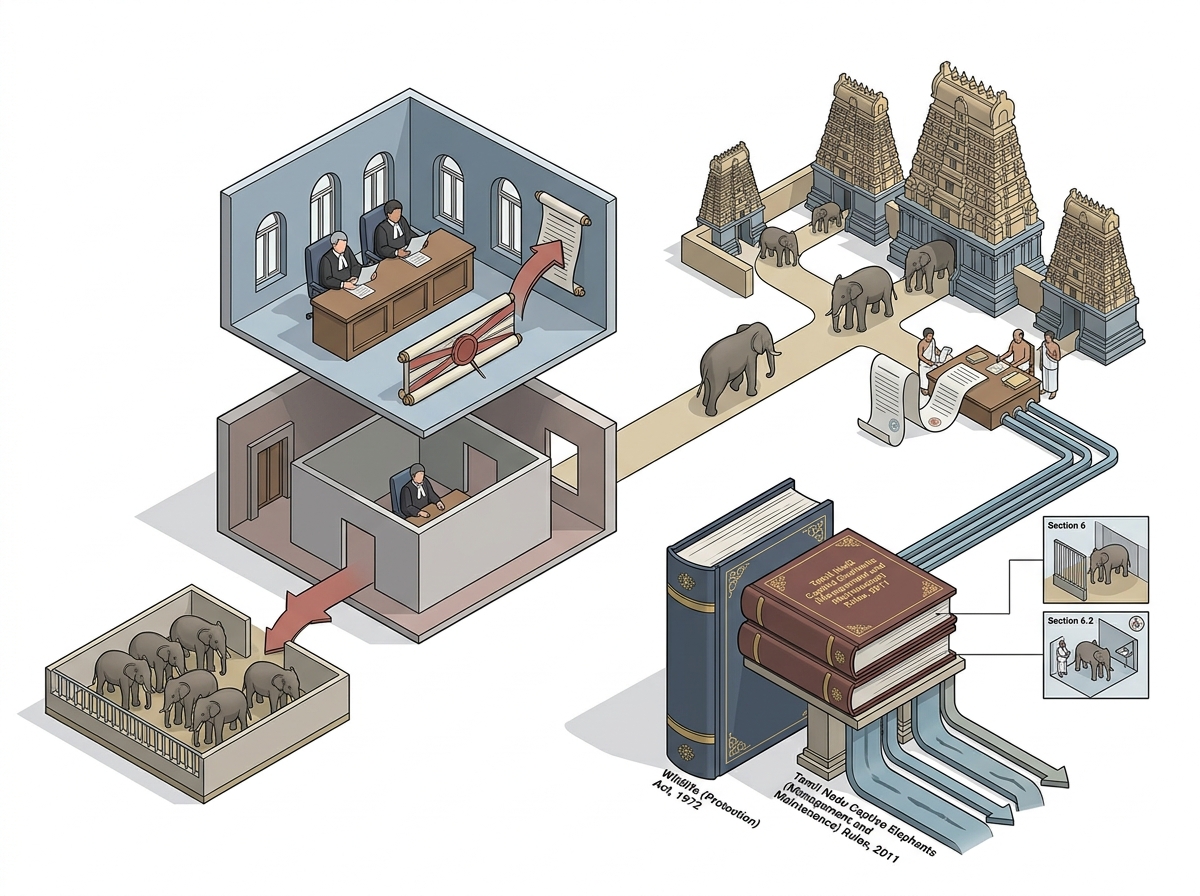
On 2 September 2026, a Division Bench of the Madras High Court set aside a single judge’s order that had prohibited Tamil Nadu temples from acquiring elephants and directed the state government to consider shifting all captive elephants to rehabilitation homes. The Division Bench held that the single judge’s order was unsustainable as it was passed without affording the state or temple authorities an opportunity of being heard and contravened the statutory framework governing captive elephants under the Wildlife (Protection) Act, 1972, and the Tamil Nadu Captive Elephants (Management and Maintenance) Rules, 2011.
Background
- The Wildlife (Protection) Act, 1972, is the primary legislation regulating the protection and management of wildlife in India, including the keeping of animals in captivity.
- Under Section 64(2)(f) of the Wildlife (Protection) Act, 1972, state governments are empowered to frame rules for the management and maintenance of captive elephants.
- The Tamil Nadu Captive Elephants (Management and Maintenance) Rules, 2011, were notified to govern the possession, housing, care, feeding, working, transport, and retirement of captive elephants in the state.
- Rule 3 of the 2011 Rules explicitly permits temples to receive elephants donated by others, subject to compliance with the statutory provisions.
- The single judge’s order of 27 February 2023 had directed no further acquisition of elephants by temples and considered shifting existing captive elephants to government rehabilitation homes, which was challenged by the state and temple authorities.
- The Division Bench’s ruling underscores the principle that judicial directions must not override valid subordinate legislation without due process or challenge.
What are the legal and ecological dimensions of captive elephant management in India?
- The Wildlife (Protection) Act, 1972, classifies elephants as a Schedule I species, affording them the highest level of legal protection in India.
- Section 40 of the Act prohibits the keeping of wild animals in captivity except under a license or permit granted by the competent authority, with stringent conditions to ensure their welfare.
- The Tamil Nadu Captive Elephants (Management and Maintenance) Rules, 2011, provide a comprehensive regulatory framework for the ethical keeping, care, and management of captive elephants, including those held by religious institutions.
- Rule 3 of the 2011 Rules permits temples to receive elephants donated by others, subject to compliance with the rules, thereby balancing religious practices with statutory requirements.
- The rules mandate regular veterinary care, appropriate housing, feeding standards, working hours, and retirement provisions for captive elephants to ensure their physical and psychological well-being.
- The Madras High Court’s ruling reinforces the principle that courts must respect the legislative and executive framework governing wildlife management, and cannot issue directions that effectively amend or override statutory rules without due process.
- The judgment highlights the ethical responsibility of society, including religious institutions, to ensure the welfare of animals in captivity, as enshrined in Article 51A(g) of the Constitution, which imposes a fundamental duty on citizens to protect and improve the natural environment and have compassion for living creatures.
- The case also underscores the need for judicial restraint in matters where the executive has framed detailed subordinate legislation, ensuring that the separation of powers is respected.
Key Features
| Feature | Significance |
|---|---|
| Madras High Court Division Bench ruling (2026) | Set aside a single judge’s order restricting temple acquisition and shifting of elephants to government homes, citing lack of hearing for affected parties. |
| Tamil Nadu Captive Elephants (Management and Maintenance) Rules, 2011 | Provides a comprehensive legal framework for the possession, care, and maintenance of captive elephants, including those in temples, under Section 64(2)(f) of the Wildlife (Protection) Act, 1972. |
| Rule 3 of 2011 Rules | Permits temples to receive elephants donated by others, ensuring legal recognition of temple-based elephant custody. |
| Single judge’s order (2023) | Directed no further acquisition of elephants by temples and proposed shifting existing elephants to government rehabilitation homes, later overturned for procedural impropriety. |
| Judicial restraint principle | Courts cannot issue general directions overriding subordinate legislation without challenge to the legislation itself, ensuring separation of powers. |
Why it Matters
Legal and Judicial Significance
- Reaffirms the principle that courts must not issue directions that effectively amend or override subordinate legislation without due process or challenge to the legislation itself.
- Highlights the necessity of affording hearing to all affected parties before passing orders that impact their rights or interests.
- Demonstrates the role of higher judiciary in correcting procedural lapses in lower court orders, ensuring adherence to principles of natural justice.
Administrative and Governance Significance
- Underscores the importance of well-drafted subordinate legislation (e.g., the 2011 Rules) in providing clear guidelines for complex governance issues such as captive elephant management.
- Emphasizes the need for inter-departmental coordination between the Forest Department and temple authorities to ensure compliance with wildlife protection norms.
- Illustrates the challenges in balancing religious practices with wildlife conservation and animal welfare, requiring nuanced administrative and legal approaches.
Animal Welfare and Conservation Significance
- Reinforces the legal recognition of captive elephant management under the Wildlife (Protection) Act, 1972, and its subordinate rules, ensuring structured oversight.
- Highlights the need for standardized protocols for the care, housing, and retirement of captive elephants, including those in religious institutions.
- Raises questions about the ethical treatment of captive elephants in religious and private settings, necessitating robust enforcement mechanisms.
Challenges
1. Balancing Religious Practices with Wildlife Conservation
- Temples in Tamil Nadu hold elephants as part of religious and cultural traditions, creating a conflict between conservation laws and religious freedoms.
- Ensuring humane treatment of elephants while respecting religious sentiments requires sensitive and inclusive policy frameworks.
- Lack of uniform standards for elephant care across religious and private institutions poses enforcement challenges for wildlife authorities.
UPSC Link: GS Paper 3: Environment and Biodiversity Conservation
2. Enforcement of Wildlife Protection Laws in Religious Institutions
- Religious institutions often operate under the assumption of autonomy, complicating the enforcement of wildlife protection norms.
- Inadequate monitoring and reporting mechanisms for captive elephants in temples hinder effective implementation of the 2011 Rules.
- Legal ambiguity in distinguishing between permissible religious practices and prohibited exploitation of wildlife necessitates clearer guidelines.
UPSC Link: GS Paper 3: Environmental Governance
3. Judicial Intervention in Administrative and Religious Matters
- Courts face the challenge of adjudicating disputes that involve religious practices, administrative governance, and wildlife conservation simultaneously.
- The risk of judicial overreach in issuing broad directives without due process undermines the legitimacy of judicial decisions.
- Ensuring that judicial orders are procedurally sound and respectful of statutory frameworks is critical for maintaining public trust in the judiciary.
UPSC Link: GS Paper 2: Judiciary and Constitutional Framework
4. Public Awareness and Stakeholder Engagement
- Limited awareness among temple authorities and devotees about the legal provisions governing captive elephants leads to non-compliance.
- Engaging religious leaders, temple management, and local communities in conservation efforts is essential for sustainable outcomes.
- Misinformation or misinterpretation of wildlife laws by stakeholders can exacerbate conflicts and hinder enforcement.
UPSC Link: GS Paper 3: Environmental Governance
Challenges — UPSC Perspective
| Issue | Concern |
|---|---|
| Conflict between religious practices and wildlife laws | Temples hold elephants as part of cultural traditions, complicating enforcement of conservation norms. |
| Procedural lapses in judicial orders | Single judge’s order lacked hearing for affected parties, leading to its overturning by the Division Bench. |
| Inadequate enforcement of 2011 Rules | Monitoring and reporting mechanisms for captive elephants in temples are insufficient. |
| Ethical treatment of captive elephants | Ensuring humane conditions for elephants in religious and private custody remains a challenge. |
| Judicial overreach in governance matters | Courts risk issuing broad directives that override subordinate legislation without due process. |
Way Forward
- Strengthen inter-departmental coordination between the Forest Department, temple authorities, and local administrations to ensure compliance with the 2011 Rules.
- Conduct regular audits and inspections of captive elephants in temples and private facilities to monitor welfare standards and legal compliance.
- Develop capacity-building programs for temple authorities and religious leaders on wildlife conservation laws and humane elephant management practices.
- Establish a grievance redressal mechanism for reporting violations of captive elephant norms, ensuring transparency and accountability.
- Promote public awareness campaigns to educate devotees and the general public about the legal and ethical aspects of captive elephant management.
- Encourage research on the welfare of captive elephants in religious and private settings to inform policy and enforcement strategies.
- Explore the feasibility of establishing state-run rehabilitation centers for retired or unfit captive elephants, in collaboration with NGOs and wildlife experts.
UPSC Value Addition
Keywords for Mains Answer-Writing
Wildlife (Protection) Act, 1972 · Tamil Nadu Captive Elephants (Management and Maintenance) Rules, 2011 · Madras High Court judgment on temple elephants · Judicial review of subordinate legislation · Constitutional validity of executive rules · Judicial activism vs judicial restraint · Fundamental duty to protect wildlife · Captive animal welfare jurisprudence · Doctrine of legitimate expectation · Subordinate legislation under Article 309
Concept Flow
Temple elephants in Tamil Nadu → Legal recognition under Wildlife (Protection) Act, 1972 and Tamil Nadu Captive Elephants (Management and Maintenance) Rules, 2011 → Single judge’s order restricting acquisition and proposing shifts to government homes → Lack of hearing for affected parties → Division Bench sets aside order → Reinforcement of procedural justice and separation of powers → Need for balanced enforcement of conservation laws and religious practices.
Prelims Practice Questions
Q1. Consider the following statements regarding the Wildlife (Protection) Act, 1972:
1. Section 64(2)(f) empowers the State governments to frame rules for the management and maintenance of captive animals.
2. The Act prohibits the acquisition of elephants by religious institutions without prior approval from the Central Government.
3. The Tamil Nadu Captive Elephants (Management and Maintenance) Rules, 2011, are framed under Section 64(2)(f) of the Act.
How many of the above statements are correct?
- Only one
- Only two
- All three
- None
Answer: Only two — Statement 1 is correct as Section 64(2)(f) empowers State governments to frame rules for the management and maintenance of captive animals. Statement 2 is incorrect because the Act does not impose such a blanket prohibition on religious institutions. Statement 3 is correct as the Tamil Nadu rules are framed under Section 64(2)(f).
Q2. Assertion (A): The Madras High Court, in its judgment dated September 2, 2026, set aside the single judge’s order preventing Tamil Nadu temples from acquiring elephants.
Reason (R): The single judge’s order was passed without hearing the State or the temples concerned, violating the principles of natural justice.
Options:
A. Both A and R are true, and R is the correct explanation of A.
B. Both A and R are true, but R is not the correct explanation of A.
C. A is true, but R is false.
D. A is false, but R is true.
- A
- B
- C
- D
Answer: A — The assertion (A) is true as the Madras High Court set aside the order. The reason (R) is also true and correctly explains the assertion, as the court held that the order was passed without hearing the affected parties.
Q3. Match the following pairs:
Column I (Legal Provision)
1. Section 64(2)(f) of the Wildlife (Protection) Act, 1972
2. Article 309 of the Constitution of India
3. Article 21 of the Constitution of India
Column II (Purpose)
A. Empowers State governments to frame rules for civil services
B. Protects the life and personal liberty of all persons
C. Empowers State governments to frame rules for the management and maintenance of captive animals
Options:
1. 1-C, 2-A, 3-B
2. 1-A, 2-B, 3-C
3. 1-B, 2-C, 3-A
4. 1-C, 2-B, 3-A
- 1
- 2
- 3
- 4
Answer: 1 — Section 64(2)(f) of the Wildlife (Protection) Act, 1972 empowers State governments to frame rules for the management and maintenance of captive animals (1-C). Article 309 empowers State governments to frame rules for civil services (2-A). Article 21 protects the life and personal liberty of all persons (3-B).
Mains Practice Question
✍ The Madras High Court, in its judgment dated September 2, 2026, set aside a single judge’s order preventing Tamil Nadu temples from acquiring elephants, observing that judicial directions cannot override valid subordinate legislation framed under the Wildlife (Protection) Act, 1972. Critically examine the legal principles governing the interplay between judicial directions and subordinate legislation in India. Also, discuss the implications of this judgment for the welfare of captive elephants in India. (15 Marks)
Approach: MODEL-ANSWER SKELETON:
1. **Introduction (2 marks)**: Define subordinate legislation and its constitutional basis (Article 309 for State services, Section 64(2)(f) of the Wildlife (Protection) Act, 1972 for captive animal management). Highlight the conflict between judicial directions and subordinate legislation.
2. **Judicial Review of Subordinate Legislation (4 marks)**:
– **Doctrine of Legitimate Expectation**: Explain how affected parties (temples, State) had a legitimate expectation to be heard before the single judge’s order.
– **Natural Justice**: Emphasise the principles of audi alteram partem and reasoned decision-making.
– **Judicial Activism vs Restraint**: Discuss the limits of judicial intervention in executive/administrative domains (citing cases like *State of Tamil Nadu v. K. Shyam Sunder* and *Union of India v. Deoki Nandan Aggarwal*).
3. **Constitutional and Statutory Framework (4 marks)**:
– **Wildlife (Protection) Act, 1972**: Highlight Section 64(2)(f) and the Tamil Nadu Captive Elephants (Management and Maintenance) Rules, 2011, as a complete code for captive elephant management.
– **Constitutional Provisions**: Discuss Article 51A(g) (Fundamental Duty to protect wildlife) and Article 21 (right to life and personal liberty of animals).
4. **Implications for Captive Elephant Welfare (3 marks)**:
– **Balancing Welfare and Tradition**: Discuss the need to balance cultural practices with animal welfare (citing *Animal Welfare Board of India v. A. Nagaraja* and *People for Ethical Treatment of Animals v. Union of India*).
– **Role of State Governments**: Highlight the responsibility of State governments under the 2011 Rules to ensure the welfare of captive elephants.
5. **Conclusion (2 marks)**: Summarise the legal principles and reiterate the need for judicial restraint in overriding valid subordinate legislation while ensuring animal welfare.
Source: The Hindu
Tamil Nadu PCS (TNPSC) — State PCS Practice
Prelims: Which of the following statements is correct regarding the Madras High Court’s recent order on temple elephants in Tamil Nadu?
- The Madras High Court set aside an order that prevented temples in Tamil Nadu from acquiring elephants.
- The Madras High Court upheld an order banning the acquisition of elephants by temples in Tamil Nadu.
- The Madras High Court directed the Tamil Nadu government to immediately confiscate all elephants from temples.
- The Madras High Court ruled that temples cannot use elephants for religious purposes in Tamil Nadu.
Answer: The Madras High Court set aside an order that prevented temples in Tamil Nadu from acquiring elephants. — The Madras High Court set aside an order that had previously prevented temples in Tamil Nadu from acquiring elephants.
Mains: Discuss the legal and ethical implications of the Madras High Court’s decision to set aside the order preventing Tamil Nadu temples from acquiring elephants. Examine the role of judicial intervention in balancing religious practices with animal welfare concerns in the state.
Generated by AanyaAi for educational purpose.
Related guides on our sites
- Best PSIR optional coaching for upsc
- Best Law optional coaching for upsc
- Best PSIR optional teacher for upsc
- Best teacher of PSIR optional for upsc

- सुप्रीम कोर्ट ने शिक्षक भर्ती में ट्रांसजेंडर्स को शामिल न करने पर सरकार से पूछा सवाल - October 20, 2026
- SBI SCO 2026 Recruitment: AI & Tech Posts Open for Experts - October 20, 2026
- दिल्ली में प्रदूषण नियंत्रण: 1 नवंबर से लागू होंगे 10 प्रमुख उपाय - October 20, 2026

No Comments