


24 Sep Madras HC quashes case against Annamalai over Thevar remarks: UPSC Polity Analysis
 Madras High CourtCriminal caseJudicial magistrateFreedom of speechCode of Criminal ProcedureConstitutional principle
✎ The Madras High Court’s quashing of the case against K. Annamalai underscores that prior government sanction under Section 196 CrPC and judicial scrutiny of cognisance under Section 190 CrPC are essential safeguards against…
Subject Relevance — Where This Topic Fits
- GS Paper II — Polity and Governance — Fundamental Rights and Judicial Review | GS Paper III — Security and Governance — Criminal Justice System and Preventive Measures
- Prelims: Section 196 CrPC, Judicial review of criminal complaints, Freedom of speech and reasonable restrictions, Sanction for prosecution under IPC, Judicial magistrate’s powers under Section 190 CrPC
- Essay: The balance between freedom of expression and public order in a constitutional democracy, Judicial activism and the limits of judicial intervention in criminal proceedings
Quick Revision: The Madras High Court’s quashing of the case against K. Annamalai underscores that prior government sanction under Section 196 CrPC and judicial scrutiny of cognisance under Section 190 CrPC are essential safeguards against frivolous prosecutions that may impinge on freedom of speech.
Why is this in the news?
The Madras High Court on 24 September 2026 quashed a criminal case against K. Annamalai for remarks attributed to him regarding Pasumpon Muthuramalinga Thevar, highlighting critical issues in the procedural safeguards governing private complaints and the exercise of judicial discretion under the Code of Criminal Procedure, 1973. The judgment underscores the constitutional principle that judicial magistrates must apply procedural rigour before taking cognisance of offences, particularly where the allegations implicate fundamental rights such as freedom of speech.
Background
- The case originated from a 2023 press conference where K. Annamalai reportedly referenced a historical incident involving Pasumpon Muthuramalinga Thevar and C.N. Annadurai, linking it to contemporary debates on Sanatana Dharma.
- The Tamil Nadu government, on 28 April 2024, accorded sanction under Section 196 CrPC for prosecution, a statutory prerequisite for offences under Sections 153A and 505 IPC.
- The Magistrate took cognisance in February 2026 and issued summons, prompting Annamalai to file a petition under Section 482 CrPC for quashing the proceedings.
- The High Court examined whether the Magistrate had complied with procedural safeguards, including the requirement of a preliminary inquiry or hearing, before taking cognisance.
- The judgment reflects ongoing judicial scrutiny of the balance between freedom of expression and the prevention of communal disharmony in public discourse.
Key Legal Provisions and Judicial Principles Underpinning the Judgment
- Section 196 CrPC mandates prior government sanction for prosecution of offences under Sections 153A, 153B, 295A, and 505 IPC, ensuring executive oversight to prevent misuse of criminal law for political or personal vendetta.
- Section 190 CrPC empowers a Magistrate to take cognisance of offences either upon receiving a complaint, police report, or upon information received from any source, but does not absolve the Magistrate of the duty to apply judicial mind before issuing process.
- Section 482 CrPC confers inherent powers on High Courts to prevent abuse of process of law or to secure the ends of justice, enabling quashing of proceedings where no prima facie case exists or where the complaint is frivolous or vexatious.
- The judgment reaffirms the principle that judicial magistrates must conduct a preliminary assessment to determine whether the allegations disclose a prima facie offence, failing which cognisance may be deemed illegal.
- Freedom of speech under Article 19(1)(a) is subject to reasonable restrictions under Article 19(2), including public order and incitement to offence, but such restrictions must be narrowly tailored and not overbroad.
- The court emphasised that historical references in political discourse do not automatically constitute offences unless they are demonstrably intended to incite hatred or violence against identifiable groups.
- The decision underscores the judiciary’s role in safeguarding democratic discourse while ensuring that criminal law is not weaponised to stifle legitimate political debate.
Key Features
| Feature | Significance |
|---|---|
| Quashing of criminal proceedings by Madras High Court | Upholds the principle that private complaints must not be used to stifle legitimate political discourse, provided they do not incite violence or promote enmity. |
| Sanction under Section 196 CrPC for prosecution | Highlights the constitutional safeguard requiring prior government sanction for offences under Sections 153A and 505(1)(c) IPC, ensuring checks against misuse of criminal law for political ends. |
| Judicial scrutiny of cognisance by Magistrate | Demonstrates the judiciary’s role in preventing frivolous or politically motivated prosecutions by ensuring due process and opportunity of hearing. |
| Historical reference in political discourse | Illustrates the permissible limits of invoking historical events in public debates, provided such references do not distort facts or incite communal disharmony. |
| Role of Section 153A and 505(1)(c) IPC | Reinforces the legal framework governing speech that may disrupt public tranquillity or promote enmity on grounds of religion, race, or community. |
Why it Matters
Legal and Constitutional
- The judgment underscores the judiciary’s responsibility to protect free speech while balancing it against the need to prevent communal disharmony under Articles 19(1)(a) and 25 of the Constitution.
- The case highlights the procedural safeguard of Section 196 CrPC, which mandates prior sanction for prosecution under IPC Sections 153A and 505(1)(c), preventing arbitrary use of criminal law.
- The ruling clarifies that historical references in political discourse are not per se criminal unless they directly incite violence or promote enmity, as defined under IPC provisions.
Political and Social
- The case exemplifies the intersection of historical narratives with contemporary political rhetoric, particularly in a state with a rich history of Dravidian and nationalist movements.
- It demonstrates the judiciary’s role in adjudicating disputes arising from political speech, ensuring that debates remain within the bounds of constitutional morality.
Institutional
- The Madras High Court’s intervention in quashing the case reinforces the judiciary’s role as a guardian of free speech and a check against frivolous litigation.
- The case highlights the importance of due process in criminal proceedings, including the necessity of a preliminary inquiry and opportunity of hearing before cognisance is taken.
Challenges
1. Balancing Free Speech and Communal Harmony
- The primary challenge lies in delineating the boundaries of permissible political speech, particularly when historical references are invoked.
- Public figures often navigate the fine line between exercising their right to free speech and avoiding statements that could be construed as promoting enmity or disrupting public order.
- The judiciary must balance the need for free expression with the imperative to prevent speech that incites violence or hatred, as enshrined in Articles 19(2) and 25(1) of the Constitution.
UPSC Link: GS-II: Fundamental Rights
2. Misuse of Criminal Law for Political Ends
- Private complaints under IPC Sections 153A and 505(1)(c) can be weaponised to target political opponents, undermining democratic discourse.
- The requirement of prior sanction under Section 196 CrPC acts as a safeguard but may not always prevent politically motivated prosecutions, especially in cases with weak evidentiary bases.
- Judicial scrutiny of such complaints is essential to prevent the misuse of the criminal justice system for partisan purposes.
UPSC Link: GS-II: Judiciary and Governance
3. Historical Narratives in Contemporary Politics
- Political figures often invoke historical events to bolster their arguments, risking distortions or misinterpretations that could exacerbate communal tensions.
- The judiciary must assess whether such references are factually accurate and whether they serve a legitimate public purpose or merely inflame passions.
- Historical narratives are often contested, and their invocation in political discourse requires careful contextualisation to avoid polarisation.
UPSC Link: GS-I: Indian Culture
4. Procedural Safeguards in Criminal Proceedings
- The case highlights the importance of due process, including the necessity of a preliminary inquiry and opportunity of hearing before cognisance is taken by a Magistrate.
- Frivilous or politically motivated complaints can clog the judicial system, delaying justice for genuine cases and undermining public trust in the judiciary.
- Judicial interventions, such as quashing proceedings, are essential to prevent the misuse of the criminal justice system.
UPSC Link: GS-II: Judiciary
Challenges — UPSC Perspective
| Issue | Concern |
|---|---|
| Free Speech vs. Communal Harmony | Risk of speech being misconstrued as incitement to violence or hatred, despite being within the bounds of political discourse. |
| Misuse of IPC Sections 153A and 505(1)(c) | Potential for private complaints to be filed with malicious intent, targeting political opponents under the guise of promoting communal harmony. |
| Judicial Scrutiny of Historical References | Difficulty in assessing the factual accuracy and intent behind historical references in contemporary political debates. |
| Procedural Delays in Criminal Cases | Risk of judicial system being bogged down by frivolous complaints, delaying justice for genuine cases. |
| Balancing Constitutional Rights | Need to uphold Articles 19(1)(a) and 25 while ensuring that speech does not violate Articles 19(2) or 25(1). |
Way Forward
- Clarify judicial guidelines on the invocation of historical narratives in political speech to prevent distortions and communal tensions.
- Strengthen the procedural safeguards under Section 196 CrPC to ensure that prior sanction is granted only after a thorough review of the complaint’s merits.
- Encourage public figures to exercise restraint in invoking historical events, ensuring that references are factually accurate and contextually appropriate.
- Enhance judicial training on the nuances of free speech, communal harmony, and the limits of political rhetoric to ensure consistent adjudication.
- Promote inter-faith and inter-community dialogues to foster mutual understanding and reduce the risk of speech being misconstrued as incitement.
- Leverage digital literacy campaigns to educate the public on the legal boundaries of free speech and the consequences of hate speech.
- Encourage media houses to verify historical claims made in political discourse to prevent the spread of misinformation.
- Conduct periodic reviews of IPC Sections 153A and 505(1)(c) to ensure they remain aligned with constitutional principles and contemporary societal needs.
UPSC Value Addition
Keywords for Mains Answer-Writing
Freedom of Speech and Expression · Reasonable Restrictions under Article 19(2) · Section 196 CrPC · Judicial Review of Sanction Orders · Hate Speech Laws in India · Constitutional Protection of Historical Narratives · Judicial Activism and Judicial Restraint · Right to Reputation and Defamation · Balancing Fundamental Rights · Judicial Interpretation of Section 153A IPC · Judicial Interpretation of Section 505(1)(c) IPC · Sanction for Prosecution under IPC · Judicial Quashing of Criminal Proceedings · Madras High Court Jurisdiction · Constitutional Morality and Public Order
Constitutional & Policy Linkages
- Article 19(1)(a) – Freedom of speech and expression
- Article 19(2) – Reasonable restrictions on free speech
- Article 25 – Freedom of conscience and free profession, practice, and propagation of religion
- Article 26 – Freedom to manage religious affairs
Concept Flow
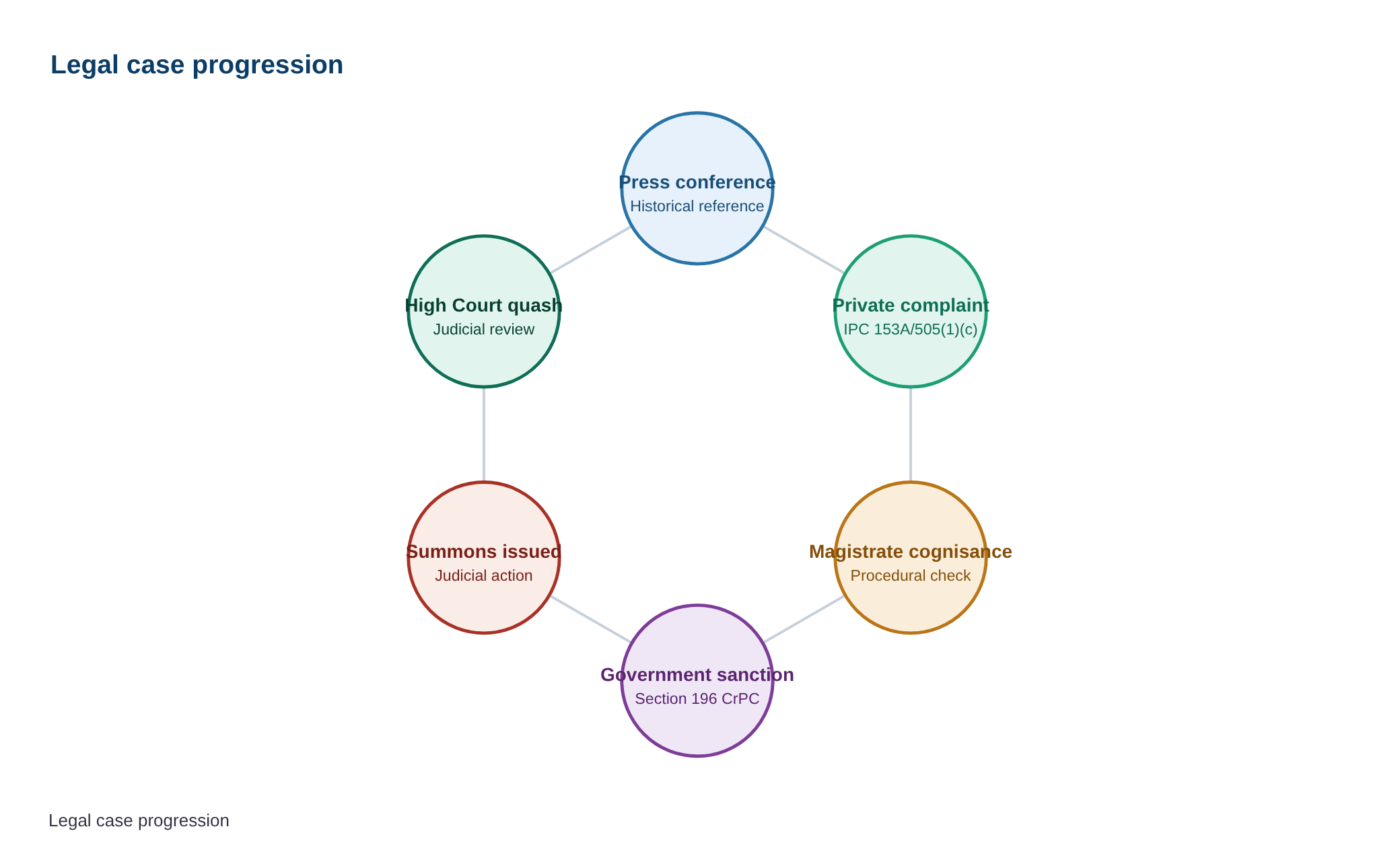
Political figure invokes a historical event in a press conference → Activist files a private complaint under IPC Sections 153A and 505(1)(c) → Magistrate takes cognisance of the complaint → Government grants sanction under Section 196 CrPC → Judicial Magistrate issues summons → Petitioner moves High Court to quash proceedings → High Court examines procedural lapses and intent behind speech → Judgment quashes case, citing lack of evidence of incitement or communal disharmony
Prelims Practice Questions
Q1. Consider the following statements regarding the provisions of the Indian Penal Code (IPC) and the Code of Criminal Procedure (CrPC):
1. Section 153A of the IPC pertains to the promotion of enmity between different groups on grounds of religion, race, place of birth, residence, language, caste or community.
2. Section 505(1)(c) of the IPC criminalises the making of any statement, rumour or report with intent to incite any class or community of persons to commit any offence against any other class or community.
3. Section 196 of the CrPC mandates prior sanction from the appropriate government before prosecuting any person for offences under Sections 153A and 505(1)(c) of the IPC.
4. The sanction under Section 196 CrPC is not required if the offence is committed by a public servant in the discharge of his official duties.
How many of the above statements are correct?
- Only one
- Only two
- Only three
- All four
Answer: All four — Statements 1, 2, and 3 are correct. Statement 4 is incorrect because the requirement of sanction under Section 196 CrPC applies irrespective of the status of the accused as a public servant.
Q2. Assertion (A): The Madras High Court, in its judgment quashing the case against K. Annamalai, relied on the principle that the complainant failed to identify two discernible communities between whom the petitioner attempted to create a divide.
Reason (R): The principle of ‘reasonable restrictions’ under Article 19(2) of the Constitution permits the state to impose restrictions on freedom of speech only if such speech is likely to disrupt public order or incite violence.
In the context of the above two statements, which of the following is correct?
- Both A and R are true, and R is the correct explanation of A
- Both A and R are true, but R is not the correct explanation of A
- A is true, but R is false
- A is false, but R is true
Answer: A is true, but R is false — Both statements are true, but the reasoning in R does not directly explain the judicial reasoning in A. The court’s decision was based on procedural grounds (lack of sanction and failure to identify communities) rather than the substantive principle of reasonable restrictions.
Q3. Match the following provisions of the Indian Penal Code (IPC) with their corresponding descriptions:
Column I (Provision)
A. Section 153A IPC
B. Section 505(1)(c) IPC
C. Section 295 IPC
D. Section 124A IPC
Column II (Description)
1. Deliberate and malicious acts intended to outrage religious feelings of any class by insulting its religion or religious beliefs.
2. Promoting enmity between different groups on grounds of religion, race, place of birth, residence, language, caste or community.
3. Making any statement, rumour or report with intent to incite any class or community of persons to commit any offence against any other class or community.
4. The offence of sedition, defined as bringing or attempting to bring into hatred or contempt, or exciting or attempting to excite disaffection towards the Government established by law in India.
- 1; 2; 3; 4
- A-2, B-3, C-1, D-4
- A-3, B-2, C-4, D-1
- A-1, B-4, C-2, D-3
Answer: A-2, B-3, C-1, D-4 — The correct match is: A-2 (Section 153A IPC), B-3 (Section 505(1)(c) IPC), C-1 (Section 295 IPC), and D-4 (Section 124A IPC).
Mains Practice Question
✍ Critically examine the constitutional and statutory framework governing the offence of promoting enmity between different groups under Section 153A of the Indian Penal Code. In this context, analyse the judicial reasoning in the Madras High Court’s judgment quashing the case against K. Annamalai. Also, discuss the implications of the requirement of prior sanction under Section 196 of the Code of Criminal Procedure for prosecuting such offences. (15 Marks)
Approach: MODEL-ANSWER SKELETON:
1. **Constitutional Framework**:
– Freedom of speech under Article 19(1)(a) and its reasonable restrictions under Article 19(2) (public order, morality, incitement to offence).
– Judicial interpretation of ‘public order’ (Ram Manohar Lohia v. State of Bihar, 1965; Kedar Nath Singh v. State of Bihar, 1962).
2. **Statutory Framework**:
– Section 153A IPC: Elements of the offence (promoting enmity between groups on grounds of religion, race, etc.).
– Section 196 CrPC: Requirement of prior sanction for prosecution under Section 153A IPC.
– Judicial standards for granting sanction (State of Maharashtra v. Rajendra J. Gandhi, 2019).
3. **Judicial Reasoning in the Instant Case**:
– Madras High Court’s reliance on procedural grounds (lack of sanction, failure to identify discernible communities).
– The court’s observation that the complainant did not establish a prima facie case of promoting enmity.
– Contrast with judicial activism in hate speech cases (e.g., Shreya Singhal v. Union of India, 2015).
4. **Implications of Section 196 CrPC**:
– Role of the executive in granting sanction: safeguard against frivolous prosecutions or misuse.
– Judicial review of sanction orders (State of Haryana v. Bhajan Lal, 1992).
– Balance between free speech and protection of social harmony.
5. **Critical Perspective**:
– Debate on whether Section 153A IPC is overbroad or necessary to prevent communal tensions.
– The role of historical narratives in public discourse and the limits of criminalising speech.
– Suggestions for reform: clearer definitions of ‘enmity’ and ‘groups’, and stricter judicial scrutiny of sanction orders.
Source: The Hindu
Generated by AanyaAi for educational purpose.
Related guides on our sites
- Best PSIR optional coaching for upsc
- Best PSIR optional teacher for upsc
- Best teacher of PSIR optional for upsc
- Best PSIR optional coaching in delhi for UPSC

- Madras HC quashes case against Annamalai over Thevar remarks: UPSC Polity Analysis - September 24, 2026
- डीडीयू-जीकेवाई 2.0: ग्रामीण युवाओं को कौशल एवं रोजगार से जोड़ने की केंद्र सरकार की पहल - September 24, 2026
- DDU-GKY 2.0: UPSC Focused Guide on Rural Skill Scheme for 2026-27 - September 24, 2026

No Comments