


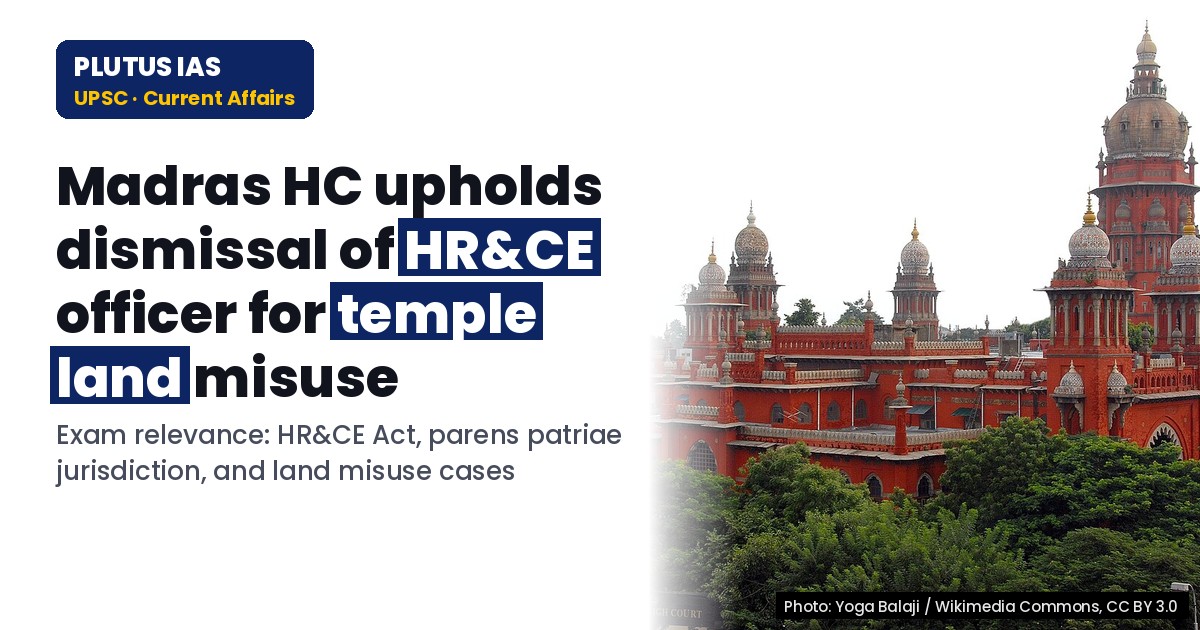
20 Oct Madras HC upholds dismissal of HR&CE officer for temple land fraud
✎ The HR&CE Department in Tamil Nadu is statutorily mandated to protect temple lands as a guardian under the parens patriae doctrine, and its Executive Officers are held accountable for administrative failures that result in…
Subject Relevance — Where This Topic Fits
- GS Paper II — Constitutional and Non-Constitutional Bodies (Role of High Courts) | GS Paper II — Fundamental Rights (Right to Property and Cultural Heritage) | GS Paper III — Land Reforms and Revenue Administration
- Prelims: Hindu Religious and Charitable Endowments (HR&CE) Act, 1951, Parens patriae jurisdiction, Tamil Nadu Public Service Commission (TNPSC), Patta (revenue land record), Madras High Court, Temple land encroachment, Government Order (G.O.), Executive Officer (EO) in HR&CE, Fit Person under HR&CE Act
- Essay: The interplay between administrative accountability and judicial oversight in protecting cultural heritage, The role of institutions in preserving public assets: A case study of temple land management
Quick Revision: The HR&CE Department in Tamil Nadu is statutorily mandated to protect temple lands as a guardian under the parens patriae doctrine, and its Executive Officers are held accountable for administrative failures that result in illegal transfers of such lands.
Why is this in the news?
The Madras High Court has upheld the dismissal of an HR&CE Executive Officer for failing to prevent the illegal transfer of 20.94 acres of temple land to private individuals, invoking the parens patriae jurisdiction to underscore the state’s duty as the guardian of temple properties. The judgment highlights the legal and administrative consequences of dereliction of duty in land revenue records and reinforces the judiciary’s role in safeguarding public assets under constitutional protections.
Background
- The Hindu Religious and Charitable Endowments (HR&CE) Department, established under the Tamil Nadu Hindu Religious and Charitable Endowments Act, 1959, is responsible for the administration and management of temple lands and properties in Tamil Nadu.
- Temple lands are often encroached upon due to lapses in revenue records, collusive transfers, or administrative negligence, leading to disputes and loss of public revenue.
- The HR&CE Act empowers the state to appoint Executive Officers (EOs) to manage temple affairs, including the maintenance of land records and prevention of encroachments.
- The parens patriae doctrine, invoked by the court, treats deities as legal entities akin to minors, requiring the state to act as their guardian in matters of property and administration.
- Illegal transfers of temple land are frequently facilitated through collusion between revenue officials, temple authorities, and private parties, necessitating stringent administrative and judicial oversight.
- The case underscores the importance of timely appeals and record-keeping in revenue administration to prevent loss of public assets.
What is the HR&CE Department and its role in temple land management?
- The HR&CE Department, governed by the Tamil Nadu Hindu Religious and Charitable Endowments Act, 1959, is a statutory body in Tamil Nadu tasked with managing and protecting temple lands, properties, and endowments.
- The department appoints Executive Officers (EOs) through the Tamil Nadu Public Service Commission (TNPSC) to oversee the administration of temples, including land records, revenue collection, and encroachment prevention.
- EOs are responsible for maintaining accurate revenue records (such as pattas), preventing unauthorized transfers, and ensuring compliance with the HR&CE Act and revenue laws.
- The department operates under the principle of ‘parens patriae,’ where the state acts as the guardian of temple properties, ensuring their protection and proper use for religious and public purposes.
- The HR&CE Act empowers the state to take corrective actions, including the dismissal of officials for dereliction of duty, to safeguard temple assets from encroachment or misuse.
- Temple lands are often subject to disputes due to historical transfers, encroachments, or revenue record discrepancies, requiring the department to conduct regular audits and legal proceedings.
- The role of the HR&CE Department is critical in balancing the religious, cultural, and public interests associated with temple properties while adhering to legal and administrative frameworks.
Key Features
| Feature | Significance |
|---|---|
| Dismissal of HR&CE Executive Officer | Affirms accountability in temple land administration and upholds administrative discipline within religious endowment departments. |
| Parens Patriae Jurisdiction | Empowers the High Court to act as a guardian for temple properties, treating deities as legal minors to prevent misappropriation. |
| Charge Memo and Inquiry Process | Demonstrates the procedural safeguards in administrative disciplinary actions, including due process and evidence-based findings. |
| Revenue Records (Patta) Transfer | Highlights the vulnerability of temple lands to illegal encroachments due to lapses in revenue administration and temple management. |
| HR&CE Department’s Role | Underscores the statutory responsibility of the Hindu Religious and Charitable Endowments Department in protecting temple assets and ensuring transparent management. |
Why it Matters
Administrative Accountability
- Reinforces the principle that public servants entrusted with temple land management are legally bound to prevent encroachments and unauthorized transfers.
- Sets a precedent for strict disciplinary action against officials failing in their fiduciary duty, even when such failures span over a decade.
- Demonstrates the judiciary’s role in ensuring administrative probity in matters concerning religious endowments.
Legal Safeguards for Temple Lands
- Invokes the parens patriae doctrine, treating temple deities as legal entities requiring protection, akin to minors, against exploitation.
- Exposes systemic gaps in revenue record-keeping and land administration that enable illegal transfers of temple lands.
- Illustrates the interplay between civil courts, revenue authorities, and administrative tribunals in resolving disputes over temple properties.
Revenue Administration and Land Records
- Highlights the critical importance of accurate and up-to-date revenue records (patta) in preventing encroachments and illegal transfers.
- Underscores the need for real-time monitoring of temple lands by HR&CE officials to detect and rectify discrepancies promptly.
- Raises questions about the efficacy of periodic land surveys and the integration of digital land records to curb malpractices.
Judicial Oversight in Governance
- Showcases the judiciary’s proactive role in directing executive action to retrieve encroached temple lands, even suo motu.
- Emphasizes the High Court’s supervisory jurisdiction over temple administration, ensuring compliance with constitutional and statutory mandates.
- Demonstrates the judiciary’s capacity to intervene in matters of public trust, particularly when executive agencies fail in their duties.
Challenges
1. Encroachment and Illegal Transfer of Temple Lands
- Temple lands are frequently targeted for illegal encroachments due to weak administrative oversight and collusion between revenue officials and private parties.
- Delays in legal proceedings and administrative appeals exacerbate the problem, allowing encroachers to consolidate illegal possession.
- Lack of real-time digital integration between revenue records and temple land inventories hampers effective monitoring and dispute resolution.
UPSC Link: GS-II: Governance, Transparency & Accountability
2. Administrative Lapses in HR&CE Department
- Inadequate training and sensitization of HR&CE officials on legal provisions governing temple lands contribute to procedural failures.
- Absence of a robust grievance redressal mechanism within the department delays detection and rectification of land disputes.
- Political interference or external pressures may undermine the autonomy of temple management bodies, leading to mismanagement.
UPSC Link: GS-II: Role of Civil Services in Governance
3. Judicial Delays in Land Dispute Resolution
- Protracted litigation over temple lands discourages timely retrieval of encroached properties, benefiting illegal possessors.
- Overburdened judiciary and lack of specialized tribunals for temple land disputes impede swift justice.
- Need for alternative dispute resolution mechanisms, such as mediation or fast-track courts, to expedite resolution.
UPSC Link: GS-II: Judiciary and Judicial Reforms
4. Revenue Record Management Challenges
- Outdated and fragmented land records (patta) make it difficult to verify ownership and detect illegal transfers.
- Absence of a unified land record system across states hinders inter-departmental coordination and transparency.
- Manual processes in revenue administration are prone to errors, omissions, and deliberate manipulations.
UPSC Link: GS-II: Land Reforms and Record Modernization
5. Protection of Deity’s Legal Rights
- Treating deities as legal entities under parens patriae is a progressive but underutilized legal doctrine in temple land disputes.
- Ensuring that temple funds and assets are used exclusively for religious and charitable purposes remains a persistent challenge.
- Need for clearer statutory definitions of the deity’s legal status to strengthen judicial interventions.
UPSC Link: GS-II: Constitutional Provisions on Religious Freedom
Challenges — UPSC Perspective
| Issue | Concern |
|---|---|
| Illegal Encroachments | Systemic failure to prevent unauthorized occupation of temple lands due to weak monitoring and collusion. |
| Revenue Record Discrepancies | Outdated and fragmented patta records facilitate illegal transfers and disputes. |
| Administrative Delays | Protracted disciplinary and legal processes allow encroachers to consolidate illegal possession. |
| Judicial Overburdening | Delays in dispute resolution undermine the retrieval of temple lands and deter future violations. |
| Lack of Digital Integration | Absence of real-time land record updates and inter-departmental coordination hampers effective governance. |
| Political Interference | External pressures may compromise the autonomy of temple management bodies, leading to mismanagement. |
Way Forward
- Strengthen the HR&CE Department’s capacity through mandatory training on land laws, revenue records, and legal procedures for temple land management.
- Implement a real-time digital land record system, integrating revenue records with temple land inventories to enable proactive monitoring and dispute detection.
- Establish fast-track tribunals or special courts for temple land disputes to expedite resolution and deter illegal encroachments.
- Conduct periodic audits of temple lands by independent agencies to identify encroachments and unauthorized transfers promptly.
- Enhance transparency by mandating public disclosure of temple land records and transactions on official departmental portals.
- Introduce a whistleblower protection mechanism within the HR&CE Department to encourage reporting of malpractices and collusion.
- Promote awareness campaigns among temple authorities and local communities about legal rights and procedures for protecting temple lands.
- Reform the parens patriae doctrine into a statutory framework to provide clearer legal standing for deities in land disputes.
UPSC Value Addition
Keywords for Mains Answer-Writing
Madras High Court jurisdiction · Parens patriae doctrine in temple administration · Hindu Religious and Charitable Endowments (HR&CE) Department · Temple land encroachment and revenue records · Executive Officer dismissal under service rules · Tamil Nadu Public Service Commission (TNPSC) selection process · Patta transfer and revenue administration · Temple land protection and retrieval mechanisms · Constitutional provisions for religious institutions · Judicial review of executive actions in land disputes
Constitutional & Policy Linkages
- [‘Article 25’, ‘Freedom of religion and management of religious institutions.’]
- [‘Article 26’, ‘Right of religious denominations to manage their own affairs.’]
- [‘Article 29’, ‘Protection of cultural and educational rights of minorities.’]
- [‘Article 30’, ‘Right of minorities to establish and administer educational institutions.’]
Concept Flow
Temple land encroachment begins with administrative lapses in revenue records (patta) and HR&CE oversight. → Private individuals exploit gaps to illegally transfer temple land, often with collusion from revenue officials. → HR&CE Executive Officer fails to prevent or report the transfer, violating fiduciary duty and procedural norms. → Disciplinary inquiry finds the officer guilty, leading to dismissal after statutory appeals are exhausted. → High Court invokes parens patriae jurisdiction, directing the state to retrieve the encroached land. → Judicial oversight ensures accountability but also highlights systemic weaknesses in land and temple administration. → Reforms in digital records, tribunal reforms, and administrative training become necessary to prevent recurrence.
Prelims Practice Questions
Q1. Consider the following statements regarding the Hindu Religious and Charitable Endowments (HR&CE) Department in India:
1. The HR&CE Department is a constitutional body under Article 29 of the Constitution.
2. The Department is responsible for the administration and management of religious institutions and their properties.
3. The Executive Officer (EO) of a temple is appointed by the State Public Service Commission.
4. The Madras High Court invoked the parens patriae jurisdiction to protect temple land in the recent judgment.
How many of the above statements are correct?
- Only one
- Only two
- Only three
- All
Answer: Only three — Statement 1 is incorrect as the HR&CE Department is a statutory body under state legislation, not a constitutional body under Article 29. Statements 2, 3, and 4 are correct.
Q2. Assertion (A): The dismissal of an Executive Officer by the HR&CE Department for failing to protect temple land is subject to judicial review.
Reason (R): The judiciary can intervene in administrative decisions if they are arbitrary or violate statutory provisions.
Options:
A. Both A and R are true, and R is the correct explanation of A.
B. Both A and R are true, but R is not the correct explanation of A.
C. A is true, but R is false.
D. A is false, but R is true.
Answer: ? — The assertion is true as judicial review applies to administrative actions. The reason is also true and correctly explains the assertion, as the judiciary can examine the legality of such dismissals.
Q3. Match the following terms with their correct descriptions:
Column I
1. Patta
2. Parens patriae
3. HR&CE Department
4. Executive Officer (EO)
Column II
A. Legal document evidencing land ownership
B. Doctrine empowering courts to act as guardians for entities unable to protect themselves
C. Statutory body managing religious institutions and their properties
D. Officer appointed to administer and manage temple affairs
Options:
A. 1-A, 2-B, 3-C, 4-D
B. 1-B, 2-A, 3-D, 4-C
C. 1-C, 2-D, 3-A, 4-B
D. 1-D, 2-C, 3-B, 4-A
Answer: ? — 1-A (Patta is a revenue record), 2-B (Parens patriae is a legal doctrine), 3-C (HR&CE Department manages religious institutions), 4-D (EO administers temple affairs).
Mains Practice Question
✍ The Madras High Court, invoking the parens patriae jurisdiction, has directed the Tamil Nadu government to retrieve temple land encroached upon since 2012. In this context, critically examine the constitutional and statutory framework governing the protection of religious institutions’ properties in India. Also, discuss the role of the judiciary in ensuring accountability of temple administrators. (15 Marks)
Approach: MODEL-ANSWER SKELETON:
1. Introduction (2 marks): Briefly define the HR&CE Department, its constitutional/statutory basis (state-specific HR&CE Acts), and the concept of parens patriae jurisdiction.
2. Constitutional Framework (4 marks):
– Mention Articles 25-26 (Freedom of Religion) and Article 29 (Protection of Interests of Minorities) as foundational rights.
– Highlight the State’s role in regulating religious institutions under Entry 32 of the State List (Seventh Schedule).
– Reference the Supreme Court’s observations in *Commissioner, Hindu Religious Endowments, Madras v. Sri Lakshmindra Thirtha Swamiar* (1954) on the State’s regulatory power.
3. Statutory Provisions (4 marks):
– Tamil Nadu HR&CE Act, 1959: Sections on appointment of Executive Officers, duties to protect temple properties, and penalties for dereliction.
– Role of TNPSC in appointing EOs (as per service rules).
– Provisions for land records (Patta) and revenue administration under the Tamil Nadu Land Revenue Code.
4. Judicial Role and Accountability (3 marks):
– Discuss the doctrine of parens patriae and its application in *Bijoe Emmanuel v. State of Kerala* (1986) and the present case.
– Judicial review of administrative actions (Article 226 of the Constitution) and suo motu powers.
– Consequences of judicial intervention: retrieval of land, dismissal of errant officers, and systemic reforms.
5. Challenges and Way Forward (2 marks):
– Issues: Delay in retrieval, collusion between officials and encroachers, lack of digital land records.
– Suggest measures: digitization of land records, time-bound retrieval mechanisms, and stricter penalties under HR&CE Acts.
Source: The Hindu
Generated by AanyaAi for educational purpose.
Related guides on our sites
- Anthropology VS PSIR
- Best PSIR optional coaching
- Best PSIR optional coaching online
- Best coaching for law optional

- डीआरआई ने गुजरात में 19 करोड़ रुपये सोने की तस्करी गिरोह का भंडाफोड़ किया - October 21, 2026
- सितंबर 2026 में कोर उद्योग सूचकांक में 7.9% वृद्धि, लौह अयस्क सर्वाधिक प्रभावी - October 21, 2026
- Kerala HC Orders SBI to Refund ₹3.73 Lakh in Cyberfraud Case: Key Judgment for UPSC - October 21, 2026

No Comments