


06 Aug MAHA Jal Mission: ANRF’s 5-Pillar Water Research Programme for UPSC
✎ The Maha Jal Mission integrates mission-mode research, industrial partnerships, and statutory governance (via ANRF) to address India’s water security challenges through five core thematic areas and mandatory stakeholder…
Subject Relevance — Where This Topic Fits
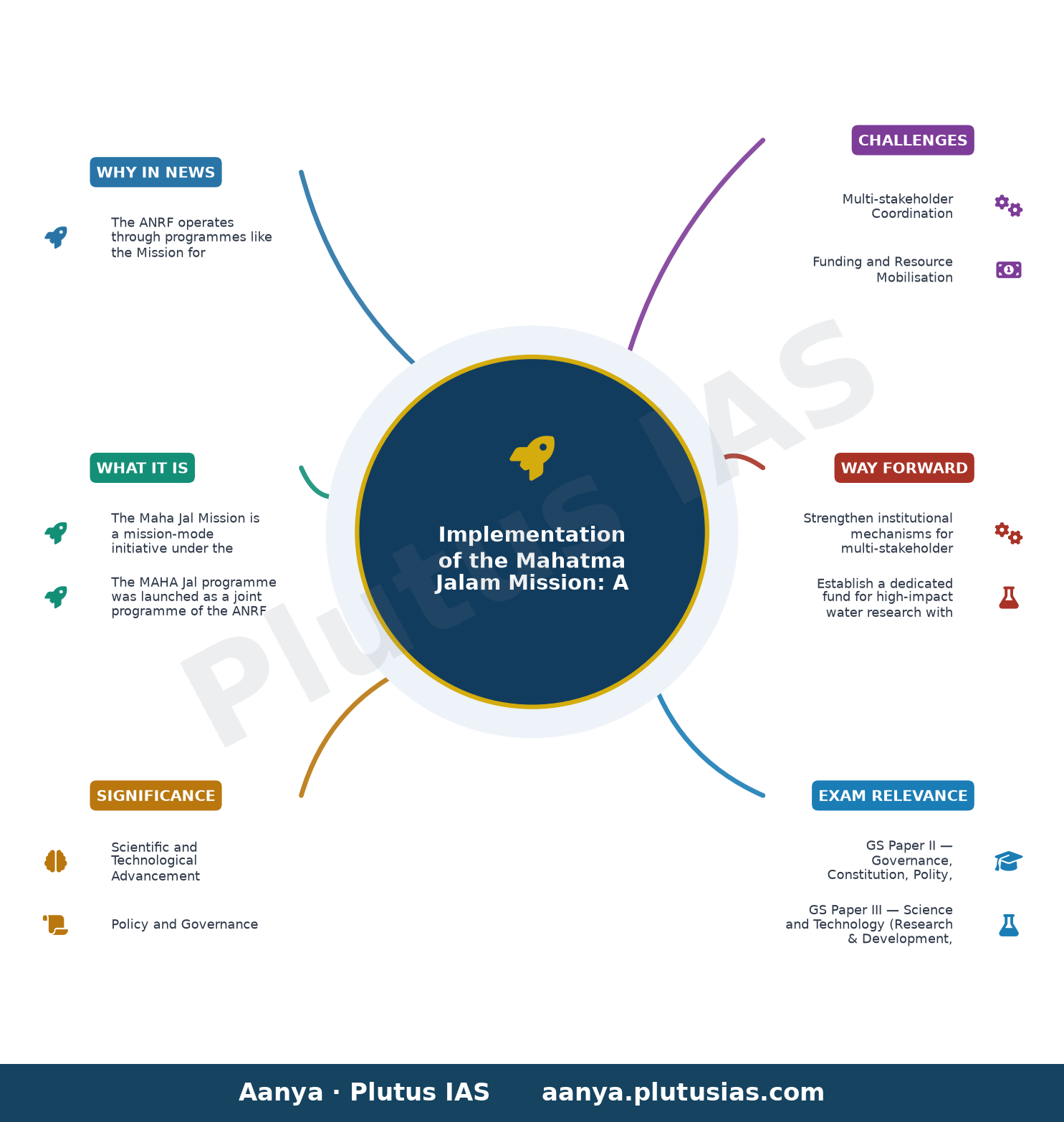
- GS Paper II — Governance, Constitution, Polity, Social Justice and International Relations (Role of statutory bodies like ANRF) | GS Paper III — Science and Technology (Research & Development, Innovation), Environment and Disaster Management (Water resources, Climate resilience) | GS Paper IV — Ethics, Integrity and Aptitude (Stakeholder collaboration, public-private partnerships)
- Prelims: National Research Foundation (ANRF) Act, 2023, Mission for Advancement in High-Impact Areas (MAHIA), Jal Shakti Ministry, Water Quality, Circular Economy, Climate Resilience, Start-up India, MSMEs, Wastewater Management, Field-Ready Technologies
- Essay: Water Security as a Prerequisite for Sustainable Development: Balancing Innovation with Inclusive Governance, The Role of Public-Private Partnerships in Addressing Climate-Induced Water Crises
Quick Revision: The Maha Jal Mission integrates mission-mode research, industrial partnerships, and statutory governance (via ANRF) to address India’s water security challenges through five core thematic areas and mandatory stakeholder collaboration.
Why is this in the news?
The ANRF operates through programmes like the Mission for Advancement in High-Impact Areas (MAHIA), which focuses on mission-mode, priority-driven research in critical sectors, including water.
Background
- The National Research Foundation (ANRF) was established as a statutory body to provide high-level strategic direction for scientific and technical research across natural, humanities, and social sciences, in line with the National Education Policy.
- The ANRF operates through programmes like the Mission for Advancement in High-Impact Areas (MAHIA), which focuses on mission-mode, priority-driven research in critical sectors, including water.
- The Ministry of Jal Shakti, established in 2019, is the nodal ministry for water resources, river development, and drinking water supply in India, with a mandate to ensure water security and sustainable management.
- India faces severe water stress, with over 600 million people experiencing high to extreme water scarcity, and projections indicating that water demand will exceed supply by 2030.
- The Jal Shakti Abhiyan (2019) and Atal Mission for Rejuvenation and Urban Transformation (AMRUT) 2.0 have laid the groundwork for integrated water management, but gaps remain in research, technology adoption, and stakeholder collaboration.
- The MAHA Jal programme was launched as a joint initiative of ANRF and the Ministry of Jal Shakti to address water sector challenges through mission-oriented research and innovation.
What is the Maha Jal Mission?
- The Maha Jal Mission is a mission-mode initiative under the MAHIA programme of the ANRF, designed to address India’s critical water challenges through solution-driven, multidisciplinary research and innovation.
- The MAHA Jal programme was launched as a joint programme of the ANRF and the Ministry of Jal Shakti, with the objective of supporting mission-oriented and solution-based research to enhance water security.
- The mission focuses on five thematic areas: (1) Assessment and sustainable management of water resources; (2) Drinking water supply; (3) Water quality; (4) Human and ecological health; and (5) Water-use efficiency and Circular Economy; and Climate Resilience and Adaptation.
- The programme operates on a consortium model, inviting proposals from Principal Investigators, academic institutions, research laboratories, and registered research organizations under DSIR-SIRO, including eligible Section 8 companies.
- A mandatory 10% cash contribution from the total project cost is required, with the participation of at least one start-up/MSME/industry partner to ensure practical implementation and scalability of solutions.
- The mission promotes the development and deployment of field-ready technologies through initiatives like the India-WIN portal, which facilitates partnerships between start-ups/MSMEs and research institutions.
- The Jal Shakti Hackathon-2025 was organized to identify and promote practical, scalable, and field-ready technologies to address water sector challenges.
- Research outcomes are shared with stakeholders, including state governments, union territories, and implementing agencies, to ensure adoption and implementation of innovative solutions.
Key Features
| Feature | Significance |
|---|---|
| Statutory Body: ANRF (National Research Foundation) | Established under ANRF Act, 2023 to provide strategic direction for research in natural sciences, humanities, and social sciences, aligning with NEP 2020 recommendations. |
| Mission for Advancement in High-Impact Areas (MAHIA) | A flagship programme of ANRF focusing on mission-mode, priority-driven research in critical sectors with industrial partnerships. |
| MAHIA Jal Programme (01 June 2026) | Joint initiative by ANRF and Ministry of Jal Shakti to address water sector challenges through solution-oriented research. |
| Consortium-based Approach | Multi-institutional, multi-disciplinary research with mandatory participation of start-ups/MSMEs/industry partners (10% cash contribution). |
| WIN Portal for Start-ups/MSMEs | Facilitates collaboration and accelerates development of water technologies by streamlining partnerships. |
| Jal Shakti Hackathon-2025 | Promotes field-ready, scalable technologies to address water sector challenges through practical innovation. |
Why it Matters
Scientific and Technological Advancement
- Encourages high-impact research in water sciences with a focus on sustainability, efficiency, and climate resilience.
- Bridges the gap between academia, industry, and governance through collaborative consortia.
- Enhances India’s self-reliance in water technologies by fostering indigenous innovation.
Policy and Governance
- Aligns with the Jal Jeevan Mission and National Water Policy objectives by integrating research with implementation.
- Provides a structured framework for state-level adoption of R&D outcomes through stakeholder engagement.
- Strengthens inter-ministerial coordination (e.g., Ministry of Jal Shakti, DSIR-SIRO) for holistic water management.
Economic and Industrial Impact
- Mandatory industry participation ensures commercial viability and scalability of research outcomes.
- Supports the growth of start-ups and MSMEs in the water technology sector, fostering entrepreneurship.
- Reduces import dependence in critical water technologies through indigenous development.
Environmental and Public Health
- Prioritises water quality, human health, and ecological sustainability as core research themes.
- Promotes circular economy principles in water resource management to minimise waste and maximise efficiency.
- Addresses climate resilience and adaptation strategies for water infrastructure.
Challenges
1. Multi-stakeholder Coordination
- Ensuring seamless collaboration between ANRF, Ministry of Jal Shakti, states, and industry partners.
- Balancing academic research priorities with industry-driven commercialisation timelines.
UPSC Link: GS-II Governance
2. Funding and Resource Mobilisation
- Securing consistent funding for long-term, high-impact research projects.
- Ensuring equitable distribution of resources among participating institutions and start-ups.
UPSC Link: GS-III Economy
3. Technology Transfer and Scalability
- Overcoming barriers in translating research outcomes into field-ready, scalable solutions.
- Addressing regulatory and bureaucratic hurdles in technology adoption by states and local bodies.
UPSC Link: GS-III Science & Tech
4. Geographical and Demographic Disparities
- Tailoring solutions to address diverse water challenges across regions (e.g., drought-prone vs. flood-prone areas).
- Ensuring inclusive participation of marginalised communities in technology deployment.
UPSC Link: GS-II Social Justice
5. Climate Change Integration
- Incorporating climate resilience into water infrastructure planning and research priorities.
- Addressing uncertainties in long-term climate projections for water resource management.
UPSC Link: GS-III Environment
Challenges — UPSC Perspective
| Issue | Concern |
|---|---|
| Funding Sustainability | Risk of project discontinuation due to budgetary constraints or shifting policy priorities. |
| Regulatory Bottlenecks | Delays in approvals and clearances for technology deployment across states. |
| Industry-Academia Divide | Mismatch between academic research timelines and industry expectations for commercialisation. |
| Data Accessibility | Lack of standardised, real-time data on water resources for research validation. |
| Public Awareness | Limited awareness among stakeholders about the benefits and utilisation of research outcomes. |
Way Forward
- Strengthen institutional mechanisms for multi-stakeholder collaboration (e.g., ANRF-Ministry of Jal Shakti joint committees).
- Establish a dedicated fund for high-impact water research with transparent allocation criteria.
- Develop standardised protocols for technology transfer and scaling, including pilot projects in diverse regions.
- Enhance capacity-building initiatives for state agencies and local bodies to adopt research outcomes.
- Promote public-private partnerships (PPPs) to accelerate commercialisation of water technologies.
- Integrate climate resilience metrics into all research projects under the MAHIA Jal Programme.
- Leverage the WIN Portal to create a repository of validated water technologies for easy access by stakeholders.
- Conduct periodic reviews to assess progress and address bottlenecks in project implementation.
UPSC Value Addition
Keywords for Mains Answer-Writing
National Research Foundation (NRF) Act, 2023 · Mission for Advancement in High-Impact Areas (MAHI) · MAHI Jal Programme · Water Resources Management · Sustainable Development Goals (SDGs) 6 and 14 · Multi-disciplinary research in water sector · Public-Private Partnership (PPP) in R&D · Circular economy in water management · Climate resilience and water adaptation · Jal Shakti Ministry · ANRF-MAHI Jal Consortium · Water quality and human health · Field-ready water technologies · Jal Shakti Hackathon 2025 · Start-up and MSME participation in R&D
Concept Flow
National Research Foundation (ANRF) established under ANRF Act, 2023 → Provides strategic direction for research in natural and social sciences. → Mission for Advancement in High-Impact Areas (MAHIA) launched → Focuses on priority sectors with industrial partnerships. → MAHIA Jal Programme initiated (01 June 2026) → Joint effort by ANRF and Ministry of Jal Shakti to address water challenges. → Research consortia formed with academia, industry, and start-ups → Multi-disciplinary, mission-mode projects initiated. → Technologies developed and validated → Field-ready solutions piloted and scaled up. → Outcomes shared with states and stakeholders → Adoption and implementation of research-driven water management strategies. → Feedback loop established → Continuous improvement in research priorities and policy alignment.
Prelims Practice Questions
Q1. Consider the following statements regarding the National Research Foundation (NRF):
1. NRF is a statutory body established under the NRF Act, 2023.
2. It functions under the Ministry of Education.
3. NRF promotes research, innovation, and entrepreneurship in natural sciences, humanities, and social sciences.
4. MAHI is a programme under NRF focused on mission-mode, solution-oriented research.
How many of the above statements are correct?
- Only one
- Only two
- Only three
- All four
Answer: All four — Statements 1, 3, and 4 are correct. Statement 2 is incorrect as NRF operates under the aegis of the Prime Minister’s Science, Technology and Innovation Advisory Council (PM-STIAC) and is not under the Ministry of Education.
Q2. Assertion (A): The MAHI Jal Programme is a joint initiative of the ANRF and the Jal Shakti Ministry.
Reason (R): The programme aims to address water sector challenges through mission-oriented, solution-based research.
In the context of the above two statements, which one of the following is correct?
- Both A and R are true, and R is the correct explanation of A.
- Both A and R are true, but R is not the correct explanation of A.
- A is true, but R is false.
- A is false, but R is true.
Answer: Both A and R are true, but R is not the correct explanation of A. — Both the Assertion (A) and Reason (R) are true, and R correctly explains A. The MAHI Jal Programme is indeed a joint initiative of ANRF and the Jal Shakti Ministry, with the stated objective of addressing water sector challenges through mission-oriented research.
Q3. Match the following initiatives with their respective objectives:
Column I (Initiative) Column II (Objective)
A. MAHI Jal Programme 1. To promote field-ready water technologies
B. Jal Shakti Hackathon 2025 2. To facilitate start-up and MSME participation in R&D
C. WIWIN (Water Innovation) Portal 3. To support mission-oriented research in water sector
D. ANRF Act, 2023 4. To establish a statutory body for research promotion
Select the correct match:
- A-3, B-1, C-2, D-4
- A-2, B-1, C-3, D-4
- A-3, B-2, C-1, D-4
- A-1, B-3, C-2, D-4
Answer: A-3, B-1, C-2, D-4 — A-3: MAHI Jal Programme supports mission-oriented research in the water sector. B-1: Jal Shakti Hackathon 2025 promotes field-ready water technologies. C-2: WIWIN Portal facilitates start-up and MSME participation in R&D. D-4: ANRF Act, 2023 establishes a statutory body for research promotion.
Mains Practice Question
✍ The MAHI Jal Programme, launched under the aegis of the National Research Foundation (NRF), represents a paradigm shift in addressing India’s water challenges through mission-oriented, multi-disciplinary research. Critically examine its objectives, institutional framework, and potential to achieve Sustainable Development Goals (SDGs) 6 and 14. Also, analyse the role of public-private partnerships in ensuring the programme’s success. (15 Marks)
Approach: 1. **Introduction**: Define MAHI Jal Programme, its launch date (01 June 2026), and its alignment with NRF Act, 2023 and National Education Policy recommendations.
2. **Objectives of MAHI Jal Programme**:
– Water resource assessment and sustainable management.
– Drinking water security.
– Water quality and human/ecological health.
– Water-use efficiency and circular economy.
– Climate resilience and adaptation.
– Emphasise the mission-mode, solution-based approach.
3. **Institutional Framework**:
– Role of ANRF as a statutory body under NRF Act, 2023.
– Collaboration with Jal Shakti Ministry.
– Multi-disciplinary, multi-institutional, and multi-investigator consortia.
– Inclusion of start-ups, MSMEs, and industry partners (10% cash contribution mandatory).
– Mention of WIWIN Portal and Jal Shakti Hackathon 2025 as enablers.
4. **Potential to Achieve SDGs 6 (Clean Water and Sanitation) and 14 (Life Below Water)**:
– SDG 6: Focus on drinking water, water quality, and sustainable management.
– SDG 14: Addressing water pollution, ecosystem health, and climate resilience.
– Highlight the programme’s alignment with global commitments while addressing domestic priorities.
5. **Role of Public-Private Partnerships (PPPs)**:
– PPPs as a catalyst for innovation, funding, and scalability.
– Start-up and MSME engagement for grassroots-level solutions.
– Challenges: Ensuring equitable access, avoiding commercialisation of public goods, and balancing profit with public welfare.
6. **Critical Examination**:
– Strengths: Mission-mode focus, multi-disciplinary approach, and industry collaboration.
– Weaknesses: Dependence on start-up/industry participation, potential delays in field implementation, and scalability challenges.
– Opportunities: Leveraging global best practices, fostering indigenous innovation, and aligning with climate adaptation strategies.
– Threats: Regulatory hurdles, funding constraints, and resistance from traditional bureaucratic structures.
7. **Conclusion**: Summarise the programme’s transformative potential while acknowledging the need for robust monitoring, stakeholder engagement, and adaptive governance to realise its objectives.
Source: PIB (Press Information Bureau)
Generated by AanyaAi for educational purpose.

- KWML’s Feasibility Reports for Water Metro in 18 Cities: UPSC & PCS Insights - October 3, 2026
- ओडिशा में वन्यजीव अनुसंधान अनुदान कार्यक्रम शुरू, सिमिलिपाल में 300 कैमरे और बढ़ेंगे - October 3, 2026
- India Summons Pakistan High Commission Official Over Violation - October 3, 2026

No Comments