


06 Aug MAHA Jal Mission: ANRF’s Mission-Oriented Water Research Program Explained
✎ The MAHIA Jal Programme operationalises the NRF-MAHIA framework to deliver mission-mode, solution-oriented research in water management, integrating academia, industry, and government for scalable, climate-resilient, and…
Subject Relevance — Where This Topic Fits
- GS Paper II — Governance, Transparency and Institutional Mechanisms | GS Paper III — Environment, Conservation, Environmental Pollution and Degradation, Environmental Impact Assessment | GS Paper III — Science and Technology— Developments and their Applications and Effects in Everyday Life
- Prelims: National Research Foundation (NRF), Mission for Advancement in High-Impact Areas (MAHIA), Jal Shakti Ministry, Circular Economy, Climate Resilience, Water Quality, Sustainable Water Management, Hackathon
- Essay: Water security as a determinant of national resilience and socio-economic equity, The role of multi-disciplinary research in addressing India’s developmental paradoxes
Quick Revision: The MAHIA Jal Programme operationalises the NRF-MAHIA framework to deliver mission-mode, solution-oriented research in water management, integrating academia, industry, and government for scalable, climate-resilient, and circular-economy solutions.
Why is this in the news?
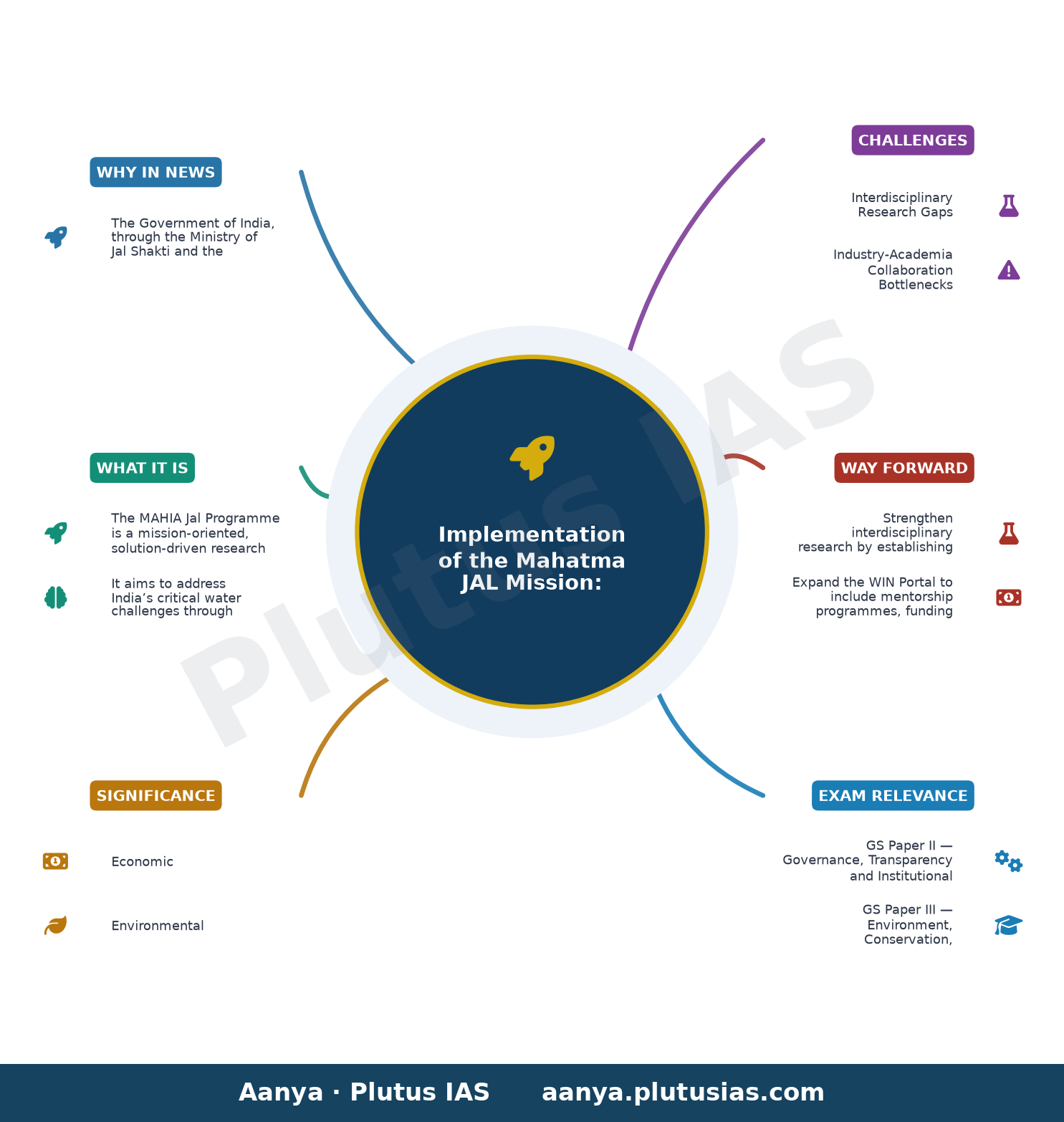
The Government of India, through the Ministry of Jal Shakti and the statutory National Research Foundation (NRF), has operationalised the MAHIA Jal Programme to catalyse mission-oriented, solution-driven research in critical water-sector domains. This initiative, launched on 1 June 2026, signals a strategic pivot from conventional water governance to evidence-based, technology-enabled, and stakeholder-embedded interventions aimed at resolving India’s most pressing water challenges.
Background
- India faces severe water stress, with per capita availability projected to decline to 1,140 m³ by 2050, below the water-stressed threshold of 1,700 m³.
- The National Education Policy (NEP) 2020 recommended the establishment of a high-level, autonomous body to foster scientific and technological research at the interface of natural, social, and human sciences.
- The National Research Foundation (NRF) was constituted under the NRF Act, 2023, to provide strategic direction, promote innovation, and support entrepreneurship in high-impact areas.
- The Mission for Advancement in High-Impact Areas (MAHIA) is a flagship NRF programme designed to address national priorities through mission-mode, multi-disciplinary, multi-institutional, and multi-investigator research projects.
- The MAHIA Jal Programme is a joint initiative of the NRF and the Ministry of Jal Shakti, launched to accelerate research, development, and deployment of scalable water technologies.
- Prior initiatives such as the Jal Jeevan Mission (2019) and Atal Mission for Rejuvenation and Urban Transformation (AMRUT) have established foundational infrastructure but underscore the need for innovation in water quality, efficiency, and climate resilience.
What is the MAHIA Jal Programme?
- The MAHIA Jal Programme is a mission-oriented, solution-driven research programme under the MAHIA framework, administered by the National Research Foundation (NRF) in partnership with the Ministry of Jal Shakti.
- It aims to address India’s critical water challenges through high-impact, field-ready, and scalable technologies, with a strong emphasis on multi-disciplinary collaboration.
- The programme operates on five thematic pillars: (i) assessment and sustainable management of water resources, (ii) potable water supply, (iii) water quality, (iv) human and ecological health, and (v) water-use efficiency and circular economy, including climate resilience and adaptation.
- The initiative mandates the participation of at least one start-up, MSME, or industry partner, contributing a minimum 10% cash component to the total project cost, thereby fostering public-private partnerships and accelerating technology translation.
- Proposals are invited through consortium mode, involving Principal Investigators, academic institutions, research laboratories, DSIR-registered organisations, and Section 8 companies, ensuring multi-institutional and multi-stakeholder engagement.
- The NRF has launched the WIN (Water Innovation) portal to streamline start-up/MSME participation and expedite the development and deployment of water technologies.
- A dedicated ‘Jal Shakti Hackathon-2025’ was organised to crowdsource practical, scalable, and field-ready solutions for pressing water-sector challenges.
- Research outputs are shared with stakeholders—states, Union Territories, collaborating ministries, and implementing agencies—to ensure adoption and implementation of evidence-based interventions.
Key Features
| Feature | Significance |
|---|---|
| Statutory National Research Foundation (ANRF) | Provides high-level strategic direction for scientific, technological, and interdisciplinary research in natural sciences, humanities, and social sciences, aligning with National Education Policy 2023. |
| Mission for Advancement in High-Impact Areas (MAHIA) | A mission-mode programme under ANRF to focus on priority areas through multi-disciplinary, multi-institutional, and multi-investigator research with industrial partnerships. |
| MAHIA JAL Programme (launched 01 June 2026) | A joint initiative by ANRF and the Ministry of Jal Shakti to address critical challenges in the water sector through mission-oriented, solution-driven research. |
| Consortium-based Research Proposals | Invites Principal Investigators, academic institutions, laboratories, and industry partners (including startups/MSMEs) to collaborate in addressing water sector challenges. |
| WIN Portal for Startups/MSMEs | Facilitates participation of startups and MSMEs in developing and deploying water-related technologies, accelerating innovation in the sector. |
Why it Matters
Economic
- Promotes indigenous research and innovation in water technologies, reducing reliance on imports and fostering self-reliance (Atmanirbhar Bharat).
- Encourages private sector participation (startups/MSMEs) through funding models, stimulating entrepreneurship and job creation in the water sector.
Environmental
- Supports sustainable water resource management, aligning with global commitments like the UN Sustainable Development Goals (SDG 6: Clean Water and Sanitation).
- Promotes circular economy principles in water use, reducing waste and enhancing resource efficiency.
Scientific
- Fosters interdisciplinary research at the interface of natural sciences, humanities, and social sciences, addressing complex water challenges holistically.
- Encourages field-ready, scalable technologies through initiatives like the ‘Jal Shakti Hackathon-2025’.
Governance
- Strengthens coordination between central ministries (Jal Shakti), statutory bodies (ANRF), and state governments for integrated water resource management.
- Ensures stakeholder engagement by sharing research outcomes with states, union territories, and implementing agencies for adoption and implementation.
Challenges
1. Interdisciplinary Research Gaps
- Water challenges are inherently multi-dimensional, requiring seamless integration of scientific, social, and policy dimensions; current research often remains siloed.
- Need for stronger linkages between academia, industry, and policymakers to translate research into actionable solutions.
UPSC Link: GS-III: Science & Tech
2. Industry-Academia Collaboration Bottlenecks
- Low participation of startups/MSMEs due to high entry barriers, including financial constraints and lack of awareness about funding opportunities.
- Need for simplified regulatory frameworks and incentives to encourage private sector engagement in water innovation.
UPSC Link: GS-III: Economy
3. Scalability and Field Readiness of Technologies
- Many water technologies developed in labs fail to meet field conditions, necessitating rigorous testing and adaptation before large-scale deployment.
- Limited infrastructure for pilot testing and validation of innovative solutions in diverse geographical and climatic zones.
UPSC Link: GS-III: Environment
4. Sustainable Funding Mechanisms
- Dependence on government funding may not be sufficient for long-term research; need for diversified funding sources (e.g., CSR, international collaborations).
- Ensuring equitable distribution of funds across regions and institutions to prevent concentration in urban/elite centres.
UPSC Link: GS-III: Economy
5. Policy-Research Integration
- Lag between research outcomes and policy adoption due to bureaucratic delays, lack of awareness, or misalignment with ground realities.
- Need for institutional mechanisms to bridge the gap between research institutions and implementing agencies (e.g., state water departments).
UPSC Link: GS-II: Governance
Challenges — UPSC Perspective
| Issue | Concern |
|---|---|
| Fragmented Research | Lack of coordination between disciplines leads to suboptimal solutions. |
| Low Industry Participation | Limited engagement of startups/MSMEs due to high risks and low incentives. |
| Technology-Field Mismatch | Lab-developed solutions often fail in real-world conditions. |
| Funding Constraints | Over-reliance on government funds limits scalability and innovation. |
| Policy-Implementation Gap | Research findings are not adopted due to slow bureaucratic processes. |
Way Forward
- Strengthen interdisciplinary research by establishing dedicated centres of excellence at premier institutions (e.g., IITs, IISc) for water-related studies.
- Expand the WIN Portal to include mentorship programmes, funding guides, and regulatory support for startups/MSMEs.
- Launch pilot projects in diverse geographical zones to test and validate technologies before scaling up.
- Introduce performance-linked incentives for industry partners to encourage long-term collaboration.
- Develop a national water innovation fund with contributions from government, private sector, and international agencies.
- Establish a dedicated task force to monitor research outcomes and facilitate their adoption by state governments.
- Promote public-private partnerships (PPPs) for large-scale deployment of proven technologies in water-scarce regions.
- Conduct annual hackathons and innovation challenges to crowdsource solutions for emerging water challenges.
UPSC Value Addition
Keywords for Mains Answer-Writing
National Research Foundation (NRF) Act 2023 · Mission for Advancement in High-Impact Areas (MAHIA) · ANRF-MAHIA Water Programme · Sustainable Water Resource Management · Jal Shakti Mission · Circular Economy in Water Sector · Water Quality and Health · Climate Resilience in Water Sector · Multi-disciplinary Research Consortia · Public-Private Partnerships in R&D · Water Hackathon 2025 · WIWIN Portal for Start-ups · Mission Mode Research in Water Sector
Concept Flow
Identification of critical water challenges (e.g., depleting groundwater, poor water quality) → → Formation of ANRF under ANRF Act, 2023 to provide strategic direction for research → → Launch of MAHIA JAL Programme (01 June 2026) to address priority areas → → Invitation of consortium-based research proposals with mandatory industry/startup participation → → Development and testing of field-ready technologies through initiatives like ‘Jal Shakti Hackathon-2025’ → → Adoption and implementation of solutions by states, union territories, and implementing agencies → → Feedback loop to refine research priorities and policies for continuous improvement.
Prelims Practice Questions
Q1. Consider the following statements regarding the National Research Foundation (NRF):
1. NRF is a statutory body established under the NRF Act, 2023.
2. It functions under the Ministry of Education.
3. It promotes research, innovation, and entrepreneurship across natural sciences, humanities, and social sciences.
4. The Mission for Advancement in High-Impact Areas (MAHIA) is a programme under NRF.
How many of the above statements are correct?
- Only one
- Only two
- Only three
- All
Answer: All — Statements 1, 3, and 4 are correct. Statement 2 is incorrect as NRF functions under the Ministry of Science and Technology, not the Ministry of Education.
Q2. Assertion (A): The ANRF-MAHIA Water Programme is a joint initiative of the National Research Foundation and the Ministry of Jal Shakti.
Reason (R): The programme aims to address critical water challenges through mission-oriented, solution-driven research with multi-disciplinary and multi-institutional collaboration.
Options:
A. Both A and R are true, and R is the correct explanation of A.
B. Both A and R are true, but R is not the correct explanation of A.
C. A is true, but R is false.
D. A is false, but R is true.
Answer: ? — Both Assertion (A) and Reason (R) are true, and Reason (R) correctly explains Assertion (A). The ANRF-MAHIA Water Programme is indeed a joint initiative and aims to address water challenges through mission-oriented research.
Q3. Match the following initiatives with their respective objectives:
Initiative
A. MAHIA Water Programme
B. Water Hackathon 2025
C. WIWIN Portal
D. ANRF Act, 2023
Objective
1. Promote mission-oriented research in water sector
2. Accelerate development and deployment of water technologies
3. Foster practical, scalable, and field-ready water technologies
4. Establish NRF as a statutory body for strategic research direction
Options:
A – 1, B – 3, C – 2, D – 4
A – 2, B – 1, C – 3, D – 4
A – 1, B – 2, C – 3, D – 4
A – 4, B – 3, C – 2, D – 1
- A – 1, B – 3, C – 2, D – 4
- A – 2, B – 1, C – 3, D – 4
- A – 1, B – 2, C – 3, D – 4
- A – 4, B – 3, C – 2, D – 1
Answer: A – 1, B – 3, C – 2, D – 4 — Correct matching: A (MAHIA Water Programme) – 1 (Promote mission-oriented research in water sector), B (Water Hackathon 2025) – 3 (Foster practical, scalable, and field-ready water technologies), C (WIWIN Portal) – 2 (Accelerate development and deployment of water technologies), D (ANRF Act, 2023) – 4 (Establish NRF as a statutory body for strategic research direction).
Mains Practice Question
✍ The ANRF-MAHIA Water Programme represents a paradigm shift in India’s approach to addressing water security challenges. Critically examine the significance of this programme in the context of India’s water governance framework, with reference to its objectives, institutional architecture, and potential impact on sustainable water management. Also, discuss the challenges in its effective implementation. (15 Marks)
Approach: MODEL-ANSWER SKELETON:
1. **Introduction (2 Marks)**
– Brief context: India’s water security challenges (e.g., depleting groundwater, water quality degradation, climate change impacts).
– Define ANRF-MAHIA Water Programme: A mission-oriented, solution-driven research initiative under NRF and Ministry of Jal Shakti.
2. **Objectives and Institutional Architecture (4 Marks)**
– Five key thematic areas: (a) Water resource assessment and sustainable management, (b) Drinking water, (c) Water quality, (d) Human and ecological health, (e) Water-use efficiency and circular economy, (f) Climate resilience and adaptation.
– Multi-disciplinary, multi-institutional, and multi-investigator consortia model.
– Mandatory participation of start-ups/MSMEs/industry partners with 10% cash contribution.
– Role of NRF Act, 2023: Establishes NRF as a statutory body for strategic research direction.
3. **Significance in Water Governance (5 Marks)**
– **Mission Mode Approach**: Contrast with traditional ad-hoc, fragmented research; emphasis on priority-focused, solution-driven outcomes.
– **Public-Private Partnerships (PPP)**: Integration of industry and start-ups accelerates technology adoption and commercialization.
– **Climate Resilience**: Addresses adaptation needs in water sector through research on climate-resilient infrastructure and practices.
– **Circular Economy**: Promotes water-use efficiency and reuse, aligning with SDG 6 (Clean Water and Sanitation).
– **Institutional Synergy**: Collaboration between ANRF, Ministry of Jal Shakti, and state agencies ensures policy-relevant research and implementation.
4. **Challenges in Implementation (4 Marks)**
– **Funding and Sustainability**: Ensuring long-term funding beyond initial project cycles; balancing public and private investments.
– **Inter-State Coordination**: Water governance involves multiple stakeholders; requires robust federal coordination mechanisms.
– **Technology Transfer and Scalability**: Bridging the gap between research outcomes and field-level deployment.
– **Data and Monitoring**: Lack of standardized data on water resources; need for real-time monitoring systems.
– **Stakeholder Engagement**: Ensuring participation from academia, industry, and local communities for inclusive solutions.
5. **Conclusion (2 Marks)**
– Summarize the transformative potential of the programme in addressing India’s water challenges.
– Emphasize the need for sustained political will, institutional capacity, and adaptive governance to realize its objectives.
Source: PIB (Press Information Bureau)
Generated by AanyaAi for educational purpose.

- गृह मंत्री ने मध्य प्रदेश में गौपालक सम्मेलन का किया उद्घाटन, नए अपराध कानूनों पर प्रदर्शनी का किया शुभारंभ - October 3, 2026
- Jal Arpan: 1850+ Gram Panchayats Join Hands for Rural Water Supply - October 3, 2026
- भारत ने किया 5.56 किमी मुक्त अंतरिक्ष क्वांटम की वितरण लिंक का सफल परीक्षण - October 3, 2026

No Comments