


16 Dec MGNREGA at the Crossroads: Transition to VB-G RAM G, Rights-Based Welfare and the Politics of Reform
This article covers “Daily Current Affairs” and From MGNREGA at the Crossroads: Transition to VB-G RAM G, Rights-Based Welfare and the Politics of Reform
SYLLABUS MAPPING
GS – 2 – Polity & Governance – MGNREGA at the Crossroads: Transition to VB-G RAM G, Rights-Based Welfare and the Politics of Reform
FOR PRELIMS
Examine the constitutional significance of replacing MGNREGA with a new rural employment law.
FOR MAINS
Evaluate the role of Parliament in protecting socio-economic rights while repealing welfare laws.
Why in the News?
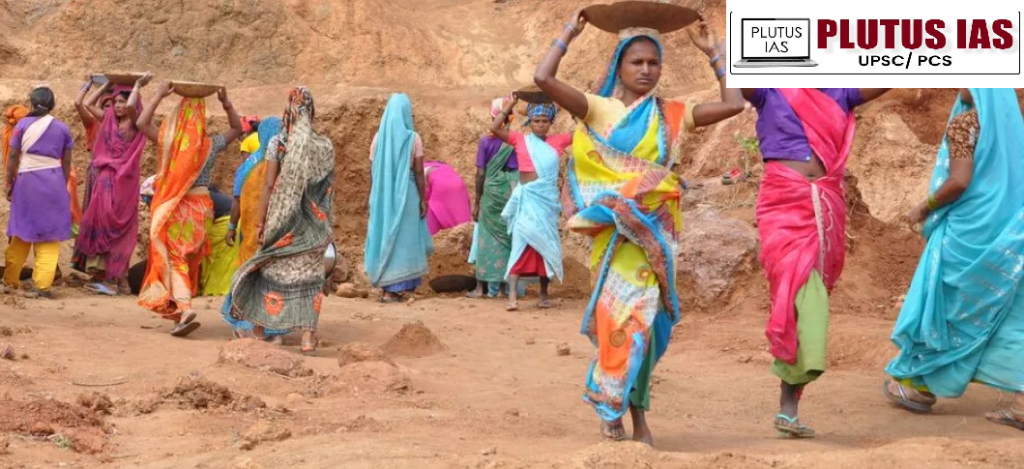
The Mahatma Gandhi National Rural Employment Guarantee Act (MGNREGA), 2005 has returned to the centre of public debate following the Union Government’s proposal to repeal and replace it with a new legislation, tentatively titled the Viksit Bharat–Guarantee for Rozgar and Ajeevika Mission (Gramin) Bill, 2025. Beyond administrative reforms, this move raises important constitutional, legislative, and federal questions
MGNREGA as a Statutory Rights-Based Law
MGNREGA occupies a unique position in India’s welfare architecture because it is anchored in statute, not executive policy. Unlike most social schemes that operate through budgetary allocations and government guidelines, MGNREGA creates legally enforceable obligations on the State.
1. Legal Right to Work: Under the Act, any rural household can demand employment as a matter of right, not charity. Once a job card holder applies for work, the State is legally bound to provide employment within 15 days. This demand-driven design shifts the power balance from the administration to citizens, strengthening democratic accountability.
2. Justiciability and Unemployment Allowance: If employment is not provided within the stipulated time, the law mandates payment of an unemployment allowance by the State government. This provision is crucial because it introduces legal consequences for administrative failure, making the right enforceable through grievance redressal mechanisms and, ultimately, courts. In effect, MGNREGA transforms welfare delivery into a rights-claim framework.
3. Constitutional Linkages (Article 21): Judicial interpretation has expanded Article 21 (Right to Life) to include the right to livelihood and dignified existence. MGNREGA operationalises this constitutional vision by ensuring minimum income security through guaranteed work. It thus acts as a statutory instrument giving concrete expression to substantive social justice embedded in the Constitution’s Directive Principles, particularly Articles 39 and 41.
4. Polity Significance of Repeal and Replacement: The proposed repeal of MGNREGA and its replacement with a new law raises critical governance concerns:
(i) Whether the right to work will remain justiciable, or be converted into a policy-based entitlement subject to annual budgetary priorities
(ii) Whether administrative discretion will replace citizen enforceability, weakening accountability
(iii) Whether unemployment allowance and grievance mechanisms will continue with the same legal force
(iv) A shift from a rights-based statute to a more flexible, programme-oriented framework risks diluting the legal certainty and entitlement security that MGNREGA provided, especially for vulnerable rural households.
5. Broader Governance Implications: At stake is not merely a change in scheme design, but a constitutional question of how welfare is delivered—as enforceable rights or discretionary benefits. This debate reflects a larger tension in Indian governance between social rights protection and fiscal-administrative flexibility.
Parliamentary Supremacy and Legislative Competence
The proposed replacement of MGNREGA raises important issues related to parliamentary supremacy and legislative competence. Under Article 245 of the Constitution, Parliament is fully empowered to enact, amend, or repeal any law, including welfare legislations such as MGNREGA. Therefore, from a constitutional standpoint, the repeal of the existing Act and the introduction of a new law with altered objectives, structure, and nomenclature fall well within Parliament’s legislative authority. However, in polity terms, the core issue is not Parliament’s competence but the legislative intent and the continuity of rights. MGNREGA is not merely a scheme but a statute that confers a justiciable right to work. Replacing it with a new law raises concerns about whether this legally enforceable entitlement will be preserved or diluted into a policy-based benefit dependent on executive discretion and budgetary priorities. Parliamentary supremacy thus also entails democratic responsibility—any legislative change must ensure that previously guaranteed socio-economic rights are not weakened, especially when they operationalise the constitutional vision of social justice under Article 21.
Federalism and Centre–State Relations
| Dimension | MGNREGA Framework | Proposed VB-G RAM G Framework | Federalism Concerns & Polity Significance |
|---|---|---|---|
| Constitutional Basis | Falls under Concurrent List entries relating to Labour and Social Security, with rural development as a shared responsibility | Continues to operate in the same constitutional space but with altered fiscal and institutional design | Concurrent subjects require consultation, coordination and consensus; unilateral changes can weaken cooperative federalism |
| Legislative Role | Central legislation with uniform national standards and statutory guarantees | Central legislation with revised objectives and implementation architecture | Parliament can legislate, but federal norms demand state buy-in for effective implementation |
| Funding Pattern | Predominantly Centre-funded, especially wages; states bore limited material and administrative costs | Increased cost-sharing by states (e.g., 60:40), raising state financial obligations | Poorer and fiscally constrained states may struggle, leading to regional disparities |
| Fiscal Capacity of States | Limited impact on states’ fiscal health due to high central support | Greater dependence on states’ own revenues and borrowing | Undermines horizontal equity and disadvantages BIMARU and special category states |
| Implementation Uniformity | Relatively uniform access to guaranteed employment across states | Implementation quality may vary based on state finances | Risks creating uneven realisation of a national entitlement |
| Cooperative Federalism | Reflected shared responsibility with Centre as principal financier | Shifts financial burden without commensurate revenue support | Raises concerns about consultative deficit and trust erosion |
| Centre–State Trust | MGNREGA acted as a confidence-building welfare instrument | Fiscal rebalancing may be perceived as cost-shifting | Reinforces long-standing Centre–State tensions over unfunded mandates |
| Governance Implication | Strong central backing ensured continuity during crises (e.g., droughts, pandemics) | States may cut back employment due to fiscal stress | Weakens the scheme’s role as a counter-cyclical safety net |
Rights vs Discretion: Shift in Welfare Philosophy
1. Evolution towards Rights-Based Welfare: Since the 2000s, India has increasingly moved towards rights-based welfare legislation, where entitlements are backed by law. Schemes like MGNREGA, RTI Act, NFSA and RTE Act converted welfare benefits from discretionary government support into justiciable rights, strengthening citizen–state accountability.
2. Emerging Fears of Rights Dilution: Critics point out that recent policy shifts may weaken this framework. There are concerns about erosion of legal enforceability, greater executive discretion in deciding work availability and funding, and a narrowing of grievance-redress mechanisms, including judicial oversight.
3. The Constitutional Dilemma in Welfare Design: At its core, this debate raises a key polity question: Should socio-economic welfare be constitutionally protected as enforceable rights, or treated as policy commitments subject to executive discretion? The answer has implications for democratic accountability, federal balance, and the realization of social justice in India.
Democratic Accountability and Rule of Law
1. Statutory Foundations of Accountability under MGNREGA: MGNREGA is not merely a welfare scheme but a statutory framework rooted in democratic accountability. It clearly defines the duties and obligations of the state, such as providing employment on demand, timely payment of wages, and compensation for delays. The Act also mandates transparency tools like social audits, public disclosure of records, and participatory monitoring, which empower rural citizens to hold authorities accountable.
2. Legal Safeguards and Grievance Redressal Mechanisms: A key strength of MGNREGA lies in its legal clarity and enforceability. Citizens have access to grievance redressal mechanisms, including complaints to authorities, ombudsman oversight, and judicial remedies. These mechanisms ensure that violations of rights are not treated as administrative lapses but as breaches of legal duty, reinforcing the rule of law at the grassroots level.
3. Implications for Rule of Law and Democratic Governance: From a polity perspective, any new law or reform must be evaluated on whether it preserves clear legal obligations, effective grievance redressal, and continuity of accountability mechanisms. Weakening these aspects may shift welfare delivery from a rights-based model to discretionary governance, undermining the rule of law, particularly for vulnerable rural citizens who rely on legal protections to secure their entitlements.
Wayforward
1. Retain statutory right to work: Ensure that the new legislation explicitly preserves the justiciable right to employment, including time-bound work provision and legally enforceable unemployment allowance.
2. Parliamentary scrutiny and debate: Refer the proposed Bill to a Standing Committee of Parliament to assess constitutional implications, continuity of rights, and impact on federal balance.
3. Continuity of legal protections: Incorporate saving and transitional clauses so that existing beneficiaries do not lose accrued rights during repeal and replacement of MGNREGA.
4. Respect cooperative federalism: Maintain a balanced Centre–State funding structure, with flexibility for fiscally weaker states, to uphold the spirit of cooperative federalism.
5. Clear legislative drafting: Avoid excessive executive discretion by defining rights, duties, and liabilities clearly in the statute rather than in subordinate legislation.
6. Preserve accountability mechanisms in law: Statutorily mandate grievance redressal, social audit, and transparency provisions, ensuring rule of law and democratic accountability.
7. Align with constitutional values: Reflect Gandhian principles of dignity of labour, decentralisation, and social justice, irrespective of nomenclature, to reinforce constitutional morality.
8. Judicial safeguards: Provide scope for judicial review and remedies to protect citizens’ socio-economic rights under Articles 14 and 21.
9. Phased implementation: Adopt a gradual transition rather than abrupt repeal to avoid legal uncertainty and disruption of livelihoods.
10. Outcome-neutral political consensus: Build cross-party consensus to ensure that reforms focus on rights protection and constitutional propriety, not political symbolism.
Conclusion
The debate surrounding the replacement of MGNREGA is not merely about rural employment, but about Parliament’s role in shaping socio-economic rights, the nature of Indian federalism, and the constitutional balance between rights and executive discretion. For UPSC aspirants, the issue should be analysed through the lens of statutory rights, legislative continuity, federal equity, and constitutional values, making it a significant contemporary development in Indian Polity.
Prelims question
Q. With reference to the Mahatma Gandhi National Rural Employment Guarantee Act (MGNREGA), consider the following statements:
1. It provides a statutory guarantee of wage employment to rural households.
2. The right to employment under the Act is justiciable in nature.
3. Unemployment allowance is payable if employment is not provided within a stipulated time.
Which of the statements given above are correct?
(a) 1 and 2 only
(b) 1 and 3 only
(c) 1, 2 and 3
(d) 2 and 3 only
Answer: C
Mains Question
Q. MGNREGA represents a shift from welfare schemes to rights-based legislation. In light of the proposed replacement of MGNREGA, examine the constitutional significance of statutory socio-economic rights in India. (250 words)

- PRAGATI: A Decade of Cooperative, Outcome-Driven Governance - January 15, 2026
- Iran’s Large-Scale Protests: Political Stability, Public Dissent and Regional Implications - January 14, 2026
- India–Oman CEPA: A Strategic Trade Pact for Jobs, Exports and Regional Integration - January 10, 2026

No Comments